Nursing Care Plan: Guide, Examples & Tips for Effective Patient Care
nursing care plan
Nursing Care Plan: A Complete Guide for Healthcare Professionals
A nursing care plan is a vital tool used by nurses to ensure patients receive individualized and effective care. It serves as a roadmap for patient treatment, aligning nursing interventions with specific patient needs, medical diagnoses, and expected outcomes. Understanding how to create and implement a nursing care plan is essential for both new and experienced nurses.
What is a Nursing Care Plan?
A nursing care plan is a written guide outlining the care a patient requires. It details the patient’s health problems, nursing diagnoses, interventions, and expected outcomes. The goal is to provide structured, patient-centered care that improves health outcomes and promotes recovery.
Key Components of a Nursing Care Plan:
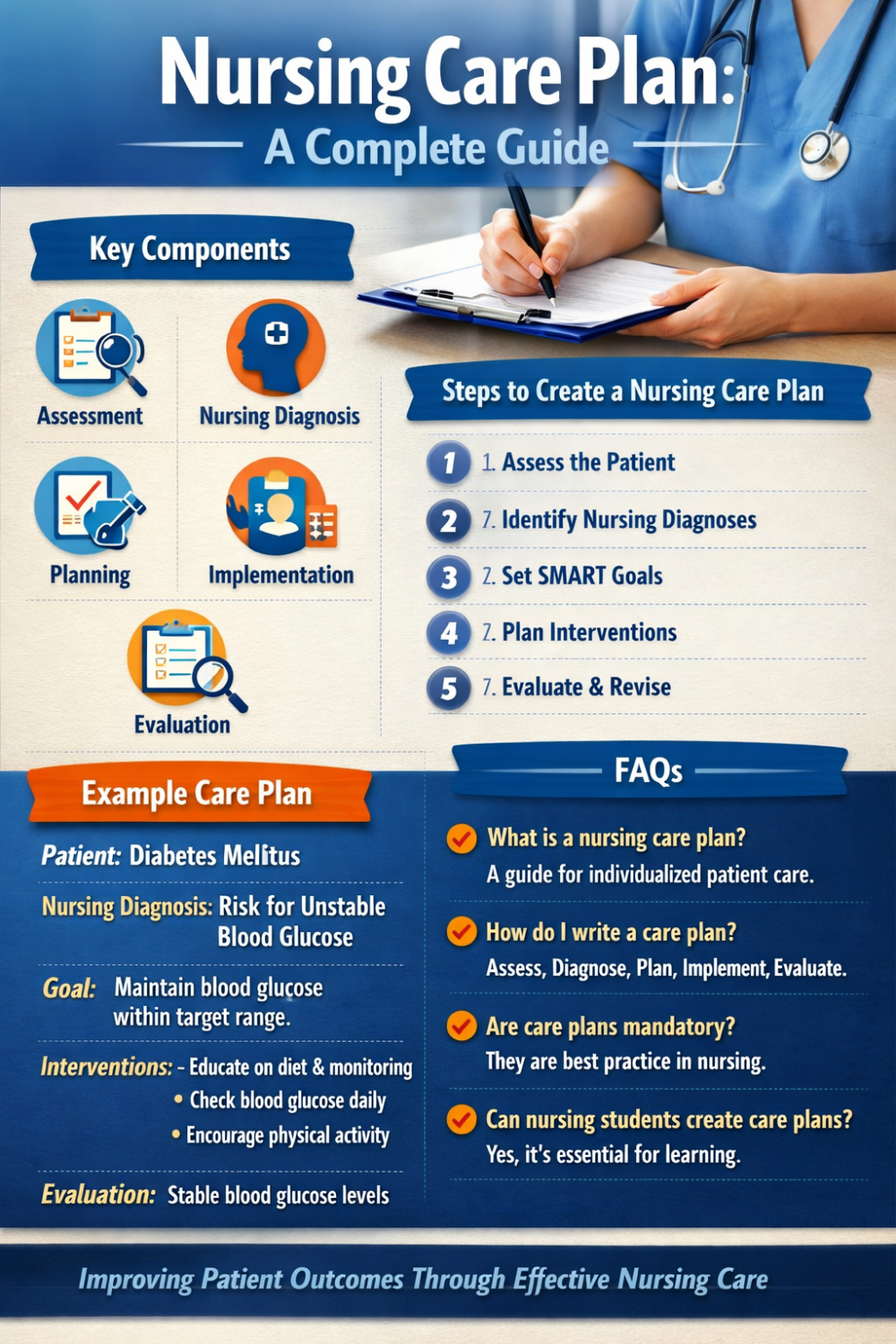
Assessment – Collecting patient data through observation, interviews, and medical records.
Nursing Diagnosis – Identifying patient health problems based on assessment data.
Planning – Setting measurable, achievable goals for patient care.
Implementation – Executing nursing interventions according to the care plan.
Evaluation – Monitoring patient progress and modifying the plan as necessary.
Importance of a Nursing Care Plan
Creating a nursing care plan offers multiple benefits:
Personalized Care: Ensures care is tailored to each patient’s specific needs.
Improved Communication: Provides a clear reference for all healthcare team members.
Better Patient Outcomes: Structured care leads to faster recovery and fewer complications.
Legal Protection: Documented care plans serve as legal evidence of proper patient care.
Steps to Create an Effective Nursing Care Plan
Assess the Patient Thoroughly – Conduct physical exams, review medical history, and gather vital signs.
Identify Nursing Diagnoses – Use standardized classifications like NANDA-I to define problems.
Set SMART Goals – Goals should be Specific, Measurable, Achievable, Relevant, and Time-bound.
Plan Interventions – Include both independent nursing actions and collaborative interventions with other healthcare professionals.
Evaluate and Revise – Continuously monitor patient progress and update the care plan as needed.
Example of a Nursing Care Plan
Patient Condition: Hypertension
Nursing Diagnosis: Risk for ineffective health management
Goal: Patient will maintain blood pressure within normal range within 2 weeks.
Interventions:
Educate patient on low-sodium diet.
Monitor blood pressure daily.
Encourage physical activity.
Evaluation: Patient demonstrates understanding of lifestyle changes and maintains stable blood pressure.
Tips for Writing a Nursing Care Plan
Use clear, concise, and professional language.
Focus on measurable outcomes.
Include both short-term and long-term goals.
Regularly update based on patient progress.
Conclusion
A nursing care plan is an indispensable part of modern nursing practice. It guides nurses in providing systematic, patient-centered care, improving communication among healthcare providers, and ensuring optimal patient outcomes. Mastery of nursing care plan development is a key skill for all healthcare professionals seeking excellence in patient care.
Nursing Care Plan: The Complete Guide for Nurses
A nursing care plan is an essential document in the nursing profession. It serves as a roadmap for patient care, ensuring that every intervention is tailored to the patient’s unique needs. Whether you are a nursing student, a practicing nurse, or a healthcare professional, understanding how to create and implement an effective nursing care plan is crucial for achieving optimal patient outcomes.
What is a Nursing Care Plan?
A nursing care plan (NCP) is a formal, written plan that outlines the care a patient requires. It includes the assessment of patient needs, nursing diagnoses, specific interventions, and expected outcomes. The care plan serves multiple purposes: it provides a framework for individualized patient care, enhances communication among healthcare providers, and ensures legal documentation of nursing actions.
Key Components of a Nursing Care Plan
Creating a comprehensive nursing care plan involves several critical steps:
1. Assessment
The first step in developing a nursing care plan is gathering detailed information about the patient. This includes:
Vital signs
Medical history
Physical examination findings
Laboratory and diagnostic test results
Patient lifestyle, habits, and psychosocial factors
2. Nursing Diagnosis
A nursing diagnosis identifies actual or potential patient problems that nurses can address independently. Standardized classifications such as NANDA-I (North American Nursing Diagnosis Association International) help nurses create accurate diagnoses.
3. Planning
During the planning phase, nurses establish measurable, achievable goals based on the nursing diagnosis. Goals should follow the SMART framework: Specific, Measurable, Achievable, Relevant, and Time-bound.
4. Implementation
Implementation is the stage where nurses carry out planned interventions. These may include:
Independent nursing interventions – actions performed by nurses without physician orders (e.g., patient education, wound care)
Collaborative interventions – actions involving other healthcare team members (e.g., administering prescribed medications)
5. Evaluation
Evaluation involves monitoring patient outcomes to determine whether the goals of the care plan have been met. Nurses revise the care plan as necessary based on patient progress.
Importance of Nursing Care Plans
A well-designed nursing care plan offers numerous benefits:
Personalized Patient Care: Ensures that care is tailored to each patient’s individual needs.
Improved Communication: Acts as a reference for all healthcare team members.
Better Health Outcomes: Structured care reduces complications and accelerates recovery.
Legal Documentation: Provides proof of professional, systematic nursing care.
How to Create an Effective Nursing Care Plan
Creating an effective nursing care plan involves a systematic approach:
Assess the Patient Thoroughly – Gather comprehensive data through observation, interviews, and medical records.
Identify Nursing Diagnoses – Use standardized tools like NANDA-I to pinpoint actual or potential patient issues.
Set SMART Goals – Define measurable outcomes and realistic timelines for achieving them.
Plan Interventions – Include nursing actions, patient education, and collaboration with other healthcare professionals.
Implement and Monitor – Execute interventions while continuously observing patient responses.
Evaluate and Revise – Update the care plan based on patient progress and changing conditions.
Example Nursing Care Plan
Patient Condition: Diabetes Mellitus
Nursing Diagnosis: Risk for unstable blood glucose levels
Goal: Patient will maintain blood glucose within target range within 2 weeks.
Interventions:
Educate patient on proper diet and carbohydrate counting
Monitor blood glucose levels daily
Encourage regular physical activity
Evaluation: Patient demonstrates proper self-management techniques and maintains stable glucose readings.
Common Types of Nursing Care Plans
Nursing care plans can vary depending on patient needs and care settings:
Acute Care Nursing Care Plan – Focuses on patients with immediate, short-term needs
Chronic Care Nursing Care Plan – For patients managing long-term illnesses like diabetes or hypertension
Pediatric Nursing Care Plan – Tailored to infants, children, or adolescents
Geriatric Nursing Care Plan – Addresses the unique needs of elderly patients
Tips for Writing an Effective Nursing Care Plan
Use clear, concise, and professional language
Include both short-term and long-term goals
Focus on measurable outcomes
Regularly review and update the plan based on patient progress
Use evidence-based interventions for maximum effectiveness
Frequently Asked Questions (FAQs)
Q1: What is the purpose of a nursing care plan?
A: The purpose of a nursing care plan is to guide nursing interventions, ensure individualized care, and improve patient outcomes.
Q2: How do I write a nursing care plan?
A: Start with patient assessment, identify nursing diagnoses, set SMART goals, plan interventions, implement them, and evaluate the results.
Q3: Are nursing care plans mandatory?
A: While not always legally required, nursing care plans are considered a best practice and are widely used in clinical settings.
Q4: Can nursing students create care plans?
A: Yes, creating nursing care plans is a key learning tool for students to develop critical thinking and clinical skills.
Conclusion
A nursing care plan is more than just a document; it is a cornerstone of quality patient care. It allows nurses to deliver personalized, structured, and evidence-based care while improving communication and legal documentation. Mastery of nursing care plan development is essential for healthcare professionals committed to achieving excellent patient outcomes.
Needs help with Nursing Assignment?
We are available 24x7 to deliver the best services and assignment ready within 3-4 hours? Order a custom-written, plagiarism-free paper
 Get Answer Over WhatsApp
 Order Paper Now