Patient Assessment Documentation Help: 15 Powerful Benefits, Common Mistakes & Honest Nursing Student Verdict (2026)
/in Nursing /by Brian
Table of Contents
ToggleWhat Is Patient Assessment Documentation Help?
Patient Assessment Documentation Help refers to academic and professional guidance that assists nursing students in accurately recording patient assessments, observations, interventions, and clinical findings. Documentation is one of the most important responsibilities in nursing because patient records influence communication, treatment decisions, continuity of care, and legal accountability.
Many nursing students quickly discover that documenting patient assessments is more challenging than it initially appears. Recording information accurately requires attention to detail, clinical judgment, professional terminology, and adherence to healthcare documentation standards.
Students are often expected to document patient histories, physical assessments, vital signs, nursing observations, care plans, interventions, and patient responses. These requirements can feel overwhelming, particularly during early clinical placements.
This is why many learners seek Patient Assessment Documentation Help. Professional support helps students understand documentation expectations while developing confidence in clinical record keeping.
Healthcare organizations consistently emphasize accurate documentation because incomplete or unclear records can affect patient safety and quality of care. Documentation serves as a permanent record of healthcare interactions and supports effective communication among healthcare teams.
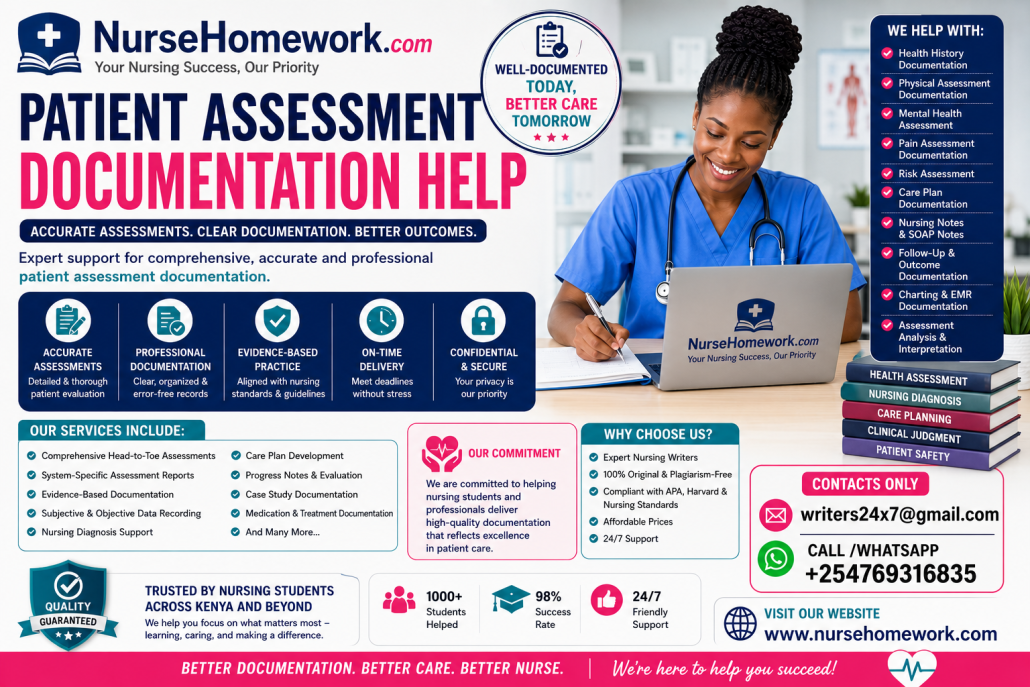
Patient Assessment Documentation Help
Why Patient Assessment Documentation Matters
Documentation is a fundamental part of nursing practice.
Every patient interaction generates information that must be communicated effectively to other healthcare professionals. Accurate documentation ensures that important observations, assessments, treatments, and patient responses are available when needed.
Without proper records, continuity of care becomes difficult. Nurses, physicians, therapists, and other healthcare providers rely on documentation to understand patient conditions and make informed decisions.
Patient records also serve legal and professional purposes. Documentation demonstrates what care was provided, when it was delivered, and how patients responded to interventions.
Because documentation influences both patient outcomes and professional accountability, nursing programs place significant emphasis on documentation training. Students who receive Patient Assessment Documentation Help often develop stronger clinical communication skills and better understanding of professional standards.
Growing Demand for Patient Assessment Documentation Help
Healthcare documentation requirements continue evolving.
Modern healthcare systems increasingly rely on electronic health records, digital documentation platforms, and standardized assessment frameworks. As technology advances, documentation expectations become more detailed and structured.
Nursing students must learn not only how to assess patients but also how to document findings accurately using approved formats.
Many learners struggle to balance assessment skills with documentation requirements. During clinical placements, students often focus heavily on patient interactions while feeling uncertain about how to record information correctly afterward.
The demand for Patient Assessment Documentation Help continues growing because documentation remains one of the most frequently evaluated nursing competencies.
Students recognize that strong documentation skills contribute directly to academic success, clinical performance, and future employability.
Common Documentation Challenges for Nursing Students
One of the most common challenges involves determining what information should be documented.
New nursing students sometimes record too little information, leaving important details out of patient records. Others document excessively, creating lengthy notes that lack focus and clarity.
Another challenge involves professional terminology. Healthcare documentation requires precise language that accurately reflects clinical observations.
Students may also struggle with objectivity. Documentation should describe observable facts rather than assumptions or personal opinions.
Time pressure creates additional difficulties. During clinical placements, students must balance patient care activities, learning objectives, and documentation responsibilities simultaneously.
Many learners seek Patient Assessment Documentation Help because these challenges can affect both placement performance and academic assessments.
Components of Effective Patient Assessment Documentation
Effective documentation begins with accurate patient assessment.
Nurses gather information through observation, communication, physical examination, and review of patient histories. This information must then be organized logically within patient records.
A comprehensive assessment often includes vital signs, physical findings, symptoms, patient concerns, mental status observations, pain assessments, mobility evaluations, and relevant health history.
Documentation should be clear, concise, objective, and timely.
Healthcare facilities often use structured formats that help ensure consistency across patient records. These frameworks guide nurses in recording essential information while maintaining professional standards.
Professional Patient Assessment Documentation Help frequently focuses on helping students understand these structures and apply them effectively.
The Importance of Accurate Clinical Records
Accurate clinical records support patient safety.
When healthcare providers have access to complete and reliable information, they can make better decisions regarding diagnosis, treatment, and ongoing care.
For example, documented changes in a patient’s condition may alert healthcare teams to emerging complications. Similarly, accurate medication records help prevent errors and support safe treatment planning.
Documentation also protects healthcare professionals. Clear records demonstrate that appropriate assessments and interventions were performed.
Because documentation affects both patient outcomes and professional accountability, nursing students must develop strong record-keeping habits early in their education.
Many students use Patient Assessment Documentation Help to strengthen these skills before entering professional practice.
Documentation Standards in Nursing Practice
Professional nursing documentation follows established standards designed to promote accuracy, consistency, and patient safety.
These standards emphasize clarity, objectivity, completeness, confidentiality, and timeliness.
Documentation should reflect factual observations rather than assumptions. Entries must be understandable to other healthcare professionals and accurately represent patient conditions.
Students are often evaluated on their ability to follow these standards during clinical placements and academic assessments.
Learning these expectations can be challenging, particularly for individuals new to healthcare environments.
This is why Patient Assessment Documentation Help remains valuable throughout nursing education.
Electronic Health Records and Modern Documentation
Electronic Health Records have transformed healthcare documentation.
Many healthcare organizations now use digital systems rather than traditional paper charts. These systems improve accessibility, facilitate information sharing, and support healthcare coordination.
However, electronic documentation introduces new learning requirements.
Students must understand navigation, data entry procedures, privacy regulations, and system-specific documentation practices.
Some learners find electronic systems intimidating at first. Others struggle with balancing technology use and patient interaction.
Professional Patient Assessment Documentation Help often addresses these challenges by helping students understand documentation principles that apply across different healthcare systems.
Strong documentation skills remain important regardless of whether records are maintained electronically or on paper.
Benefits of Patient Assessment Documentation Help
One major benefit is improved accuracy.
Students who understand documentation standards are less likely to make recording errors or omit important information.
Another advantage is increased confidence. Many nursing students feel uncertain when documenting patient assessments, particularly during early placements.
Professional guidance helps learners understand expectations and develop stronger clinical communication skills.
Documentation support also improves academic performance. Nursing assignments frequently require assessment reports, case studies, care plans, and reflective analyses based on documented patient information.
Students who receive Patient Assessment Documentation Help often find these assignments easier to complete because they understand how to organize and present clinical information effectively.
Improving Critical Thinking Through Documentation
Documentation involves more than recording information.
Nurses must evaluate observations, identify relevant findings, and determine which details require further attention.
This process strengthens critical thinking skills.
For example, documenting changes in a patient’s respiratory status requires observation, interpretation, and clinical judgment. Nurses must recognize significant findings and communicate them effectively.
Students who develop strong documentation habits often improve their overall clinical reasoning abilities.
Patient Assessment Documentation Help supports this development by encouraging thoughtful analysis and accurate communication.
These skills remain valuable throughout nursing careers because effective documentation contributes directly to safe and evidence-based patient care.
Common Documentation Mistakes
Several mistakes frequently appear in nursing documentation.
One common problem is incomplete documentation. Missing information can create confusion and reduce the usefulness of patient records.
Another issue involves vague language. Documentation should be specific and objective rather than general or ambiguous.
Students sometimes delay documentation, increasing the risk of forgetting important details.
Spelling errors, incorrect terminology, and inconsistent formatting can also reduce documentation quality.
Professional Patient Assessment Documentation Help helps students recognize these issues and develop stronger documentation practices.
Avoiding these mistakes improves both academic performance and clinical competence.
Risk Factors and How to Mitigate Them
Documentation errors can have serious consequences.
Incomplete records may affect patient care continuity. Miscommunication can lead to misunderstandings among healthcare providers.
Students can reduce these risks by documenting promptly, reviewing entries carefully, and following established documentation guidelines.
Another risk involves confidentiality breaches. Healthcare records contain sensitive information that must be protected according to professional and legal standards.
Nursing students should always follow privacy requirements and institutional policies regarding patient information.
Professional Patient Assessment Documentation Help emphasizes these responsibilities while helping students develop safe and ethical documentation habits.
Is Patient Assessment Documentation Help Worth It?
For most nursing students, yes.
Documentation is one of the most frequently assessed clinical competencies. Strong documentation skills influence academic performance, placement evaluations, patient safety, and professional readiness.
Many students initially underestimate the complexity of nursing documentation. However, they quickly discover that accurate record keeping requires practice, attention to detail, and understanding of professional standards.
Professional guidance helps students develop these competencies more efficiently.
Viewed as an educational investment, Patient Assessment Documentation Help can improve confidence, strengthen clinical performance, and prepare students for future nursing responsibilities.
Why Students Choose NurseHomework.com
Nursing students often require specialized support that addresses healthcare-specific academic requirements.
NurseHomework.com provides assistance with nursing assignments, care plans, clinical reflections, case studies, evidence-based practice projects, research proposals, and documentation-related coursework.
Additional healthcare resources students may find useful include:
- PubMed
- World Health Organization
- Centers for Disease Control and Prevention
- National Institutes of Health
- American Nurses Association
- Sigma Nursing
- APA Style Guide
- NurseHomework Blog
These resources support evidence-based learning and professional nursing development.
How Patient Assessment Documentation Supports Patient Safety
Patient safety is one of the most important priorities in healthcare, and documentation plays a direct role in maintaining it. Every assessment that a nurse performs creates information that may influence treatment decisions, medication administration, care planning, and communication among healthcare professionals.
When documentation is complete and accurate, healthcare providers can quickly understand a patient’s condition and respond appropriately. A clearly documented change in symptoms, pain levels, mobility, or vital signs may alert the healthcare team to potential complications before they become serious problems.
For nursing students, understanding this connection between documentation and patient safety is essential. Documentation is not simply an academic exercise or administrative task. It serves as a communication tool that supports patient care throughout the healthcare journey.
Many students seeking Patient Assessment Documentation Help discover that improving documentation skills also improves their understanding of patient care processes. As students become more confident in recording clinical observations, they often develop stronger assessment and critical thinking abilities as well.
Healthcare organizations consistently emphasize that quality documentation contributes to safer care environments. Strong documentation habits developed during nursing education can therefore benefit students throughout their entire professional careers.
Patient Assessment Documentation Help for Nursing Assignments
Documentation skills are frequently assessed through nursing coursework.
Many nursing programs require students to complete patient assessment reports, clinical reflections, care plans, case studies, and evidence-based practice assignments. These academic activities often rely heavily on accurate documentation principles.
Students may understand patient care concepts but struggle to organize information in a professional format. Others may collect relevant assessment data but find it difficult to determine which details are most important for inclusion in reports.
This is where Patient Assessment Documentation Help becomes particularly valuable. Guidance helps students understand how to structure assignments logically while maintaining professional documentation standards.
For example, a nursing case study may require students to document patient history, physical assessment findings, nursing diagnoses, interventions, and outcomes. Learning how these elements connect improves both assignment quality and clinical understanding.
Students who develop strong documentation skills often perform better across multiple nursing subjects because documentation principles apply to many areas of nursing education.
Understanding Subjective and Objective Data
One of the most important concepts in nursing documentation involves distinguishing between subjective and objective information.
Subjective data refers to information reported directly by patients. This may include symptoms, feelings, concerns, pain descriptions, or personal experiences. For example, a patient may report experiencing dizziness, fatigue, nausea, or difficulty sleeping.
Objective data consists of information that healthcare providers can observe, measure, or verify. Examples include blood pressure readings, temperature measurements, wound appearance, mobility observations, and laboratory results.
Many nursing students initially find this distinction confusing. They may accidentally mix subjective and objective information or document observations in ways that reduce clarity.
Professional Patient Assessment Documentation Help often focuses on strengthening understanding of these foundational concepts because accurate classification improves documentation quality.
The ability to separate subjective and objective information also supports stronger clinical reasoning and healthcare communication.
The Role of Documentation in Multidisciplinary Care
Modern healthcare involves collaboration among many professionals.
Physicians, nurses, pharmacists, therapists, social workers, dietitians, and other specialists often contribute to patient care plans. Documentation allows these professionals to share information efficiently and coordinate treatment efforts.
A nurse’s documentation may influence decisions made by other members of the healthcare team. For example, documented observations regarding patient mobility could assist physical therapists in developing rehabilitation plans. Similarly, nutritional concerns recorded by nurses may guide dietary interventions.
Because healthcare delivery depends on effective teamwork, documentation must be clear and understandable to all professionals involved in patient care.
Students receiving Patient Assessment Documentation Help often gain a better appreciation for the broader purpose of documentation. Rather than viewing records as isolated assignments, they learn how documentation contributes to collaborative healthcare delivery.
This understanding helps students approach documentation more thoughtfully and professionally.
Developing Professional Accountability Through Documentation
Professional accountability is a key component of nursing practice.
Documentation creates a permanent record of assessments, interventions, observations, and clinical decisions. These records demonstrate what care was provided and how patients responded.
For nursing students, documentation represents an opportunity to develop professional responsibility. Accurate records reflect attention to detail, ethical conduct, and commitment to patient care standards.
Many healthcare organizations consider documentation quality when evaluating employee performance because documentation directly affects patient safety and organizational effectiveness.
Through Patient Assessment Documentation Help, students learn how professional accountability extends beyond direct patient interactions. Documentation reflects clinical competence and demonstrates adherence to professional standards.
Developing these habits during nursing education helps prepare students for future workplace expectations.
Building Confidence With Clinical Documentation
Confidence is an important factor in nursing education.
Many students feel uncertain when documenting patient assessments, particularly during their first clinical placements. They may worry about making mistakes, omitting important details, or using incorrect terminology.
Fortunately, confidence improves with practice and guidance.
Students who regularly review documentation standards, seek feedback, and learn from experience typically become more comfortable over time. Exposure to different patient scenarios also helps strengthen documentation abilities.
Professional Patient Assessment Documentation Help accelerates this process by providing structured support and practical guidance. Students gain a clearer understanding of expectations while developing skills in a supportive learning environment.
As confidence grows, students often become more engaged during clinical experiences because they spend less time worrying about documentation requirements and more time focusing on patient care.
How Strong Documentation Skills Improve Career Opportunities
Documentation skills remain important long after graduation.
Healthcare employers expect nurses to maintain accurate records, communicate effectively, and follow documentation policies. Strong documentation abilities can therefore enhance employability and professional advancement opportunities.
New graduate nurses often face steep learning curves as they transition into professional roles. Those who already possess strong documentation skills may adapt more quickly to workplace expectations.
Specialized nursing positions, leadership roles, quality improvement projects, and advanced practice opportunities frequently require extensive documentation responsibilities. Developing these competencies early can support long-term career growth.
Students who seek Patient Assessment Documentation Help are not only improving academic performance. They are also investing in skills that may benefit future employment and professional development.
Frequently Asked Questions
What is Patient Assessment Documentation Help?
It is professional guidance that helps nursing students improve assessment records, clinical documentation skills, and healthcare communication.
Who benefits from Patient Assessment Documentation Help?
BSN, MSN, DNP, practical nursing students, and healthcare learners who complete clinical documentation assignments.
Why is documentation important in nursing?
Documentation supports patient safety, continuity of care, communication among healthcare teams, and professional accountability.
Does documentation affect clinical placement performance?
Yes. Documentation is commonly evaluated during clinical placements and contributes to competency assessments.
Why choose NurseHomework.com?
NurseHomework.com specializes in nursing-focused academic support, including care plans, nursing research, clinical assignments, and documentation guidance.
Final Thoughts on Patient Assessment Documentation Help
Documentation is one of the most essential skills in nursing practice. It supports patient safety, healthcare communication, professional accountability, clinical decision-making, and continuity of care.
Although many students initially find documentation challenging, these skills improve through education, practice, and guidance. Learning how to record patient information accurately helps students become more effective healthcare professionals.
Patient Assessment Documentation Help provides valuable support throughout this learning process. Whether students are completing care plans, assessment reports, clinical reflections, case studies, or placement documentation, professional guidance can improve both confidence and performance.
Most importantly, strong documentation skills extend far beyond nursing school. They contribute to safer patient care, stronger professional communication, and greater career readiness.
Students who dedicate time to mastering documentation often discover that these abilities enhance many other aspects of nursing practice. From clinical assessments and critical thinking to teamwork and patient advocacy, documentation serves as a foundation for professional nursing success.
As healthcare continues evolving and documentation requirements become increasingly sophisticated, the value of strong documentation skills will only continue to grow. Investing in Patient Assessment Documentation Help today can therefore provide benefits that last throughout an entire nursing career.
Patient assessment documentation is one of the most important responsibilities in nursing practice.
Accurate records support patient safety, healthcare communication, clinical decision-making, and professional accountability.
Although documentation can be challenging for students, proper guidance significantly improves confidence and performance.
Patient Assessment Documentation Help provides valuable support that helps learners understand documentation standards, avoid common mistakes, and develop essential nursing competencies.
Whether completing clinical placements, nursing assignments, care plans, or professional documentation exercises, students who invest in documentation skills often achieve stronger academic and clinical outcomes.
Get Started Today
Need professional Patient Assessment Documentation Help?
Visit NurseHomework.com today for expert assistance with nursing assignments, care plans, clinical reflections, patient assessment reports, nursing research, evidence-based practice projects, and healthcare documentation. Build stronger nursing skills, improve academic performance, and gain confidence in clinical documentation.
Needs help with Nursing Assignment?
We are available 24x7 to deliver the best services and assignment ready within 3-4 hours? Order a custom-written, plagiarism-free paper
 Get Answer Over WhatsApp
 Order Paper Now