Remote Patient Monitoring Assignment: 15 Powerful Insights, Healthcare Benefits & Honest Student Verdict (2026)
/in Nursing /by Brian
Table of Contents
ToggleWhat Is a Remote Patient Monitoring Assignment?
A Remote Patient Monitoring Assignment is an academic task that requires nursing, healthcare, public health, informatics, or medical students to analyze the use of remote monitoring technologies in patient care. These assignments often examine how healthcare providers collect patient data outside traditional clinical settings and use that information to improve outcomes.
Remote patient monitoring has become one of the fastest-growing areas in healthcare technology. Hospitals, clinics, insurance providers, and healthcare systems increasingly use connected devices to track patient conditions without requiring frequent in-person visits.
Because of this rapid growth, universities frequently include the Remote Patient Monitoring Assignment topic in nursing and healthcare programs. Students are expected to evaluate technologies, identify benefits and limitations, assess patient outcomes, and explore future healthcare applications.
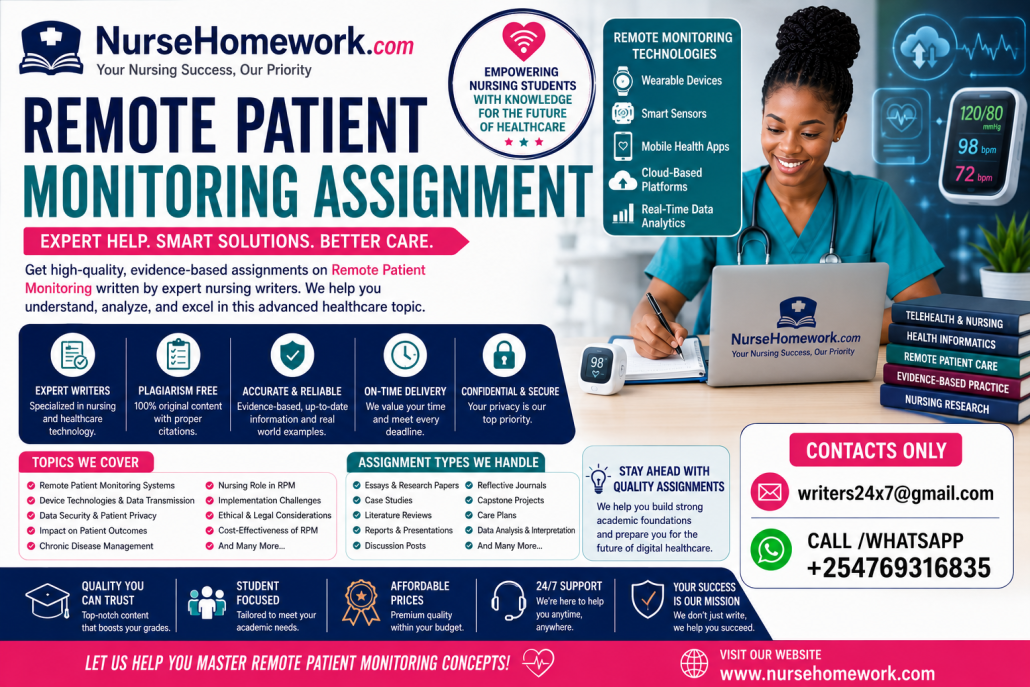
Remote Patient Monitoring Assignment
Understanding Remote Patient Monitoring
Remote Patient Monitoring (RPM) refers to the use of digital technologies that collect health information from patients outside healthcare facilities and transmit that information to healthcare providers.
Common RPM devices include blood pressure monitors, glucose monitoring systems, pulse oximeters, heart rate trackers, wearable fitness devices, and connected weight scales.
Healthcare professionals use these devices to monitor patient conditions, identify potential complications, and provide timely interventions.
The increasing adoption of RPM reflects a broader shift toward technology-enabled healthcare delivery. Healthcare systems seek solutions that improve patient access while supporting more efficient care management.
Students completing a Remote Patient Monitoring Assignment often analyze how these technologies improve patient engagement, chronic disease management, and healthcare accessibility.
Why Remote Patient Monitoring Matters
Healthcare systems worldwide face growing challenges related to aging populations, chronic diseases, workforce shortages, and rising healthcare costs.
Remote patient monitoring helps address some of these challenges by allowing providers to monitor patients between appointments.
For example, a patient with hypertension may record blood pressure readings at home using a connected device. Healthcare professionals can review the data and identify concerning trends without requiring frequent clinic visits.
Similarly, patients with diabetes may use continuous glucose monitoring systems that provide real-time information regarding blood sugar levels.
The ability to monitor patients remotely supports early intervention and ongoing disease management.
This explains why the Remote Patient Monitoring Assignment has become increasingly relevant in healthcare education.
Growing Demand for Remote Patient Monitoring Assignment Support
The healthcare technology sector continues expanding rapidly.
Healthcare organizations are investing heavily in telehealth services, digital health platforms, wearable technologies, and remote monitoring solutions.
As a result, nursing and healthcare programs increasingly require students to understand digital health innovations.
Many students find these topics challenging because they combine healthcare knowledge with technology concepts.
A Remote Patient Monitoring Assignment may require learners to analyze data management, patient engagement, cybersecurity, healthcare policy, ethical considerations, and clinical outcomes simultaneously.
Because these assignments cover multiple disciplines, students often seek academic guidance to improve understanding and performance.
Technologies Used in Remote Patient Monitoring
A variety of technologies support remote patient monitoring programs.
Wearable devices are among the most common tools. These devices track metrics such as heart rate, activity levels, oxygen saturation, sleep patterns, and physical movement.
Connected medical devices provide more specialized monitoring. Examples include digital blood pressure cuffs, glucose monitoring systems, ECG monitors, and smart inhalers.
Mobile health applications also play an important role. Patients can enter symptoms, track medications, receive reminders, and communicate with healthcare providers through smartphone platforms.
Cloud-based systems store patient data securely and allow healthcare teams to access information remotely.
Students working on a Remote Patient Monitoring Assignment often evaluate how these technologies improve healthcare delivery while introducing new challenges.
Benefits of Remote Patient Monitoring
One major benefit is improved access to healthcare services.
Patients living in rural areas or individuals with mobility limitations may find it difficult to attend frequent appointments. Remote monitoring reduces travel requirements while maintaining clinical oversight.
Another advantage involves earlier identification of health concerns.
Continuous monitoring often reveals trends that might otherwise go unnoticed between clinic visits. Healthcare providers can respond more quickly when patient conditions begin changing.
Remote monitoring also encourages patient engagement. Individuals become more involved in managing their health when they regularly track measurements and receive feedback.
Many students discussing these topics within a Remote Patient Monitoring Assignment highlight the potential for improved chronic disease management and patient outcomes.
The Role of Nurses in Remote Monitoring
Nurses play a critical role in remote patient monitoring programs.
They review patient data, identify concerning trends, educate patients about device use, communicate with healthcare teams, and coordinate follow-up care when necessary.
Remote monitoring requires strong clinical judgment because nurses must determine which changes require immediate attention and which can be addressed during routine follow-up.
Patient education is another important responsibility.
Many patients need guidance regarding device operation, symptom reporting, medication adherence, and data submission procedures.
A Remote Patient Monitoring Assignment frequently explores how nursing responsibilities evolve as healthcare technology becomes increasingly integrated into patient care.
Challenges in Remote Patient Monitoring
Despite its benefits, remote monitoring presents several challenges.
Technology adoption can be difficult for some patients, particularly older adults who have limited experience with digital devices.
Internet connectivity issues may also affect data transmission reliability.
Privacy and cybersecurity concerns represent another challenge. Healthcare organizations must protect sensitive patient information while maintaining accessibility.
Data overload is an additional concern. Large monitoring programs may generate substantial amounts of patient information that healthcare teams must review efficiently.
Students preparing a Remote Patient Monitoring Assignment should examine both advantages and limitations to provide balanced analysis.
Remote Patient Monitoring and Chronic Disease Management
Chronic diseases account for a significant portion of healthcare utilization worldwide.
Conditions such as diabetes, hypertension, heart failure, asthma, and chronic obstructive pulmonary disease often require long-term monitoring and management.
Remote patient monitoring supports these efforts by providing continuous visibility into patient conditions.
For example, patients with heart failure may use connected scales to track daily weight changes. Significant increases could indicate fluid retention and prompt earlier intervention.
Similarly, diabetic patients may benefit from glucose monitoring technologies that provide ongoing data regarding blood sugar levels.
These applications are frequently discussed in a Remote Patient Monitoring Assignment because they demonstrate practical healthcare benefits.
Academic Challenges Students Face
Many students encounter difficulties when completing remote monitoring assignments.
One challenge involves understanding healthcare technology terminology. Concepts such as interoperability, telehealth integration, wearable sensors, predictive analytics, and health informatics may be unfamiliar.
Another difficulty involves evaluating research evidence.
Remote monitoring literature includes clinical studies, healthcare policy discussions, technology evaluations, and economic analyses.
Students must synthesize information from multiple sources while maintaining academic rigor.
Professional support can help learners organize ideas, understand key concepts, and develop stronger assignments.
This explains why many students seek assistance when completing a Remote Patient Monitoring Assignment.
Benefits of Remote Patient Monitoring Assignment Help
Academic support provides several advantages.
Students gain a better understanding of healthcare technology concepts and their practical applications.
Guidance also helps improve assignment structure, literature reviews, evidence integration, and critical analysis.
Another benefit involves time management.
Healthcare students often balance coursework, clinical placements, employment, and personal responsibilities. Professional support helps streamline the research and writing process.
Most importantly, Remote Patient Monitoring Assignment assistance helps students develop confidence in discussing emerging healthcare technologies.
Risk Factors and How to Mitigate Them
Remote monitoring programs involve several risks.
One concern is inaccurate or incomplete data collection. Device errors or improper usage may affect measurement reliability.
Patient noncompliance can also reduce program effectiveness. Individuals may forget to record readings or use devices incorrectly.
Privacy breaches represent another risk. Healthcare organizations must implement robust security measures to protect patient information.
Students can address these issues in a Remote Patient Monitoring Assignment by discussing education programs, cybersecurity strategies, device validation procedures, and patient engagement initiatives.
Balanced analysis demonstrates critical thinking and strengthens academic quality.
Is a Remote Patient Monitoring Assignment Worth Studying?
Absolutely.
Remote monitoring represents one of the most important developments in modern healthcare.
Technology-driven care models are expanding rapidly, creating new opportunities for healthcare professionals.
Understanding remote monitoring helps students prepare for future clinical environments where digital health technologies will play increasingly significant roles.
A Remote Patient Monitoring Assignment develops knowledge related to healthcare innovation, patient care, nursing practice, technology integration, and evidence-based healthcare delivery.
These topics remain highly relevant across multiple healthcare disciplines.
Why Students Choose NurseHomework.com
Healthcare assignments often require specialized knowledge that combines nursing principles, healthcare systems, research evidence, and emerging technologies.
NurseHomework.com provides academic support for nursing students, healthcare learners, public health students, and healthcare professionals pursuing advanced education.
Additional healthcare resources include:
- PubMed
- World Health Organization
- Centers for Disease Control and Prevention
- National Institutes of Health
- American Nurses Association
- Agency for Healthcare Research and Quality
- HealthIT.gov
- NurseHomework Blog
Future Trends in Remote Patient Monitoring
The future of healthcare is becoming increasingly digital, and remote patient monitoring is expected to remain a major component of this transformation. Healthcare systems are investing heavily in technologies that allow providers to track patient conditions outside traditional hospital and clinic environments. As a result, students working on a Remote Patient Monitoring Assignment should understand not only current applications but also future developments shaping the healthcare industry.
Artificial intelligence is one of the most discussed innovations in remote monitoring. Advanced systems can analyze large volumes of patient data and identify patterns that might be difficult for healthcare professionals to detect manually. These systems may help identify early warning signs of health deterioration, allowing providers to intervene before conditions become severe.
Predictive analytics is another area experiencing rapid growth. Healthcare organizations are exploring ways to use patient data to forecast potential complications and improve preventive care strategies. For example, monitoring trends in blood pressure, glucose levels, activity patterns, and medication adherence may help healthcare teams recognize risks earlier than traditional appointment-based care models.
Wearable technology is also evolving rapidly. Devices are becoming smaller, more accurate, and more comfortable for long-term use. Future wearables may continuously monitor additional health indicators while transmitting real-time information directly to healthcare providers.
Students completing a Remote Patient Monitoring Assignment can strengthen their analysis by discussing how these technological advancements may influence healthcare delivery in the coming years.
Remote Patient Monitoring in Rural Healthcare
Rural healthcare remains a significant challenge in many countries. Patients living in remote areas often face barriers related to transportation, specialist availability, healthcare infrastructure, and travel costs.
Remote patient monitoring offers practical solutions to many of these challenges. Patients can share health information with providers without traveling long distances for routine assessments. Healthcare professionals can review patient data, identify concerns, and recommend interventions remotely.
For individuals managing chronic illnesses, this approach can reduce the burden associated with frequent clinic visits. It also allows healthcare providers to maintain closer oversight of patient conditions.
A Remote Patient Monitoring Assignment often explores how digital health technologies improve healthcare equity by expanding access to underserved populations. Rural healthcare programs increasingly rely on telehealth and remote monitoring to address workforce shortages and improve patient outcomes.
As governments and healthcare organizations continue investing in digital infrastructure, remote monitoring may play an even larger role in supporting rural communities.
Ethical Considerations in Remote Patient Monitoring
Ethics remains an important topic within healthcare technology discussions.
Patients participating in remote monitoring programs share sensitive personal health information through digital platforms. Healthcare organizations have a responsibility to protect this information and ensure that privacy standards are maintained.
Informed consent is another important consideration. Patients should understand how monitoring systems operate, what information is collected, who can access their data, and how it will be used.
Equity issues also deserve attention. Not all patients have equal access to smartphones, internet connections, or digital literacy training. Healthcare providers must consider how technology adoption may affect different populations.
When writing a Remote Patient Monitoring Assignment, students should evaluate ethical challenges alongside clinical benefits. Balanced discussions demonstrate critical thinking and a deeper understanding of healthcare technology implementation.
Healthcare professionals must ensure that technological innovation does not compromise patient rights, privacy, or access to care.
The Importance of Patient Education in Remote Monitoring
Technology alone cannot guarantee successful remote monitoring outcomes.
Patients must understand how to use monitoring devices correctly, interpret instructions, and communicate concerns when necessary. Effective education programs therefore represent a critical component of successful monitoring initiatives.
Nurses frequently play a leading role in patient education. They explain device operation, review monitoring schedules, answer questions, and help patients understand the significance of collected data.
Patients who feel confident using monitoring equipment are more likely to participate consistently and report accurate information.
A Remote Patient Monitoring Assignment may examine how patient education influences program effectiveness. Strong educational support improves adherence, reduces errors, and increases patient satisfaction.
Healthcare organizations increasingly recognize that successful monitoring programs depend on both technology and patient engagement.
Healthcare Cost Considerations
One frequently discussed benefit of remote monitoring involves healthcare resource optimization.
While implementing monitoring programs requires investments in devices, software platforms, training, and technical support, many healthcare organizations view these programs as long-term strategic investments.
Remote monitoring may help reduce avoidable hospital admissions, emergency department visits, and unnecessary clinic appointments by identifying issues before they escalate into more serious problems.
For example, if a patient with heart failure experiences changes in weight and symptoms, healthcare providers may intervene earlier and potentially prevent hospitalization. Similarly, improved diabetes monitoring can support better disease management and reduce complications.
Students working on a Remote Patient Monitoring Assignment should approach cost discussions carefully. Rather than making unrealistic claims, it is more appropriate to explain that outcomes vary depending on patient populations, program design, healthcare systems, and monitoring effectiveness.
Balanced analysis strengthens academic credibility and demonstrates evidence-based reasoning.
Research Opportunities in Remote Patient Monitoring
Remote monitoring remains an active area of healthcare research.
Researchers continue exploring questions related to patient outcomes, technology adoption, cost-effectiveness, healthcare access, patient satisfaction, and clinical workflows.
New monitoring technologies require ongoing evaluation to determine their effectiveness in different healthcare settings. Researchers also examine how remote monitoring can support specific patient populations, including older adults, pediatric patients, and individuals with complex chronic conditions.
A Remote Patient Monitoring Assignment often requires students to review scholarly literature and analyze current evidence. Understanding research trends helps students identify gaps in knowledge and emerging opportunities for innovation.
Healthcare professionals who understand research findings are better equipped to implement evidence-based monitoring strategies in clinical practice.
Why Remote Patient Monitoring Skills Matter for Future Nurses
Healthcare technology literacy is becoming increasingly important for nursing professionals.
Modern nurses interact with electronic health records, digital communication platforms, telehealth systems, and remote monitoring technologies regularly. Understanding these tools improves patient care and supports effective collaboration within healthcare teams.
Remote monitoring requires nurses to interpret patient data, identify concerning trends, educate patients, and coordinate care responses. These responsibilities combine traditional nursing competencies with technology-enabled healthcare delivery.
Students completing a Remote Patient Monitoring Assignment gain exposure to concepts that will likely remain relevant throughout their careers.
Healthcare organizations continue expanding digital health initiatives, creating demand for professionals who understand both clinical practice and healthcare technology.
Developing this knowledge during nursing education provides valuable preparation for future workplace expectations.
Frequently Asked Questions
What is a Remote Patient Monitoring Assignment?
It is an academic project that examines technologies used to monitor patients outside traditional healthcare facilities.
Which students complete Remote Patient Monitoring Assignments?
Nursing, healthcare administration, public health, health informatics, and medical students frequently study this topic.
Why is remote patient monitoring important?
It improves patient access, supports chronic disease management, and enables earlier healthcare interventions.
What technologies are commonly used?
Wearable devices, glucose monitors, blood pressure monitors, mobile health apps, and connected medical equipment.
Why choose NurseHomework.com?
NurseHomework.com specializes in nursing and healthcare academic support, including technology-focused healthcare assignments.
Final Verdict
Remote patient monitoring continues transforming healthcare delivery.
By combining healthcare expertise with digital technologies, providers can monitor patients more effectively while improving access to care.
The topic remains highly relevant because healthcare organizations increasingly rely on technology-enabled solutions to manage patient populations and chronic diseases.
A Remote Patient Monitoring Assignment helps students understand these innovations while developing critical thinking, research, and healthcare analysis skills.
For nursing and healthcare students, mastering this topic provides valuable preparation for the future of healthcare practice.
Conclusion: The Growing Importance of Remote Patient Monitoring Assignment Topics
The healthcare industry is undergoing significant transformation driven by technological innovation, changing patient expectations, and increasing demand for accessible care.
Remote monitoring represents one of the most promising approaches for improving healthcare delivery while supporting patient engagement and chronic disease management.
For students, completing a Remote Patient Monitoring Assignment offers an opportunity to explore the intersection of healthcare, technology, ethics, patient education, and evidence-based practice.
Understanding remote monitoring technologies prepares future healthcare professionals for increasingly digital clinical environments. It also strengthens critical thinking, research abilities, and healthcare analysis skills.
As healthcare systems continue adopting innovative care models, knowledge gained through studying remote monitoring will remain highly valuable. Students who develop expertise in this area position themselves to contribute meaningfully to the future of patient-centered, technology-enabled healthcare.
Ultimately, a strong understanding of remote monitoring supports both academic success and long-term professional growth, making the Remote Patient Monitoring Assignment an important topic within modern nursing and healthcare education.
Get Started Today
Need professional help with your Remote Patient Monitoring Assignment?
Visit NurseHomework.com today for expert support with nursing assignments, healthcare technology projects, research papers, case studies, evidence-based practice assignments, public health coursework, and healthcare informatics topics. Build stronger academic skills and gain confidence in emerging healthcare technologies.
Needs help with Nursing Assignment?
We are available 24x7 to deliver the best services and assignment ready within 3-4 hours? Order a custom-written, plagiarism-free paper
 Get Answer Over WhatsApp
 Order Paper Now