Introduction to Nursing: 12 Essential Fundamentals Every Future Nurse Must Master (2026)
/in Homewok help /by BrianTable of Contents
ToggleIntroduction to Nursing
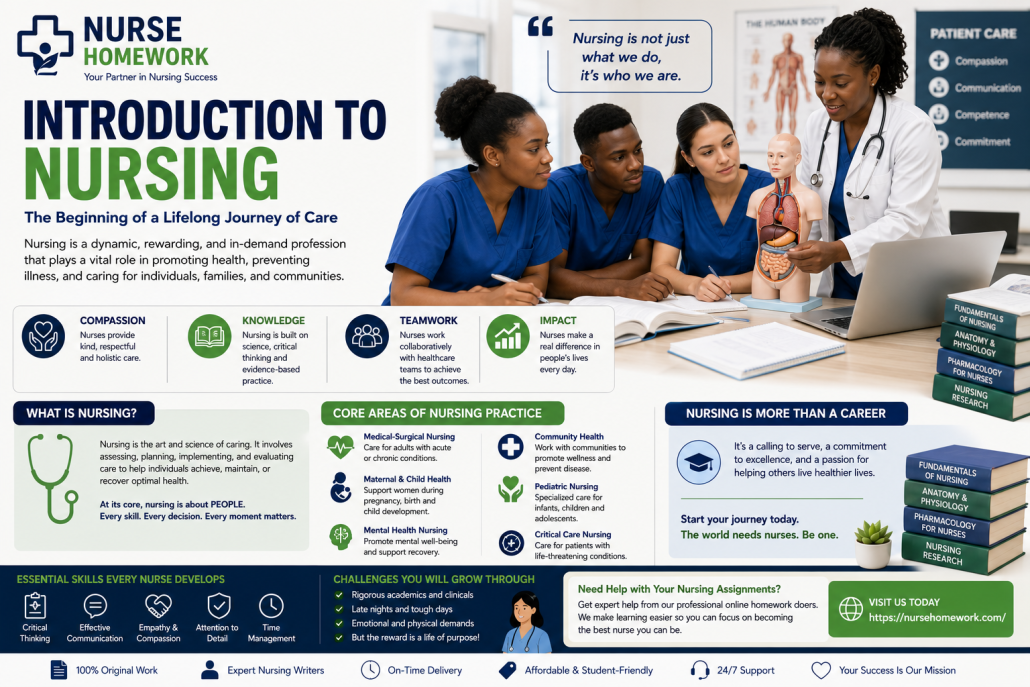
The phrase introduction to nursing represents far more than the first chapter of a nursing textbook. It marks the beginning of one of the world’s most respected healthcare professions—a profession built on compassion, scientific knowledge, critical thinking, ethical decision-making, and patient advocacy. Whether you are a first-year nursing student, a healthcare professional considering further education, or someone interested in understanding the nursing profession, developing a solid introduction to nursing provides the foundation needed for long-term academic and professional success.
Nursing is often described simply as caring for patients, but modern nursing extends far beyond bedside care. Today’s nurses assess patients, develop care plans, administer medications, educate families, coordinate healthcare teams, interpret clinical information, promote disease prevention, support mental health, and contribute to healthcare research. Every nursing specialty—from pediatrics and emergency medicine to intensive care and community health—relies on the concepts introduced during an introduction to nursing course.
Many online articles discussing introduction to nursing provide only basic definitions and historical summaries. While these explanations are useful, they rarely prepare students for the practical realities of nursing education. New nursing students frequently encounter evidence-based practice, anatomy, physiology, pharmacology, pathophysiology, patient assessment, professional ethics, communication skills, and clinical reasoning much earlier than expected. Understanding these concepts from the beginning reduces anxiety and builds confidence throughout nursing school.
This guide provides a comprehensive introduction to nursing, explains what students should expect during their education, explores the profession’s core principles, and highlights why academic support resources such as NurseHomework.com help nursing students navigate challenging coursework responsibly.
introduction to nursing
What Existing Articles Miss About Introduction to Nursing
After reviewing popular resources covering introduction to nursing, several common weaknesses become apparent.
Many articles spend significant time discussing Florence Nightingale and the history of nursing but devote little attention to modern healthcare environments. Today’s nurses work with electronic medical records, evidence-based guidelines, interdisciplinary healthcare teams, advanced medical technologies, and increasingly complex patient populations.
Another common issue is oversimplification. Statements such as “nurses care for patients” fail to capture the complexity of professional nursing. Nurses continuously assess patient conditions, prioritize interventions, monitor treatment effectiveness, educate patients, advocate for safety, and collaborate with physicians, therapists, pharmacists, and other healthcare professionals.
Some resources also ignore the academic challenges students face. Courses covering pharmacology, microbiology, anatomy, physiology, biostatistics, research methods, and pathophysiology require disciplined study habits and critical thinking. A realistic introduction to nursing should prepare students academically as well as professionally.
Finally, many articles overlook the importance of lifelong learning. Nursing evolves continuously through medical research, updated clinical guidelines, and advances in healthcare technology. Successful nurses remain committed to professional development throughout their careers.
What Is Nursing?
A proper introduction to nursing begins with understanding what nursing actually involves.
Nursing is a professional healthcare discipline dedicated to promoting health, preventing illness, caring for individuals experiencing disease or injury, supporting recovery, and improving quality of life across all age groups.
Unlike many healthcare professions that focus primarily on diagnosis or treatment, nursing addresses the physical, psychological, emotional, social, and educational needs of patients.
Professional nurses provide care in numerous environments, including:
- Hospitals
- Community health centres
- Clinics
- Schools
- Nursing homes
- Rehabilitation facilities
- Mental health institutions
- Emergency departments
- Intensive care units
- Home healthcare services
- Public health organizations
Every healthcare setting requires nurses who combine scientific knowledge with compassion, communication, and sound clinical judgment.
The History of Nursing
Any introduction to nursing should acknowledge the profession’s historical development.
Although caregiving has existed throughout human history, modern nursing emerged during the nineteenth century through the pioneering work of Florence Nightingale.
During the Crimean War, Nightingale introduced structured sanitation practices, patient observation, statistical analysis, and organized nursing education. Her emphasis on hygiene and evidence significantly reduced mortality among injured soldiers.
Since then, nursing has evolved into a highly specialized profession supported by university education, scientific research, advanced clinical practice, leadership development, and international professional standards.
Today’s nurses contribute not only to direct patient care but also to education, policy development, healthcare management, informatics, and research.
Why Nursing Matters
Healthcare systems cannot function effectively without nurses.
A strong introduction to nursing explains that nurses spend more direct time with patients than most other healthcare professionals. This continuous interaction allows nurses to identify changes in patient conditions, recognize complications early, provide emotional support, educate families, and coordinate treatment plans.
Nurses contribute to:
- Patient safety
- Health promotion
- Disease prevention
- Rehabilitation
- Chronic disease management
- Emergency care
- Maternal health
- Child health
- Mental healthcare
- Community outreach
Because of these responsibilities, nursing remains one of the most trusted professions worldwide.
Core Principles Introduced in Nursing Education
Every introduction to nursing course introduces students to several fundamental concepts that shape professional practice throughout their careers.
These principles include patient-centred care, evidence-based practice, ethical decision-making, communication, cultural competence, teamwork, professionalism, accountability, and lifelong learning.
Students also begin understanding the nursing process:
- Assessment
- Nursing diagnosis
- Planning
- Implementation
- Evaluation
This systematic approach helps nurses deliver organized, safe, and effective patient care across different clinical environments.
Learning these principles early provides the framework for more advanced clinical courses.
Qualities of Successful Nurses
Academic knowledge alone does not define an excellent nurse.
A meaningful introduction to nursing also explores the personal characteristics required for professional success.
Effective nurses demonstrate:
- Compassion
- Critical thinking
- Emotional resilience
- Professional integrity
- Attention to detail
- Strong communication
- Adaptability
- Leadership
- Teamwork
- Ethical judgment
- Time management
- Continuous curiosity
These qualities become increasingly important as students progress through clinical placements and professional practice.
Nursing Education: What Students Should Expect
Beginning nursing school can feel overwhelming.
A comprehensive introduction to nursing prepares students for the intensity of healthcare education.
Most nursing programs include coursework in:
- Human anatomy
- Physiology
- Microbiology
- Pharmacology
- Pathophysiology
- Health assessment
- Fundamentals of nursing
- Community health
- Medical-surgical nursing
- Mental health nursing
- Maternal and child health
- Research methods
- Leadership
- Ethics
Clinical placements accompany classroom learning, allowing students to apply theoretical knowledge in supervised healthcare settings.
Time management quickly becomes one of the most valuable skills for nursing students because assignments, laboratory sessions, examinations, clinical rotations, and group projects often occur simultaneously.
Why Students Seek Academic Support
Nursing education is rewarding, but it is also academically demanding.
Students frequently complete evidence-based practice assignments, care plans, case studies, reflective journals, research papers, discussion posts, presentations, and literature reviews while attending lectures and clinical placements.
Professional academic guidance can help students understand assignment expectations, improve research techniques, strengthen academic writing, and learn proper referencing styles.
NurseHomework.com provides responsible academic assistance by connecting students with subject specialists familiar with nursing education, APA formatting, evidence-based practice, and university standards.
Rather than replacing independent learning, these resources serve as educational references that help students better understand complex nursing concepts while improving confidence in academic writing.
Nursing Specialties Every Student Should Know
A complete introduction to nursing should explain that nursing is not a single career path. Instead, it offers dozens of specialties that allow professionals to focus on different patient populations, healthcare settings, and clinical interests. As students progress through their education, they often discover areas that match their strengths, personality, and long-term career goals.
Medical-surgical nursing is one of the largest specialties because it provides care for adult patients recovering from illness, injury, or surgery. Many newly graduated nurses begin their careers in medical-surgical units because they gain exposure to diverse medical conditions while developing essential clinical skills.
Pediatric nursing focuses on infants, children, and adolescents. Pediatric nurses monitor growth and development, administer medications, educate parents, and provide emotional support for young patients during hospitalization.
Maternal and newborn nursing supports women throughout pregnancy, childbirth, postpartum recovery, and neonatal care. Nurses in this specialty help families navigate one of the most important periods of their lives while monitoring maternal and infant health.
Mental health nursing emphasizes psychological well-being. These nurses work with patients experiencing depression, anxiety, substance use disorders, schizophrenia, bipolar disorder, and other psychiatric conditions. Communication, empathy, and therapeutic relationships become especially important within this specialty.
Critical care nursing involves caring for seriously ill patients in intensive care units. Nurses monitor advanced medical equipment, administer complex medications, and respond quickly to rapidly changing patient conditions.
Community health nursing shifts the focus from hospitals to entire populations. Community nurses promote disease prevention, vaccination programs, health education, maternal care, and chronic disease management within local communities.
Every nursing specialty builds upon the concepts introduced during an introduction to nursing, making foundational knowledge essential regardless of future career direction.
Roles and Responsibilities of Professional Nurses
One of the biggest misconceptions addressed during an introduction to nursing is the belief that nurses simply follow physicians’ instructions.
Modern nursing involves independent clinical judgment alongside collaborative healthcare practice.
Professional nurses perform comprehensive patient assessments by collecting health histories, measuring vital signs, observing symptoms, and identifying potential complications.
They develop individualized nursing care plans based on patient needs and continuously evaluate whether treatments are achieving desired outcomes.
Medication administration is another major responsibility. Nurses verify medication orders, calculate dosages, monitor patient responses, educate patients about medications, and recognize potential adverse reactions.
Patient education remains equally important. Nurses explain diseases, treatments, medications, discharge instructions, preventive healthcare strategies, and lifestyle modifications that improve long-term health outcomes.
Documentation is also a critical nursing responsibility. Accurate patient records support continuity of care while providing legal and professional accountability.
As students continue their introduction to nursing, they discover that professional nursing combines scientific knowledge, communication, compassion, leadership, and analytical thinking.
Essential Clinical Skills Every Nursing Student Must Learn
A successful introduction to nursing exposes students to numerous practical skills that become increasingly advanced throughout nursing school.
Among the most important clinical competencies are:
- Patient assessment.
- Vital signs measurement.
- Infection prevention.
- Hand hygiene.
- Medication administration.
- Wound care.
- Catheter care.
- Intravenous therapy.
- Oxygen administration.
- Pain assessment.
- Documentation.
- Patient positioning.
- Mobility assistance.
- Health education.
- Emergency response.
Initially, students practice these procedures in simulation laboratories before performing them under supervision during clinical placements.
Repeated practice helps transform theoretical knowledge into professional competence.
Communication in Nursing
Communication is one of the most valuable skills emphasized during an introduction to nursing.
Nurses communicate with:
- Patients.
- Families.
- Physicians.
- Pharmacists.
- Therapists.
- Laboratory staff.
- Administrators.
- Fellow nurses.
Clear communication reduces medical errors while improving patient satisfaction.
Professional nurses also practice active listening.
Understanding patient concerns, fears, symptoms, and expectations helps nurses deliver more individualized care.
Written communication remains equally important because nursing documentation supports clinical decision-making across healthcare teams.
Ethics and Professionalism
Every introduction to nursing includes professional ethics because nurses regularly encounter situations involving difficult clinical decisions.
Ethical nursing practice emphasizes:
- Respect.
- Confidentiality.
- Honesty.
- Accountability.
- Justice.
- Patient autonomy.
- Beneficence.
- Non-maleficence.
Maintaining patient privacy and protecting confidential medical information are fundamental professional responsibilities.
Students also learn that professionalism extends beyond clinical knowledge.
Professional nurses demonstrate punctuality, reliability, respectful communication, lifelong learning, cultural sensitivity, and ethical decision-making throughout their careers.
Evidence-Based Practice
Healthcare continues evolving through scientific research.
For this reason, every introduction to nursing introduces evidence-based practice.
Evidence-based practice combines:
- Current scientific research.
- Clinical expertise.
- Patient preferences.
Rather than relying solely on tradition, nurses evaluate research findings before implementing interventions.
Students quickly discover that nursing assignments frequently require peer-reviewed journal articles supporting clinical recommendations.
Learning how to locate, evaluate, and apply scientific evidence becomes essential for both academic success and professional practice.
Common Challenges Nursing Students Face
Nursing school is rewarding, but it is rarely easy.
Many students experience challenges during their introduction to nursing because healthcare education combines demanding academic coursework with practical clinical training.
Common challenges include:
- Heavy reading requirements.
- Clinical placements.
- Laboratory practice.
- Multiple assignments.
- Time management.
- Examination pressure.
- APA referencing.
- Research writing.
- Emotional stress.
- Balancing employment and education.
Developing strong organizational skills early helps students manage these competing responsibilities more effectively.
Seeking academic guidance whenever difficulties arise also improves long-term learning.
Career Opportunities After Nursing School
Completing an introduction to nursing marks only the beginning of a wide range of career opportunities.
Registered nurses may work in:
- Hospitals.
- Community clinics.
- Emergency departments.
- Intensive care units.
- Surgical theatres.
- Public health organizations.
- Schools.
- Universities.
- Rehabilitation centres.
- Mental health facilities.
- Research institutions.
- Government agencies.
- International health organizations.
Many nurses later specialize in advanced practice, leadership, education, informatics, administration, or research.
The profession also provides opportunities for postgraduate education leading to master’s and doctoral qualifications.
Why Academic Support Matters
Nursing education requires students to complete numerous assignments involving evidence-based practice, clinical reasoning, pharmacology, anatomy, physiology, pathophysiology, and healthcare ethics.
These assignments often require extensive literature reviews, critical analysis, and strict adherence to APA formatting.
NurseHomework.com helps students navigate these academic demands by providing educational support from writers familiar with nursing education and university expectations.
Students commonly receive assistance with:
- Nursing essays.
- Care plans.
- Research papers.
- Discussion posts.
- Reflective journals.
- Evidence-based practice assignments.
- Literature reviews.
- Capstone projects.
- Case studies.
- Presentation preparation.
Using professionally prepared academic material responsibly allows students to strengthen research skills, improve writing quality, and better understand complex nursing concepts.
Risks Nursing Students Face and How to Overcome Them
Every introduction to nursing should prepare students not only for the rewards of the profession but also for its challenges. Nursing school is academically demanding, emotionally intense, and physically exhausting at times. Understanding these challenges early allows students to prepare realistic strategies for success.
One of the biggest risks is poor time management. Nursing students often balance lectures, laboratory sessions, clinical placements, assignments, examinations, family responsibilities, and sometimes part-time employment. Missing deadlines can quickly affect academic performance. Creating weekly study schedules, prioritizing urgent assignments, and breaking large projects into smaller tasks can significantly reduce stress.
Academic burnout is another challenge. Long study hours, difficult examinations, and emotionally demanding clinical experiences may leave students mentally exhausted. Regular breaks, healthy sleep habits, exercise, and peer support help maintain emotional well-being throughout nursing school.
Clinical anxiety affects many students during their first placements. Fear of making mistakes or communicating with patients is common. Confidence develops through preparation, supervision, and repeated clinical practice. Asking questions and seeking guidance from clinical instructors helps students grow professionally.
Research and academic writing also present challenges. Many nursing assignments require APA formatting, evidence-based practice, critical analysis, and peer-reviewed references. Students unfamiliar with academic writing may initially struggle. Using educational resources responsibly, practicing research skills, and reviewing professional examples improve writing confidence over time.
Finally, maintaining professionalism is essential. Respecting patient confidentiality, following ethical guidelines, communicating effectively, and demonstrating accountability form the foundation of successful nursing practice.
Is Nursing Worth It? An Honest Verdict
After completing an introduction to nursing, many students ask whether pursuing nursing is worth the effort.
For most students, the answer is yes—but with realistic expectations.
Nursing is not an easy profession. It requires continuous learning, emotional resilience, excellent communication, critical thinking, and a genuine commitment to patient care. Students should expect challenging coursework, demanding clinical placements, and lifelong professional development.
However, nursing also offers meaningful rewards. Nurses make a direct difference in patients’ lives every day. They provide comfort during illness, promote healthier communities, educate families, and contribute to improved healthcare outcomes.
The profession also offers diverse career paths, opportunities for specialization, leadership roles, advanced education, research, healthcare administration, and international employment opportunities.
Students who enter nursing because they genuinely enjoy helping others, solving problems, and learning continuously often find it to be one of the most fulfilling careers available.
Frequently Asked Questions
1. What is covered in an introduction to nursing?
An introduction to nursing typically covers nursing history, professional roles, ethics, communication, patient-centred care, the nursing process, healthcare systems, evidence-based practice, professionalism, and the fundamentals required before entering clinical practice.
2. Is nursing difficult for beginners?
Yes. Nursing combines science, healthcare knowledge, clinical practice, and academic writing. However, consistent study habits, practical experience, and strong organizational skills help students adapt successfully.
3. What skills are most important for nursing students?
Successful nursing students develop communication, critical thinking, clinical reasoning, time management, empathy, teamwork, professionalism, adaptability, and evidence-based decision-making skills throughout their education.
4. Why do nursing students seek academic support?
Many nursing students manage lectures, clinical placements, laboratory work, examinations, and multiple assignments simultaneously. Educational support helps students better understand complex concepts, improve research skills, and strengthen academic writing.
5. How can NurseHomework.com help nursing students?
NurseHomework.com provides responsible academic assistance with nursing essays, care plans, research papers, case studies, discussion posts, literature reviews, evidence-based practice assignments, capstone projects, and other nursing coursework prepared by subject specialists.
Why Choose NurseHomework.com?
Throughout your introduction to nursing, you will encounter increasingly challenging assignments that require evidence-based research, APA formatting, critical thinking, and professional writing.
NurseHomework.com supports nursing students by providing access to experienced academic professionals who understand healthcare education and university standards.
Students can receive educational assistance with:
- Nursing homework
- Care plans
- Case studies
- Nursing essays
- Research papers
- Discussion board posts
- Literature reviews
- Reflection papers
- Capstone projects
- Evidence-based practice assignments
- BSN, MSN, and DNP coursework
The platform emphasizes:
- Original academic content
- Qualified nursing experts
- Confidential service
- On-time delivery
- Accurate APA referencing
- Responsive customer support
- Professional quality assurance
Whether you are beginning your introduction to nursing or completing advanced nursing coursework, responsible academic guidance can help strengthen your understanding and confidence.
today to learn more about professional nursing academic support.
Conclusion
A strong introduction to nursing provides far more than definitions and historical facts. It introduces students to one of the world’s most respected professions while laying the academic and professional foundation required for future success.
Throughout nursing school, students develop scientific knowledge, clinical competence, communication skills, ethical judgment, leadership abilities, and evidence-based decision-making. These competencies prepare nurses to provide safe, compassionate, and effective care across hospitals, clinics, community health centres, schools, rehabilitation facilities, and many other healthcare settings.
Although nursing education presents significant challenges, students who remain committed to continuous learning, disciplined study habits, and professional growth often discover rewarding lifelong careers dedicated to improving the lives of others.
For students seeking additional educational support, NurseHomework.com offers expert academic assistance that complements independent learning while helping students navigate demanding nursing coursework responsibly.
Recommended Internal DoFollow Links
- https://nursehomework.com/
- https://nursehomework.com/nursing-homework-help/
- https://nursehomework.com/blog/
- https://nursehomework.com/contact/
Recommended External DoFollow Links
- https://www.icn.ch
- https://www.who.int
- https://www.cdc.gov
- https://pubmed.ncbi.nlm.nih.gov
- https://scholar.google.com
- https://apastyle.apa.org
- https://owl.purdue.edu
- https://www.ncsbn.org
Needs help with Nursing Assignment?
We are available 24x7 to deliver the best services and assignment ready within 3-4 hours? Order a custom-written, plagiarism-free paper
 Get Answer Over WhatsApp
 Order Paper Now
