DNP Project Writing Help
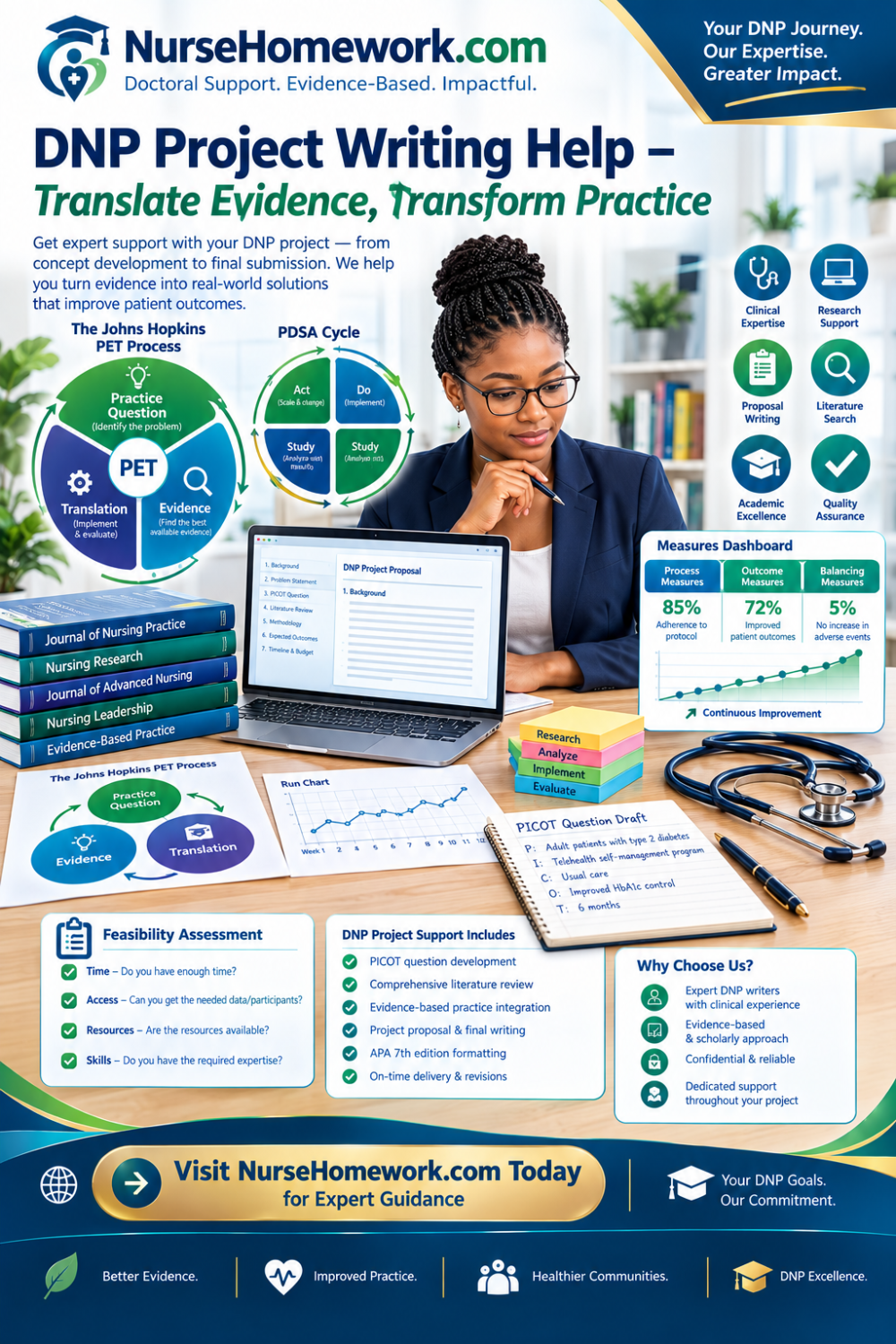
DNP project writing help is one of the most valuable resources a Doctor of Nursing Practice student can access, because the DNP project is the culminating scholarly work that demonstrates your ability to translate evidence into practice. At NurseHomework.com, we understand that DNP project writing help differs fundamentally from thesis or dissertation support, since the DNP project emphasizes practice improvement rather than generating new theory. This comprehensive guide provides DNP project writing help across project design, evidence translation, quality improvement methodology, implementation, evaluation, and scholarly writing.
Understanding What a DNP Project Actually Is
Before diving into DNP project writing help, it is essential to understand what distinguishes the DNP project from other doctoral scholarly work. The DNP project is a translational, practice-focused scholarly project that demonstrates competency in applying evidence to improve health outcomes or healthcare delivery. It is not original research in the traditional sense, and it is not a thesis. It is a structured practice change.
According to the American Association of Colleges of Nursing, the DNP project is designed to demonstrate the student’s ability to translate evidence into practice, evaluate outcomes, and lead system-level change. This framing shapes every aspect of DNP project writing help, because projects that attempt to generate new theory rather than translate existing evidence miss the purpose entirely.
Most DNP projects follow a quality improvement or evidence-based practice framework. Common models include the Iowa Model of Evidence-Based Practice, the Johns Hopkins Evidence-Based Practice Model, and the Plan-Do-Study-Act cycle. Understanding DNP project writing help means understanding which framework fits your project and how to apply it rigorously.
The DNP Project Triad: Practice Question, Evidence, Translation
The Johns Hopkins Evidence-Based Practice Model for Nurses and Healthcare Professionals, now in its fifth edition, provides the widely used PET process: Practice Question, Evidence, and Translation. This framework organizes both project design and written documentation, and it is central to effective DNP project writing help.
Practice Question
The practice question asks what problem in your clinical setting requires improvement and what evidence exists to guide the change. Unlike a research question that seeks new knowledge, a practice question seeks to close a gap between current practice and best evidence. Formulating this question correctly is the first critical element of DNP project writing help.
Evidence
The evidence phase requires systematic appraisal of the best available research, clinical guidelines, and expert consensus relevant to your practice question. A complete DNP project writing help process includes literature search strategy development, critical appraisal using tools such as the Johns Hopkins Evidence Level and Quality Guide, and synthesis of findings into a practice recommendation.
Translation
The translation phase converts evidence into an actionable practice change, implements it in a defined setting, evaluates outcomes, and disseminates findings. This is where most of the work in DNP project writing help occurs, because implementation requires navigating real-world constraints.
Common DNP Project Types
Understanding which project type fits your topic determines the structure of your writing and the methodology you will apply.
Quality Improvement Projects
QI projects use frameworks such as Plan-Do-Study-Act or Model for Improvement to test and refine practice changes in a defined setting. These are the most common DNP project type.
Evidence-Based Practice Implementation Projects
EBP projects translate published evidence into practice through structured implementation, often using the Iowa Model or Johns Hopkins Model. They emphasize appraisal and adaptation rather than local testing alone.
Program Development and Evaluation
Program projects design a new service, education program, or clinical pathway and evaluate its outcomes.
Practice Change and Policy Projects
Policy projects address system-level changes such as protocol development, policy revision, or workflow redesign.
Clinical Innovation Projects
Innovation projects introduce new technology, care models, or delivery methods into practice and evaluate the impact.
The DNP Project Paper Structure
A typical DNP project paper follows a defined structure. Understanding this structure is a core component of DNP project writing help.
Introduction and Background
This section establishes the problem, its significance, the practice setting, and why the project matters. It should include epidemiological data, local practice data, and the gap between current practice and recommended practice.
Problem Statement and Purpose
The problem statement articulates the specific clinical problem. The purpose statement describes what your project will accomplish. Both should be concise and measurable.
Clinical Question
The clinical question is typically formulated using PICOT: Population, Intervention, Comparison, Outcome, and Time. Unlike a research question, the DNP PICOT question addresses a practice gap rather than generating new knowledge.
Literature Review and Evidence Synthesis
This section presents the appraised evidence supporting your intervention. It includes the search strategy, inclusion and exclusion criteria, appraisal results using an evidence hierarchy, and synthesis of findings. The Johns Hopkins Model’s simplified appraisal tools and updated categories of evidence are particularly useful here.
Theoretical and Conceptual Framework
This section identifies the change model, EBP model, and any nursing theory informing your project. Common frameworks include the Iowa Model, Johns Hopkins Model, Lewin’s Change Theory, Kotter’s Change Model, and the transtheoretical model.
Methodology
This section describes the project design, setting, population, intervention, implementation plan, timeline, and evaluation plan. It should be detailed enough that another practitioner could replicate your project.
Implementation
This section documents what actually occurred, including stakeholder engagement, barriers encountered, adaptations made, and resources used.
Evaluation and Outcomes
This section presents outcome data, including process measures, outcome measures, and balancing measures. Statistical analysis should match the data type and the question.
Discussion
This section interprets the findings, compares them to existing literature, addresses limitations, and identifies implications for practice.
Sustainability and Dissemination
This section addresses how the change will be maintained, spread to other units, and shared through presentations or publications.
Writing the DNP Project Proposal
The proposal stage often creates the most anxiety, and it is where DNP project writing help delivers significant value.
Establishing the Practice Gap
Proposals frequently fail because the practice gap is not clearly established. You must demonstrate that current practice differs from best evidence and that this difference matters. Local data, benchmark comparisons, and guideline deviations all support this.
Justifying the Intervention
Your chosen intervention must be supported by evidence, feasible in your setting, and appropriate to the problem. Interventions drawn from single studies rather than synthesized evidence weaken proposals considerably.
Demonstrating Feasibility
The proposal must show that you can access the setting, recruit participants or stakeholders, obtain approvals, and complete the project within your program’s timeframe.
Addressing Ethical Considerations
DNP projects typically require institutional review board determination, even when they qualify as quality improvement rather than research. Some projects qualify for exempt status, while others require full review. Understanding this distinction is essential.
Preparing for Committee Review
Your proposal defense requires clear articulation of the problem, the evidence, the intervention, and the evaluation plan. Anticipating committee questions in advance strengthens the defense considerably.
Evidence Appraisal for DNP Projects
Appraisal is where DNP project writing help becomes technically demanding.
Selecting an Appraisal Tool
The Johns Hopkins Evidence Level and Quality Guide provides one of the most widely used appraisal frameworks for DNP projects. It assesses both level of evidence and quality, producing a final rating that informs recommendation strength.
Applying the Evidence Hierarchy
Levels I and II evidence from systematic reviews and randomized controlled trials carries the greatest weight. Observational studies, expert opinion, and organizational experience carry less. Your synthesis should reflect this hierarchy.
Synthesizing Rather Than Summarizing
Synthesis groups findings into themes, identifies consensus and controversy, and produces a recommendation. Summarizing individual studies without synthesis produces a weak evidence chapter, which is one of the most common weaknesses addressed by DNP project writing help.
Addressing Evidence Gaps
Where evidence is insufficient, your recommendation must acknowledge this and describe how expert consensus, clinical guidelines, or organizational data informed the decision.
Quality Improvement Methodology
Most DNP projects use QI methodology, and understanding its language is essential.
Plan-Do-Study-Act Cycles
PDSA cycles test small-scale changes, study results, and adapt before scaling. Multiple cycles are usually required before a change is ready for broader implementation.
Model for Improvement
The Model for Improvement asks three questions: What are we trying to accomplish? How will we know that a change is an improvement? What changes can we make that will result in improvement? These questions structure the entire project.
Run Charts and Statistical Process Control
Run charts and control charts display outcome data over time and distinguish signal from noise. Understanding these tools is a core element of DNP project writing help for QI-focused projects.
Balancing Measures
Balancing measures ensure that improvement in one area does not create unintended consequences elsewhere. A project reducing length of stay, for example, should also monitor readmission rates.
Data Collection and Analysis
Selecting Measures
DNP projects typically report three measure types. Process measures assess whether the intervention was delivered as intended. Outcome measures assess whether patient or system outcomes improved. Balancing measures assess unintended effects.
Choosing Appropriate Statistical Tests
Descriptive statistics summarize baseline and post-intervention data. Paired t-tests compare pre-post means within one group. Chi-square tests compare categorical outcomes. Non-parametric tests are used when data do not meet normality assumptions.
Displaying Data Effectively
Run charts, bar graphs, and tables communicate results efficiently. Each figure should answer a specific question rather than display data generally.
Interpreting Findings Honestly
Outcomes that do not improve are still findings and should be reported transparently. Projects that report only positive results undermine credibility.
Scholarly Writing Standards for DNP Projects
Formal Academic Voice
DNP projects require formal, third-person scholarly voice, unlike reflective writing which uses first person.
APA 7th Edition Compliance
DNP projects follow APA 7th edition formatting, including title page, headings, in-text citations, reference list, tables, and figures. Citation accuracy is heavily weighted in most rubrics.
Consistency in Terminology
Terminology must remain consistent throughout, including your use of patient versus client, intervention versus implementation, and outcome versus result.
Precision in Describing Methodology
Methodological descriptions must be precise enough for replication. Vague descriptions such as “data was analyzed” without specifying tests weaken the methodology chapter considerably.
Common DNP Project Challenges
Confusing research with quality improvement. DNP projects translate evidence; they do not generate new theory.
Weak problem statements. Proposals fail when the practice gap is not clearly documented with local or benchmark data.
Insufficient evidence synthesis. Summarizing studies individually without synthesis weakens the evidence chapter.
Overly ambitious scope. Projects that attempt system-wide change within a single semester inevitably stall.
Inadequate stakeholder engagement. Implementation fails when frontline staff are not involved from the beginning.
Missing sustainability planning. Projects that end with data collection leave the change unsustained.
Neglecting IRB determination. Assuming a project requires no review is a common and serious error.
Poor data display. Tables that overwhelm readers and figures that confuse rather than clarify weaken the results chapter.
How NurseHomework.com Supports DNP Project Writing
At NurseHomework.com, we provide comprehensive DNP project writing help for doctoral nursing students. Our services include:
PICOT clinical question development for practice-focused projects
Johns Hopkins PET process application and Iowa Model implementation guidance
Literature search strategy development and critical appraisal using established tools
Evidence synthesis that groups findings thematically rather than summarizing studies
Quality improvement methodology support including PDSA cycles and run charts
Measure selection covering process, outcome, and balancing measures
Statistical analysis guidance matched to data type and question
Proposal development and committee defense preparation
IRB determination and ethical consideration review
APA 7th edition citation and reference verification
Sustainability and dissemination planning
Whether you are developing a proposal, implementing a practice change, or finalizing your project paper, NurseHomework.com is here to support your doctoral success.
Frequently Asked Questions About DNP Project Writing Help
What is a DNP project?
A DNP project is a translational, practice-focused scholarly project demonstrating competency in applying evidence to improve health outcomes or healthcare delivery. It is not traditional research and not a thesis.
How does a DNP project differ from a PhD dissertation?
A DNP project translates existing evidence into practice. A PhD dissertation generates new knowledge through original research.
What framework should I use for my DNP project?
The Johns Hopkins Evidence-Based Practice Model with its PET process and the Iowa Model of Evidence-Based Practice are the most widely used. QI-focused projects often use the Model for Improvement or PDSA cycles.
What is the difference between a PICOT question for research and for a DNP project?
A DNP PICOT question addresses a practice gap requiring evidence translation, while a research PICOT question seeks to generate new knowledge.
Does a DNP project require IRB approval?
Most DNP projects require IRB determination. Some qualify for exempt status as quality improvement, while others require full review. Never assume your project requires no review.
What is the difference between process, outcome, and balancing measures?
Process measures assess whether the intervention was delivered as intended. Outcome measures assess whether patient or system outcomes improved. Balancing measures assess unintended effects elsewhere.
Can NurseHomework.com help with DNP project writing?
Yes. NurseHomework.com offers PICOT development, evidence synthesis, QI methodology guidance, and APA verification for DNP project writing help.
How long should a DNP project paper be?
Length varies by program, but most range from 5,000 to 15,000 words. Always confirm your program’s specific requirements.
What is the most common reason DNP proposals are rejected?
Weak problem statements that fail to document the practice gap with local or benchmark data.
How do I ensure my DNP project is sustainable?
Engage stakeholders from the beginning, embed the change in policy or workflow, identify ongoing ownership, and plan for dissemination beyond your graduation.
Learning DNP project writing help is ultimately about translating evidence into measurable practice improvement. By understanding the DNP project’s translational purpose, applying the PET process rigorously, selecting the appropriate framework, synthesizing rather than summarizing evidence, using quality improvement methodology correctly, selecting meaningful measures, writing with scholarly precision, and planning for sustainability from the outset, you produce a project that demonstrates genuine doctoral competency and improves care in your setting.
At NurseHomework.com, we are committed to helping doctoral nursing students complete projects that matter. Our PICOT development, evidence synthesis, and QI methodology support make DNP project writing help structured, rigorous, and achievable. Don’t let your culminating project stall. Visit NurseHomework.com today and discover how we can help you master DNP project writing help and complete a project that advances both your career and your practice setting.
- DNP project writing help
- DNP project writing help
- DNP project writing help
- DNP project writing help
- DNP project writing help
Needs help with Nursing Assignment?
We are available 24x7 to deliver the best services and assignment ready within 3-4 hours? Order a custom-written, plagiarism-free paper
 Get Answer Over WhatsApp
 Order Paper Now
