Perioperative Nursing Assignment Help
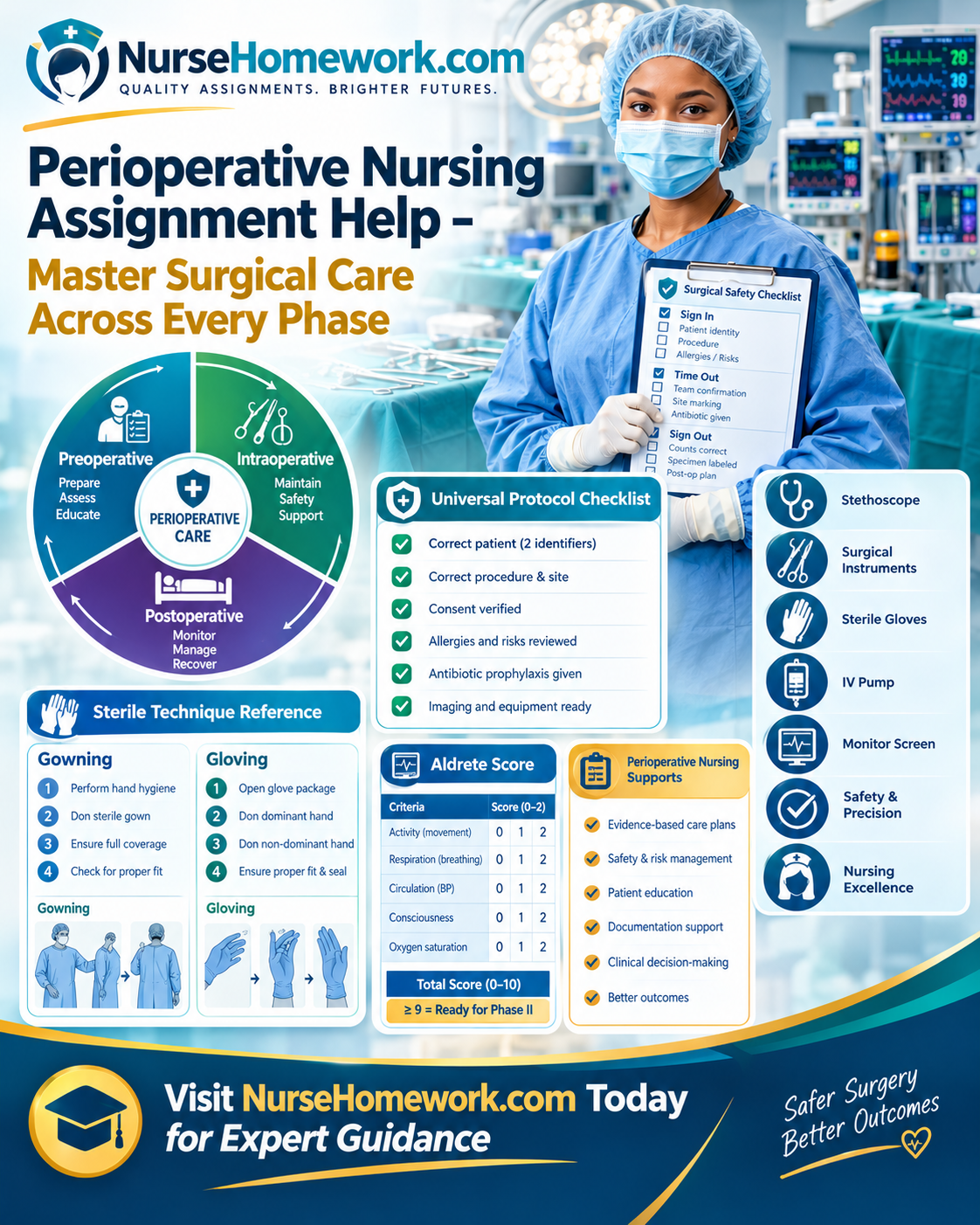
Perioperative nursing assignment help is one of the most valuable resources a nursing student can access, because perioperative nursing spans three distinct phases of surgical care, each with its own assessment priorities, safety standards, and documentation requirements. At NurseHomework.com, we understand that perioperative nursing assignment help must address preoperative preparation, intraoperative safety, and postoperative recovery as an integrated continuum rather than three separate topics. This comprehensive perioperative nursing assignment help guide covers surgical safety checklists, sterile technique, anesthesia considerations, PACU assessment, and common postoperative complications.
Why Perioperative Nursing Coursework Overwhelms Students
Before going further into perioperative nursing assignment help, it is essential to understand what makes this specialty difficult. Perioperative nursing requires mastery of content that students rarely encounter in other clinical rotations. The surgical environment operates under its own protocols, vocabulary, and safety systems, and students who arrive unprepared find the setting disorienting.
The second challenge is that perioperative patients move through multiple settings within a short timeframe. A patient scheduled for surgery progresses from preoperative holding, to the operating room, to the PACU, and finally to the surgical unit, and each transition requires different nursing priorities and documentation. Understanding perioperative nursing assignment help means learning to reason across these transitions rather than studying each phase in isolation.
The third challenge is safety precision. Surgical errors including wrong-site surgery, retained foreign objects, surgical site infections, and medication errors are considered never events, and the safety systems designed to prevent them appear throughout perioperative coursework. Assignments consistently test whether students understand these systems and can apply them under case study conditions.
The Three Phases of Perioperative Care
A complete perioperative nursing assignment help framework organizes care into three phases, and each requires distinct nursing responsibilities.
Preoperative Phase
The preoperative phase begins when surgery is scheduled and ends when the patient is transferred to the operating room. Nursing priorities include assessment, education, informed consent verification, and preparation.
Intraoperative Phase
The intraoperative phase begins when the patient enters the operating room and ends when the patient is transferred to the PACU. Nursing priorities include safety, sterility, positioning, and continuous monitoring.
Postoperative Phase
The postoperative phase begins in the PACU and continues through discharge and follow-up. Nursing priorities include airway management, hemodynamic monitoring, pain control, and complication recognition.
Preoperative Assessment Priorities
Preoperative assessment appears extensively in any perioperative nursing assignment help resource because it determines surgical readiness.
Comprehensive Health History
Assessment includes cardiovascular status, respiratory status, renal function, hepatic function, endocrine status including diabetes control, bleeding history, and previous surgical experiences. Each of these affects anesthetic risk and postoperative recovery.
Medication Review
Particular attention is required for anticoagulants, antiplatelets, insulin, oral hypoglycemics, and herbal supplements that affect bleeding or anesthesia. Patients are frequently instructed to hold specific medications before surgery, and understanding these instructions is a recurring assignment focus.
Allergy Assessment
Documenting allergies to medications, latex, adhesives, and anesthesia agents prevents adverse reactions. Latex allergy is particularly important in perioperative settings because surgical supplies frequently contain latex.
Laboratory and Diagnostic Review
Preoperative laboratory studies typically include complete blood count, coagulation studies, electrolytes, renal function, glucose, blood type and screen, and pregnancy testing where applicable. Understanding which values would delay surgery demonstrates clinical reasoning.
Airway Assessment
Difficult airway prediction uses tools such as the Mallampati classification, thyromental distance, and neck mobility assessment. Findings influence anesthesia planning and are important components of perioperative nursing assignment help content.
Baseline Vital Signs and Weight
Baseline vital signs and accurate weight are essential for medication dosing and postoperative comparison. Weight-based dosing requires precise measurement, and safe formatting conventions apply.
Informed Consent Verification
Informed consent is a legal and ethical requirement in perioperative care.
Elements of Valid Consent
Valid consent requires capacity, voluntariness, disclosure of information, and comprehension. The physician is responsible for obtaining consent, while the nurse verifies that consent was properly obtained and documented.
Nursing Responsibilities
Nurses verify that the patient understands the procedure, that the consent form is signed and witnessed, and that the patient has had the opportunity to ask questions. A patient who expresses confusion about the procedure requires the surgeon to be notified before proceeding.
Special Situations
Minors, patients without capacity, and emergency situations each follow distinct consent pathways. Understanding these variations is essential for perioperative nursing assignment help assignments addressing ethical or legal scenarios.
Preoperative Patient Education
Effective preoperative education reduces anxiety and improves postoperative outcomes.
Content Priorities
Education covers the surgical procedure in general terms, what to expect during recovery, pain management expectations, coughing and deep breathing exercises, incentive spirometry use, early ambulation importance, and incision care.
Timing
Education is most effective when delivered before the day of surgery, when the patient is not sedated and has time to process information. This timing principle is emphasized in any rigorous perioperative nursing assignment help guide.
Verification
Teach-back confirms understanding. Asking the patient to explain the plan in their own words reveals gaps that simple confirmation questions miss.
Family Involvement
Family members often need the same information, particularly for discharge planning and home care. Including family in education improves postoperative adherence.
Surgical Safety Systems
Safety systems are among the most heavily tested content in perioperative nursing assignment help.
The Universal Protocol
The Universal Protocol addresses wrong-site, wrong-procedure, and wrong-person surgery through three elements: pre-procedure verification, site marking, and time-out.
Pre-procedure verification confirms patient identity, procedure, and site using multiple sources. Site marking occurs with the patient involved and aware whenever possible. The time-out occurs immediately before the procedure with the full team present and all team members confirming agreement.
The Surgical Safety Checklist
The World Health Organization surgical safety checklist includes sign-in before anesthesia induction, time-out before incision, and sign-out before the patient leaves the operating room. Each phase requires specific verifications.
Retained Surgical Items Prevention
Preventing retained surgical items requires systematic counting of sponges, instruments, and sharps. Counts occur before the procedure, before wound closure, and at skin closure. Any discrepancy requires immediate action including radiographic imaging before the patient leaves the operating room. This content appears consistently in perioperative nursing assignment help case studies.
Surgical Site Infection Prevention
Prevention bundles include appropriate antibiotic prophylaxis within one hour before incision, chlorhexidine skin antisepsis, normothermia maintenance, glucose control, and supplemental oxygen where indicated.
Intraoperative Nursing Roles
The Circulating Nurse
The circulating nurse remains unsterile, manages the environment, documents care, obtains supplies, and coordinates the team. Responsibilities include positioning assistance, documentation of counts, medication administration, and communication with the family.
The Scrub Nurse
The scrub nurse or scrub technologist maintains the sterile field, passes instruments to the surgeon, and anticipates surgical needs. In many settings this role is filled by a surgical technologist rather than a nurse.
The Registered Nurse First Assistant
The RNFA performs advanced intraoperative responsibilities including tissue handling, suturing, and hemostasis under the direction of the surgeon.
The Anesthesia Provider
Certified registered nurse anesthetists are advanced practice nurses who administer anesthesia independently or in collaboration with anesthesiologists.
Sterile Technique Fundamentals
Sterile technique appears in every perioperative nursing assignment help resource because breaks in technique produce surgical site infections.
Establishing the Sterile Field
The sterile field is created using sterile drapes, and only sterile items may contact it. The field’s borders extend a defined distance from the edges, and any area beyond is considered contaminated.
Sterile Gowning and Gloving
Closed gloving technique maintains sterility during gowning. Open gloving applies when gowning is not required. Understanding the distinction prevents technique errors.
Maintaining Sterility
Sterile personnel must remain within the sterile field, avoid reaching over non-sterile areas, and maintain visualization of the field at all times. Sterile items touching non-sterile surfaces are considered contaminated.
Recognizing Breaks
Common breaks include reaching below waist level, turning away from the field, items touching the gown, and moisture strike-through. Any break requires correction before proceeding.
Positioning and Patient Safety
Positioning Principles
Positioning must maintain patient dignity, prevent pressure injury, allow surgical access, and prevent nerve compression. Common positions include supine, Trendelenburg, lateral, prone, lithotomy, and sitting.
Pressure Injury Prevention
Pressure-reducing surfaces, padding at bony prominences, and periodic reassessment prevent intraoperative pressure injuries. Surgical procedures lasting more than four hours increase risk substantially.
Nerve Protection
Brachial plexus injury from arm positioning, ulnar nerve compression, and peroneal nerve injury from leg positioning are all preventable with appropriate padding.
Thermoregulation
Maintaining normothermia prevents surgical site infection, coagulopathy, cardiac events, and prolonged recovery. Active warming measures include forced-air warming blankets, warmed fluids, and increased ambient temperature.
Anesthesia Considerations
General Anesthesia
General anesthesia produces unconsciousness, amnesia, analgesia, and muscle relaxation. Risks include aspiration, dental injury, malignant hyperthermia, and postoperative cognitive dysfunction.
Regional Anesthesia
Regional anesthesia includes spinal, epidural, and peripheral nerve blocks. Considerations include sensory and motor blockade, hypotension risk, headache risk with spinal anesthesia, and catheter management for epidurals.
Local Anesthesia
Local anesthesia infiltrates a specific area. Monitoring for allergic reactions including anaphylaxis is a nursing responsibility.
Monitored Anesthesia Care
Monitored anesthesia care combines sedation with local anesthesia and requires the same monitoring as general anesthesia.
Malignant Hyperthermia
Malignant hyperthermia is a life-threatening hypermetabolic reaction to certain anesthetic agents. Recognition includes rising end-tidal carbon dioxide, muscle rigidity, tachycardia, and hyperthermia. Treatment includes discontinuation of triggering agents and administration of dantrolene. This emergency appears frequently in perioperative nursing assignment help case studies.
PACU Assessment and Care
Post-anesthesia care unit content is central to perioperative nursing assignment help.
Initial Assessment Priorities
The PACU nurse’s first priorities are airway patency, breathing effectiveness, and circulation. Assessment includes respiratory rate and depth, oxygen saturation, breath sounds, heart rate and rhythm, blood pressure, and level of consciousness.
The Aldrete Score
The Aldrete scoring system evaluates activity, respiration, circulation, consciousness, and oxygen saturation. A score of 9 or 10 typically indicates readiness for transfer to the surgical unit.
Airway Management
Positioning, suctioning, and oxygen delivery maintain airway patency. Recognizing obstruction from the tongue, secretions, or laryngospasm is critical.
Hemodynamic Monitoring
Blood pressure monitoring includes frequency defined by policy and clinical status. Hypotension may indicate hemorrhage, anesthetic effect, or fluid deficit. Hypertension may indicate pain, bladder distension, or inadequate analgesia.
Pain Assessment
Pain assessment uses validated scales and considers the patient’s sedation level. Multimodal analgesia combines opioids, non-opioid analgesics, and regional techniques.
Nausea and Vomiting
Postoperative nausea and vomiting affects a substantial proportion of surgical patients. Interventions include antiemetic administration, hydration, and minimizing triggers.
Temperature Management
Hypothermia is common after surgery. Active warming continues in the PACU until normothermia is achieved.
Fluid and Electrolyte Monitoring
Intake and output monitoring, urine output assessment, and electrolyte review guide fluid management.
Common Postoperative Complications
Recognizing complications is essential content in any perioperative nursing assignment help guide.
Hemorrhage
Presents with hypotension, tachycardia, decreasing hemoglobin, restlessness, and wound drainage. Requires immediate escalation.
Atelectasis
Presents with decreased breath sounds, low-grade fever, and hypoxemia. Prevention includes coughing, deep breathing, incentive spirometry, and early ambulation.
Deep Vein Thrombosis
Presents with unilateral calf pain, swelling, and warmth. Prevention includes sequential compression devices, early mobility, and anticoagulation where indicated. Never massage a suspected clot.
Pulmonary Embolism
Presents with sudden dyspnea, chest pain, tachycardia, and hypoxemia. Requires immediate escalation and anticoagulation.
Surgical Site Infection
Presents with fever, wound redness, warmth, purulent drainage, and increased pain. Typically appears three to seven days postoperatively.
Paralytic Ileus
Presents with absent bowel sounds, abdominal distension, nausea, and absence of flatus. Management includes nasogastric decompression, ambulation, and fluid management.
Urinary Retention
Presents with bladder distension, restlessness, and absence of output. Interventions include bladder scanning and catheterization if indicated.
Wound Dehiscence and Evisceration
Presents with wound separation, increased drainage, and in evisceration, protrusion of abdominal contents. Management includes positioning, covering the wound with sterile moist dressings, and immediate surgical notification.
Enhanced Recovery After Surgery Protocols
ERAS protocols have transformed perioperative care by standardizing evidence-based interventions across all phases.
Preoperative Elements
Carbohydrate loading, avoiding prolonged fasting, and avoiding routine bowel preparation where not indicated.
Intraoperative Elements
Short-acting anesthetics, regional anesthesia where appropriate, minimal invasive techniques, and normothermia maintenance.
Postoperative Elements
Multimodal analgesia with opioid-sparing strategies, early oral intake, early ambulation, and removal of drains and catheters as soon as possible.
Understanding ERAS principles demonstrates current knowledge and strengthens any perioperative nursing assignment help submission.
Documentation Standards
Preoperative Documentation
Includes assessment findings, consent verification, allergy review, medication reconciliation, education provided, and any communication with the surgical team.
Intraoperative Documentation
Includes time-out verification, positioning, skin preparation, counts, implants used, medication administration, and patient response.
Postoperative Documentation
Includes PACU admission assessment, Aldrete score, vital signs, pain assessment, interventions provided, and readiness for transfer.
Safe Medication Conventions
All documentation must reflect safe formatting including leading zeros, no trailing zeros, standard unit abbreviations, and avoidance of dangerous abbreviations. These conventions appear consistently in perioperative nursing assignment help evaluations.
Common Mistakes in Perioperative Assignments
Treating phases as isolated. Perioperative care is a continuum requiring integrated reasoning.
Neglecting safety systems. The Universal Protocol and surgical safety checklist appear frequently in assignments.
Using generic goals. SMART goals must be specific to the patient and procedure.
Ignoring ERAS principles. Contemporary perioperative care emphasizes opioid-sparing and early recovery strategies.
Missing safe formatting conventions. Leading zeros, trailing zeros, and unit abbreviations are consistently assessed.
Inadequate complication recognition. Postoperative deterioration requires prompt identification.
Forgetting documentation requirements. Each phase has distinct documentation standards.
Breaching confidentiality. Clinical examples require de-identification.
Underestimating psychological care. Surgical anxiety affects recovery and requires nursing attention.
Weak evaluation sections. Evaluation must specify whether goals were met and what revisions followed.
How NurseHomework.com Supports Perioperative Assignments
At NurseHomework.com, we provide comprehensive perioperative nursing assignment help for nursing students at all levels. Our services include:
Preoperative assessment frameworks covering history, medications, labs, and airway evaluation
Informed consent verification and ethical consideration review
Surgical safety checklist and Universal Protocol application
Intraoperative role clarification for circulator, scrub, and RNFA responsibilities
Sterile technique fundamentals and break recognition
Positioning and pressure injury prevention guidance
Anesthesia type considerations and malignant hyperthermia recognition
PACU assessment using Aldrete scoring
Postoperative complication recognition and management
ERAS protocol integration
Dosage calculation verification and safe formatting convention review
NANDA-I diagnosis selection and SMART goal development
APA 7th edition citation and reference verification
Whether you are preparing for a perioperative examination, completing a case study, or developing a postoperative care plan, NurseHomework.com is here to support your success.
Frequently Asked Questions About Perioperative Nursing Assignment Help
What is perioperative nursing assignment help?
It is academic support for coursework covering the preoperative, intraoperative, and postoperative phases of surgical care, including safety systems, sterile technique, anesthesia considerations, and complication recognition.
What are the three phases of perioperative care?
Preoperative, intraoperative, and postoperative. Each phase requires distinct assessment priorities, safety standards, and documentation.
What is the Universal Protocol?
A safety system addressing wrong-site, wrong-procedure, and wrong-person surgery through pre-procedure verification, site marking, and time-out.
What is the time-out?
A pause immediately before the procedure during which the full team confirms patient identity, procedure, site, and other critical details.
How do I recognize malignant hyperthermia?
Rising end-tidal carbon dioxide, muscle rigidity, tachycardia, and hyperthermia. Treatment includes discontinuation of triggering agents and administration of dantrolene.
What is the Aldrete score?
A scoring system evaluating activity, respiration, circulation, consciousness, and oxygen saturation to determine readiness for transfer from the PACU. Scores of 9 or 10 typically indicate readiness.
Can NurseHomework.com help with perioperative nursing assignment help?
Yes. NurseHomework.com offers preoperative assessment frameworks, safety system application, PACU assessment guidance, and documentation support for perioperative nursing assignment help.
What are safe medication formatting conventions?
Always use a leading zero such as 0.5 mg, never use a trailing zero such as 5.0 mg, use standard unit abbreviations such as mg and mL, and never use the letter U for units.
What are the most common postoperative complications?
Hemorrhage, atelectasis, deep vein thrombosis, pulmonary embolism, surgical site infection, paralytic ileus, urinary retention, and wound dehiscence.
How often should perioperative documentation be updated?
Documentation occurs continuously throughout each phase, with PACU assessment documented at admission, at defined intervals, and at transfer.
Mastering perioperative nursing assignment help is ultimately about integrating safety, sterility, and precision across three phases of surgical care. By understanding preoperative assessment priorities, verifying informed consent appropriately, applying the Universal Protocol and surgical safety checklist, maintaining sterile technique, protecting patients during positioning, recognizing anesthesia complications, conducting thorough PACU assessments, identifying postoperative deterioration early, and documenting with precision, you develop the surgical care competence that patients and surgical teams depend upon.
At NurseHomework.com, we are committed to helping nursing students master surgical care. Our assessment frameworks, safety system application, and documentation support make perioperative nursing assignment help structured, rigorous, and achievable. Don’t let the complexity of surgical care overwhelm your preparation. Visit NurseHomework.com today and discover how we can help you master perioperative nursing assignment help and excel in your nursing program.
- Perioperative nursing assignment help
- Perioperative nursing assignment help
- Perioperative nursing assignment help
- Perioperative nursing assignment help
- Perioperative nursing assignment help
Needs help with Nursing Assignment?
We are available 24x7 to deliver the best services and assignment ready within 3-4 hours? Order a custom-written, plagiarism-free paper
 Get Answer Over WhatsApp
 Order Paper Now
