Academic Coaching or Mentoring: Powerful 2026 Guide to Student Success, Career Growth & Better Grades
/in Nursing /by BrianTable of Contents
ToggleAcademic Coaching or Mentoring
Academic coaching or mentoring has become one of the most effective ways for students to improve academic performance, develop better study habits, and complete demanding university programs successfully. Whether you are pursuing nursing, medicine, business, engineering, education, or another degree, structured guidance can help you overcome academic challenges while building confidence and independence.
Recent research shows that effective academic coaching is more than occasional advice. Structured coaching programs that provide regular sessions over several weeks are associated with improvements in academic performance, motivation, goal setting, time management, and student well-being. Reviews of higher education coaching also suggest that professional coaching works best when sessions are consistent, personalized, and focused on helping students develop their own strategies rather than simply providing answers.
Many websites discussing Academic coaching or mentoring make broad claims such as “students achieve amazing results” without explaining why outcomes differ. In reality, success depends on the student’s commitment, the quality of coaching, realistic goal setting, and consistent follow-through. Coaching is not a shortcut that guarantees top grades. Instead, it provides structured support that helps students improve their learning process.
For example, imagine a Kenyan nursing student balancing coursework, clinical placements, family responsibilities, and part-time employment. Without proper planning, deadlines can quickly become overwhelming. Through Academic coaching or mentoring, the student can develop a weekly study schedule, prioritize assignments, improve research techniques, and build confidence before examinations. These practical improvements often reduce stress while improving academic performance.
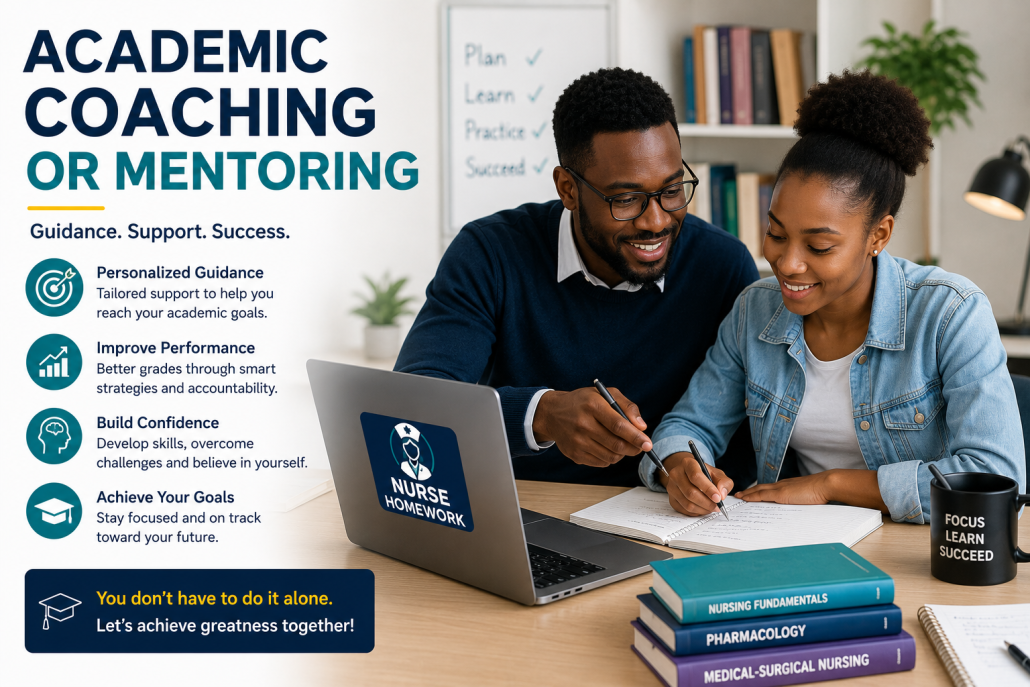
Academic coaching or mentoring
At NurseHomework.com, we support nursing and healthcare students by providing academic guidance, research assistance, assignment support, study resources, and professional educational services designed to help learners succeed throughout their academic journey.
Start your academic success journey today by visiting https://nursehomework.com/
.
Why Academic Coaching or Mentoring Is Becoming More Important
The demands placed on university students continue increasing every year. Modern learners must balance lectures, assignments, clinical practice, research projects, online learning, examinations, internships, and personal responsibilities simultaneously.
This changing educational environment has made Academic coaching or mentoring increasingly valuable.
Unlike traditional tutoring, coaching focuses on helping students become independent learners. Instead of simply teaching subject content, coaches help students improve time management, organization, goal setting, study techniques, motivation, resilience, and academic decision-making.
Mentoring adds another important dimension by allowing students to learn from experienced professionals who have successfully completed similar academic journeys. Mentors provide practical guidance, encouragement, career insights, and emotional support during challenging periods.
Studies have linked academic coaching with improved student retention, stronger goal achievement, higher motivation, better self-efficacy, and enhanced well-being, particularly when coaching is structured, personalized, and delivered consistently over several weeks.
For nursing students, these benefits are especially important because healthcare education combines theoretical learning with demanding clinical practice, making effective study strategies essential.
Academic Coaching or Mentoring vs Traditional Tutoring
Many students mistakenly believe that Academic coaching or mentoring is identical to tutoring.
Although both support learning, they serve different purposes.
Tutoring primarily focuses on explaining academic content. A tutor may help a student understand anatomy, pharmacology, statistics, or research methodology by reviewing specific course material.
Academic coaching, however, focuses on improving the student’s learning process. Coaches help learners develop better habits, organize workloads, overcome procrastination, prepare for examinations, strengthen critical thinking, and maintain long-term academic progress.
Mentoring extends beyond academics by providing guidance based on personal experience. A mentor can help students understand career pathways, professional expectations, leadership development, networking opportunities, and workplace preparation.
Combining these approaches often produces the strongest results because students improve both academic knowledge and personal development.
Benefits of Academic Coaching or Mentoring
The advantages of Academic coaching or mentoring extend well beyond improving grades.
Students frequently develop stronger confidence because they begin understanding how to manage demanding workloads more effectively.
Better time management reduces last-minute assignment submissions and examination anxiety.
Improved organization allows students to balance coursework with employment, family responsibilities, internships, and extracurricular activities.
Coaching also encourages reflective thinking. Instead of relying on memorization alone, students learn how to analyze problems, evaluate evidence, and make informed academic decisions.
Many learners also improve communication skills through regular discussions with coaches and mentors.
These skills remain valuable long after graduation because employers increasingly seek graduates who demonstrate critical thinking, adaptability, professionalism, and effective communication.
Why Nursing Students Benefit Significantly
Healthcare education presents unique academic challenges.
Nursing students must master theoretical knowledge while simultaneously developing practical clinical competence.
Assignments often involve evidence-based practice, patient care planning, research appraisal, reflective writing, case studies, and professional ethics.
Clinical placements introduce additional responsibilities, requiring students to balance patient care with ongoing academic work.
This makes Academic coaching or mentoring particularly valuable for nursing students.
A structured coaching relationship helps students prioritize competing responsibilities, strengthen academic writing, improve research skills, and prepare confidently for examinations.
Professional mentors who understand healthcare education can also provide valuable career advice regarding specialization options, postgraduate education, licensing preparation, and workplace expectations.
For many nursing students, coaching becomes an important source of accountability and encouragement during demanding academic periods.
Common Challenges That Academic Coaching or Mentoring Helps Students Overcome
University life is rewarding, but it also presents numerous obstacles that can affect academic performance and mental well-being. Many students begin their programs with enthusiasm only to discover that managing multiple assignments, examinations, practical sessions, and personal responsibilities is more difficult than expected. This is where Academic coaching or mentoring becomes valuable because it provides structured guidance that helps students address challenges before they become overwhelming.
One of the most common issues is poor time management. Students often underestimate how long research, reading, assignment writing, and exam preparation require. As deadlines accumulate, stress levels rise and the quality of submitted work may decline. Through Academic coaching or mentoring, students learn how to create realistic study schedules, prioritize important tasks, and break large projects into manageable milestones.
Procrastination is another challenge affecting learners worldwide. Delaying coursework until the final days before submission usually results in rushed assignments and unnecessary anxiety. Academic coaches help students identify the reasons behind procrastination and develop practical strategies that encourage consistent progress throughout the semester.
Another significant challenge is adapting to university-level expectations. Many first-year students discover that higher education requires independent learning, critical thinking, and evidence-based research rather than simply memorizing classroom notes. Mentors who have successfully completed similar programs can explain these expectations while sharing practical advice that helps students transition more confidently.
Essential Skills Developed Through Academic Coaching or Mentoring
The greatest benefit of Academic coaching or mentoring is that it equips students with skills that remain valuable long after graduation. Rather than focusing only on one assignment or examination, coaching encourages lifelong learning habits.
Effective goal setting is one of the first skills students develop. Instead of setting vague objectives such as “I want better grades,” coaches encourage learners to establish measurable academic goals with realistic timelines. Clear goals help students remain motivated while making it easier to monitor progress throughout the semester.
Critical thinking also improves through regular coaching conversations. Students learn how to evaluate research evidence, compare different viewpoints, identify credible academic sources, and present balanced arguments in assignments. These skills are particularly important for nursing and healthcare students because evidence-based practice is a core professional requirement.
Communication skills improve as students become more comfortable discussing academic concerns, presenting ideas, and asking meaningful questions. Strong communication supports success in presentations, group projects, clinical placements, and future professional environments.
Academic resilience is another important outcome. University education inevitably includes setbacks such as disappointing grades, difficult modules, or challenging clinical experiences. Coaching helps students respond constructively rather than becoming discouraged, allowing them to continue progressing toward graduation.
Academic Coaching or Mentoring for Nursing Students
Nursing education is widely recognized as one of the most demanding academic pathways because students must combine classroom learning with practical clinical experience. Coursework often includes anatomy, physiology, pharmacology, pathophysiology, research methods, ethics, community health, leadership, and evidence-based nursing practice.
Because of these demands, Academic coaching or mentoring provides nursing students with structured support that extends beyond subject knowledge. Coaches help learners organize clinical schedules, prepare reflective journals, improve care plans, strengthen literature reviews, and manage competing academic deadlines.
Mentors with healthcare experience also provide valuable insight into professional expectations after graduation. They can explain workplace culture, registration requirements, career specialization opportunities, continuing education options, and strategies for succeeding during internships or graduate transition programs.
Students preparing dissertations or capstone projects benefit particularly from coaching because research planning often requires consistent guidance over several months. Coaches help learners maintain momentum while ensuring projects remain organized and academically sound.
At NurseHomework.com, our experienced academic professionals support nursing students with assignment guidance, research support, editing, proofreading, evidence-based writing assistance, and personalized academic coaching designed to strengthen independent learning rather than encourage dependency.
Learn more at https://nursehomework.com/.
How Technology Has Improved Academic Coaching or Mentoring
Technology has transformed Academic coaching or mentoring, making personalized support accessible to students regardless of their location.
Virtual meetings allow students to connect with coaches through secure video conferencing platforms without travelling long distances. This flexibility is particularly valuable for working professionals, international students, distance learners, and nursing students completing clinical placements.
Cloud-based collaboration tools allow coaches to review assignment drafts, monitor progress, share study plans, and provide feedback efficiently. Students can organize notes, maintain research libraries, and track learning objectives using digital productivity platforms.
Artificial intelligence has also become an important educational resource. AI-powered tools assist with brainstorming, grammar checking, research organization, citation management, and study planning. However, students should always use AI responsibly while ensuring submitted work reflects their own understanding and complies with university academic integrity policies.
Digital libraries have expanded access to scholarly resources. Students receiving Academic coaching or mentoring are encouraged to use peer-reviewed journals, university databases, and credible healthcare publications when completing assignments. Learning how to identify reliable academic evidence remains one of the most valuable skills developed during coaching.
Choosing the Right Academic Coach or Mentor
Not every coach or mentor offers the same level of expertise. Students should carefully evaluate qualifications, professional experience, communication style, and subject knowledge before selecting academic support.
An effective coach listens carefully, encourages independent thinking, provides constructive feedback, and helps students develop practical study strategies rather than simply supplying answers. Ethical coaching promotes learning while respecting university academic integrity requirements.
Students should also consider whether the coach has experience within their discipline. Nursing, medicine, engineering, law, education, and business programs each present unique academic expectations that benefit from specialized guidance.
Consistency is equally important. Regular coaching sessions often produce better outcomes than occasional meetings because continuous support allows students to build sustainable academic habits throughout the semester.
Measuring the Success of Academic Coaching or Mentoring
Many students ask whether Academic coaching or mentoring actually works. The answer depends on how success is measured. Coaching should not be evaluated solely by whether a student’s grades improve after one assignment or examination. Instead, long-term progress provides a more accurate picture of its effectiveness.
Students who actively participate in Academic coaching or mentoring often notice improvements in several areas simultaneously. They become more organized, complete assignments earlier, prepare more effectively for examinations, communicate better with lecturers, and develop stronger confidence when handling difficult coursework.
Academic success also includes increased class participation, improved research skills, stronger academic writing, and better critical thinking. These improvements may not appear immediately but become increasingly noticeable over an entire semester or academic year.
Another important measure is student retention. Many universities have found that students who receive structured academic support are more likely to continue their studies rather than withdraw because of academic difficulties. Consistent guidance helps learners remain focused even when coursework becomes challenging.
For postgraduate students, success may involve completing research proposals on schedule, improving literature reviews, strengthening methodology chapters, and managing large independent research projects more effectively. These achievements contribute to smoother degree completion while reducing unnecessary stress.
Common Misconceptions About Academic Coaching or Mentoring
Despite its growing popularity, several misconceptions still surround Academic coaching or mentoring.
One misconception is that coaching is only for struggling students. In reality, many high-performing students work with academic coaches because they want to maximize their potential, prepare for postgraduate education, improve leadership skills, or strengthen professional development.
Another misconception is that coaching replaces independent study. Effective Academic coaching or mentoring does not complete assignments on behalf of students. Instead, it teaches strategies that help learners become more independent, organized, and academically confident.
Some students also believe mentoring guarantees excellent grades. While coaching significantly improves learning strategies, academic success ultimately depends on personal effort, attendance, consistent revision, and active engagement with course materials.
There is also a belief that coaching only benefits undergraduate students. In practice, postgraduate students, doctoral researchers, healthcare professionals, and lifelong learners also benefit from structured guidance throughout their educational journeys.
Understanding these realities allows students to approach coaching with realistic expectations while maximizing its long-term benefits.
How NurseHomework.com Supports Academic Coaching or Mentoring
At NurseHomework.com, we understand that every student’s academic journey is unique. Nursing and healthcare education demands commitment, critical thinking, evidence-based practice, and excellent academic writing skills. Our goal is to provide professional support that helps students build these competencies while maintaining academic integrity.
Our experienced academic team assists students with assignment guidance, evidence-based research, literature reviews, nursing care plans, reflective writing, case study support, editing, proofreading, citation guidance, dissertation assistance, and personalized Academic coaching or mentoring.
Rather than offering one-size-fits-all solutions, we work with students to identify their individual academic challenges and recommend practical strategies for continuous improvement. Whether you are preparing for examinations, writing your first research paper, or completing a final-year dissertation, our support is designed to strengthen your learning process.
Students can also access professional academic resources covering research methods, APA formatting, evidence appraisal, healthcare writing, and academic success strategies through our website.
Begin your academic journey today by visiting https://nursehomework.com/
and discover how our educational services can help you achieve your academic goals.
External Resources That Complement Academic Coaching or Mentoring
Students benefit most from Academic coaching or mentoring when they combine personalized guidance with credible academic resources. Reputable organizations publish valuable materials that strengthen research skills, evidence-based practice, academic writing, and professional development.
Healthcare students should regularly consult the World Health Organization (WHO) for current health information and global healthcare guidelines. Nursing students can also improve evidence-based practice by exploring resources from the International Council of Nurses (ICN).
Students conducting academic research should use databases such as PubMed, Google Scholar, and the Cochrane Library to locate peer-reviewed research articles rather than relying solely on general internet searches.
Universities also encourage students to become familiar with academic integrity guidelines published by organizations such as the Committee on Publication Ethics (COPE). Understanding proper citation practices helps students avoid plagiarism while strengthening the credibility of their academic work.
Combining professional coaching with high-quality academic resources creates a stronger foundation for long-term educational success.
Academic Coaching or Mentoring for Online and Distance Learning Students
The rapid growth of online education has made Academic coaching or mentoring more important than ever. Many students now complete diploma, undergraduate, postgraduate, and professional certification programs remotely while balancing employment, family responsibilities, and other commitments. Although online learning offers flexibility, it also requires a high level of self-discipline, organization, and motivation.
Students studying remotely often face unique challenges such as isolation, limited interaction with lecturers, difficulty maintaining study routines, and managing competing priorities. Academic coaching or mentoring helps bridge these gaps by providing accountability, regular feedback, and personalized guidance throughout the learning journey.
A coach can help students establish realistic weekly study goals, monitor assignment deadlines, prepare for online examinations, and develop effective revision strategies. Mentors can also share practical advice based on their own academic experiences, helping learners avoid common mistakes while building confidence in their abilities.
For nursing students completing online theory modules alongside hospital placements, structured coaching provides an effective way to balance clinical responsibilities with academic expectations.
Academic Coaching or Mentoring and Academic Integrity
One of the most important aspects of Academic coaching or mentoring is maintaining academic honesty. Professional coaching should always support learning rather than encourage academic misconduct.
Ethical coaches help students understand assignment requirements, strengthen research skills, improve critical thinking, organize ideas, and develop better writing techniques. They guide students through the learning process instead of completing assessed work on the student’s behalf.
Academic integrity remains a fundamental principle in universities worldwide. Students should properly acknowledge all academic sources, avoid plagiarism, follow institutional citation guidelines, and submit original work that reflects their own understanding.
Professional coaching encourages independent learning while helping students develop confidence in their own academic abilities. This approach prepares learners not only for graduation but also for future professional practice where ethical decision-making remains essential.
At NurseHomework.com, we emphasize responsible academic support that strengthens learning while respecting university academic integrity policies.
Long-Term Career Benefits of Academic Coaching or Mentoring
The value of Academic coaching or mentoring extends well beyond university graduation. Many of the skills developed during coaching continue benefiting graduates throughout their professional careers.
Students who master effective communication, critical thinking, time management, leadership, organization, and problem-solving become more competitive in today’s job market. Employers increasingly seek graduates who can work independently, collaborate effectively, adapt to change, and make evidence-based decisions.
Healthcare professionals, in particular, benefit from lifelong learning because nursing practice continuously evolves through new research, clinical guidelines, and healthcare technologies. The learning habits developed through Academic coaching or mentoring help graduates remain committed to continuous professional development.
Many former students also become mentors themselves. Sharing knowledge with junior colleagues strengthens leadership skills while contributing positively to professional communities.
Whether pursuing advanced nursing practice, healthcare administration, research, education, or clinical specialization, coaching provides a strong foundation for long-term career growth.
Why Choose NurseHomework.com?
Choosing the right academic support partner can make a significant difference throughout your educational journey. At NurseHomework.com, we understand the unique challenges faced by nursing and healthcare students at diploma, undergraduate, master’s, and doctoral levels.
Our experienced academic professionals provide personalized support in nursing assignments, healthcare research, evidence-based practice, dissertations, literature reviews, reflective writing, case studies, editing, proofreading, referencing, and Academic coaching or mentoring.
We focus on helping students strengthen their academic skills while maintaining high standards of professionalism and academic integrity. Every learner receives guidance tailored to individual learning needs rather than generic solutions.
Beyond coaching, our educational resources help students improve academic writing, research quality, referencing accuracy, examination preparation, and critical thinking skills.
If you are looking for reliable academic support that promotes long-term success, begin your journey today by visiting:
Our team is ready to help you achieve your educational goals with confidence and professionalism.
Practical Tips for Getting the Most from Academic Coaching or Mentoring
Students who benefit the most from Academic coaching or mentoring usually approach the process with a willingness to learn, accept constructive feedback, and consistently apply the strategies discussed during coaching sessions. Coaching works best when students actively participate instead of expecting immediate solutions to every academic challenge.
One practical tip is to prepare before every coaching session. Keeping a list of assignments, upcoming examinations, research questions, and areas of difficulty allows the coach to provide more focused guidance. This preparation also makes each session more productive because time is spent addressing real academic needs rather than identifying problems.
Students should also develop the habit of setting achievable weekly goals. Instead of attempting to complete every assignment at once, breaking work into smaller milestones improves consistency while reducing stress. Coaches often encourage students to review progress regularly and adjust study plans when necessary.
Reflection is another valuable habit developed through Academic coaching or mentoring. After completing an assignment or examination, students should evaluate what worked well and what could be improved. Continuous reflection strengthens learning while helping students become increasingly independent.
Maintaining open communication is equally important. Honest discussions about academic struggles, workload, or personal challenges allow coaches to recommend practical solutions that fit each student’s circumstances.
Academic Coaching or Mentoring for Postgraduate and Research Students
Postgraduate education introduces a different level of academic complexity. Master’s and doctoral students spend significant time conducting independent research, reviewing scholarly literature, developing research methodologies, analyzing data, and writing lengthy dissertations or theses. These responsibilities make Academic coaching or mentoring particularly valuable.
Research projects often span several months or even years. Without structured planning, students may struggle with delayed milestones, inconsistent writing progress, or uncertainty about research direction. Academic coaches help learners establish realistic timelines, organize research activities, and remain accountable throughout the project.
Mentors who have completed postgraduate research can also provide valuable advice regarding publication strategies, conference presentations, supervisor communication, and academic career development. Their practical experience helps students avoid common mistakes while maintaining steady progress toward graduation.
For nursing researchers, coaching can strengthen evidence appraisal, improve systematic literature reviews, support qualitative and quantitative research planning, and encourage adherence to ethical research standards. These competencies remain valuable long after completing postgraduate studies.
The Future of Academic Coaching or Mentoring
Higher education continues evolving rapidly through technological innovation, flexible learning models, and increasing global collaboration. As these changes continue, Academic coaching or mentoring is expected to become an even more important component of student success.
Artificial intelligence is already supporting personalized learning by helping students organize study schedules, summarize academic material, and identify knowledge gaps. However, AI cannot replace the human encouragement, accountability, professional judgment, and personal experience that effective coaches and mentors provide.
Universities are also placing greater emphasis on student well-being, career readiness, leadership development, and employability. Academic coaching complements these priorities by helping students build transferable skills that remain valuable throughout their professional lives.
Healthcare education will continue requiring graduates who can think critically, communicate effectively, adapt to changing clinical environments, and engage in lifelong learning. These qualities are strengthened through structured Academic coaching or mentoring that focuses on both academic achievement and personal development.
As educational demands become increasingly complex, students who invest in developing effective learning strategies will be better positioned for long-term academic and professional success.
Final Thoughts on Academic Coaching or Mentoring
The importance of Academic coaching or mentoring continues to grow as universities place greater emphasis on independent learning, critical thinking, evidence-based research, and career readiness. Students today face increasing academic expectations, tighter deadlines, and more complex coursework than ever before. Having structured guidance allows learners to navigate these challenges confidently while developing skills that remain valuable throughout their professional lives.
Rather than viewing coaching as a service only for struggling students, it should be seen as an investment in long-term academic and career success. High-performing students, postgraduate researchers, nursing students, and working professionals all benefit from personalized guidance that improves organization, productivity, communication, and decision-making.
The most successful students understand that academic excellence is rarely achieved through intelligence alone. Consistency, planning, resilience, effective study habits, and access to reliable support all contribute significantly to positive outcomes. Academic coaching or mentoring helps students build these habits while encouraging continuous improvement throughout their educational journey.
Whether your goal is passing a challenging nursing course, completing a dissertation, improving research skills, preparing for professional licensing examinations, or simply becoming a more confident learner, structured coaching provides a practical pathway toward achieving those objectives.
At NurseHomework.com, we are committed to supporting students through ethical academic assistance, professional guidance, personalized learning strategies, research support, assignment assistance, editing, proofreading, and comprehensive Academic coaching or mentoring designed to strengthen independent learning.
Start your journey today by visiting https://nursehomework.com/
and discover how professional academic support can help you reach your educational goals.
Is Academic Coaching or Mentoring Worth It?
For most university and college students, Academic coaching or mentoring is a worthwhile investment because it develops skills that extend beyond earning higher grades. Students improve time management, critical thinking, communication, research abilities, organization, and confidence while becoming more independent learners.
The greatest value lies in developing lifelong learning habits that remain useful throughout professional careers. Nurses, healthcare professionals, educators, engineers, business managers, and researchers all benefit from the ability to organize work, solve problems, communicate effectively, and adapt to changing environments.
Students who actively participate in coaching, apply feedback consistently, and maintain academic integrity are generally better positioned to complete their programs successfully while preparing for future career opportunities.
Frequently Asked Questions
1. What is Academic coaching or mentoring?
Academic coaching or mentoring is a structured process that helps students improve study habits, time management, research skills, academic writing, confidence, and long-term learning strategies while supporting independent academic success.
2. Is Academic coaching or mentoring only for struggling students?
No. Many high-achieving students use Academic coaching or mentoring to strengthen leadership skills, prepare for postgraduate studies, improve research quality, and maximize academic performance.
3. Can nursing students benefit from Academic coaching or mentoring?
Yes. Nursing students often balance demanding coursework, clinical placements, research projects, and examinations. Coaching helps improve organization, evidence-based practice, academic writing, and examination preparation.
4. Does Academic coaching or mentoring replace tutoring?
No. Tutoring primarily focuses on explaining course content, while Academic coaching or mentoring develops independent learning skills, goal setting, productivity, motivation, and long-term academic success.
5. Why choose NurseHomework.com?
NurseHomework.com provides ethical academic support, assignment guidance, research assistance, editing, proofreading, dissertation support, and personalized Academic coaching or mentoring tailored to nursing and healthcare students worldwide.
Recommended Internal DoFollow Links
- https://nursehomework.com/
- https://nursehomework.com/nursing-homework-help/
- https://nursehomework.com/nursing-assignment-help/
- https://nursehomework.com/dissertation-writing-services/
- https://nursehomework.com/research-paper-writing/
- https://nursehomework.com/essay-writing-services/
- https://nursehomework.com/blog/
- https://nursehomework.com/contact/
Recommended External DoFollow Links
- World Health Organization (WHO): https://www.who.int/
- International Council of Nurses (ICN): https://www.icn.ch/
- PubMed: https://pubmed.ncbi.nlm.nih.gov/
- Google Scholar: https://scholar.google.com/
- Cochrane Library: https://www.cochranelibrary.com/
- American Psychological Association (APA Style): https://apastyle.apa.org/
- Committee on Publication Ethics (COPE): https://publicationethics.org/
- National Library of Medicine: https://www.nlm.nih.gov/
Needs help with Nursing Assignment?
We are available 24x7 to deliver the best services and assignment ready within 3-4 hours? Order a custom-written, plagiarism-free paper
 Get Answer Over WhatsApp
 Order Paper Now

