Best Study Resources for Nursing Students
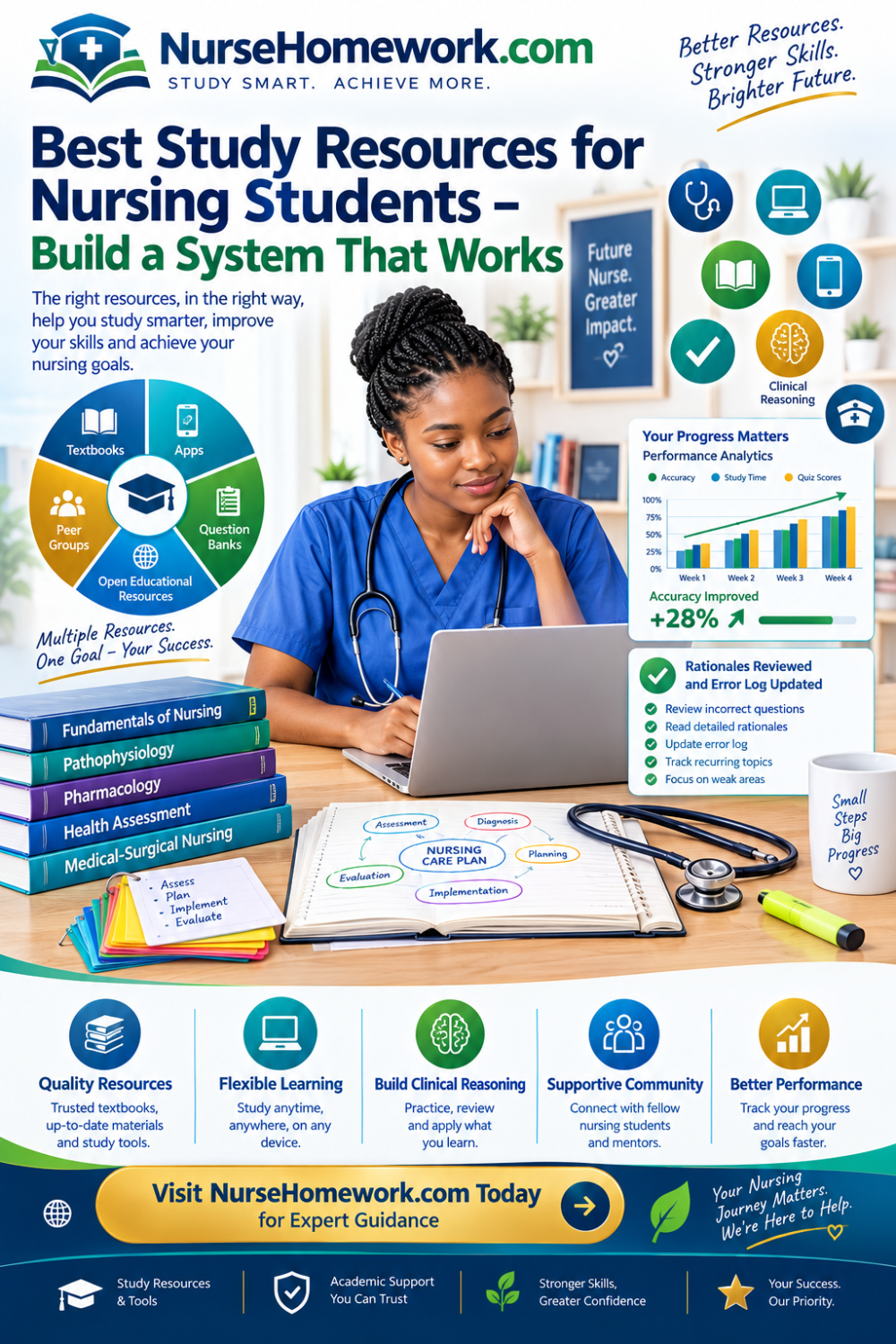
Best study resources for nursing students are not simply the most popular ones, but the ones that match how nursing is actually assessed—through clinical judgment, prioritization, and application rather than memorization. At NurseHomework.com, we understand that the best study resources for nursing students are those that build reasoning skills while reinforcing content mastery. This comprehensive guide explores the best study resources for nursing students across textbooks, digital platforms, question banks, open educational resources, and institutional support, with practical guidance on how to combine them effectively.
Why the Right Resources Matter More in Nursing Than in Most Disciplines
Nursing examinations test application, not recall. A question rarely asks what a medication does. It asks which client should be assessed first, which finding requires immediate intervention, or which statement indicates a need for further teaching. This means that resources designed for passive review produce disappointing results, while resources that force active retrieval and clinical reasoning produce measurable gains.
The best study resources for nursing students therefore share three characteristics: they organize content by concept rather than by chapter, they include rationales that explain why answers are correct and why distractors fail, and they provide practice under timed conditions that mirror actual examinations. Resources lacking these features may feel productive but rarely translate into improved performance.
Textbooks and Reference Guides
Core Nursing Textbooks
The foundational textbooks in nursing programs remain among the best study resources for nursing students because they align with course content and provide the depth required for care planning and clinical reasoning.
Medical-surgical nursing textbooks such as Brunner & Suddarth’s Textbook of Medical-Surgical Nursing provide comprehensive coverage of adult health content, which constitutes the largest portion of the NCLEX test plan. These texts include pathophysiology, assessment, interventions, and evaluation in a consistent structure that supports concept mapping.
Fundamentals of nursing textbooks such as Potter & Perry’s Fundamentals of Nursing establish the foundational skills, safety principles, and nursing process framework that every subsequent course builds upon.
Pharmacology textbooks organized by drug classification rather than alphabetically allow you to reason about unfamiliar drugs by understanding mechanisms of action and adverse effect profiles.
Health assessment textbooks such as Jarvis’s Physical Examination & Health Assessment provide the assessment techniques and normal versus abnormal findings that underpin every clinical decision.
Specialty Reference Guides
Beyond core textbooks, the best study resources for nursing students include specialty references that condense complex content into accessible formats.
Illustrated study guides for the NCLEX-RN use colorful drawings and mnemonic cartoons to help you review and remember nursing content, and they include thousands of review questions covering all major content areas.
Clinical judgment and test-taking strategy guides provide tools to overcome test anxiety, develop strong study skills, and improve test scores. These resources are particularly valuable because they address the reasoning process rather than content alone.
Evidence-based practice references such as the Johns Hopkins Evidence-Based Practice for Nurses and Healthcare Professionals provide the PET process—Practice Question, Evidence, and Translation—along with appraisal tools that strengthen literature reviews and capstone projects. The fifth edition, published in 2025, offers a simplified model with updated categories of evidence and a revised evidence phase decision tree.
Digital Apps and Platforms
Concept Mastery Apps
Digital platforms have become among the best study resources for nursing students because they support spaced repetition and active recall, two techniques with the strongest evidence base in learning science.
Osmosis Nursing provides over 1,200 nursing-related videos, 2,000+ questions with answer explanations, and medication tables covering key concepts encountered in nursing school, clinical practice, and the NCLEX. The platform is designed for students who want deeper understanding of nursing topics rather than surface-level review.
Picmonic uses visual guidance and mnemonic support to help students learn nursing concepts and study for examinations. Visual and mnemonic approaches are particularly effective for pharmacology and pathophysiology content, where retention of many similar items is required.
Brainscape and Quizlet support memorization of nursing terminology and pharmacology content through digital flashcards. These platforms are most effective when used with spaced repetition rather than massed review before examinations.
Clinical Support Apps
Clinical support apps function as the best study resources for nursing students during clinical rotations, when quick access to accurate information is essential.
Epocrates, Medscape, and Nursing Central provide real-time drug references, diagnosis tools, and case studies. These resources support safe medication administration and clinical decision-making at the bedside.
PEPID offers drug and clinical resources that are particularly useful for students who need to verify medication classifications, interactions, and nursing considerations during clinical shifts.
Med Mnemonics provides mnemonic support for recalling assessment sequences, drug adverse effects, and clinical frameworks.
Organizational Apps
Notion, Evernote, and Google Keep help students organize study materials, track deadlines, and maintain clinical notes. Organization is a prerequisite for consistent study, and these tools reduce the cognitive load of managing multiple courses and clinical schedules.
Question Banks and NCLEX Preparation
Comprehensive Review Books
Comprehensive review books remain among the best study resources for nursing students preparing for exit examinations and the NCLEX.
Saunders Comprehensive Review for the NCLEX-RN Examination provides a complete, all-in-one guide with review questions and test-taking strategies. The companion Evolve website includes practice questions in the same electronic format used on the Next-Generation NCLEX, which helps students acclimate to the examination interface.
Illustrated Study Guide for the NCLEX-RN Exam includes 5,000 review questions on the companion Evolve website with Next-Generation NCLEX question modes. The illustrated format supports visual learners and reinforces content through mnemonic cartoons.
Comprehensive Review for the NCLEX-PN Examination provides similar resources for practical nursing students, including 850 review questions and electronic format practice.
Case Study and NGN Practice Resources
As the NCLEX increasingly emphasizes clinical judgment, case study resources have become essential.
Case Study Practice Review for the Next Generation NCLEX provides step-by-step advice and concrete methods for solving case studies and targeted questions. These resources build the critical thinking and clinical judgment skills that the NGN assesses.
Q&A flash cards color coded by content area offer portable review with rationales for both correct and incorrect answers, along with test-taking tips that help students critically analyze question types.
Adaptive Testing Platforms
NurseAchieve and ATI MobileMentor are leading NCLEX preparation platforms with question banks, rationales, and adaptive testing features. Adaptive platforms adjust difficulty based on performance, which mirrors the computerized adaptive testing format of the actual NCLEX.
Open Educational Resources
Free Textbooks and Curricular Resources
Open educational resources have become some of the best study resources for nursing students because they are free, peer-reviewed, and aligned with current curriculum standards.
OpenStax Nursing provides eight interactive textbooks covering core subjects including Fundamentals of Nursing, Maternal-Newborn Nursing, Medical-Surgical Nursing, Nutrition for Nurses, Pharmacology for Nurses, Population Health for Nurses, and Psychiatric-Mental Health Nursing. These textbooks are written by experts and available free online.
NextGenU.org offers free, expertly created learning materials in medicine, nursing, public health, and related fields. Every course and resource is 100 percent free, with no tuition required.
MERLOT Health Sciences provides a curated collection of free and open online teaching, learning, and faculty development resources contributed by an international education community.
Open RN offers open textbooks and virtual reality scenarios that support clinical judgment development.
LibreTexts Nursing Fundamentals provides an open educational resource with CC-BY licensing developed for entry-level nursing students, available free online and in multiple downloadable formats with adaptive learning activities in each chapter.
Government and Institutional Resources
The National Library of Medicine and NCBI provide free access to biomedical literature, which is essential for evidence-based practice assignments and literature reviews.
Khan Academy provides free, high-quality educational resources that support nursing students in building a strong foundation in health sciences.
Nursing Times Learning Hub publishes high-quality, peer-reviewed, openly licensed educational content at no cost.
Study Groups and Peer Support
Peer Study Groups
Peer study groups function as some of the best study resources for nursing students because reciprocal teaching strengthens retention for the explainer more than the listener. Explaining a concept aloud exposes gaps in your own understanding, which silent review does not.
Effective study groups follow a structure. Each member prepares a content area, teaches it briefly, and fields questions. The group then practices application questions together, discussing why each answer is correct or incorrect. Groups that devolve into social conversation or silent parallel study provide far less value.
Mnemonics and Memory Aids
Mnemonics for Nurses from Lippincott provides established memory aids for assessment sequences, drug classifications, and clinical frameworks. Mnemonics reduce the cognitive load of recalling structured information, freeing attention for clinical reasoning.
Test-Taking Strategy Resources
Test Success: Test-Taking Techniques for Beginning Nursing Students provides foundational strategy instruction, including prioritizing care and time management. These skills are particularly valuable for students transitioning from science prerequisites into nursing coursework.
Institutional Resources
University Libraries and Research Guides
University library nursing guides curate discipline-specific resources including databases, citation tools, and NCLEX preparation materials. Library research consultations help with database searching, source evaluation, and citation management at no cost.
Writing Centers
University writing centers improve mechanics, structure, and citation accuracy. While writing center consultants may lack nursing-specific expertise, they provide valuable feedback on clarity and organization.
Faculty Office Hours
Faculty office hours offer the most authoritative guidance available. Instructors clarify rubric expectations, explain reasoning, and frequently reveal what they consider most important—information that no external resource can provide.
Simulation Laboratories
Simulation laboratories provide hands-on practice with assessment skills, medication administration, and clinical scenarios. Deliberate practice in simulation builds confidence and competence before patient contact.
How to Choose the Right Resources
Match Resources to Assessment Format
If your examinations emphasize clinical judgment and case studies, prioritize resources with case-based practice and NGN-format questions. If your examinations emphasize content recall, content review resources may suffice—though this format is increasingly rare in nursing.
Prioritize Active Over Passive Resources
The best study resources for nursing students are those that force retrieval rather than recognition. Question banks with rationales, flashcards used with spaced repetition, and case studies requiring reasoning all outperform rereading and highlighting.
Use Multiple Resource Types
No single resource covers every need. Textbooks provide depth, apps provide portability and spaced repetition, question banks provide application practice, and peer groups provide reciprocal teaching. The best study resources for nursing students are combinations rather than single tools.
Align With Your Program’s Requirements
Some programs require specific platforms such as ATI or HESI. Understanding which resources your program mandates prevents unnecessary expense and ensures alignment with progression requirements.
Verify Currency
Nursing knowledge evolves. Textbooks and guidelines should reflect current practice standards. Checking publication dates and edition numbers prevents studying outdated content.
Consider Accessibility and Cost
Open educational resources provide high-quality content at no cost. Institutional library access provides subscription databases and textbooks free of charge. Paid resources should be reserved for areas where free options are insufficient.
How NurseHomework.com Supports Resource Selection
At NurseHomework.com, we provide comprehensive support for nursing students learning to identify and use the best study resources for nursing students effectively. Our services include:
Resource evaluation frameworks to match tools with assessment formats
Concept mapping and study guide development across all body systems
Clinical judgment instruction using the Clinical Judgment Measurement Model
Question bank rationale analysis and error categorization
Dosage calculation verification and safe formatting review
Care plan development with NANDA-I diagnoses and SMART goals
Evidence-based practice support including PICOT development and literature appraisal
APA 7th edition citation and reference verification
Timed practice scheduling and test-taking strategy instruction
Personalized study plan development based on diagnostic performance data
Whether you are preparing for a unit examination, a comprehensive final, or the NCLEX, NurseHomework.com is here to help you get the most from the best study resources for nursing students.
Frequently Asked Questions About Best Study Resources for Nursing Students
What are the best study resources for nursing students?
The most effective resources combine content depth with active retrieval practice. Core textbooks, question banks with rationales, concept mastery apps, clinical support apps, open educational resources, and peer study groups all contribute when used together.
Are free nursing study resources as good as paid ones?
Yes. OpenStax Nursing, NextGenU.org, MERLOT, and institutional library resources provide peer-reviewed, current content at no cost. Paid resources are most valuable for question banks and adaptive testing platforms.
What is the best app for nursing students?
Osmosis Nursing provides over 1,200 videos and 2,000+ questions with explanations. Picmonic excels for visual and mnemonic learning. Epocrates and Medscape are essential clinical support apps.
How do I prepare for the Next-Generation NCLEX?
Use case study resources and NGN-format question banks. Practice unfolding case studies that reveal information progressively and require reasoning across multiple steps.
Are question banks enough to pass nursing exams?
No. Question banks develop test-taking skill but do not build content foundation. Combine question practice with content review and rationale analysis.
What are open educational resources for nursing?
Free, openly licensed textbooks and learning materials. OpenStax Nursing offers eight textbooks covering core subjects, and NextGenU.org provides free courses and resources.
Can NurseHomework.com help me find the best study resources for nursing students?
Yes. NurseHomework.com offers resource evaluation, study planning, and clinical judgment instruction to help you use the best study resources for nursing students effectively.
How should I use study groups effectively?
Structure groups around reciprocal teaching. Each member prepares and teaches a content area, then the group practices application questions together with rationale discussion.
What is the most important resource for NCLEX preparation?
A comprehensive question bank with detailed rationales for correct and incorrect answers. Reviewing every rationale is where most learning occurs.
How do I avoid wasting money on resources I will not use?
Match resources to your program’s requirements and your assessment format. Verify currency and read reviews. Use free institutional and open resources first, and invest in paid resources only where gaps remain.
Identifying the best study resources for nursing students is ultimately about matching tools to how nursing is assessed. By combining core textbooks for depth, digital apps for spaced repetition and portability, question banks for application practice, open educational resources for cost-effective coverage, peer groups for reciprocal teaching, and institutional support for authoritative guidance, you build a resource system that addresses content mastery, clinical reasoning, and examination technique simultaneously.
At NurseHomework.com, we are committed to helping nursing students get the most from every resource they use. Our resource evaluation frameworks, study planning, and clinical judgment instruction make the best study resources for nursing students genuinely effective rather than merely available. Don’t collect resources you never use. Visit NurseHomework.com today and discover how we can help you identify and apply the best study resources for nursing students and excel in your nursing program.
- Best study resources for nursing students
- Best study resources for nursing students
- Best study resources for nursing students
Needs help with Nursing Assignment?
We are available 24x7 to deliver the best services and assignment ready within 3-4 hours? Order a custom-written, plagiarism-free paper
 Get Answer Over WhatsApp
 Order Paper Now
