Nurse Homework Site: 15 Powerful Reasons to Choose the Right Nursing Academic Support in 2026
If you’re searching for the best nurse homework site, you’re probably managing multiple deadlines, clinical placements, laboratory sessions, exams, and personal responsibilities simultaneously. Nursing school is academically demanding because every assignment requires not only strong writing skills but also clinical reasoning, evidence-based research, and proper referencing. Choosing the right academic support platform can make studying more manageable while helping you understand difficult nursing concepts.One platform dedicated exclusively to nursing education is https://nursehomework.com/, where students receive assistance with nursing essays, care plans, case studies, research papers, discussion posts, capstone projects, literature reviews, and APA formatting. Unlike general academic writing services, the platform focuses specifically on nursing coursework and healthcare-related assignments.
Nurse Homework Site
Why Students Search for a Reliable Nurse Homework Site
Demand for a trustworthy nurse homework site continues to increase because nursing education has become increasingly evidence-based. Modern nursing programs expect students to analyze clinical scenarios, evaluate peer-reviewed research, apply patient-centered interventions, and justify recommendations using current healthcare guidelines.
Many students are also balancing full-time employment, family commitments, or clinical rotations. As deadlines accumulate, finding professional academic guidance becomes an effective way to stay organized without sacrificing the quality of submitted work.
Research Findings from the Top Ranking Websites
Before preparing this guide, we reviewed the leading websites currently ranking for nurse homework site.
The highest-ranking pages consistently promote features such as:
Expert nursing writers
Confidential services
Affordable pricing
Plagiarism-free assignments
Fast turnaround
Customized papers
High success rates
Evidence-based research
However, many of these websites rely on broad marketing statements without explaining how assignments are actually produced or reviewed. For example, phrases like “expert writers,” “top quality,” “best service,” or “guaranteed success” often lack detailed information about quality assurance, peer review, writer qualifications, or academic methodology.
The strongest providers distinguish themselves by explaining their writing workflow, use of current scholarly literature, revision policies, citation standards, and subject specialization rather than relying only on promotional language.
What Makes a Good Nurse Homework Site?
Not every homework website understands nursing education. A professional nurse homework site should demonstrate expertise in healthcare topics instead of offering generic academic writing.
Reliable nursing support typically includes assistance with:
Care Plans
SOAP Notes
PICOT Questions
Nursing Research Papers
Case Study Analysis
Community Health Assignments
Nursing Leadership Projects
Reflective Journals
Discussion Board Posts
Capstone Projects
Evidence-Based Practice Papers
Literature Reviews
Clinical Documentation
PowerPoint Presentations
The best services also understand specialized nursing terminology, current clinical guidelines, APA 7th edition formatting, and evidence-based practice requirements.
Why Specialized Nursing Writers Matter
Nursing assignments differ significantly from essays in business, history, or literature. Students are expected to demonstrate clinical judgment, prioritize patient care, interpret assessment findings, and apply evidence from peer-reviewed journals.
For example, writing a nursing care plan requires accurate NANDA nursing diagnoses, measurable patient outcomes, nursing interventions, rationales, and evaluation criteria. A general academic writer without healthcare experience may struggle to produce technically accurate work.
A specialized nurse homework site provides writers who understand subjects such as:
Adult Health Nursing
Medical-Surgical Nursing
Pediatric Nursing
Mental Health Nursing
Community Health
Maternal Nursing
Pharmacology
Pathophysiology
Nursing Informatics
Critical Care
Public Health
Healthcare Ethics
This subject expertise helps ensure assignments meet university expectations.
Evidence-Based Nursing Is Essential
Modern nursing education emphasizes evidence-based practice rather than personal opinion.
Assignments should reference current scholarly journals and recognized healthcare organizations such as:
Using recent peer-reviewed evidence strengthens research papers while helping students develop critical appraisal skills required throughout professional nursing practice.
Who Uses a Nurse Homework Site?
A professional nurse homework site serves students across different academic levels.
focuses exclusively on nursing academic support rather than serving every university discipline. The platform provides assistance with research papers, nursing essays, case studies, care plans, presentations, discussion posts, editing, proofreading, and customized academic guidance for nursing students. Its emphasis on nursing-specific expertise, confidentiality, and structured support makes it different from general homework websites.
Students should still provide detailed assignment instructions, grading rubrics, and lecturer requirements to help ensure the completed work aligns with course expectations.
How to Evaluate the Best Nurse Homework Site
Choosing the right nurse homework site requires more than comparing prices. Nursing assignments demand accuracy, evidence-based research, proper formatting, and a clear understanding of healthcare concepts. A website that specializes in nursing education is generally better prepared to handle these requirements than a general academic writing platform.
When evaluating a provider, begin by reviewing the services offered. A professional nursing homework platform should clearly explain the assignment types it supports, the nursing subjects covered, revision policies, confidentiality measures, and quality assurance process. Transparency demonstrates professionalism and helps students know what to expect before placing an order.
explains its nursing-focused services and provides support for care plans, nursing essays, research papers, case studies, capstone projects, discussion posts, presentations, and evidence-based practice assignments. This specialization allows students to receive assistance from writers familiar with nursing terminology and academic expectations rather than general academic writers.
Features Every Reliable Nurse Homework Site Should Offer
A quality nurse homework site should prioritize educational value alongside assignment completion. Students benefit most when the completed work demonstrates logical organization, evidence-based analysis, accurate citations, and professional writing standards.
Some of the most valuable features include:
Nursing subject specialists
APA 7th Edition formatting
Evidence-based references
Plagiarism-free writing
Confidential ordering
Timely delivery
Responsive customer support
Clear revision policy
Grammar and proofreading review
Assignment customization
These features contribute to higher-quality academic work while helping students better understand complex nursing concepts.
Understanding Different Types of Nursing Assignments
Nursing education involves many assignment formats, each requiring a different writing strategy. Students searching for a nurse homework site often need assistance with more than traditional essays.
Research papers require students to review scholarly literature, analyze evidence, compare healthcare interventions, and present balanced conclusions supported by current research.
Case studies require careful assessment of patient scenarios, identification of nursing priorities, development of interventions, and application of evidence-based practice.
Care plans demand knowledge of NANDA nursing diagnoses, patient goals, nursing interventions, rationales, and evaluation methods.
Discussion board posts require concise yet scholarly responses that engage classmates while referencing current nursing literature.
Reflective journals encourage students to connect classroom learning with clinical experiences, emphasizing critical thinking and professional growth.
Capstone projects typically involve comprehensive literature reviews, healthcare improvement proposals, and implementation planning supported by current evidence.
Each assignment requires specialized knowledge, reinforcing the importance of selecting a nurse homework site that focuses exclusively on nursing education.
Why Evidence-Based Practice Matters
Evidence-based practice remains one of the foundations of modern nursing. Universities expect assignments to reference current peer-reviewed research rather than relying solely on textbooks or personal opinions.
Reliable nursing homework assistance should incorporate information from respected healthcare organizations and research databases, including:
Using current literature demonstrates critical thinking while ensuring recommendations reflect modern healthcare standards.
Common Mistakes Students Make
Many students searching for a nurse homework site unintentionally reduce the quality of their assignments by making avoidable mistakes.
One of the most common mistakes is waiting until the final deadline before requesting assistance. Nursing assignments often require literature searches, evidence appraisal, drafting, editing, and formatting. Allowing sufficient preparation time generally leads to stronger assignments.
Another mistake involves providing incomplete instructions. Writers need assignment prompts, grading rubrics, lecture notes, and instructor expectations to prepare work that aligns with university requirements.
Some students also overlook citation requirements. Even excellent research can lose marks if APA formatting is inconsistent or references are incomplete.
Selecting a provider solely because it offers the lowest price can also be problematic. Extremely cheap services sometimes rely on recycled content, inexperienced writers, or minimal editing.
The Writing Process Behind Professional Nursing Assignments
Professional nursing academic support follows a structured workflow designed to improve quality and accuracy.
The process begins by reviewing assignment instructions, grading criteria, preferred citation style, and deadline requirements. Writers then identify relevant peer-reviewed research using trusted healthcare databases.
After gathering evidence, the assignment is organized into logical sections with clear arguments supported by current literature. APA formatting, grammar, citation accuracy, and originality are checked before final delivery.
This structured approach helps ensure assignments meet university standards while remaining easy to read and academically credible.
Can Professional Academic Support Improve Learning?
Using a nurse homework site responsibly can contribute to improved academic performance. Rather than replacing learning, professionally prepared assignments demonstrate effective organization, evidence integration, scholarly writing, and proper referencing techniques.
Students who carefully review completed assignments often develop stronger writing skills, better understand nursing concepts, and become more confident when completing future coursework independently.
Reading the referenced journal articles, comparing evidence, and discussing difficult concepts with instructors further reinforces learning.
Time Management for Nursing Students
Balancing coursework, clinical placements, examinations, employment, and family responsibilities can be challenging. Effective time management remains one of the most important skills for nursing students.
Creating weekly study schedules, breaking large assignments into smaller tasks, reviewing lecture notes regularly, and beginning research early all reduce academic stress.
Professional academic guidance can complement these strategies by helping students organize complex assignments while allowing more time for clinical preparation and examination revision.
Preparing for Long-Term Success
Choosing the right nurse homework site is only one part of academic success. Students should also develop strong research habits, improve critical thinking, practice evidence appraisal, and stay current with healthcare developments.
Regularly reviewing clinical guidelines, participating in study groups, practicing NCLEX-style questions, attending skills laboratories, and seeking feedback from instructors all contribute to professional growth.
When combined with responsible academic support, these habits help students become more confident writers, stronger critical thinkers, and better-prepared future nurses.
Risks of Using a Nurse Homework Site and How to Avoid Them
Using a nurse homework site can provide valuable academic support, but students should understand the potential risks and know how to minimize them. The goal should always be to improve learning rather than simply complete assignments.
One of the biggest risks is choosing a website that lacks nursing expertise. General writing services may assign healthcare topics to writers without a nursing background, resulting in inaccurate terminology, weak evidence-based discussions, or incorrect clinical recommendations. This can affect grades and reduce the educational value of the assignment. Selecting a specialized platform such as https://nursehomework.com/
helps reduce this risk because it focuses specifically on nursing coursework.
Another concern is outdated references. Nursing practice changes continuously as new research emerges. Assignments supported by old textbooks instead of current peer-reviewed journals may not satisfy university expectations. Students should verify that assignments include recent scholarly sources whenever possible.
Plagiarism is another issue students should take seriously. Universities use plagiarism detection software, making originality essential. Students should review completed assignments carefully, confirm citations are accurate, and understand the material before submission.
Students should also avoid placing orders without uploading complete assignment instructions. Grading rubrics, lecturer notes, preferred references, and formatting requirements help writers produce work that aligns closely with university expectations.
Finally, students should remember that academic support complements learning rather than replacing it. Reading completed assignments, reviewing references, and asking questions about unfamiliar concepts helps reinforce long-term knowledge.
Is a Nurse Homework Site Worth It?
For many nursing students, the answer is yes.
Nursing programs combine demanding coursework with clinical placements, practical assessments, examinations, and extensive reading. Managing all these responsibilities can become challenging, particularly for students balancing employment or family obligations.
A professional nurse homework site can help students organize complex assignments, improve academic writing, understand APA formatting, and develop stronger evidence-based arguments. Instead of spending excessive time struggling with assignment structure, students can focus more attention on understanding clinical concepts and preparing for practical assessments.
However, no service should promise guaranteed grades or replace personal effort. Nursing requires clinical reasoning, ethical decision-making, patient communication, and lifelong learning. Academic assistance is most valuable when students actively study the completed work and use it as a learning resource.
When used responsibly, professional academic support becomes an educational investment rather than simply an assignment service.
How to Get the Best Results from a Nurse Homework Site
Students who benefit most from a nurse homework site usually follow several good academic practices.
Begin by providing detailed instructions. Upload the assignment prompt, grading rubric, formatting requirements, lecture materials, and any instructor feedback available. The more information provided, the easier it is to prepare work that aligns with course expectations.
Communicate clearly throughout the writing process if additional requirements arise. Reviewing drafts, requesting clarification, and confirming assignment objectives help ensure the final submission reflects the intended learning outcomes.
After receiving the completed assignment, take time to read every section carefully. Review the cited journal articles, understand the evidence supporting each recommendation, and compare the discussion with classroom learning. This approach strengthens both academic writing and clinical understanding.
Why Nursing Students Continue Choosing Specialized Academic Support
Healthcare education continues evolving as new treatments, technologies, and research become available. Universities increasingly expect students to evaluate evidence critically rather than memorize information.
A specialized nurse homework site supports this educational approach by helping students develop research skills, understand scholarly literature, organize complex ideas, and present evidence-based arguments clearly.
Whether studying medical-surgical nursing, pharmacology, pediatrics, leadership, community health, mental health, pathophysiology, or advanced nursing practice, professional academic guidance can reduce unnecessary stress while supporting academic development.
Frequently Asked Questions
1. Is using a nurse homework site allowed?
Academic support services are generally intended to help students improve their understanding of coursework, research methods, and academic writing. Students remain responsible for following the academic integrity policies of their university and should use completed work responsibly.
2. What assignments can a nurse homework site help with?
Professional nursing platforms commonly assist with nursing essays, research papers, literature reviews, care plans, SOAP notes, case studies, discussion posts, reflective journals, PowerPoint presentations, capstone projects, evidence-based practice assignments, and nursing leadership papers.
3. Can graduate nursing students use these services?
Yes. Many BSN, RN-to-BSN, MSN, DNP, and doctoral nursing students seek academic guidance for advanced research projects, systematic literature reviews, quality improvement initiatives, and evidence-based practice assignments.
4. How do I know if a nurse homework site is reliable?
Look for nursing specialization, transparent policies, responsive customer support, evidence-based writing, APA expertise, confidentiality, revision options, and clear explanations of the writing process. Avoid websites that rely only on vague marketing claims without explaining how assignments are completed.
focuses exclusively on nursing education rather than offering generic academic writing. Students receive support for nursing-specific assignments, including care plans, case studies, research papers, presentations, discussion posts, editing, proofreading, and evidence-based practice projects designed around current nursing curricula.
Final Thoughts
Selecting the right nurse homework site can make a significant difference in a student’s academic journey. Nursing education requires far more than strong writing skills—it demands critical thinking, evidence-based decision-making, proper referencing, and an understanding of complex healthcare concepts.
A specialized platform helps students navigate these challenges by providing structured academic guidance while encouraging independent learning. Instead of relying on generic writing services, nursing students benefit from working with professionals who understand healthcare terminology, current clinical standards, and university expectations.
Students should always combine academic support with personal study, participation in lectures, clinical preparation, and continuous reading of current healthcare literature. This balanced approach supports both immediate academic success and long-term professional development.
to explore nursing-focused academic support for essays, care plans, research papers, case studies, presentations, discussion posts, capstone projects, literature reviews, editing, and proofreading. The platform is designed specifically for nursing students seeking evidence-based, well-structured academic assistance tailored to their coursework.
nurse homework site
Needs help with Nursing Assignment?
We are available 24x7 to deliver the best services and assignment ready within 3-4 hours? Order a custom-written, plagiarism-free paper
https://nursehomework.com/wp-content/uploads/2024/10/Nursing-Homework.svg00Brianhttps://nursehomework.com/wp-content/uploads/2024/10/Nursing-Homework.svgBrian2026-07-10 09:32:132026-07-10 09:32:13Nurse Homework Site: 15 Powerful Reasons Students Choose Professional Nursing Help (2026)
Nurse Homework Help Online: 17 Powerful Reasons Nursing Students Improve Their Grades (2026)
If you are searching for nurse homework help online, chances are you are balancing lectures, clinical placements, examinations, family responsibilities, and tight assignment deadlines. Nursing education is among the most demanding academic programs because it combines theoretical learning with evidence-based practice and clinical competence. Missing one assignment or submitting poor-quality work can significantly affect your final grade.That is why thousands of nursing students worldwide now seek professional academic guidance through https://nursehomework.com/. Rather than struggling alone, students receive structured assistance with research, formatting, literature reviews, care plans, SOAP notes, discussion posts, presentations, and evidence-based nursing assignments that meet university expectations.
Unlike many generic homework websites, specialized nursing services focus exclusively on healthcare education. This means writers understand NANDA diagnoses, APA formatting, pharmacology, pathophysiology, nursing ethics, community health, leadership, pediatrics, mental health, and advanced nursing practice.
nurse homework help online
Why So Many Students Search for Nurse Homework Help Online
The demand for nurse homework help online continues to grow because nursing programs become more rigorous every academic year. Universities increasingly require students to demonstrate critical thinking, evidence-based practice, patient-centered care, and professional communication instead of simply memorizing facts.
Current providers emphasize expert writers, plagiarism-free work, and fast delivery, but many make broad claims without explaining what those promises actually mean for students. Statements such as “high-quality papers,” “expert writers,” or “guaranteed success” rarely describe the actual academic process or how students should evaluate a legitimate service.
A trustworthy nursing homework platform should instead explain:
How writers are matched with nursing specialties.
Whether current peer-reviewed evidence is used.
How APA formatting is verified.
Whether revisions are available.
How confidentiality is maintained.
What quality assurance procedures exist before delivery.
These practical details matter much more than marketing slogans.
What Does Nurse Homework Help Online Include?
Professional nursing academic support extends far beyond essay writing.
Students commonly request assistance with:
Nursing research papers
Care plans
SOAP notes
PICOT assignments
Capstone projects
Discussion board responses
Nursing presentations
Reflection journals
Evidence-Based Practice (EBP) papers
Nursing leadership assignments
Community health reports
Health assessment projects
Nursing ethics essays
Pharmacology assignments
Pathophysiology homework
Because every nursing specialization has unique academic expectations, experienced nursing writers understand the terminology and current clinical standards expected by instructors.
For example, a care plan requires entirely different skills from a nursing leadership reflection paper.
Why Nursing Assignments Are More Difficult Than Ordinary University Homework
Unlike many undergraduate programs, nursing assignments must combine several competencies simultaneously.
Students are expected to:
Interpret clinical scenarios.
Apply nursing theories.
Use peer-reviewed evidence.
Follow APA formatting.
Demonstrate patient safety principles.
Reference current clinical guidelines.
Develop realistic nursing interventions.
Justify clinical decisions.
This explains why nurse homework help online has become an important academic resource rather than simply a writing service.
The Importance of Evidence-Based Nursing
Modern nursing education revolves around evidence-based practice.
Instead of relying on opinions, nursing students must support recommendations using current peer-reviewed journal articles, systematic reviews, clinical practice guidelines, and recognized healthcare organizations.
For example, an assignment discussing pressure ulcer prevention should reference current clinical recommendations rather than outdated textbook information.
Professional nursing writers understand how to integrate recent research naturally while maintaining academic integrity.
Who Benefits Most from Nurse Homework Help Online?
Although almost any nursing student can benefit from academic guidance, certain groups often require additional support.
These include:
First-year nursing students adapting to university expectations.
International students unfamiliar with APA formatting.
Working registered nurses pursuing BSN or MSN programs.
Students completing accelerated nursing degrees.
Graduate nursing students writing evidence-based projects.
DNP candidates managing research alongside professional practice.
Each group faces unique academic challenges requiring different forms of support.
Academic Integrity Still Matters
Using nurse homework help online responsibly means treating professional assistance as educational support rather than a shortcut.
Students should:
Read completed work carefully.
Understand referenced research.
Verify citations.
Learn proper academic writing techniques.
Ask questions whenever concepts are unclear.
Responsible academic support strengthens learning rather than replacing it.
Why Choose NurseHomework.com?
When selecting nurse homework help online, choosing a platform dedicated specifically to nursing education makes a significant difference.
, students can access assistance for essays, care plans, case studies, research papers, PowerPoint presentations, editing, proofreading, online quizzes, and custom nursing research support. The platform focuses entirely on nursing coursework, allowing assignments to be tailored to nursing curricula rather than general academic writing.
Students are encouraged to communicate assignment requirements clearly, provide grading rubrics where available, and request clarification whenever needed to ensure the final work aligns with instructor expectations.
Combining professional academic support with authoritative healthcare resources helps students produce stronger, evidence-based assignments.
How to Choose the Best Nurse Homework Help Online Provider
Selecting the right nurse homework help online service is one of the most important decisions a nursing student can make. A professional academic support provider should do more than promise fast delivery. It should demonstrate an understanding of nursing concepts, evidence-based practice, academic integrity, and university grading expectations. The best providers explain how assignments are completed, what quality assurance measures are in place, and how students can communicate with the support team throughout the writing process.
One of the first things to evaluate is specialization. A platform dedicated to nursing assignments is generally better equipped to handle complex topics than a general homework website. Nursing coursework requires familiarity with clinical terminology, patient care standards, ethical frameworks, pharmacology, pathophysiology, and current healthcare guidelines. A specialized service such as https://nursehomework.com/
focuses specifically on these requirements, allowing students to receive guidance that aligns with nursing education rather than generic academic writing.
Another important factor is transparency. Many websites claim to employ “expert writers” but provide little information about the review process. A trustworthy service explains how assignments are checked for grammar, APA compliance, logical organization, citation accuracy, and originality before delivery. This gives students greater confidence that the work will meet academic standards.
Communication also plays a significant role. Students often need to provide additional instructions, grading rubrics, instructor feedback, or updated reference materials after placing an order. A reliable provider makes this communication straightforward and responds promptly to questions or revision requests.
Characteristics of High-Quality Nurse Homework Help Online
Not every academic support platform offers the same level of service. High-quality nurse homework help online providers typically share several characteristics that help students receive better academic outcomes.
Assignments should be customized rather than copied from previous papers. Nursing professors frequently use plagiarism detection systems, making originality essential. Professional writers prepare each assignment according to the student’s instructions, university guidelines, and current nursing literature.
Quality services also prioritize recent evidence. Nursing recommendations change over time as new clinical research becomes available. Whether discussing diabetes management, infection control, mental health interventions, or cardiovascular care, assignments should reference current peer-reviewed journals and recognized healthcare organizations instead of relying on outdated textbooks.
Formatting accuracy is another indicator of professionalism. Nursing schools commonly require APA formatting, including title pages, headings, citations, references, tables, and appendices where applicable. Proper formatting contributes to both readability and grading.
Common Nursing Assignments Students Request
Students seeking nurse homework help online often require assistance with a wide variety of coursework throughout their academic journey. Although each university structures assignments differently, several types appear consistently across nursing programs.
Research papers remain among the most common requests because they require extensive literature reviews, critical analysis, and evidence-based discussion. These assignments frequently involve evaluating current healthcare interventions, comparing treatment approaches, or examining patient safety initiatives.
Care plans also present significant challenges. Developing accurate nursing diagnoses, identifying measurable patient outcomes, planning interventions, providing rationales, and evaluating expected results requires both theoretical knowledge and practical understanding.
Students additionally request assistance with:
SOAP Notes
Case Study Analysis
Reflective Journals
PICOT Questions
Capstone Projects
Community Health Reports
Nursing Leadership Papers
Health Promotion Plans
Clinical Reflection Assignments
Nursing Discussion Posts
PowerPoint Presentations
Evidence-Based Practice Projects
Nursing Literature Reviews
Annotated Bibliographies
Clinical Scenario Analysis
Each assignment type requires a different writing approach, emphasizing the importance of working with writers familiar with nursing education.
Mistakes Students Make When Choosing Academic Help
Many nursing students choose a provider based solely on price. While affordability is important, extremely low prices may indicate rushed work, recycled content, or inexperienced writers. Academic quality should always remain the primary consideration.
Another common mistake involves placing orders at the last minute. Nursing assignments often require literature searches, careful analysis, proofreading, and APA formatting. Providing adequate time allows writers to produce more comprehensive and thoroughly researched work.
Students also sometimes fail to upload grading rubrics or assignment instructions. Even experienced writers need complete information to tailor assignments to the instructor’s expectations. Clear communication helps reduce unnecessary revisions and improves the final result.
Ignoring revision policies is another avoidable mistake. Students should understand how revision requests are handled and whether changes can be made if instructors provide additional feedback.
Understanding the Writing Process
Professional nurse homework help online providers generally follow a structured process designed to improve assignment quality.
The process begins with reviewing the student’s instructions, grading rubric, required citation style, and deadline. Writers then conduct literature research using peer-reviewed journals, textbooks, clinical guidelines, and reputable healthcare organizations.
Once sufficient evidence has been gathered, the assignment is drafted with clear headings, logical organization, and appropriate academic language. After drafting, editors review grammar, sentence structure, APA formatting, citation consistency, and overall coherence before delivery.
This systematic approach helps minimize errors while ensuring assignments meet university expectations.
The Importance of Current Nursing Research
Healthcare evolves rapidly. Clinical guidelines, medication recommendations, infection control procedures, and patient safety standards continue to change as new evidence becomes available.
For this reason, nurse homework help online should incorporate recent scholarly research whenever possible. Using outdated references can weaken an assignment and may result in lower grades if instructors require current literature.
Reliable nursing assignments often reference organizations such as:
Centers for Disease Control and Prevention (CDC)
World Health Organization (WHO)
National Institutes of Health (NIH)
American Nurses Association (ANA)
National Institute for Health and Care Excellence (NICE)
PubMed
MedlinePlus
These sources provide evidence-based recommendations widely accepted within nursing education.
Can Academic Support Improve Learning?
Professional academic assistance should complement—not replace—a student’s own learning. Reviewing completed assignments helps students understand research methods, evidence appraisal, academic writing, and APA formatting.
Many students report that reading professionally structured assignments improves their ability to organize ideas, evaluate evidence, and write more confidently in future coursework.
This educational benefit is one reason responsible use of nurse homework help online continues to grow among undergraduate and graduate nursing students.
Protecting Yourself When Using Nurse Homework Help Online
Students should exercise caution when selecting any academic support service. Verify that the website clearly explains its policies, maintains confidentiality, and provides responsive customer support. Avoid services that make unrealistic promises such as guaranteed grades or instant completion of highly technical assignments without reviewing instructions.
A professional provider encourages students to remain actively involved in the learning process by reviewing completed work, asking questions, and understanding the evidence presented. This approach supports acade
Risks of Using Nurse Homework Help Online and How to Mitigate Them
Although nurse homework help online offers valuable academic support, students should understand the potential risks before choosing a provider. Responsible use begins with selecting a reputable service and using completed assignments as learning resources rather than submitting work blindly.
One common risk is receiving generic or poorly researched content. Some websites rely on writers who lack nursing knowledge, resulting in assignments that contain inaccurate terminology, outdated clinical evidence, or incorrect APA formatting. This can lead to lower grades and additional revision requests. Students can reduce this risk by choosing specialized nursing platforms like https://nursehomework.com/
that focus specifically on nursing education and evidence-based academic writing.
Finally, students should avoid becoming overly dependent on academic assistance. Nursing education prepares future healthcare professionals who must think critically, make evidence-based decisions, and communicate effectively. Academic support should strengthen these abilities rather than replace independent learning.
Is Nurse Homework Help Online Worth It?
For many nursing students, the answer is yes—provided the service is used responsibly.
Nursing programs demand significant amounts of reading, clinical preparation, research, and written coursework. Many students are also balancing employment, family responsibilities, internships, or professional nursing practice. During particularly demanding periods, professional academic guidance can help students organize their research, improve academic writing, understand APA formatting, and better structure evidence-based assignments.
However, no academic service should promise guaranteed grades or claim it can replace personal study. Success in nursing depends on developing clinical reasoning, communication skills, ethical decision-making, and lifelong learning habits. Professional guidance works best when students actively review completed work, understand the supporting evidence, and use each assignment as a learning opportunity.
If your goal is to improve your understanding of nursing concepts while managing a demanding schedule, nurse homework help online can be a worthwhile educational resource.
Best Practices for Getting the Most from Nurse Homework Help Online
Students who achieve the best results usually approach academic support as a partnership rather than simply purchasing a completed assignment.
Provide detailed instructions, grading rubrics, preferred references, and any lecturer feedback when placing an order. Explain the assignment objectives clearly and mention any university-specific formatting requirements.
After receiving the completed assignment, carefully review every section. Compare the discussion with lecture materials, read the cited journal articles where possible, and ask questions if anything is unclear. This approach helps reinforce learning while preparing students for examinations, clinical assessments, and future coursework.
Maintaining organized study schedules, participating in class discussions, practicing NCLEX-style questions, and using professional academic guidance together creates a stronger foundation for long-term nursing success.
Frequently Asked Questions About Nurse Homework Help Online
1. Is nurse homework help online legal?
Yes. Academic support services are generally intended to help students understand coursework, improve research skills, and develop stronger academic writing. Students remain responsible for complying with their institution’s academic integrity policies.
2. What nursing subjects can receive academic assistance?
Most professional services support subjects including medical-surgical nursing, pediatrics, pharmacology, pathophysiology, community health, nursing leadership, evidence-based practice, psychiatric nursing, maternity nursing, public health, healthcare ethics, nursing informatics, and many other specialized courses.
3. Are assignments written from scratch?
Reputable providers prepare assignments according to the student’s instructions using current scholarly literature and appropriate referencing styles. Students should always review completed work before submission.
4. Can graduate nursing students use nurse homework help online?
Yes. Many providers assist BSN, RN-to-BSN, MSN, DNP, and doctoral nursing students with research projects, literature reviews, capstone papers, presentations, and evidence-based practice assignments.
specializes exclusively in nursing academic support rather than general homework assistance. This specialized focus allows assignments to align more closely with nursing curricula, clinical terminology, evidence-based practice, and university expectations.
Final Thoughts
Finding dependable nurse homework help online is about much more than meeting deadlines. It is about improving academic confidence, strengthening research skills, understanding evidence-based nursing, and producing assignments that reflect professional standards.
As nursing education continues becoming more demanding, students increasingly benefit from specialized academic guidance that supports both learning and academic success. By selecting a reputable provider, communicating assignment requirements clearly, and actively engaging with completed work, students can maximize the educational value of professional assistance.
provides assistance across a wide range of nursing subjects, assignment types, and academic levels while emphasizing quality, evidence-based research, APA formatting, and personalized support.
Start Today
Ready to improve your nursing assignments with professional academic guidance? Visit https://nursehomework.com/
today to learn more about its nursing-focused services, discuss your assignment requirements, and receive support tailored to your academic goals. Whether you need help with a care plan, case study, discussion post, capstone project, literature review, or evidence-based practice paper, the platform is designed to help nursing students succeed while continuing to build the knowledge and skills required for a successful healthcare career.
nurse homework help online
Needs help with Nursing Assignment?
We are available 24x7 to deliver the best services and assignment ready within 3-4 hours? Order a custom-written, plagiarism-free paper
https://nursehomework.com/wp-content/uploads/2024/10/Nursing-Homework.svg00Brianhttps://nursehomework.com/wp-content/uploads/2024/10/Nursing-Homework.svgBrian2026-07-10 09:18:452026-07-10 09:18:45Nurse Homework Help Online – 17 Powerful Reasons Students Choose Professional Nursing Academic Support (2026)
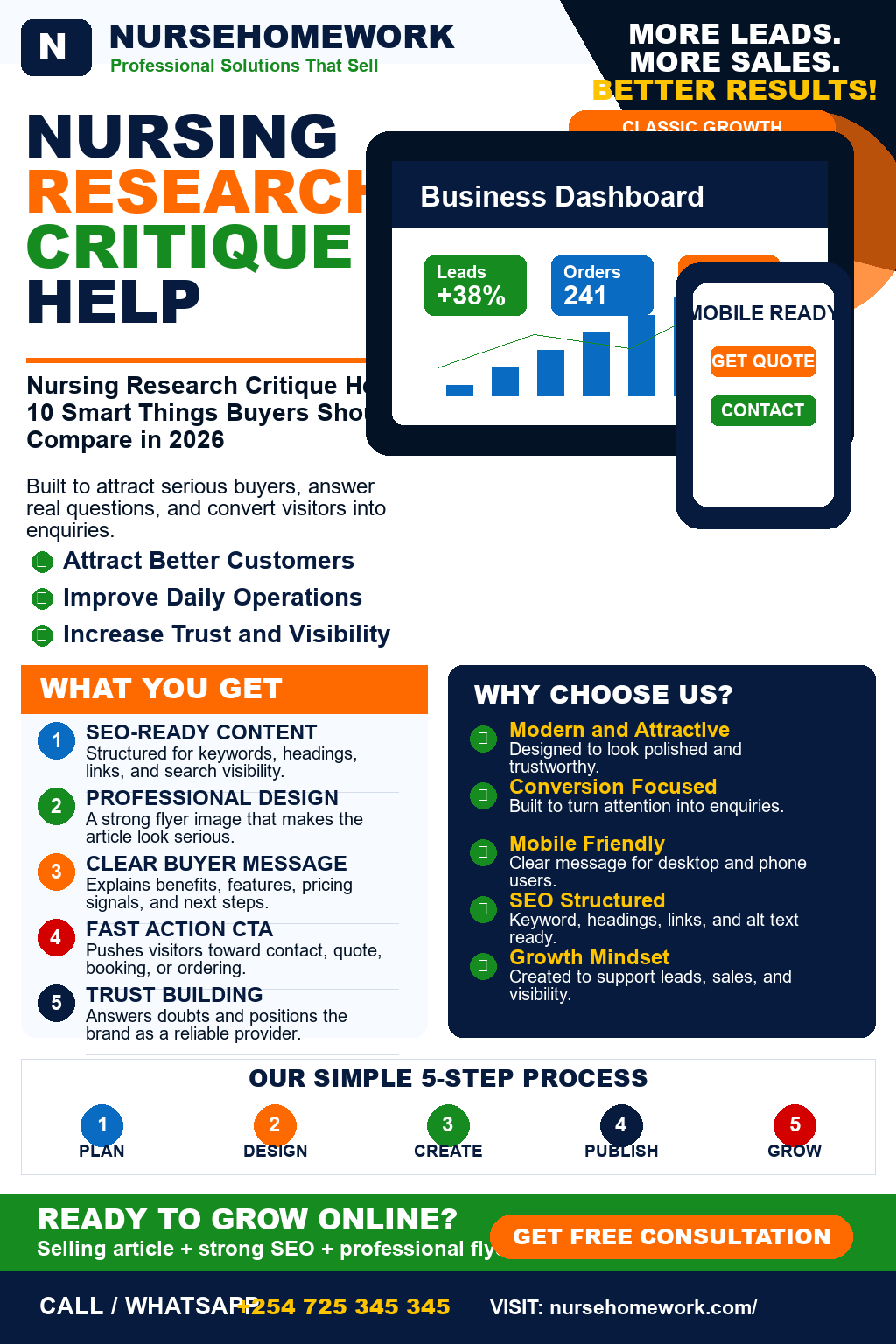
Nursing Research Critique Help: 10 Smart Things Buyers Should Compare in 2026
Nursing Research Critique Help by NurseHomework
Nursing Research Critique Help is a strong buyer-intent keyword because the visitor is usually comparing providers, prices, features, timelines, and proof before making a decision.
Nursing Research Critique Help is one of the fresh buyer-focused topics NurseHomework should publish around today because it matches what serious buyers are searching before they request a demo, quote, rollout plan, or implementation support.
For buyers, students, business owners, managers, administrators, founders, and decision makers looking for a practical solution, the real problem is manual work, unclear communication, weak records, missed deadlines, poor visibility, and difficulty comparing trusted providers. A useful article should answer the questions that serious buyers ask before they contact a provider or request a quotation.
This search usually comes from a person who already feels the pain. They may be losing enquiries, wasting time with manual work, struggling with deadlines, missing records, or comparing suppliers before paying.
The right content should make the decision easier. It should explain the problem clearly, show the features that matter, reduce fear, and give the visitor a simple next step.
NurseHomework can use this topic to attract qualified visitors who are closer to buying because they are searching around a real need.
Important Features Buyers Should Expect
clear onboarding – helps buyers get a clearer, faster, and more reliable outcome.
secure records – helps buyers get a clearer, faster, and more reliable outcome.
fast communication – helps buyers get a clearer, faster, and more reliable outcome.
mobile access – helps buyers get a clearer, faster, and more reliable outcome.
reports and updates – helps buyers get a clearer, faster, and more reliable outcome.
support after delivery – helps buyers get a clearer, faster, and more reliable outcome.
clear process – buyers should understand what happens before, during, and after delivery.
mobile friendly experience – users should be able to access the service or platform comfortably on phones.
useful reports or updates – clients should see progress, records, or results without repeated follow-up.
reliable support – the provider should support improvements after launch or delivery.
How to Compare Providers
Start with workflow fit. The provider should understand the exact users, tasks, deadlines, records, communication channels, payments, and reports involved.
Next, compare trust. Look for clear service pages, examples, practical explanations, realistic promises, visible contacts, and content that answers real questions.
Then compare long-term value. The best option is not always the lowest quote. The right provider should save time, reduce confusion, improve experience, and make future growth easier.
Mistakes to Avoid
Choosing Only by Price
Cheap work can become expensive if it creates weak design, unclear communication, poor support, missing features, or repeated revisions.
Ignoring the Real User
A solution must work for the people who use it daily. If users find it confusing, the project loses value quickly.
Publishing Thin Content
SEO pages should not only repeat keywords. They should answer buyer questions and explain the next step clearly.
How to Get Started
Write down the exact result you want. Include the users, current problem, documents, deadlines, records, payments, reports, and the main action you want visitors or customers to take.
Then contact a provider with a clear request. Share the pain points and ask for a practical plan, timeline, and support process.
Why Choose NurseHomework?
NurseHomework helps nursing students organize care plans, EBP tasks, case studies, SOAP notes, research papers, and APA formatting.
Nursing Research Critique Help is useful for buyers, students, business owners, managers, administrators, founders, and decision makers looking for a practical solution, especially when the current process is manual, unclear, slow, or hard to scale.
What should buyers compare first?
Compare workflow fit, support, examples, communication, features, timelines, and whether the provider understands the real problem.
Can the solution be customized?
Yes. A serious provider should shape the solution around users, records, reports, content, communication, and growth plans.
Conclusion
Nursing Research Critique Help is worth targeting because it connects to real buying intent. The best content should educate the visitor, build confidence, and make the next enquiry easy.
Deep Buyer Guide for Nursing Research Critique Help
Before making a decision, buyers should separate must-have requirements from nice-to-have extras. The must-have items are the features that protect revenue, save time, improve communication, or prevent operational confusion. A buyer searching for Nursing Research Critique Help is rarely looking for a vague overview. They normally want a practical answer that helps them choose a provider, compare options, understand implementation, and avoid a poor purchase.
The first useful step is to define the current workflow. Write down who starts the request, who approves it, where records are stored, how payments or submissions are confirmed, and which reports management needs at the end of the week or month. This exercise exposes gaps quickly. If the current process depends on scattered spreadsheets, WhatsApp screenshots, email attachments, or one person who remembers everything, the buyer should prioritize a solution that brings those records into one controlled workflow.
The second step is to compare accountability. Good providers explain how the work will be planned, who owns each stage, what information is needed before kickoff, and how progress will be reviewed. Weak providers often jump straight to price without clarifying the operating problem. For NurseHomework, the strongest content should help the reader think like a serious buyer: define the result, protect the user experience, check the support model, and make sure the final solution can keep improving after launch.
The third step is to check reporting and visibility. Many organizations do not only need a service; they need evidence that the service is working. Reports, dashboards, status updates, audit trails, and clear records reduce conflict because teams can see what happened, when it happened, and what still needs attention. This is especially important when the topic affects money, customers, students, members, tenants, voters, staff, stock, or compliance.
Future growth also matters. A good solution should allow more users, more records, more requests, more services, and better reports without forcing the organization to start again from zero. Buyers should ask whether the solution can handle new branches, new counties, new departments, new roles, new payment methods, or new reporting needs. The cheapest first option can become expensive if it blocks growth six months later.
Strong SEO content supports both trust and rankings. A long article should not fill space with repeated claims. It should answer real questions, explain trade-offs, use the focus keyword naturally, link to useful pages, and give the reader a clear next step. When visitors feel that the article understands their problem, they are more likely to enquire, request a quote, book a demo, or compare the provider seriously.
Implementation Checklist
Problem definition: describe the current bottleneck and the measurable result the buyer wants.
User roles: list administrators, managers, customers, students, members, tenants, staff, or external users who will interact with the process.
Data records: define the records, documents, payments, messages, reports, and approvals that must be captured.
Security: decide who can view, edit, approve, export, or delete sensitive records.
Support: confirm how training, bug fixes, updates, and improvements will be handled after launch.
These details make the buying conversation more productive. Instead of asking only for a general quote, the buyer can explain the workflow and ask for a practical rollout plan. That gives the provider enough context to recommend a sensible scope, timeline, and support path. It also helps the buyer avoid vague proposals that look cheap but leave critical work undefined.
Questions Buyers Should Ask
Buyers should ask how long implementation will take, what content or data must be prepared, how user training will work, and what happens after publishing or launch. They should also ask for examples of similar work, a clear contact path, and an explanation of what is included in the first delivery versus future improvements. These questions protect both sides because they make expectations clear before money changes hands.
Another useful question is how success will be measured. For some buyers, success means more enquiries. For others, it means faster reconciliation, fewer missing records, lower admin workload, better tenant communication, smoother elections, stronger academic support workflows, better farm records, more reliable connectivity, or clearer executive reporting. The right metric depends on the business problem, so the article should connect the keyword to outcomes that matter.
Finally, buyers should check whether the provider understands the local context. In Kenya and surrounding markets, details like M-Pesa, county operations, mobile-first users, WhatsApp communication, school and SACCO structures, landlord workflows, rural connectivity, and small-team administration can shape the success of a project. A generic solution may look good but fail in daily use if it ignores these realities.
Needs help with Nursing Assignment?
We are available 24x7 to deliver the best services and assignment ready within 3-4 hours? Order a custom-written, plagiarism-free paper
https://nursehomework.com/wp-content/uploads/2026/07/nursehomework-nursing-research-critique-help-july-10-1.png15361024developerhttps://nursehomework.com/wp-content/uploads/2024/10/Nursing-Homework.svgdeveloper2026-07-10 07:20:322026-07-10 07:21:32Nursing Research Critique Help: 10 Smart Things Buyers Should Compare in 2026
Nursing Reflective Essay Help: 10 Smart Things Buyers Should Compare in 2026
Nursing Reflective Essay Help by NurseHomework
Nursing Reflective Essay Help is a strong buyer-intent keyword because the visitor is usually comparing providers, prices, features, timelines, and proof before making a decision.
Nursing Reflective Essay Help is one of the fresh buyer-focused topics NurseHomework should publish around today because it matches what serious buyers are searching before they request a demo, quote, rollout plan, or implementation support.
For buyers, students, business owners, managers, administrators, founders, and decision makers looking for a practical solution, the real problem is manual work, unclear communication, weak records, missed deadlines, poor visibility, and difficulty comparing trusted providers. A useful article should answer the questions that serious buyers ask before they contact a provider or request a quotation.
This search usually comes from a person who already feels the pain. They may be losing enquiries, wasting time with manual work, struggling with deadlines, missing records, or comparing suppliers before paying.
The right content should make the decision easier. It should explain the problem clearly, show the features that matter, reduce fear, and give the visitor a simple next step.
NurseHomework can use this topic to attract qualified visitors who are closer to buying because they are searching around a real need.
Important Features Buyers Should Expect
clear onboarding – helps buyers get a clearer, faster, and more reliable outcome.
secure records – helps buyers get a clearer, faster, and more reliable outcome.
fast communication – helps buyers get a clearer, faster, and more reliable outcome.
mobile access – helps buyers get a clearer, faster, and more reliable outcome.
reports and updates – helps buyers get a clearer, faster, and more reliable outcome.
support after delivery – helps buyers get a clearer, faster, and more reliable outcome.
clear process – buyers should understand what happens before, during, and after delivery.
mobile friendly experience – users should be able to access the service or platform comfortably on phones.
useful reports or updates – clients should see progress, records, or results without repeated follow-up.
reliable support – the provider should support improvements after launch or delivery.
How to Compare Providers
Start with workflow fit. The provider should understand the exact users, tasks, deadlines, records, communication channels, payments, and reports involved.
Next, compare trust. Look for clear service pages, examples, practical explanations, realistic promises, visible contacts, and content that answers real questions.
Then compare long-term value. The best option is not always the lowest quote. The right provider should save time, reduce confusion, improve experience, and make future growth easier.
Mistakes to Avoid
Choosing Only by Price
Cheap work can become expensive if it creates weak design, unclear communication, poor support, missing features, or repeated revisions.
Ignoring the Real User
A solution must work for the people who use it daily. If users find it confusing, the project loses value quickly.
Publishing Thin Content
SEO pages should not only repeat keywords. They should answer buyer questions and explain the next step clearly.
How to Get Started
Write down the exact result you want. Include the users, current problem, documents, deadlines, records, payments, reports, and the main action you want visitors or customers to take.
Then contact a provider with a clear request. Share the pain points and ask for a practical plan, timeline, and support process.
Why Choose NurseHomework?
NurseHomework helps nursing students organize care plans, EBP tasks, case studies, SOAP notes, research papers, and APA formatting.
Nursing Reflective Essay Help is useful for buyers, students, business owners, managers, administrators, founders, and decision makers looking for a practical solution, especially when the current process is manual, unclear, slow, or hard to scale.
What should buyers compare first?
Compare workflow fit, support, examples, communication, features, timelines, and whether the provider understands the real problem.
Can the solution be customized?
Yes. A serious provider should shape the solution around users, records, reports, content, communication, and growth plans.
Conclusion
Nursing Reflective Essay Help is worth targeting because it connects to real buying intent. The best content should educate the visitor, build confidence, and make the next enquiry easy.
Deep Buyer Guide for Nursing Reflective Essay Help
Before making a decision, buyers should separate must-have requirements from nice-to-have extras. The must-have items are the features that protect revenue, save time, improve communication, or prevent operational confusion. A buyer searching for Nursing Reflective Essay Help is rarely looking for a vague overview. They normally want a practical answer that helps them choose a provider, compare options, understand implementation, and avoid a poor purchase.
The first useful step is to define the current workflow. Write down who starts the request, who approves it, where records are stored, how payments or submissions are confirmed, and which reports management needs at the end of the week or month. This exercise exposes gaps quickly. If the current process depends on scattered spreadsheets, WhatsApp screenshots, email attachments, or one person who remembers everything, the buyer should prioritize a solution that brings those records into one controlled workflow.
The second step is to compare accountability. Good providers explain how the work will be planned, who owns each stage, what information is needed before kickoff, and how progress will be reviewed. Weak providers often jump straight to price without clarifying the operating problem. For NurseHomework, the strongest content should help the reader think like a serious buyer: define the result, protect the user experience, check the support model, and make sure the final solution can keep improving after launch.
The third step is to check reporting and visibility. Many organizations do not only need a service; they need evidence that the service is working. Reports, dashboards, status updates, audit trails, and clear records reduce conflict because teams can see what happened, when it happened, and what still needs attention. This is especially important when the topic affects money, customers, students, members, tenants, voters, staff, stock, or compliance.
Future growth also matters. A good solution should allow more users, more records, more requests, more services, and better reports without forcing the organization to start again from zero. Buyers should ask whether the solution can handle new branches, new counties, new departments, new roles, new payment methods, or new reporting needs. The cheapest first option can become expensive if it blocks growth six months later.
Strong SEO content supports both trust and rankings. A long article should not fill space with repeated claims. It should answer real questions, explain trade-offs, use the focus keyword naturally, link to useful pages, and give the reader a clear next step. When visitors feel that the article understands their problem, they are more likely to enquire, request a quote, book a demo, or compare the provider seriously.
Implementation Checklist
Problem definition: describe the current bottleneck and the measurable result the buyer wants.
User roles: list administrators, managers, customers, students, members, tenants, staff, or external users who will interact with the process.
Data records: define the records, documents, payments, messages, reports, and approvals that must be captured.
Security: decide who can view, edit, approve, export, or delete sensitive records.
Support: confirm how training, bug fixes, updates, and improvements will be handled after launch.
These details make the buying conversation more productive. Instead of asking only for a general quote, the buyer can explain the workflow and ask for a practical rollout plan. That gives the provider enough context to recommend a sensible scope, timeline, and support path. It also helps the buyer avoid vague proposals that look cheap but leave critical work undefined.
Questions Buyers Should Ask
Buyers should ask how long implementation will take, what content or data must be prepared, how user training will work, and what happens after publishing or launch. They should also ask for examples of similar work, a clear contact path, and an explanation of what is included in the first delivery versus future improvements. These questions protect both sides because they make expectations clear before money changes hands.
Another useful question is how success will be measured. For some buyers, success means more enquiries. For others, it means faster reconciliation, fewer missing records, lower admin workload, better tenant communication, smoother elections, stronger academic support workflows, better farm records, more reliable connectivity, or clearer executive reporting. The right metric depends on the business problem, so the article should connect the keyword to outcomes that matter.
Finally, buyers should check whether the provider understands the local context. In Kenya and surrounding markets, details like M-Pesa, county operations, mobile-first users, WhatsApp communication, school and SACCO structures, landlord workflows, rural connectivity, and small-team administration can shape the success of a project. A generic solution may look good but fail in daily use if it ignores these realities.
Needs help with Nursing Assignment?
We are available 24x7 to deliver the best services and assignment ready within 3-4 hours? Order a custom-written, plagiarism-free paper
https://nursehomework.com/wp-content/uploads/2026/07/nursehomework-nursing-reflective-essay-help-july-10-1.png15361024developerhttps://nursehomework.com/wp-content/uploads/2024/10/Nursing-Homework.svgdeveloper2026-07-10 07:20:002026-07-10 07:21:06Nursing Reflective Essay Help: 10 Smart Things Buyers Should Compare in 2026
Nursing Discussion Post Help: 10 Smart Things Buyers Should Compare in 2026
Nursing Discussion Post Help by NurseHomework
Nursing Discussion Post Help is a strong buyer-intent keyword because the visitor is usually comparing providers, prices, features, timelines, and proof before making a decision.
Nursing Discussion Post Help is one of the fresh buyer-focused topics NurseHomework should publish around today because it matches what serious buyers are searching before they request a demo, quote, rollout plan, or implementation support.
For buyers, students, business owners, managers, administrators, founders, and decision makers looking for a practical solution, the real problem is manual work, unclear communication, weak records, missed deadlines, poor visibility, and difficulty comparing trusted providers. A useful article should answer the questions that serious buyers ask before they contact a provider or request a quotation.
This search usually comes from a person who already feels the pain. They may be losing enquiries, wasting time with manual work, struggling with deadlines, missing records, or comparing suppliers before paying.
The right content should make the decision easier. It should explain the problem clearly, show the features that matter, reduce fear, and give the visitor a simple next step.
NurseHomework can use this topic to attract qualified visitors who are closer to buying because they are searching around a real need.
Important Features Buyers Should Expect
clear onboarding – helps buyers get a clearer, faster, and more reliable outcome.
secure records – helps buyers get a clearer, faster, and more reliable outcome.
fast communication – helps buyers get a clearer, faster, and more reliable outcome.
mobile access – helps buyers get a clearer, faster, and more reliable outcome.
reports and updates – helps buyers get a clearer, faster, and more reliable outcome.
support after delivery – helps buyers get a clearer, faster, and more reliable outcome.
clear process – buyers should understand what happens before, during, and after delivery.
mobile friendly experience – users should be able to access the service or platform comfortably on phones.
useful reports or updates – clients should see progress, records, or results without repeated follow-up.
reliable support – the provider should support improvements after launch or delivery.
How to Compare Providers
Start with workflow fit. The provider should understand the exact users, tasks, deadlines, records, communication channels, payments, and reports involved.
Next, compare trust. Look for clear service pages, examples, practical explanations, realistic promises, visible contacts, and content that answers real questions.
Then compare long-term value. The best option is not always the lowest quote. The right provider should save time, reduce confusion, improve experience, and make future growth easier.
Mistakes to Avoid
Choosing Only by Price
Cheap work can become expensive if it creates weak design, unclear communication, poor support, missing features, or repeated revisions.
Ignoring the Real User
A solution must work for the people who use it daily. If users find it confusing, the project loses value quickly.
Publishing Thin Content
SEO pages should not only repeat keywords. They should answer buyer questions and explain the next step clearly.
How to Get Started
Write down the exact result you want. Include the users, current problem, documents, deadlines, records, payments, reports, and the main action you want visitors or customers to take.
Then contact a provider with a clear request. Share the pain points and ask for a practical plan, timeline, and support process.
Why Choose NurseHomework?
NurseHomework helps nursing students organize care plans, EBP tasks, case studies, SOAP notes, research papers, and APA formatting.
Nursing Discussion Post Help is useful for buyers, students, business owners, managers, administrators, founders, and decision makers looking for a practical solution, especially when the current process is manual, unclear, slow, or hard to scale.
What should buyers compare first?
Compare workflow fit, support, examples, communication, features, timelines, and whether the provider understands the real problem.
Can the solution be customized?
Yes. A serious provider should shape the solution around users, records, reports, content, communication, and growth plans.
Conclusion
Nursing Discussion Post Help is worth targeting because it connects to real buying intent. The best content should educate the visitor, build confidence, and make the next enquiry easy.
Deep Buyer Guide for Nursing Discussion Post Help
Before making a decision, buyers should separate must-have requirements from nice-to-have extras. The must-have items are the features that protect revenue, save time, improve communication, or prevent operational confusion. A buyer searching for Nursing Discussion Post Help is rarely looking for a vague overview. They normally want a practical answer that helps them choose a provider, compare options, understand implementation, and avoid a poor purchase.
The first useful step is to define the current workflow. Write down who starts the request, who approves it, where records are stored, how payments or submissions are confirmed, and which reports management needs at the end of the week or month. This exercise exposes gaps quickly. If the current process depends on scattered spreadsheets, WhatsApp screenshots, email attachments, or one person who remembers everything, the buyer should prioritize a solution that brings those records into one controlled workflow.
The second step is to compare accountability. Good providers explain how the work will be planned, who owns each stage, what information is needed before kickoff, and how progress will be reviewed. Weak providers often jump straight to price without clarifying the operating problem. For NurseHomework, the strongest content should help the reader think like a serious buyer: define the result, protect the user experience, check the support model, and make sure the final solution can keep improving after launch.
The third step is to check reporting and visibility. Many organizations do not only need a service; they need evidence that the service is working. Reports, dashboards, status updates, audit trails, and clear records reduce conflict because teams can see what happened, when it happened, and what still needs attention. This is especially important when the topic affects money, customers, students, members, tenants, voters, staff, stock, or compliance.
Future growth also matters. A good solution should allow more users, more records, more requests, more services, and better reports without forcing the organization to start again from zero. Buyers should ask whether the solution can handle new branches, new counties, new departments, new roles, new payment methods, or new reporting needs. The cheapest first option can become expensive if it blocks growth six months later.
Strong SEO content supports both trust and rankings. A long article should not fill space with repeated claims. It should answer real questions, explain trade-offs, use the focus keyword naturally, link to useful pages, and give the reader a clear next step. When visitors feel that the article understands their problem, they are more likely to enquire, request a quote, book a demo, or compare the provider seriously.
Implementation Checklist
Problem definition: describe the current bottleneck and the measurable result the buyer wants.
User roles: list administrators, managers, customers, students, members, tenants, staff, or external users who will interact with the process.
Data records: define the records, documents, payments, messages, reports, and approvals that must be captured.
Security: decide who can view, edit, approve, export, or delete sensitive records.
Support: confirm how training, bug fixes, updates, and improvements will be handled after launch.
These details make the buying conversation more productive. Instead of asking only for a general quote, the buyer can explain the workflow and ask for a practical rollout plan. That gives the provider enough context to recommend a sensible scope, timeline, and support path. It also helps the buyer avoid vague proposals that look cheap but leave critical work undefined.
Questions Buyers Should Ask
Buyers should ask how long implementation will take, what content or data must be prepared, how user training will work, and what happens after publishing or launch. They should also ask for examples of similar work, a clear contact path, and an explanation of what is included in the first delivery versus future improvements. These questions protect both sides because they make expectations clear before money changes hands.
Another useful question is how success will be measured. For some buyers, success means more enquiries. For others, it means faster reconciliation, fewer missing records, lower admin workload, better tenant communication, smoother elections, stronger academic support workflows, better farm records, more reliable connectivity, or clearer executive reporting. The right metric depends on the business problem, so the article should connect the keyword to outcomes that matter.
Finally, buyers should check whether the provider understands the local context. In Kenya and surrounding markets, details like M-Pesa, county operations, mobile-first users, WhatsApp communication, school and SACCO structures, landlord workflows, rural connectivity, and small-team administration can shape the success of a project. A generic solution may look good but fail in daily use if it ignores these realities.
Needs help with Nursing Assignment?
We are available 24x7 to deliver the best services and assignment ready within 3-4 hours? Order a custom-written, plagiarism-free paper
https://nursehomework.com/wp-content/uploads/2026/07/nursehomework-nursing-discussion-post-help-july-10-1.png15361024developerhttps://nursehomework.com/wp-content/uploads/2024/10/Nursing-Homework.svgdeveloper2026-07-10 07:19:252026-07-10 07:20:37Nursing Discussion Post Help: 10 Smart Things Buyers Should Compare in 2026
Nursing SOAP Note Help: 10 Smart Things Buyers Should Compare in 2026
Nursing SOAP Note Help by NurseHomework
Nursing SOAP Note Help is a strong buyer-intent keyword because the visitor is usually comparing providers, prices, features, timelines, and proof before making a decision.
Nursing SOAP Note Help is one of the fresh buyer-focused topics NurseHomework should publish around today because it matches what serious buyers are searching before they request a demo, quote, rollout plan, or implementation support.
For buyers, students, business owners, managers, administrators, founders, and decision makers looking for a practical solution, the real problem is manual work, unclear communication, weak records, missed deadlines, poor visibility, and difficulty comparing trusted providers. A useful article should answer the questions that serious buyers ask before they contact a provider or request a quotation.
This search usually comes from a person who already feels the pain. They may be losing enquiries, wasting time with manual work, struggling with deadlines, missing records, or comparing suppliers before paying.
The right content should make the decision easier. It should explain the problem clearly, show the features that matter, reduce fear, and give the visitor a simple next step.
NurseHomework can use this topic to attract qualified visitors who are closer to buying because they are searching around a real need.
Important Features Buyers Should Expect
clear onboarding – helps buyers get a clearer, faster, and more reliable outcome.
secure records – helps buyers get a clearer, faster, and more reliable outcome.
fast communication – helps buyers get a clearer, faster, and more reliable outcome.
mobile access – helps buyers get a clearer, faster, and more reliable outcome.
reports and updates – helps buyers get a clearer, faster, and more reliable outcome.
support after delivery – helps buyers get a clearer, faster, and more reliable outcome.
clear process – buyers should understand what happens before, during, and after delivery.
mobile friendly experience – users should be able to access the service or platform comfortably on phones.
useful reports or updates – clients should see progress, records, or results without repeated follow-up.
reliable support – the provider should support improvements after launch or delivery.
How to Compare Providers
Start with workflow fit. The provider should understand the exact users, tasks, deadlines, records, communication channels, payments, and reports involved.
Next, compare trust. Look for clear service pages, examples, practical explanations, realistic promises, visible contacts, and content that answers real questions.
Then compare long-term value. The best option is not always the lowest quote. The right provider should save time, reduce confusion, improve experience, and make future growth easier.
Mistakes to Avoid
Choosing Only by Price
Cheap work can become expensive if it creates weak design, unclear communication, poor support, missing features, or repeated revisions.
Ignoring the Real User
A solution must work for the people who use it daily. If users find it confusing, the project loses value quickly.
Publishing Thin Content
SEO pages should not only repeat keywords. They should answer buyer questions and explain the next step clearly.
How to Get Started
Write down the exact result you want. Include the users, current problem, documents, deadlines, records, payments, reports, and the main action you want visitors or customers to take.
Then contact a provider with a clear request. Share the pain points and ask for a practical plan, timeline, and support process.
Why Choose NurseHomework?
NurseHomework helps nursing students organize care plans, EBP tasks, case studies, SOAP notes, research papers, and APA formatting.
Nursing SOAP Note Help is useful for buyers, students, business owners, managers, administrators, founders, and decision makers looking for a practical solution, especially when the current process is manual, unclear, slow, or hard to scale.
What should buyers compare first?
Compare workflow fit, support, examples, communication, features, timelines, and whether the provider understands the real problem.
Can the solution be customized?
Yes. A serious provider should shape the solution around users, records, reports, content, communication, and growth plans.
Conclusion
Nursing SOAP Note Help is worth targeting because it connects to real buying intent. The best content should educate the visitor, build confidence, and make the next enquiry easy.
Deep Buyer Guide for Nursing SOAP Note Help
Before making a decision, buyers should separate must-have requirements from nice-to-have extras. The must-have items are the features that protect revenue, save time, improve communication, or prevent operational confusion. A buyer searching for Nursing SOAP Note Help is rarely looking for a vague overview. They normally want a practical answer that helps them choose a provider, compare options, understand implementation, and avoid a poor purchase.
The first useful step is to define the current workflow. Write down who starts the request, who approves it, where records are stored, how payments or submissions are confirmed, and which reports management needs at the end of the week or month. This exercise exposes gaps quickly. If the current process depends on scattered spreadsheets, WhatsApp screenshots, email attachments, or one person who remembers everything, the buyer should prioritize a solution that brings those records into one controlled workflow.
The second step is to compare accountability. Good providers explain how the work will be planned, who owns each stage, what information is needed before kickoff, and how progress will be reviewed. Weak providers often jump straight to price without clarifying the operating problem. For NurseHomework, the strongest content should help the reader think like a serious buyer: define the result, protect the user experience, check the support model, and make sure the final solution can keep improving after launch.
The third step is to check reporting and visibility. Many organizations do not only need a service; they need evidence that the service is working. Reports, dashboards, status updates, audit trails, and clear records reduce conflict because teams can see what happened, when it happened, and what still needs attention. This is especially important when the topic affects money, customers, students, members, tenants, voters, staff, stock, or compliance.
Future growth also matters. A good solution should allow more users, more records, more requests, more services, and better reports without forcing the organization to start again from zero. Buyers should ask whether the solution can handle new branches, new counties, new departments, new roles, new payment methods, or new reporting needs. The cheapest first option can become expensive if it blocks growth six months later.
Strong SEO content supports both trust and rankings. A long article should not fill space with repeated claims. It should answer real questions, explain trade-offs, use the focus keyword naturally, link to useful pages, and give the reader a clear next step. When visitors feel that the article understands their problem, they are more likely to enquire, request a quote, book a demo, or compare the provider seriously.
Implementation Checklist
Problem definition: describe the current bottleneck and the measurable result the buyer wants.
User roles: list administrators, managers, customers, students, members, tenants, staff, or external users who will interact with the process.
Data records: define the records, documents, payments, messages, reports, and approvals that must be captured.
Security: decide who can view, edit, approve, export, or delete sensitive records.
Support: confirm how training, bug fixes, updates, and improvements will be handled after launch.
These details make the buying conversation more productive. Instead of asking only for a general quote, the buyer can explain the workflow and ask for a practical rollout plan. That gives the provider enough context to recommend a sensible scope, timeline, and support path. It also helps the buyer avoid vague proposals that look cheap but leave critical work undefined.
Questions Buyers Should Ask
Buyers should ask how long implementation will take, what content or data must be prepared, how user training will work, and what happens after publishing or launch. They should also ask for examples of similar work, a clear contact path, and an explanation of what is included in the first delivery versus future improvements. These questions protect both sides because they make expectations clear before money changes hands.
Another useful question is how success will be measured. For some buyers, success means more enquiries. For others, it means faster reconciliation, fewer missing records, lower admin workload, better tenant communication, smoother elections, stronger academic support workflows, better farm records, more reliable connectivity, or clearer executive reporting. The right metric depends on the business problem, so the article should connect the keyword to outcomes that matter.
Finally, buyers should check whether the provider understands the local context. In Kenya and surrounding markets, details like M-Pesa, county operations, mobile-first users, WhatsApp communication, school and SACCO structures, landlord workflows, rural connectivity, and small-team administration can shape the success of a project. A generic solution may look good but fail in daily use if it ignores these realities.
Needs help with Nursing Assignment?
We are available 24x7 to deliver the best services and assignment ready within 3-4 hours? Order a custom-written, plagiarism-free paper
https://nursehomework.com/wp-content/uploads/2026/07/nursehomework-nursing-soap-note-help-july-10-1.png15361024developerhttps://nursehomework.com/wp-content/uploads/2024/10/Nursing-Homework.svgdeveloper2026-07-10 07:18:492026-07-10 07:20:02Nursing SOAP Note Help: 10 Smart Things Buyers Should Compare in 2026
Nursing Case Study Help Online: 10 Smart Things Buyers Should Compare in 2026
Nursing Case Study Help Online by NurseHomework
Nursing Case Study Help Online is a strong buyer-intent keyword because the visitor is usually comparing providers, prices, features, timelines, and proof before making a decision.
Nursing Case Study Help Online is one of the fresh buyer-focused topics NurseHomework should publish around today because it matches what serious buyers are searching before they request a demo, quote, rollout plan, or implementation support.
For buyers, students, business owners, managers, administrators, founders, and decision makers looking for a practical solution, the real problem is manual work, unclear communication, weak records, missed deadlines, poor visibility, and difficulty comparing trusted providers. A useful article should answer the questions that serious buyers ask before they contact a provider or request a quotation.
This search usually comes from a person who already feels the pain. They may be losing enquiries, wasting time with manual work, struggling with deadlines, missing records, or comparing suppliers before paying.
The right content should make the decision easier. It should explain the problem clearly, show the features that matter, reduce fear, and give the visitor a simple next step.
NurseHomework can use this topic to attract qualified visitors who are closer to buying because they are searching around a real need.
Important Features Buyers Should Expect
clear onboarding – helps buyers get a clearer, faster, and more reliable outcome.
secure records – helps buyers get a clearer, faster, and more reliable outcome.
fast communication – helps buyers get a clearer, faster, and more reliable outcome.
mobile access – helps buyers get a clearer, faster, and more reliable outcome.
reports and updates – helps buyers get a clearer, faster, and more reliable outcome.
support after delivery – helps buyers get a clearer, faster, and more reliable outcome.
clear process – buyers should understand what happens before, during, and after delivery.
mobile friendly experience – users should be able to access the service or platform comfortably on phones.
useful reports or updates – clients should see progress, records, or results without repeated follow-up.
reliable support – the provider should support improvements after launch or delivery.
How to Compare Providers
Start with workflow fit. The provider should understand the exact users, tasks, deadlines, records, communication channels, payments, and reports involved.
Next, compare trust. Look for clear service pages, examples, practical explanations, realistic promises, visible contacts, and content that answers real questions.
Then compare long-term value. The best option is not always the lowest quote. The right provider should save time, reduce confusion, improve experience, and make future growth easier.
Mistakes to Avoid
Choosing Only by Price
Cheap work can become expensive if it creates weak design, unclear communication, poor support, missing features, or repeated revisions.
Ignoring the Real User
A solution must work for the people who use it daily. If users find it confusing, the project loses value quickly.
Publishing Thin Content
SEO pages should not only repeat keywords. They should answer buyer questions and explain the next step clearly.
How to Get Started
Write down the exact result you want. Include the users, current problem, documents, deadlines, records, payments, reports, and the main action you want visitors or customers to take.
Then contact a provider with a clear request. Share the pain points and ask for a practical plan, timeline, and support process.
Why Choose NurseHomework?
NurseHomework helps nursing students organize care plans, EBP tasks, case studies, SOAP notes, research papers, and APA formatting.
Nursing Case Study Help Online is useful for buyers, students, business owners, managers, administrators, founders, and decision makers looking for a practical solution, especially when the current process is manual, unclear, slow, or hard to scale.
What should buyers compare first?
Compare workflow fit, support, examples, communication, features, timelines, and whether the provider understands the real problem.
Can the solution be customized?
Yes. A serious provider should shape the solution around users, records, reports, content, communication, and growth plans.
Conclusion
Nursing Case Study Help Online is worth targeting because it connects to real buying intent. The best content should educate the visitor, build confidence, and make the next enquiry easy.
Deep Buyer Guide for Nursing Case Study Help Online
Before making a decision, buyers should separate must-have requirements from nice-to-have extras. The must-have items are the features that protect revenue, save time, improve communication, or prevent operational confusion. A buyer searching for Nursing Case Study Help Online is rarely looking for a vague overview. They normally want a practical answer that helps them choose a provider, compare options, understand implementation, and avoid a poor purchase.
The first useful step is to define the current workflow. Write down who starts the request, who approves it, where records are stored, how payments or submissions are confirmed, and which reports management needs at the end of the week or month. This exercise exposes gaps quickly. If the current process depends on scattered spreadsheets, WhatsApp screenshots, email attachments, or one person who remembers everything, the buyer should prioritize a solution that brings those records into one controlled workflow.
The second step is to compare accountability. Good providers explain how the work will be planned, who owns each stage, what information is needed before kickoff, and how progress will be reviewed. Weak providers often jump straight to price without clarifying the operating problem. For NurseHomework, the strongest content should help the reader think like a serious buyer: define the result, protect the user experience, check the support model, and make sure the final solution can keep improving after launch.
The third step is to check reporting and visibility. Many organizations do not only need a service; they need evidence that the service is working. Reports, dashboards, status updates, audit trails, and clear records reduce conflict because teams can see what happened, when it happened, and what still needs attention. This is especially important when the topic affects money, customers, students, members, tenants, voters, staff, stock, or compliance.
Future growth also matters. A good solution should allow more users, more records, more requests, more services, and better reports without forcing the organization to start again from zero. Buyers should ask whether the solution can handle new branches, new counties, new departments, new roles, new payment methods, or new reporting needs. The cheapest first option can become expensive if it blocks growth six months later.
Strong SEO content supports both trust and rankings. A long article should not fill space with repeated claims. It should answer real questions, explain trade-offs, use the focus keyword naturally, link to useful pages, and give the reader a clear next step. When visitors feel that the article understands their problem, they are more likely to enquire, request a quote, book a demo, or compare the provider seriously.
Implementation Checklist
Problem definition: describe the current bottleneck and the measurable result the buyer wants.
User roles: list administrators, managers, customers, students, members, tenants, staff, or external users who will interact with the process.
Data records: define the records, documents, payments, messages, reports, and approvals that must be captured.
Security: decide who can view, edit, approve, export, or delete sensitive records.
Support: confirm how training, bug fixes, updates, and improvements will be handled after launch.
These details make the buying conversation more productive. Instead of asking only for a general quote, the buyer can explain the workflow and ask for a practical rollout plan. That gives the provider enough context to recommend a sensible scope, timeline, and support path. It also helps the buyer avoid vague proposals that look cheap but leave critical work undefined.
Questions Buyers Should Ask
Buyers should ask how long implementation will take, what content or data must be prepared, how user training will work, and what happens after publishing or launch. They should also ask for examples of similar work, a clear contact path, and an explanation of what is included in the first delivery versus future improvements. These questions protect both sides because they make expectations clear before money changes hands.
Another useful question is how success will be measured. For some buyers, success means more enquiries. For others, it means faster reconciliation, fewer missing records, lower admin workload, better tenant communication, smoother elections, stronger academic support workflows, better farm records, more reliable connectivity, or clearer executive reporting. The right metric depends on the business problem, so the article should connect the keyword to outcomes that matter.
Finally, buyers should check whether the provider understands the local context. In Kenya and surrounding markets, details like M-Pesa, county operations, mobile-first users, WhatsApp communication, school and SACCO structures, landlord workflows, rural connectivity, and small-team administration can shape the success of a project. A generic solution may look good but fail in daily use if it ignores these realities.
Needs help with Nursing Assignment?
We are available 24x7 to deliver the best services and assignment ready within 3-4 hours? Order a custom-written, plagiarism-free paper
https://nursehomework.com/wp-content/uploads/2026/07/nursehomework-nursing-case-study-help-online-july-10-2.png15361024developerhttps://nursehomework.com/wp-content/uploads/2024/10/Nursing-Homework.svgdeveloper2026-07-10 06:55:452026-07-10 07:22:00Nursing Case Study Help Online: 10 Smart Things Buyers Should Compare in 2026
Nursing Care Plan Writing Help: 10 Smart Things Buyers Should Compare in 2026
Nursing Care Plan Writing Help by NurseHomework
Nursing Care Plan Writing Help is a strong buyer-intent keyword because the visitor is usually comparing providers, prices, features, timelines, and proof before making a decision.
Nursing Care Plan Writing Help is one of the fresh buyer-focused topics NurseHomework should publish around today because it matches what serious buyers are searching before they request a demo, quote, rollout plan, or implementation support.
For buyers, students, business owners, managers, administrators, founders, and decision makers looking for a practical solution, the real problem is manual work, unclear communication, weak records, missed deadlines, poor visibility, and difficulty comparing trusted providers. A useful article should answer the questions that serious buyers ask before they contact a provider or request a quotation.
This search usually comes from a person who already feels the pain. They may be losing enquiries, wasting time with manual work, struggling with deadlines, missing records, or comparing suppliers before paying.
The right content should make the decision easier. It should explain the problem clearly, show the features that matter, reduce fear, and give the visitor a simple next step.
NurseHomework can use this topic to attract qualified visitors who are closer to buying because they are searching around a real need.
Important Features Buyers Should Expect
clear onboarding – helps buyers get a clearer, faster, and more reliable outcome.
secure records – helps buyers get a clearer, faster, and more reliable outcome.
fast communication – helps buyers get a clearer, faster, and more reliable outcome.
mobile access – helps buyers get a clearer, faster, and more reliable outcome.
reports and updates – helps buyers get a clearer, faster, and more reliable outcome.
support after delivery – helps buyers get a clearer, faster, and more reliable outcome.
clear process – buyers should understand what happens before, during, and after delivery.
mobile friendly experience – users should be able to access the service or platform comfortably on phones.
useful reports or updates – clients should see progress, records, or results without repeated follow-up.
reliable support – the provider should support improvements after launch or delivery.
How to Compare Providers
Start with workflow fit. The provider should understand the exact users, tasks, deadlines, records, communication channels, payments, and reports involved.
Next, compare trust. Look for clear service pages, examples, practical explanations, realistic promises, visible contacts, and content that answers real questions.
Then compare long-term value. The best option is not always the lowest quote. The right provider should save time, reduce confusion, improve experience, and make future growth easier.
Mistakes to Avoid
Choosing Only by Price
Cheap work can become expensive if it creates weak design, unclear communication, poor support, missing features, or repeated revisions.
Ignoring the Real User
A solution must work for the people who use it daily. If users find it confusing, the project loses value quickly.
Publishing Thin Content
SEO pages should not only repeat keywords. They should answer buyer questions and explain the next step clearly.
How to Get Started
Write down the exact result you want. Include the users, current problem, documents, deadlines, records, payments, reports, and the main action you want visitors or customers to take.
Then contact a provider with a clear request. Share the pain points and ask for a practical plan, timeline, and support process.
Why Choose NurseHomework?
NurseHomework helps nursing students organize care plans, EBP tasks, case studies, SOAP notes, research papers, and APA formatting.
Nursing Care Plan Writing Help is useful for buyers, students, business owners, managers, administrators, founders, and decision makers looking for a practical solution, especially when the current process is manual, unclear, slow, or hard to scale.
What should buyers compare first?
Compare workflow fit, support, examples, communication, features, timelines, and whether the provider understands the real problem.
Can the solution be customized?
Yes. A serious provider should shape the solution around users, records, reports, content, communication, and growth plans.
Conclusion
Nursing Care Plan Writing Help is worth targeting because it connects to real buying intent. The best content should educate the visitor, build confidence, and make the next enquiry easy.
Deep Buyer Guide for Nursing Care Plan Writing Help
Before making a decision, buyers should separate must-have requirements from nice-to-have extras. The must-have items are the features that protect revenue, save time, improve communication, or prevent operational confusion. A buyer searching for Nursing Care Plan Writing Help is rarely looking for a vague overview. They normally want a practical answer that helps them choose a provider, compare options, understand implementation, and avoid a poor purchase.
The first useful step is to define the current workflow. Write down who starts the request, who approves it, where records are stored, how payments or submissions are confirmed, and which reports management needs at the end of the week or month. This exercise exposes gaps quickly. If the current process depends on scattered spreadsheets, WhatsApp screenshots, email attachments, or one person who remembers everything, the buyer should prioritize a solution that brings those records into one controlled workflow.
The second step is to compare accountability. Good providers explain how the work will be planned, who owns each stage, what information is needed before kickoff, and how progress will be reviewed. Weak providers often jump straight to price without clarifying the operating problem. For NurseHomework, the strongest content should help the reader think like a serious buyer: define the result, protect the user experience, check the support model, and make sure the final solution can keep improving after launch.
The third step is to check reporting and visibility. Many organizations do not only need a service; they need evidence that the service is working. Reports, dashboards, status updates, audit trails, and clear records reduce conflict because teams can see what happened, when it happened, and what still needs attention. This is especially important when the topic affects money, customers, students, members, tenants, voters, staff, stock, or compliance.
Future growth also matters. A good solution should allow more users, more records, more requests, more services, and better reports without forcing the organization to start again from zero. Buyers should ask whether the solution can handle new branches, new counties, new departments, new roles, new payment methods, or new reporting needs. The cheapest first option can become expensive if it blocks growth six months later.
Strong SEO content supports both trust and rankings. A long article should not fill space with repeated claims. It should answer real questions, explain trade-offs, use the focus keyword naturally, link to useful pages, and give the reader a clear next step. When visitors feel that the article understands their problem, they are more likely to enquire, request a quote, book a demo, or compare the provider seriously.
Implementation Checklist
Problem definition: describe the current bottleneck and the measurable result the buyer wants.
User roles: list administrators, managers, customers, students, members, tenants, staff, or external users who will interact with the process.
Data records: define the records, documents, payments, messages, reports, and approvals that must be captured.
Security: decide who can view, edit, approve, export, or delete sensitive records.
Support: confirm how training, bug fixes, updates, and improvements will be handled after launch.
These details make the buying conversation more productive. Instead of asking only for a general quote, the buyer can explain the workflow and ask for a practical rollout plan. That gives the provider enough context to recommend a sensible scope, timeline, and support path. It also helps the buyer avoid vague proposals that look cheap but leave critical work undefined.
Questions Buyers Should Ask
Buyers should ask how long implementation will take, what content or data must be prepared, how user training will work, and what happens after publishing or launch. They should also ask for examples of similar work, a clear contact path, and an explanation of what is included in the first delivery versus future improvements. These questions protect both sides because they make expectations clear before money changes hands.
Another useful question is how success will be measured. For some buyers, success means more enquiries. For others, it means faster reconciliation, fewer missing records, lower admin workload, better tenant communication, smoother elections, stronger academic support workflows, better farm records, more reliable connectivity, or clearer executive reporting. The right metric depends on the business problem, so the article should connect the keyword to outcomes that matter.
Finally, buyers should check whether the provider understands the local context. In Kenya and surrounding markets, details like M-Pesa, county operations, mobile-first users, WhatsApp communication, school and SACCO structures, landlord workflows, rural connectivity, and small-team administration can shape the success of a project. A generic solution may look good but fail in daily use if it ignores these realities.
Needs help with Nursing Assignment?
We are available 24x7 to deliver the best services and assignment ready within 3-4 hours? Order a custom-written, plagiarism-free paper
https://nursehomework.com/wp-content/uploads/2026/07/nursehomework-nursing-care-plan-writing-help-july-10-2.png15361024developerhttps://nursehomework.com/wp-content/uploads/2024/10/Nursing-Homework.svgdeveloper2026-07-10 06:50:002026-07-10 06:55:49Nursing Care Plan Writing Help: 10 Smart Things Buyers Should Compare in 2026
Nursing Literature Review Help: 10 Smart Things Buyers Should Compare in 2026
Nursing Literature Review Help by NurseHomework
Nursing Literature Review Help is a strong buyer-intent keyword because the visitor is usually comparing providers, prices, features, timelines, and proof before making a decision.
Nursing Literature Review Help is one of the fresh buyer-focused topics NurseHomework should publish around today because it matches what serious buyers are searching before they request a demo, quote, rollout plan, or implementation support.
For buyers, students, business owners, managers, administrators, founders, and decision makers looking for a practical solution, the real problem is manual work, unclear communication, weak records, missed deadlines, poor visibility, and difficulty comparing trusted providers. A useful article should answer the questions that serious buyers ask before they contact a provider or request a quotation.
This search usually comes from a person who already feels the pain. They may be losing enquiries, wasting time with manual work, struggling with deadlines, missing records, or comparing suppliers before paying.
The right content should make the decision easier. It should explain the problem clearly, show the features that matter, reduce fear, and give the visitor a simple next step.
NurseHomework can use this topic to attract qualified visitors who are closer to buying because they are searching around a real need.
Important Features Buyers Should Expect
clear onboarding – helps buyers get a clearer, faster, and more reliable outcome.
secure records – helps buyers get a clearer, faster, and more reliable outcome.
fast communication – helps buyers get a clearer, faster, and more reliable outcome.
mobile access – helps buyers get a clearer, faster, and more reliable outcome.
reports and updates – helps buyers get a clearer, faster, and more reliable outcome.
support after delivery – helps buyers get a clearer, faster, and more reliable outcome.
clear process – buyers should understand what happens before, during, and after delivery.
mobile friendly experience – users should be able to access the service or platform comfortably on phones.
useful reports or updates – clients should see progress, records, or results without repeated follow-up.
reliable support – the provider should support improvements after launch or delivery.
How to Compare Providers
Start with workflow fit. The provider should understand the exact users, tasks, deadlines, records, communication channels, payments, and reports involved.
Next, compare trust. Look for clear service pages, examples, practical explanations, realistic promises, visible contacts, and content that answers real questions.
Then compare long-term value. The best option is not always the lowest quote. The right provider should save time, reduce confusion, improve experience, and make future growth easier.
Mistakes to Avoid
Choosing Only by Price
Cheap work can become expensive if it creates weak design, unclear communication, poor support, missing features, or repeated revisions.
Ignoring the Real User
A solution must work for the people who use it daily. If users find it confusing, the project loses value quickly.
Publishing Thin Content
SEO pages should not only repeat keywords. They should answer buyer questions and explain the next step clearly.
How to Get Started
Write down the exact result you want. Include the users, current problem, documents, deadlines, records, payments, reports, and the main action you want visitors or customers to take.
Then contact a provider with a clear request. Share the pain points and ask for a practical plan, timeline, and support process.
Why Choose NurseHomework?
NurseHomework helps nursing students organize care plans, EBP tasks, case studies, SOAP notes, research papers, and APA formatting.
Nursing Literature Review Help is useful for buyers, students, business owners, managers, administrators, founders, and decision makers looking for a practical solution, especially when the current process is manual, unclear, slow, or hard to scale.
What should buyers compare first?
Compare workflow fit, support, examples, communication, features, timelines, and whether the provider understands the real problem.
Can the solution be customized?
Yes. A serious provider should shape the solution around users, records, reports, content, communication, and growth plans.
Conclusion
Nursing Literature Review Help is worth targeting because it connects to real buying intent. The best content should educate the visitor, build confidence, and make the next enquiry easy.
Deep Buyer Guide for Nursing Literature Review Help
Before making a decision, buyers should separate must-have requirements from nice-to-have extras. The must-have items are the features that protect revenue, save time, improve communication, or prevent operational confusion. A buyer searching for Nursing Literature Review Help is rarely looking for a vague overview. They normally want a practical answer that helps them choose a provider, compare options, understand implementation, and avoid a poor purchase.
The first useful step is to define the current workflow. Write down who starts the request, who approves it, where records are stored, how payments or submissions are confirmed, and which reports management needs at the end of the week or month. This exercise exposes gaps quickly. If the current process depends on scattered spreadsheets, WhatsApp screenshots, email attachments, or one person who remembers everything, the buyer should prioritize a solution that brings those records into one controlled workflow.
The second step is to compare accountability. Good providers explain how the work will be planned, who owns each stage, what information is needed before kickoff, and how progress will be reviewed. Weak providers often jump straight to price without clarifying the operating problem. For NurseHomework, the strongest content should help the reader think like a serious buyer: define the result, protect the user experience, check the support model, and make sure the final solution can keep improving after launch.
The third step is to check reporting and visibility. Many organizations do not only need a service; they need evidence that the service is working. Reports, dashboards, status updates, audit trails, and clear records reduce conflict because teams can see what happened, when it happened, and what still needs attention. This is especially important when the topic affects money, customers, students, members, tenants, voters, staff, stock, or compliance.
Future growth also matters. A good solution should allow more users, more records, more requests, more services, and better reports without forcing the organization to start again from zero. Buyers should ask whether the solution can handle new branches, new counties, new departments, new roles, new payment methods, or new reporting needs. The cheapest first option can become expensive if it blocks growth six months later.
Strong SEO content supports both trust and rankings. A long article should not fill space with repeated claims. It should answer real questions, explain trade-offs, use the focus keyword naturally, link to useful pages, and give the reader a clear next step. When visitors feel that the article understands their problem, they are more likely to enquire, request a quote, book a demo, or compare the provider seriously.
Implementation Checklist
Problem definition: describe the current bottleneck and the measurable result the buyer wants.
User roles: list administrators, managers, customers, students, members, tenants, staff, or external users who will interact with the process.
Data records: define the records, documents, payments, messages, reports, and approvals that must be captured.
Security: decide who can view, edit, approve, export, or delete sensitive records.
Support: confirm how training, bug fixes, updates, and improvements will be handled after launch.
These details make the buying conversation more productive. Instead of asking only for a general quote, the buyer can explain the workflow and ask for a practical rollout plan. That gives the provider enough context to recommend a sensible scope, timeline, and support path. It also helps the buyer avoid vague proposals that look cheap but leave critical work undefined.
Questions Buyers Should Ask
Buyers should ask how long implementation will take, what content or data must be prepared, how user training will work, and what happens after publishing or launch. They should also ask for examples of similar work, a clear contact path, and an explanation of what is included in the first delivery versus future improvements. These questions protect both sides because they make expectations clear before money changes hands.
Another useful question is how success will be measured. For some buyers, success means more enquiries. For others, it means faster reconciliation, fewer missing records, lower admin workload, better tenant communication, smoother elections, stronger academic support workflows, better farm records, more reliable connectivity, or clearer executive reporting. The right metric depends on the business problem, so the article should connect the keyword to outcomes that matter.
Finally, buyers should check whether the provider understands the local context. In Kenya and surrounding markets, details like M-Pesa, county operations, mobile-first users, WhatsApp communication, school and SACCO structures, landlord workflows, rural connectivity, and small-team administration can shape the success of a project. A generic solution may look good but fail in daily use if it ignores these realities.
Needs help with Nursing Assignment?
We are available 24x7 to deliver the best services and assignment ready within 3-4 hours? Order a custom-written, plagiarism-free paper
https://nursehomework.com/wp-content/uploads/2026/07/nursehomework-nursing-literature-review-help-july-8-1.png15361024developerhttps://nursehomework.com/wp-content/uploads/2024/10/Nursing-Homework.svgdeveloper2026-07-08 07:57:092026-07-08 07:57:09Nursing Literature Review Help: 10 Smart Things Buyers Should Compare in 2026
Nursing APA Formatting Help: 10 Smart Things Buyers Should Compare in 2026
Nursing APA Formatting Help by NurseHomework
Nursing APA Formatting Help is a strong buyer-intent keyword because the visitor is usually comparing providers, prices, features, timelines, and proof before making a decision.
Nursing APA Formatting Help is one of the fresh buyer-focused topics NurseHomework should publish around today because it matches what serious buyers are searching before they request a demo, quote, rollout plan, or implementation support.
For buyers, students, business owners, managers, administrators, founders, and decision makers looking for a practical solution, the real problem is manual work, unclear communication, weak records, missed deadlines, poor visibility, and difficulty comparing trusted providers. A useful article should answer the questions that serious buyers ask before they contact a provider or request a quotation.
This search usually comes from a person who already feels the pain. They may be losing enquiries, wasting time with manual work, struggling with deadlines, missing records, or comparing suppliers before paying.
The right content should make the decision easier. It should explain the problem clearly, show the features that matter, reduce fear, and give the visitor a simple next step.
NurseHomework can use this topic to attract qualified visitors who are closer to buying because they are searching around a real need.
Important Features Buyers Should Expect
clear onboarding – helps buyers get a clearer, faster, and more reliable outcome.
secure records – helps buyers get a clearer, faster, and more reliable outcome.
fast communication – helps buyers get a clearer, faster, and more reliable outcome.
mobile access – helps buyers get a clearer, faster, and more reliable outcome.
reports and updates – helps buyers get a clearer, faster, and more reliable outcome.
support after delivery – helps buyers get a clearer, faster, and more reliable outcome.
clear process – buyers should understand what happens before, during, and after delivery.
mobile friendly experience – users should be able to access the service or platform comfortably on phones.
useful reports or updates – clients should see progress, records, or results without repeated follow-up.
reliable support – the provider should support improvements after launch or delivery.
How to Compare Providers
Start with workflow fit. The provider should understand the exact users, tasks, deadlines, records, communication channels, payments, and reports involved.
Next, compare trust. Look for clear service pages, examples, practical explanations, realistic promises, visible contacts, and content that answers real questions.
Then compare long-term value. The best option is not always the lowest quote. The right provider should save time, reduce confusion, improve experience, and make future growth easier.
Mistakes to Avoid
Choosing Only by Price
Cheap work can become expensive if it creates weak design, unclear communication, poor support, missing features, or repeated revisions.
Ignoring the Real User
A solution must work for the people who use it daily. If users find it confusing, the project loses value quickly.
Publishing Thin Content
SEO pages should not only repeat keywords. They should answer buyer questions and explain the next step clearly.
How to Get Started
Write down the exact result you want. Include the users, current problem, documents, deadlines, records, payments, reports, and the main action you want visitors or customers to take.
Then contact a provider with a clear request. Share the pain points and ask for a practical plan, timeline, and support process.
Why Choose NurseHomework?
NurseHomework helps nursing students organize care plans, EBP tasks, case studies, SOAP notes, research papers, and APA formatting.
Nursing APA Formatting Help is useful for buyers, students, business owners, managers, administrators, founders, and decision makers looking for a practical solution, especially when the current process is manual, unclear, slow, or hard to scale.
What should buyers compare first?
Compare workflow fit, support, examples, communication, features, timelines, and whether the provider understands the real problem.
Can the solution be customized?
Yes. A serious provider should shape the solution around users, records, reports, content, communication, and growth plans.
Conclusion
Nursing APA Formatting Help is worth targeting because it connects to real buying intent. The best content should educate the visitor, build confidence, and make the next enquiry easy.
Deep Buyer Guide for Nursing APA Formatting Help
Before making a decision, buyers should separate must-have requirements from nice-to-have extras. The must-have items are the features that protect revenue, save time, improve communication, or prevent operational confusion. A buyer searching for Nursing APA Formatting Help is rarely looking for a vague overview. They normally want a practical answer that helps them choose a provider, compare options, understand implementation, and avoid a poor purchase.
The first useful step is to define the current workflow. Write down who starts the request, who approves it, where records are stored, how payments or submissions are confirmed, and which reports management needs at the end of the week or month. This exercise exposes gaps quickly. If the current process depends on scattered spreadsheets, WhatsApp screenshots, email attachments, or one person who remembers everything, the buyer should prioritize a solution that brings those records into one controlled workflow.
The second step is to compare accountability. Good providers explain how the work will be planned, who owns each stage, what information is needed before kickoff, and how progress will be reviewed. Weak providers often jump straight to price without clarifying the operating problem. For NurseHomework, the strongest content should help the reader think like a serious buyer: define the result, protect the user experience, check the support model, and make sure the final solution can keep improving after launch.
The third step is to check reporting and visibility. Many organizations do not only need a service; they need evidence that the service is working. Reports, dashboards, status updates, audit trails, and clear records reduce conflict because teams can see what happened, when it happened, and what still needs attention. This is especially important when the topic affects money, customers, students, members, tenants, voters, staff, stock, or compliance.
Future growth also matters. A good solution should allow more users, more records, more requests, more services, and better reports without forcing the organization to start again from zero. Buyers should ask whether the solution can handle new branches, new counties, new departments, new roles, new payment methods, or new reporting needs. The cheapest first option can become expensive if it blocks growth six months later.
Strong SEO content supports both trust and rankings. A long article should not fill space with repeated claims. It should answer real questions, explain trade-offs, use the focus keyword naturally, link to useful pages, and give the reader a clear next step. When visitors feel that the article understands their problem, they are more likely to enquire, request a quote, book a demo, or compare the provider seriously.
Implementation Checklist
Problem definition: describe the current bottleneck and the measurable result the buyer wants.
User roles: list administrators, managers, customers, students, members, tenants, staff, or external users who will interact with the process.
Data records: define the records, documents, payments, messages, reports, and approvals that must be captured.
Security: decide who can view, edit, approve, export, or delete sensitive records.
Support: confirm how training, bug fixes, updates, and improvements will be handled after launch.
These details make the buying conversation more productive. Instead of asking only for a general quote, the buyer can explain the workflow and ask for a practical rollout plan. That gives the provider enough context to recommend a sensible scope, timeline, and support path. It also helps the buyer avoid vague proposals that look cheap but leave critical work undefined.
Questions Buyers Should Ask
Buyers should ask how long implementation will take, what content or data must be prepared, how user training will work, and what happens after publishing or launch. They should also ask for examples of similar work, a clear contact path, and an explanation of what is included in the first delivery versus future improvements. These questions protect both sides because they make expectations clear before money changes hands.
Another useful question is how success will be measured. For some buyers, success means more enquiries. For others, it means faster reconciliation, fewer missing records, lower admin workload, better tenant communication, smoother elections, stronger academic support workflows, better farm records, more reliable connectivity, or clearer executive reporting. The right metric depends on the business problem, so the article should connect the keyword to outcomes that matter.
Finally, buyers should check whether the provider understands the local context. In Kenya and surrounding markets, details like M-Pesa, county operations, mobile-first users, WhatsApp communication, school and SACCO structures, landlord workflows, rural connectivity, and small-team administration can shape the success of a project. A generic solution may look good but fail in daily use if it ignores these realities.
Needs help with Nursing Assignment?
We are available 24x7 to deliver the best services and assignment ready within 3-4 hours? Order a custom-written, plagiarism-free paper
https://nursehomework.com/wp-content/uploads/2026/07/nursehomework-nursing-apa-formatting-help-july-8-1.png15361024developerhttps://nursehomework.com/wp-content/uploads/2024/10/Nursing-Homework.svgdeveloper2026-07-08 07:53:442026-07-08 07:56:42Nursing APA Formatting Help: 10 Smart Things Buyers Should Compare in 2026
 Get Answer Over WhatsApp
 Order Paper Now