HESI Exam Preparation Nursing: Your Complete Guide to Mastering HESI A2 and Specialty Exams
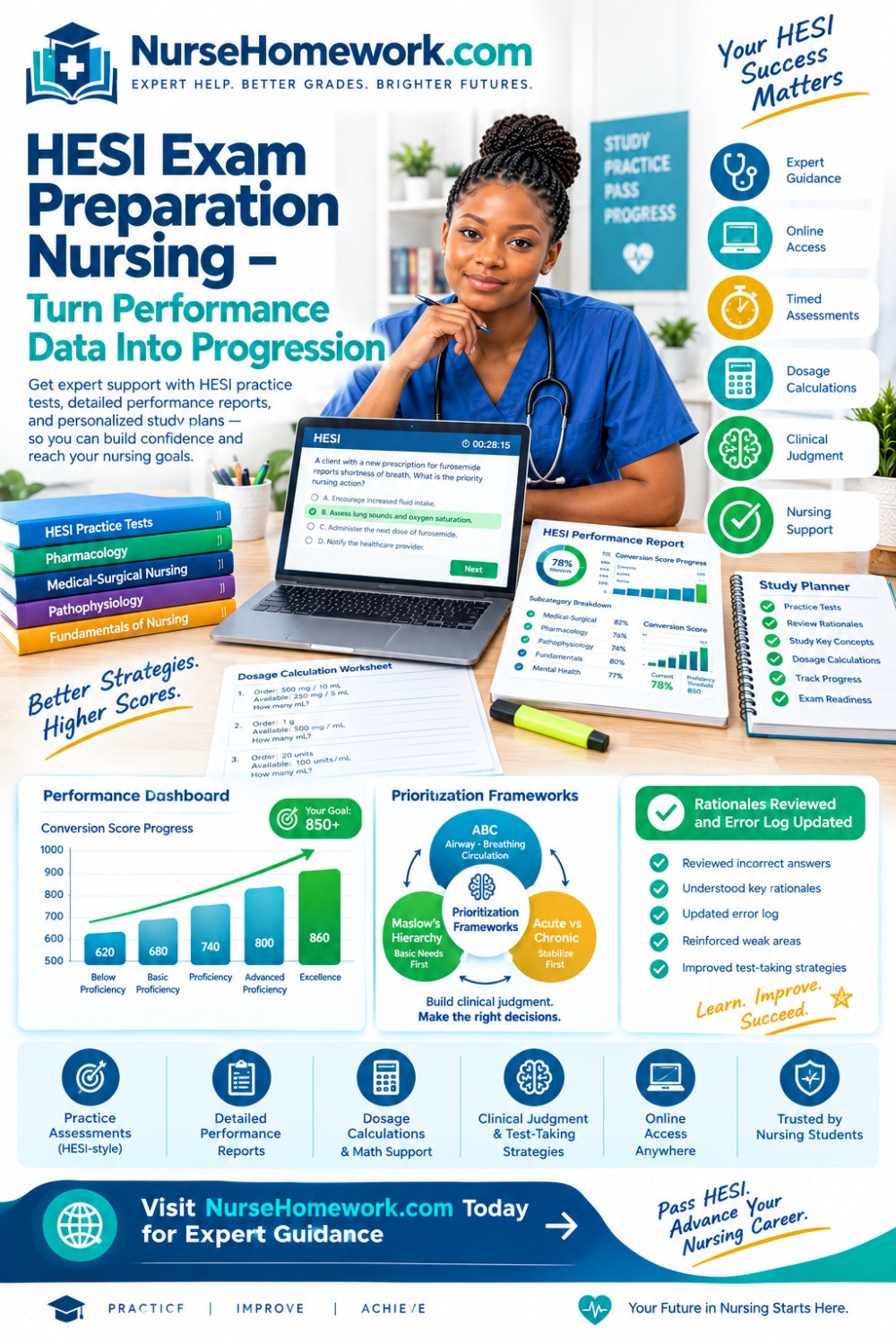
HESI exam preparation nursing is one of the most practical priorities for nursing students, because HESI assessments influence admission decisions, course grades, and program progression in ways that ordinary studying does not address. At NurseHomework.com, we understand that HESI exams require a distinct preparation strategy built around standardized benchmarks, clinical judgment, and disciplined remediation. This comprehensive guide provides HESI exam preparation nursing across exam types, content mastery, question analysis, and score improvement planning.
Understanding What HESI Exams Actually Measure
Before applying HESI exam preparation nursing, it is essential to understand what the HESI suite actually assesses. HESI, developed by Elsevier, provides standardized assessments used by nursing programs for admission screening, course evaluation, and progression decisions. These exams are not course tests. They are standardized instruments benchmarked against national performance data.
The distinction matters enormously. A student who performed well in a medical-surgical course may still score below the national benchmark on a HESI specialty exam if their reasoning is underdeveloped or their content knowledge is narrow. HESI items test application and clinical judgment across broad content areas rather than the specific emphasis of a single course.
This is why HESI exam preparation nursing must address content breadth and reasoning simultaneously. Students who treat HESI exams as another chapter test consistently underperform students who prepare specifically for the format, the benchmark, and the conversion score implications.
Types of HESI Exams
HESI A2 Admission Assessment
The HESI A2 is used by many nursing programs as an admission requirement. It typically covers mathematics, reading comprehension, vocabulary and general knowledge, grammar, biology, chemistry, anatomy and physiology, and physics. Each section carries its own score, and programs set minimum thresholds that vary considerably.
Because the A2 determines admission rather than progression, preparation here has unusually high stakes. A strong A2 score can offset a weaker GPA, while a weak score can delay admission by a full cycle.
HESI Specialty Exams
Specialty exams cover specific content areas and are frequently embedded in nursing courses. Common examples include fundamentals, medical-surgical, pharmacology, maternal newborn, pediatric, psychiatric mental health, and community health. Institutional policies vary widely. Some programs require minimum conversion scores for progression, while others assign a grade component or mandate remediation below a designated benchmark.
HESI Exit Exam
The Exit Exam assesses readiness across the full curriculum and generates a probability of NCLEX success. Many programs require a minimum score before authorizing NCLEX candidacy, and some require a higher score for graduation with distinction.
Because of this, Exit Exam preparation is among the highest-stakes applications of HESI exam preparation nursing.
Custom and Course-Specific Assessments
Some programs administer customized HESI assessments aligned to specific courses or clinical rotations. These function similarly to specialty exams but with narrower content scope.
Understanding HESI Scoring
Conversion Scores
HESI reports both raw scores and conversion scores. The conversion score is the number most programs use for progression decisions because it normalizes difficulty across exam versions. Conversion scores are typically expressed on a scale where higher values indicate stronger performance.
National Benchmark Comparison
HESI provides national means and percentile rankings. Comparing your performance to the national mean reveals whether your score reflects a personal gap or a broadly difficult assessment.
Subcategory Performance
HESI reports performance by subcategory within each exam. This data reveals which content areas require attention rather than leaving students to guess. Directing study time using this data is the single most efficient application of HESI exam preparation nursing.
Remediation Triggers
Most programs define a conversion score threshold that triggers mandatory remediation. Understanding your program’s specific policy is the first practical step in any preparation plan, because the consequences of scoring below threshold vary from additional assignments to delayed progression.
Building a HESI Study Plan
Begin With a Diagnostic Assessment
Complete a practice assessment under timed conditions before beginning content review. This establishes a baseline and identifies weak subcategories.
Analyze Every Missed Item
Categorize each missed item as a content gap, a misread question, a priority reasoning error, or an application error. Each category requires a different remedy, and misdiagnosing the cause leads to wasted preparation.
Prioritize by Subcategory Weighting
Not all subcategories carry equal weight. Direct disproportionate time toward heavily weighted areas where your performance is weakest.
Integrate Content Review With Question Practice
Review a content area and immediately practice items from that area. Retention improves substantially when review is followed by application rather than separated from it.
Schedule Spaced Review
Revisit content at expanding intervals such as day one, day three, day seven, and day twenty-one. Massed review before an assessment produces rapid forgetting.
Build a Written Plan With Dates
A written plan with specific topics, dates, and milestones produces better outcomes than a general intention to study more. This structure is a core component of effective HESI exam preparation nursing.
HESI A2 Section-by-Section Preparation
Mathematics
Focus on fractions, decimals, ratios, proportions, percentages, and basic algebra. Practice without a calculator if your testing center prohibits one. Accuracy matters more than speed, though timing practice prevents panic.
Reading Comprehension
Practice identifying main ideas, supporting details, inferences, and author purpose. This section tests interpretation rather than recall, and it benefits from deliberate passage analysis rather than skimming.
Vocabulary and General Knowledge
Build vocabulary through context and word roots rather than isolated memorization. Medical terminology prefixes, suffixes, and roots appear frequently and reward systematic study.
Grammar
Review sentence structure, punctuation, subject-verb agreement, pronoun use, and modifier placement. This section rewards careful reading rather than intuition.
Biology
Focus on cell structure, cellular respiration, photosynthesis, mitosis and meiosis, genetics, and basic ecology.
Chemistry
Focus on atomic structure, the periodic table, chemical bonding, reactions, stoichiometry, and acids and bases.
Anatomy and Physiology
This section carries substantial weight. Prioritize body systems, terminology, homeostasis, and the relationship between structure and function.
Physics
Focus on motion, forces, energy, waves, and basic electricity. This section appears less frequently but still contributes to the total score.
HESI Specialty Exam Content Areas
Fundamentals
Tests safety, infection control, positioning, mobility, nutrition, elimination, and basic nursing skills. Prioritization frameworks appear frequently.
Medical-Surgical Nursing
The broadest content area. Prioritize fluid and electrolytes, acid-base balance, perioperative care, and management of common chronic conditions.
Pharmacology
Focus on drug classifications, mechanisms of action, major adverse effects, and nursing considerations rather than memorizing individual drugs. Practice dosage calculations until the method is automatic.
Maternal Newborn Nursing
Focus on fetal monitoring interpretation, labor stages, postpartum complications, and newborn assessment and transition.
Pediatric Nursing
Prioritize developmental milestones, weight-based dosing, and recognition of deterioration in children, who compensate until they decompensate rapidly.
Psychiatric Mental Health Nursing
Focus on therapeutic communication, psychopharmacology, suicide risk assessment, and crisis intervention. Practice distinguishing therapeutic from non-therapeutic responses.
Community Health Nursing
Prioritize epidemiology principles, health promotion, and population-focused interventions.
Mastering Prioritization Frameworks
Prioritization items appear across virtually every HESI assessment, and consistent frameworks resolve them reliably.
ABC Framework
Airway, breathing, and circulation outrank all other concerns in acute scenarios.
Maslow’s Hierarchy
Physiological needs precede safety, which precedes psychosocial needs.
Acute Versus Chronic
A newly symptomatic client outranks a client with an established, unchanged diagnosis.
Unstable Versus Stable
Address the unstable client first regardless of admission time or room assignment.
Safety and Infection Control Breaches
Immediate attention is required when precautions are breached or medication safety is compromised.
Delegation Rules
Delegation requires matching task to licensure level and to client stability. Assessment, teaching, evaluation, and nursing judgment cannot be delegated. Unstable clients cannot be delegated to assistive personnel.
Question Analysis Strategies for HESI Items
Read the Entire Question Before the Options
Time pressure encourages skimming, which produces misread questions. Reading the full stem first prevents premature commitment.
Identify the Question Type
Determine whether the item asks for the first action, the best action, the priority client, an expected finding, or a complication to anticipate.
Note Qualifiers
Words such as initial, first, priority, most, least, immediate, and expected change the answer entirely.
Eliminate Absolutes With Judgment
Options containing always, never, all, and only are frequently incorrect, though not universally so.
Avoid Adding Assumptions
Answer using only the information provided. Adding unstated assumptions is a frequent source of missed items.
Review Every Rationale
Review rationales for items answered correctly as well as incorrectly. Most learning occurs in the rationale, not the answer selection.
Maintain an Error Log
Record recurring mistakes in a single document and review it before each assessment. Most students have a stable set of recurring errors accounting for a disproportionate share of lost points.
Remediation Planning After Low Performance
Understand Your Program’s Policy
Programs differ in remediation requirements, deadlines, retake allowances, and consequences for repeated low performance. Confirming policy prevents avoidable progression problems.
Address Content Gaps Systematically
Use subcategory performance data to direct content review. Comprehensive re-review of everything wastes time that should be concentrated on genuine weaknesses.
Distinguish Content Deficits From Reasoning Deficits
Students who know content well but perform poorly on application items typically have a reasoning deficit rather than a knowledge deficit. Misdiagnosing this wastes weeks of preparation.
Build a Written Remediation Plan
A written plan with dates, topics, and milestones produces better outcomes than an intention to study more. This structure is central to effective HESI exam preparation nursing.
Practice Under Timed Conditions
Untimed practice develops knowledge but not assessment performance. Timed practice develops pacing, stamina, and decision-making under pressure.
Reassess With Practice Assessments
Repeat practice assessments periodically to verify that preparation is producing measurable improvement rather than a subjective sense of progress.
HESI Exit Exam Preparation
The Exit Exam carries the highest stakes among HESI assessments because many programs require a minimum score before authorizing NCLEX candidacy.
Prepare Across the Full Curriculum
The Exit Exam samples broadly. Narrow study focused on one or two content areas produces poor results regardless of depth.
Increase Case Study Practice
The Exit Exam emphasizes clinical judgment through case-based items. Practice with unfolding scenarios that reveal information progressively.
Simulate Full-Length Conditions
Complete at least one full-length practice assessment under timed, distraction-reduced conditions before the actual exam.
Review High-Yield Content in the Final Week
Consolidate laboratory values, isolation precautions, medication classifications, and prioritization frameworks rather than acquiring new content.
Protect Sleep Before the Exam
Sleep consolidates memory. Sacrificing sleep to study additional hours reliably reduces performance.
Managing HESI Exam Anxiety
Prepare Thoroughly
Anxiety decreases with genuine preparedness. Adequate preparation remains the most reliable intervention available.
Simulate Exam Conditions
Practice under timed, distraction-reduced conditions to reduce novelty on exam day.
Use Controlled Breathing
Slow diaphragmatic breathing before the exam and during breaks moderates physiological arousal.
Reframe Physiological Arousal
Interpreting a racing heart as readiness rather than fear improves performance.
Avoid Comparison With Peers
Individual preparation timelines differ substantially. Comparison produces anxiety without improving outcomes.
Address Persistent Anxiety Directly
If anxiety consistently impairs performance despite preparation, seek support from academic advisors, counseling services, or structured academic support.
Common HESI Preparation Mistakes
Completing practice assessments for compliance. Rushing through practice assessments without analyzing rationales wastes the primary diagnostic tool available.
Relying on content review alone. HESI items test application and reasoning, which content review does not develop.
Studying familiar content repeatedly. This feels productive while leaving weak subcategories untouched.
Practicing untimed. This develops knowledge but not assessment performance.
Ignoring rationales. Most learning occurs in the rationale, not the answer.
Memorizing without understanding. Reasoning items cannot be answered by memorized facts alone.
Neglecting dosage calculation practice. Calculation accuracy is a safety competency and frequently assessed.
Sacrificing sleep before assessments. Sleep consolidates memory, and its loss reliably reduces performance.
Ignoring conversion score policy. Understanding your program’s thresholds determines how much preparation intensity is genuinely required.
How NurseHomework.com Supports HESI Preparation
At NurseHomework.com, we provide comprehensive HESI exam preparation nursing support tailored to the demands of HESI A2, specialty exams, and the Exit Exam. Our services include:
Personalized HESI study plan development based on practice assessment data
Content review organized by HESI subcategories and conversion score targets
Clinical judgment development using the Clinical Judgment Measurement Model
Structured practice with case studies, prioritization items, and alternate question formats
Prioritization and delegation strategy instruction
Rationale analysis for both correct and incorrect responses
Dosage calculation verification and safe formatting review
Remediation planning for students below threshold
Exit Exam preparation strategies across the full curriculum
Error log development to eliminate recurring mistakes
Whether you are preparing for the HESI A2 for admission, a specialty exam for progression, or the Exit Exam for NCLEX authorization, NurseHomework.com provides HESI exam preparation nursing support calibrated to your specific performance profile.
Frequently Asked Questions About HESI Exam Preparation Nursing
What is the HESI exam in nursing school?
HESI provides standardized assessments used by nursing programs for admission screening, course evaluation, and progression decisions, benchmarked against national performance data.
What is the difference between the HESI A2 and HESI specialty exams?
The HESI A2 is an admission assessment covering mathematics, reading, vocabulary, grammar, and sciences. Specialty exams cover specific nursing content areas and are typically embedded within courses.
What is a good HESI conversion score?
Thresholds vary by program and exam. Most programs designate a minimum conversion score for progression, so review your program’s specific policy and the national benchmark data in your report.
How do I prepare for the HESI A2?
Focus on mathematics, reading comprehension, vocabulary, and grammar alongside biology, chemistry, and anatomy and physiology. Practice under timed conditions and review every missed item by cause.
How do I prepare for a HESI specialty exam?
Complete a practice assessment for baseline data, analyze every missed item, direct study toward weak subcategories, integrate content review with question practice, and reassess with practice assessments.
How do I prepare for the HESI Exit Exam?
Prepare across the full curriculum, increase case study practice, simulate full-length timed conditions, review high-yield content in the final week, and protect sleep.
Can NurseHomework.com help with HESI exam preparation nursing?
Yes. NurseHomework.com offers personalized HESI exam preparation nursing including study planning, clinical judgment instruction, and dosage calculation review.
What should I do if I score below the threshold on a HESI exam?
Confirm your program’s remediation policy, address content gaps using subcategory data, distinguish content deficits from reasoning deficits, build a written remediation plan, and reassess with practice assessments.
Why do HESI exams feel harder than course exams?
HESI assessments test application and clinical judgment across broad content areas rather than the specific emphasis of a single course, and they are benchmarked nationally.
How long should I study for a HESI exam?
Begin structured preparation at least two weeks before a specialty exam and six to twelve weeks before the Exit Exam, adjusting intensity based on your baseline performance data.
Applying HESI exam preparation nursing effectively means treating HESI assessments as standardized instruments rather than course tests. By completing practice assessments for genuine diagnostic data, analyzing every missed item by cause, directing study toward weak subcategories, integrating content review with timed question practice, mastering prioritization frameworks, planning remediation systematically, and preparing comprehensively for the Exit Exam, you convert HESI requirements from a source of anxiety into a structured path toward program progression and NCLEX readiness.
At NurseHomework.com, we are committed to helping you succeed on every HESI assessment you face. Our personalized planning, clinical judgment instruction, and question analysis support make HESI exam preparation nursing practical, targeted, and effective. Don’t let HESI benchmarks stand between you and your nursing career. Visit NurseHomework.com today and discover how we can help you master HESI exam preparation nursing and excel in your nursing program.
- HESI exam preparation nursing
- HESI exam preparation nursing
- HESI exam preparation nursing
- HESI exam preparation nursing
- HESI exam preparation nursing
- HESI exam preparation nursing
- HESI exam preparation nursing
- HESI exam preparation nursing
- HESI exam preparation nursing
- HESI exam preparation nursing
- HESI exam preparation nursing
- HESI exam preparation nursing
Needs help with Nursing Assignment?
We are available 24x7 to deliver the best services and assignment ready within 3-4 hours? Order a custom-written, plagiarism-free paper
 Get Answer Over WhatsApp
 Order Paper Now
