How to Write a Nursing Clinical Reflection Paper
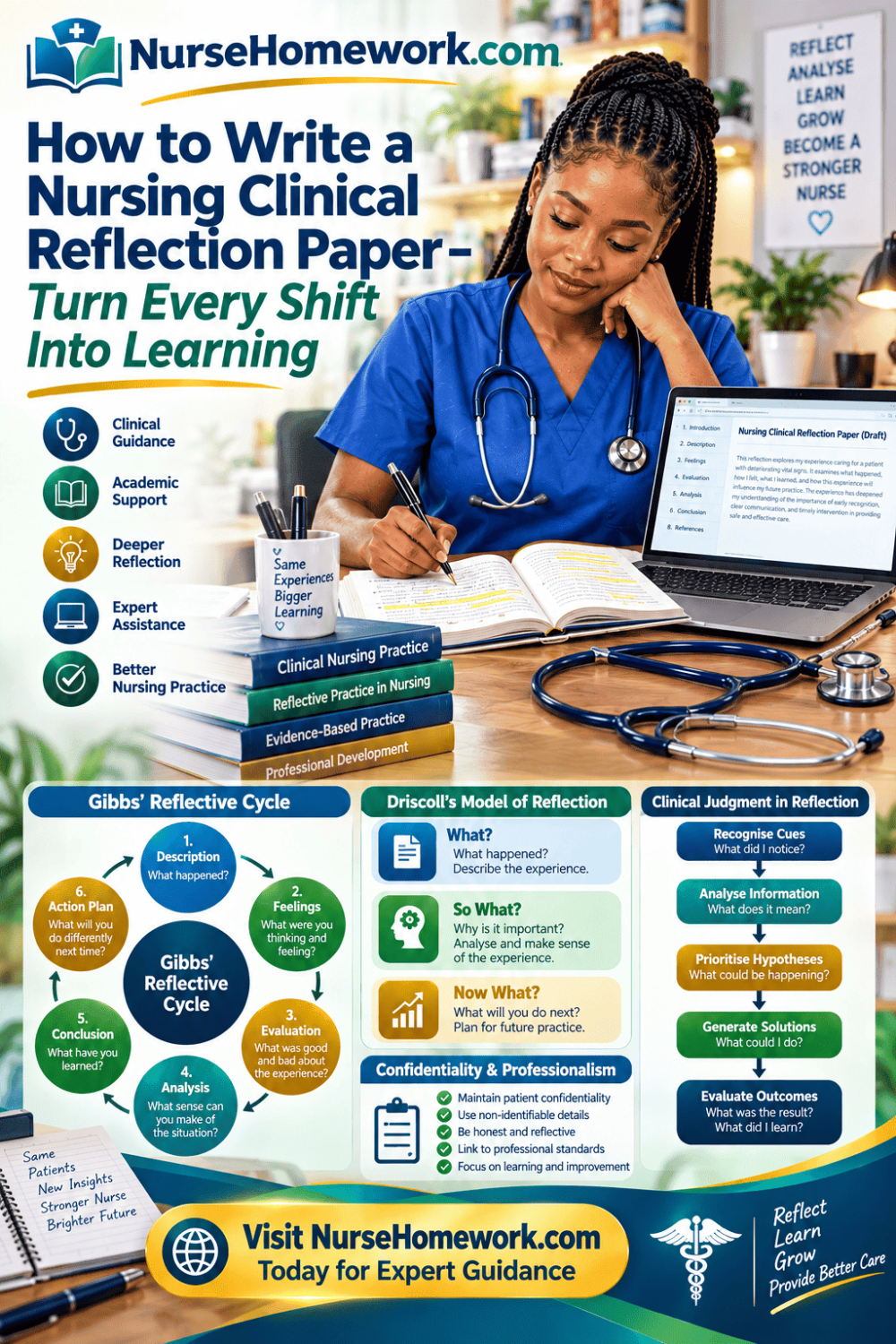
How to write a nursing clinical reflection paper is one of the most valuable skills a nursing student can develop, because clinical reflection transforms shifts into lasting clinical judgment rather than fading memories. At NurseHomework.com, we understand that clinical reflection papers differ from general reflective essays in a crucial way: they must be grounded in a specific clinical event from a rotation, analyzed with professional frameworks, and connected to safe practice. This comprehensive guide explains how to write a nursing clinical reflection paper across model selection, clinical event description, analysis development, confidentiality, and assessment criteria.
What Makes a Clinical Reflection Paper Different
Before going further into how to write a nursing clinical reflection paper, it is essential to understand what distinguishes this genre from other reflective writing. A clinical reflection paper focuses on a specific event within a clinical rotation—a patient interaction, a procedure, a communication breakdown, a decision point, or an ethical moment. The clinical setting is the source of the experience, and the learning must connect to professional practice.
Unlike a general reflective essay, a clinical reflection paper must demonstrate clinical relevance. Instructors look for evidence that you understood the clinical significance of the event, not merely that you felt something about it. A reflection describing a distressing moment without examining what the situation revealed about clinical judgment, communication, or safety misses the purpose entirely.
Clinical reflection papers also carry a stronger emphasis on professional development. Because clinical rotations are where students form their professional identity, these papers frequently assess whether you are developing the habits of a reflective practitioner rather than a task completer. This is precisely why how to write a nursing clinical reflection paper deserves deliberate attention.
Why Nursing Programs Require Clinical Reflection
Nursing programs require clinical reflection for reasons grounded in professional standards rather than academic tradition.
Continuous professional development. Regulatory bodies expect nurses to engage in reflective practice as part of maintaining competence and revalidation.
Clinical judgment development. Reflection converts clinical experience into transferable reasoning. Without it, twelve-hour shifts produce familiarity rather than insight.
Emotional processing. Clinical rotations expose students to suffering, death, ethical conflict, and error. Reflection provides structured processing rather than suppression.
Self-awareness. Recognizing your own assumptions, emotional responses, and limitations is a prerequisite for safe, patient-centered practice.
Evidence of learning. Clinical reflection papers provide instructors with evidence of how you think, not merely what you observed.
Understanding these purposes clarifies why superficial reflection is penalized. A paper that narrates a shift without analyzing a specific moment demonstrates that no learning occurred.
Choosing a Reflective Model
Most programs require a specific model, and applying it fully is where marks are earned. Selecting and applying the correct model is central to how to write a nursing clinical reflection paper.
Gibbs’ Reflective Cycle
Gibbs remains the most widely used model in nursing education, and it suits clinical reflection particularly well because its action plan stage forces forward-looking commitment.
Description. What happened during the clinical event?
Feelings. What were you thinking and feeling at the time and afterward?
Evaluation. What was good and bad about the experience?
Analysis. What sense can you make of it, and how does it connect to theory and evidence?
Conclusion. What else could you have done, and what have you learned?
Action plan. What will you do differently in your next clinical shift?
The action plan stage is especially important in clinical reflection because it converts insight into specific clinical behavior change.
Driscoll’s What, So What, Now What
Driscoll’s model suits shorter clinical reflection pieces or clinical log entries.
What? Describe the clinical event.
So what? Analyze its meaning and significance for your practice.
Now what? Identify what you will do differently going forward.
Johns’ Model for Structured Reflection
Johns’ model uses cue questions organized around aesthetics, personal knowledge, ethics, and empirics. It suits advanced practice and postgraduate clinical reflection.
Rolfe’s Framework
Rolfe’s reflective framework aligns closely with Driscoll’s and emphasizes the movement from description to analysis to action.
Clinical Judgment Measurement Model
Increasingly, programs ask students to structure clinical reflection around the Clinical Judgment Measurement Model: recognizing cues, analyzing cues, prioritizing hypotheses, generating solutions, taking action, and evaluating outcomes. This framing connects reflection directly to clinical reasoning development, and it is an advanced application of how to write a nursing clinical reflection paper.
Selecting the Clinical Event to Reflect On
The choice of event determines the quality of the paper.
Choose a Specific Moment, Not a Whole Shift
A reflection on an entire twelve-hour shift becomes a narrative summary. A reflection on a two-minute interaction, a specific decision point, or a single observation produces genuine analysis.
Choose an Event With Genuine Learning
The best clinical events for reflection involve uncertainty, discomfort, error, surprise, or a gap between what you expected and what occurred. Events that went smoothly provide less material for analysis.
Choose an Event Relevant to Professional Development
Consider events involving communication, prioritization, delegation, patient advocacy, ethical conflict, or safety. These connect naturally to professional standards.
Confirm the Event Meets Program Requirements
Some programs specify the type of event required—for example, an event involving patient education, interprofessional collaboration, or an ethical dilemma. Confirming requirements before writing prevents complete restructuring.
Ensure Confidentiality Is Maintainable
If the event involves a rare condition, a distinctive patient characteristic, or an unusual circumstance, de-identification becomes difficult. Selecting events that can be thoroughly de-identified protects both you and the patient.
Gathering Details While the Memory Is Fresh
Clinical reflection depends on accurate recall, and memory degrades quickly.
Write Clinical Notes Immediately After the Shift
Record observations, feelings, questions, and any dialogue you can recall within hours of the clinical experience. These notes become raw material for the reflection paper.
Note Specific Sensory and Emotional Details
Recalling that your hands were shaking while preparing a medication, or that a patient’s family member was crying in the hallway, produces richer reflection than generic descriptions.
Record Questions That Arose
Questions you asked yourself during the shift frequently reveal the learning edge that the reflection paper should explore.
Capture Any Feedback Received
Feedback from preceptors, instructors, or patients often becomes the most analytically rich material in a clinical reflection paper.
Structuring a Nursing Clinical Reflection Paper
Introduction
The introduction establishes the clinical context, identifies the reflective model you will use, and states what the paper will examine. It should be brief and should not reveal the conclusion prematurely.
Description of the Clinical Event
Provide a concise factual account of what occurred. This section should be economical, because excessive narrative detail crowds out analysis.
Include the clinical setting, your role, the patient situation in de-identified form, and the sequence of events. State explicitly that confidentiality has been maintained.
Feelings and Reactions
Examine your emotional response honestly. Nursing culture has historically discouraged emotional disclosure, but clinical reflection requires it.
Be specific rather than generic. “I felt nervous” is weaker than “I felt nervous because I noticed my preceptor watching me, and I worried that hesitation would be interpreted as incompetence.”
Analysis
This is the most heavily weighted section. Analysis requires connecting your clinical event to nursing theory, evidence, professional standards, or ethical frameworks.
Useful analytic moves include:
Connecting the event to a clinical framework such as the nursing process or the Clinical Judgment Measurement Model
Relating your actions to evidence-based practice
Examining ethical dimensions using the four principles of biomedical ethics
Considering alternative approaches and why they might have produced different outcomes
Exploring communication, teamwork, or system factors
Recognizing assumptions or biases that shaped your interpretation
Analysis is where how to write a nursing clinical reflection paper becomes genuinely intellectual rather than autobiographical.
Conclusion
Summarize what you learned and identify the specific insight that emerged from your analysis.
Action Plan
State concretely what you will do differently in future clinical shifts. Effective action plans are specific, measurable, and realistic.
“I will communicate better” is not an action plan. “I will use SBAR for every handoff in my next clinical rotation and ask my preceptor to observe two handoffs and provide feedback” is an action plan.
Writing About Clinical Events Ethically
Clinical reflection raises ethical obligations that general reflective writing does not.
De-Identify Thoroughly
Use initials or a pseudonym. Omit dates, locations, ages when combined with other identifying features, rare diagnoses, and distinctive circumstances. State explicitly that confidentiality has been maintained.
Avoid Disparaging Colleagues
Reflection requires honesty, but it also requires discretion. Frame criticism constructively, focusing on systems and learning rather than individuals.
Acknowledge Your Own Role
Clinical reflection is not a venue for blaming others. Examine your own decisions, assumptions, and responses alongside the actions of others.
Do Not Fabricate Events
Inventing clinical experiences to satisfy an assignment is a serious integrity violation. If you cannot recall sufficient detail from a real event, choose a different event.
Respect Institutional Policies
Some institutions restrict what may be written about clinical sites. Confirm any applicable policies before writing.
Protect Patient Dignity
Even when de-identified, patients should be described with respect. Reflection papers are academic documents, not clinical gossip.
Writing Style and Language Conventions
First Person Is Required
Clinical reflection uses first person because the subject is your own experience. This is an explicit exception to standard academic convention, and understanding it is part of how to write a nursing clinical reflection paper correctly.
Past Tense for the Event, Present Tense for Analysis
Describe the clinical event in past tense. Discuss your current understanding and general principles in present tense.
Avoid Defensiveness
Reflection requires acknowledging errors, uncertainty, and discomfort. Papers that portray the writer as flawless demonstrate a failure of reflection.
Use Clinical Terminology Accurately
Clinical reflection papers should demonstrate command of nursing terminology. Misusing terms signals unfamiliarity and undermines credibility.
Support Analysis With Evidence
Clinical reflection papers benefit from citations. Referencing a communication framework, an ethical principle, or a clinical guideline strengthens the analysis and demonstrates engagement with the evidence base.
Assessment Criteria: What Instructors Look For
Understanding how clinical reflection papers are graded clarifies what to prioritize.
Depth of reflection. Does the paper move beyond description into analysis?
Use of the reflective model. Are all stages of the chosen model addressed?
Clinical relevance. Does the reflection demonstrate understanding of the clinical significance of the event?
Integration of theory. Is the experience connected to nursing knowledge, ethics, or evidence?
Self-awareness. Does the writer examine their own assumptions, feelings, and limitations honestly?
Insight and learning. Is there a clear, specific articulation of what was learned?
Action planning. Are future clinical changes concrete and realistic?
Academic writing standards. Is the paper clearly written, properly referenced, and correctly formatted?
Confidentiality. Has patient privacy been protected?
Meeting these criteria consistently is what distinguishes papers that score highly, and it defines the practical standard for how to write a nursing clinical reflection paper.
Common Mistakes in Clinical Reflection Papers
Stopping at description. The most frequent error is recounting a clinical event without analyzing it.
Choosing an entire shift instead of a specific moment. Broad narratives prevent depth.
Generic reflection. Statements such as “I learned the importance of communication” demonstrate no specific learning.
Avoiding emotion. Suppressing feelings produces a hollow paper.
Avoiding self-critique. Portraying yourself as having acted perfectly signals defensiveness.
Breaching confidentiality. Including identifying patient details is both unethical and penalized.
Ignoring the reflective model. Each stage must be addressed.
Missing the action plan. Reflection without commitment to change is incomplete.
Weak or absent citations. Analysis supported by theory and evidence is stronger than opinion.
Superficial conclusions. Ending with a general statement about the value of experience demonstrates no insight.
Reflecting on Difficult Clinical Experiences
Not all clinical reflection involves positive outcomes, and the most valuable papers frequently address difficulty.
Reflecting on Clinical Errors
Errors provide powerful learning opportunities. Examine what happened, why it happened, what system factors contributed, what you felt, what you learned, and what safeguards you will adopt. Focus on learning rather than self-punishment.
Reflecting on Ethical Conflict
Ethical dilemmas are frequent in clinical practice. Reflection can examine which principles were in tension, how the conflict was resolved, whether you advocated effectively, and what you would do differently.
Reflecting on Patient Death
Death is a common clinical experience and a difficult one to process. Reflection provides a structured way to examine your emotional response, the care provided, the family’s experience, and your professional development.
Reflecting on Communication Failures
Communication breakdowns are frequent and instructive. Reflection can examine what you intended, what was received, why the gap occurred, and what strategies would prevent recurrence.
Reflecting on Moral Distress
Moral distress occurs when you know the ethically appropriate action but feel prevented from taking it. Reflection can examine the source of constraint, your response, and strategies for future advocacy.
Reflecting on Cultural Differences
Cultural encounters that surprise or unsettle you frequently reveal assumptions worth examining. Reflection can address what you assumed, what you learned, and how you will practice differently.
Applying the Clinical Judgment Measurement Model to Clinical Reflection
The Clinical Judgment Measurement Model provides a strong analytic structure for clinical reflection papers because it organizes reasoning into six observable steps.
A reflection might examine which cues you recognized and which you missed. It might analyze how you interpreted a cluster of findings and whether your interpretation was accurate. It might examine how you prioritized competing hypotheses and whether your prioritization reflected genuine clinical priority. It might assess whether your interventions addressed the underlying problem. And it might evaluate whether you recognized the patient’s response accurately.
Structuring reflection around these steps demonstrates that you understand how clinical reasoning develops, and it is an advanced application of how to write a nursing clinical reflection paper that distinguishes strong submissions.
Practical Writing Strategies
Write Notes Immediately After the Shift
Memory degrades quickly. Recording observations, feelings, and questions within hours of the clinical experience produces far richer reflection than reconstruction weeks later.
Draft Without Editing
Separate drafting from editing. Producing a rough draft quickly and revising afterward produces better writing than attempting to compose perfectly in one pass.
Read Aloud
Reading aloud reveals awkward constructions, missing words, and unintended repetition.
Ask a Peer to Review
Peers identify where your analysis becomes vague, because they read without your background assumptions.
Check Confidentiality Carefully
Before submission, review the paper specifically for identifying details.
Verify the Rubric
Compare the finished paper against each rubric criterion. Three minutes of rubric comparison regularly recovers marks.
Keep a Semester Clinical Journal
Maintaining a running clinical journal throughout the semester ensures you always have rich material available when reflection papers are assigned, and it develops the reflective habit that professional practice requires.
How NurseHomework.com Supports Clinical Reflection Writing
At NurseHomework.com, we provide comprehensive support for nursing students working on how to write a nursing clinical reflection paper. Our services include:
Reflective model application guidance for Gibbs, Driscoll, Johns, and Rolfe
Clinical Judgment Measurement Model structuring for reflection papers
Clinical event selection guidance to identify moments with genuine learning potential
Structural review confirming every stage of the chosen model is addressed
Analysis development support to move beyond description
Theoretical framework integration and evidence citation
Confidentiality and ethical boundary review for clinical examples
Action plan development with specific, measurable clinical commitments
APA 7th edition citation and reference verification
Rubric alignment checks to confirm every criterion is met
Whether you are writing a first clinical journal entry or a capstone clinical reflection paper, NurseHomework.com is here to support your development as a reflective practitioner.
Frequently Asked Questions About How to Write a Nursing Clinical Reflection Paper
What is a nursing clinical reflection paper?
It is a paper examining a specific event from a clinical rotation, analyzing your thoughts, feelings, and actions using a reflective model, and articulating what you learned and how you will change your practice.
Which reflective model should I use for clinical reflection?
Gibbs’ Reflective Cycle is most common. Driscoll’s What, So What, Now What suits shorter pieces. Some programs require the Clinical Judgment Measurement Model.
Should I reflect on an entire shift or a specific moment?
A specific moment. Reflecting on an entire shift produces narrative summary, while a single interaction or decision point produces genuine analysis.
Can I use first person in a clinical reflection paper?
Yes. Clinical reflection requires first person because the subject is your own experience. This is an explicit exception to standard academic convention.
How do I maintain patient confidentiality in a clinical reflection paper?
Use initials or a pseudonym, omit identifying details such as dates, locations, and rare conditions, and state explicitly that confidentiality has been maintained.
What is the difference between description and analysis in clinical reflection?
Description reports what happened. Analysis interprets why it happened, what it means, and how it connects to nursing knowledge, evidence, or ethics. Marks are earned in analysis.
Can NurseHomework.com help with a nursing clinical reflection paper?
Yes. NurseHomework.com offers reflective model guidance, clinical event selection support, and analysis development for how to write a nursing clinical reflection paper.
How do I reflect on a clinical error?
Examine what happened, why it happened, what system factors contributed, what you felt, what you learned, and what safeguards you will adopt. Focus on learning rather than self-punishment.
How long should a nursing clinical reflection paper be?
Length varies by program, but most range from 1,000 to 2,500 words. Always confirm the required length and required reflective model.
What is the most common mistake in clinical reflection papers?
Stopping at description. A paper that recounts a clinical event without analyzing it demonstrates that no learning occurred.
Learning how to write a nursing clinical reflection paper is ultimately about developing the habit of examining your own clinical practice critically and constructively. By selecting a specific clinical moment with genuine learning potential, choosing and fully applying a reflective model, describing the event concisely, examining your feelings honestly, analyzing the experience through theory and evidence, drawing a specific conclusion, committing to a concrete action plan, and protecting patient confidentiality throughout, you transform clinical shifts into durable professional growth.
At NurseHomework.com, we are committed to helping nursing students become reflective practitioners. Our model guidance, clinical event selection support, and analysis development make how to write a nursing clinical reflection paper structured, meaningful, and achievable. Don’t treat clinical reflection as a compliance exercise. Visit NurseHomework.com today and discover how we can help you master how to write a nursing clinical reflection paper and grow into the practitioner your patients will depend on.
- How to write a nursing clinical reflection paper
- How to write a nursing clinical reflection paper
- How to write a nursing clinical reflection paper
- How to write a nursing clinical reflection paper
- How to write a nursing clinical reflection paper
- How to write a nursing clinical reflection paper
- How to write a nursing clinical reflection paper
- How to write a nursing clinical reflection paper
- How to write a nursing clinical reflection paper
- How to write a nursing clinical reflection paper
- How to write a nursing clinical reflection paper
- How to write a nursing clinical reflection paper
- How to write a nursing clinical reflection paper
- How to write a nursing clinical reflection paper
- How to write a nursing clinical reflection paper
- How to write a nursing clinical reflection paper
Needs help with Nursing Assignment?
We are available 24x7 to deliver the best services and assignment ready within 3-4 hours? Order a custom-written, plagiarism-free paper
 Get Answer Over WhatsApp
 Order Paper Now
