Medical-Surgical Nursing Study Guide: Your Complete Roadmap to Adult Health Mastery
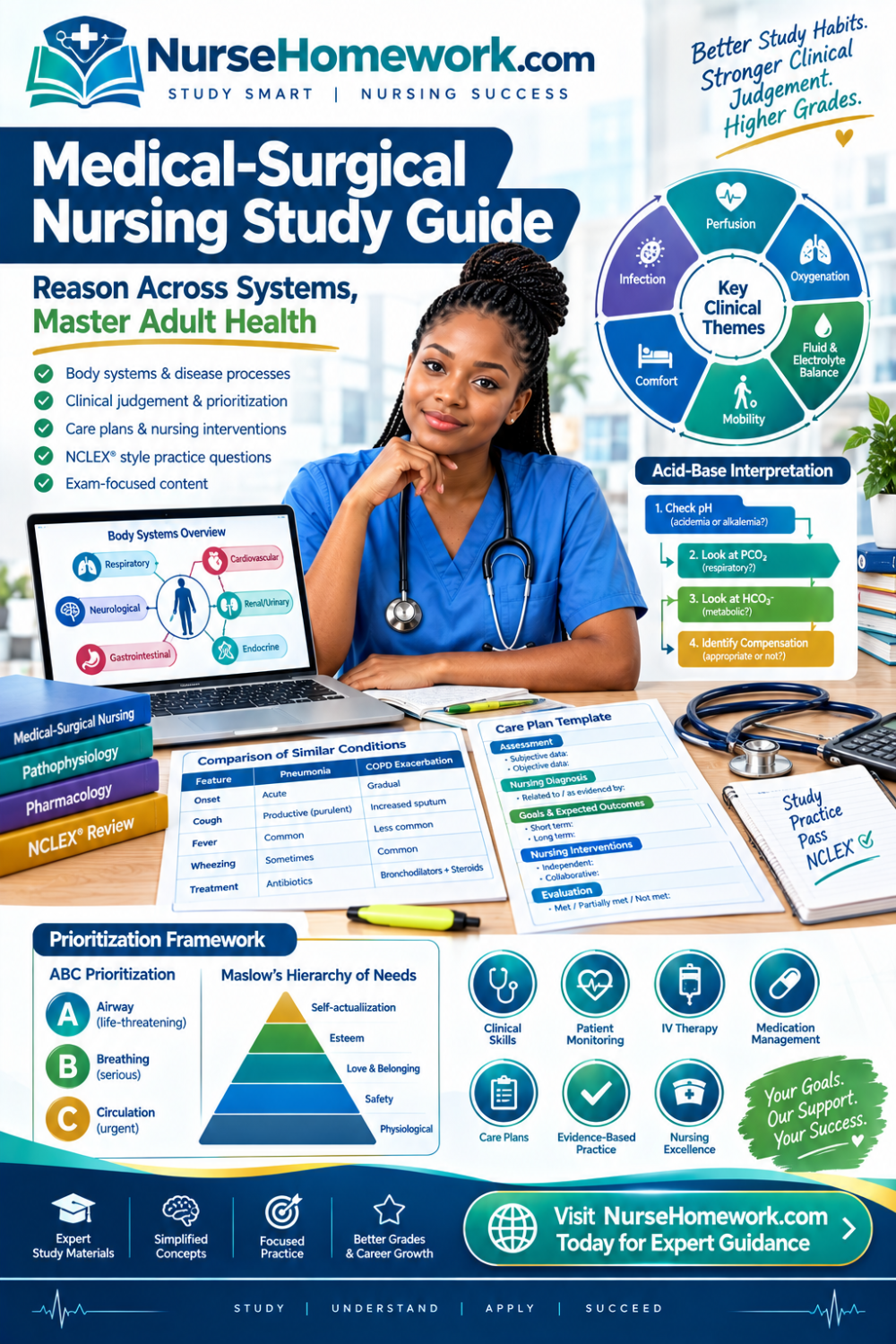
Medical-surgical nursing study guide resources are among the most valuable tools a nursing student can possess, because medical-surgical nursing represents the largest specialty in the profession and the broadest content area on the NCLEX. At NurseHomework.com, we understand that med-surg content can feel impossible to organize, and that a structured medical-surgical nursing study guide converts hundreds of disconnected conditions into a coherent reasoning framework. This comprehensive guide provides medical-surgical nursing study guide strategies across body systems, care planning, prioritization, and examination preparation.
Why Medical-Surgical Nursing Feels Overwhelming
Before applying any medical-surgical nursing study guide, it is essential to understand why this content area produces so much anxiety. The scope is genuinely enormous. Medical-surgical nursing covers every body system, every major chronic condition, every common surgical procedure, and every acute complication across the adult lifespan.
The second problem is structure. Textbooks organize content by chapter or diagnosis, but examination questions present clinical scenarios requiring reasoning across systems simultaneously. A client with heart failure who develops pneumonia and has diabetes requires reasoning about three systems at once. A well-designed medical-surgical nursing study guide reorganizes content around recurring concepts rather than disease lists.
The third problem is application. Med-surg questions rarely ask what a condition is. They ask which client should be assessed first, which finding requires immediate intervention, or which complication is most likely. These are judgment questions, and judgment requires understanding rather than memorization. This is precisely why a well-constructed medical-surgical nursing study guide emphasizes clinical reasoning above rote recall.
Start With Recurring Concepts, Not Disease Lists
The Concept-Based Approach
Rather than memorizing conditions individually, a strong medical-surgical nursing study guide organizes content around recurring concepts that appear across every body system.
Perfusion. Impaired perfusion underlies myocardial infarction, stroke, shock, peripheral vascular disease, and pulmonary embolism. Understanding perfusion as a concept allows reasoning about any condition that disrupts blood flow.
Oxygenation. Impaired oxygenation underlies COPD, pneumonia, pulmonary edema, and respiratory failure. Recognizing the shared mechanisms allows reasoning about ventilation, diffusion, and perfusion mismatches.
Fluid and Electrolyte Balance. Nearly every acute condition disrupts fluid or electrolyte status. Understanding sodium, potassium, calcium, magnesium, and acid-base balance is the single highest-yield investment in this content area.
Mobility. Impaired mobility contributes to pressure injuries, deep vein thrombosis, pneumonia, and deconditioning. It appears in orthopedic, neurological, and postoperative contexts alike.
Comfort. Pain management appears across all systems, and understanding analgesic classifications allows reasoning about any pain scenario.
Infection and Immunity. Surgical site infections, sepsis, and immunosuppression appear throughout medical-surgical nursing.
Cellular Regulation. Cancer care underlies oncology content and requires understanding of staging, treatment modalities, and oncological emergencies.
Sensory and Cognition. Neurological content requires understanding of orientation, consciousness, and cognitive change as a universal deterioration sign.
Elimination. Renal and gastrointestinal content shares common themes of obstruction, inflammation, and impaired excretion.
A concept-organized medical-surgical nursing study guide allows reasoning about unfamiliar scenarios by recognizing which concept is at stake.
Mastering Fluid, Electrolyte, and Acid-Base Content
This content area appears disproportionately on medical-surgical examinations and merits dedicated attention in any medical-surgical nursing study guide.
Key Electrolytes
Potassium. Normal range is approximately 3.5 to 5.0 mEq/L. Both hypo and hyperkalemia cause cardiac dysrhythmias. Potassium imbalances are the most frequently tested electrolyte disturbances.
Sodium. Normal range is approximately 135 to 145 mEq/L. Sodium imbalances reflect water balance rather than sodium intake, which is a distinction students frequently miss.
Calcium. Normal range is approximately 8.5 to 10.5 mg/dL. Hypocalcemia causes neuromuscular irritability, while hypercalcemia causes lethargy and altered mental status.
Magnesium. Normal range is approximately 1.3 to 2.1 mEq/L. Magnesium imbalances frequently accompany calcium and potassium imbalances.
Acid-Base Interpretation
Master the systematic approach that resolves every blood gas question.
Step one. Determine whether the pH is acidotic (below 7.35) or alkalotic (above 7.45).
Step two. Determine whether the carbon dioxide is acidotic or alkalotic. CO2 above 45 is acidotic.
Step three. Determine whether the bicarbonate is acidotic or alkalotic. Bicarbonate below 22 is acidotic.
Step four. Identify which system matches the pH direction. Respiratory imbalances involve the opposite direction of CO2, while metabolic imbalances involve the same direction as bicarbonate.
Step five. Determine compensation. If the pH is normal but both CO2 and bicarbonate are abnormal, the condition is fully compensated.
Body System Organization
Cardiovascular System
Prioritize coronary artery disease, myocardial infarction, heart failure, dysrhythmias, hypertension, and peripheral vascular disease. Understand hemodynamic monitoring, cardiac medications, and postoperative cardiac surgery care.
Respiratory System
Prioritize COPD, asthma, pneumonia, pulmonary embolism, and respiratory failure. Understand oxygen delivery devices, mechanical ventilation basics, and chest tube management.
Neurological System
Prioritize stroke, traumatic brain injury, increased intracranial pressure, seizures, and spinal cord injury. Understand neurological assessment, Glasgow Coma Scale scoring, and the significance of subtle changes in level of consciousness.
Gastrointestinal System
Prioritize gastrointestinal bleeding, inflammatory bowel disease, bowel obstruction, liver disease, and pancreatitis. Understand nasogastric tube management, ostomy care, and nutritional support.
Renal and Urinary System
Prioritize acute kidney injury, chronic kidney disease, dialysis, and urinary tract disorders. Understand fluid restrictions, electrolyte implications, and dialysis access care.
Endocrine System
Prioritize diabetes, thyroid disorders, adrenal disorders, and syndrome of inappropriate antidiuretic hormone. Understand insulin classifications, glucose monitoring, and acute complications such as diabetic ketoacidosis.
Musculoskeletal System
Prioritize fractures, joint replacement, and traction. Understand neurovascular assessment, compartment syndrome recognition, and early mobility principles.
Hematologic System
Prioritize anemia, coagulopathies, and transfusion therapy. Understand blood product administration and transfusion reaction recognition.
Integumentary System
Prioritize wound healing, pressure injuries, and burns. Understand wound assessment, staging, and burn fluid resuscitation.
Oncological Nursing
Prioritize chemotherapy, radiation therapy, and oncological emergencies. Understand neutropenic precautions, extravasation management, and tumor lysis syndrome.
Building an Effective Medical-Surgical Study System
Concept Mapping
Create maps connecting pathophysiology to manifestations, diagnostics, interventions, and evaluation. A well-constructed medical-surgical nursing study guide uses maps because they reveal relationships that linear notes conceal.
Comparison Tables
Contrast conditions presenting similarly. Crohn’s disease versus ulcerative colitis, hyperthyroidism versus hypothyroidism, and left-sided versus right-sided heart failure all appear as discrimination questions.
Laboratory Value Anchors
Memorize normal ranges for potassium, sodium, calcium, magnesium, glucose, hemoglobin, platelets, creatinine, and white blood cells. Nearly every scenario requires interpreting at least one value.
Medication Classification Fluency
Learn classifications rather than individual drugs. Understanding beta-blockers, ACE inhibitors, diuretics, anticoagulants, and corticosteroids allows reasoning about medications you have never seen.
Care Plan Templates
Standardize your approach to care plans so that each diagnosis follows a consistent structure of problem, etiology, signs and symptoms, SMART goals, interventions with rationale, and evaluation. This structure is central to any practical medical-surgical nursing study guide.
Mastering Prioritization and Delegation
Prioritization questions appear throughout medical-surgical examinations and follow consistent frameworks.
ABC Framework
Airway, breathing, and circulation outrank all other concerns in acute scenarios.
Maslow’s Hierarchy
Physiological needs precede safety, which precedes psychosocial needs.
Acute Versus Chronic
A newly symptomatic client outranks a client with an established, unchanged diagnosis.
Unstable Versus Stable
Address the unstable client first regardless of admission time or room assignment.
Safety and Infection Control Breaches
Immediate attention is required when precautions are breached or medication safety is compromised.
Delegation Rules
Delegation requires matching task to licensure level and to client stability. Assessment, teaching, evaluation, and nursing judgment cannot be delegated. Unstable clients cannot be delegated to assistive personnel.
Perioperative Nursing Content
Perioperative care appears consistently on medical-surgical examinations and deserves dedicated review in any medical-surgical nursing study guide.
Preoperative. Focus on informed consent, baseline assessment, medication reconciliation, and client teaching.
Intraoperative. Focus on positioning, asepsis, and the surgical safety checklist.
Postoperative. Focus on airway management, pain control, early mobility, wound assessment, and recognition of complications including hemorrhage, infection, atelectasis, and deep vein thrombosis.
Common Postoperative Complications
Hemorrhage. Presents with hypotension, tachycardia, decreasing hemoglobin, and restlessness.
Atelectasis. Presents with decreased breath sounds, low-grade fever, and hypoxemia.
Deep vein thrombosis. Presents with unilateral calf pain, swelling, and warmth. Never massage a suspected clot.
Surgical site infection. Presents with fever, wound redness, warmth, and purulent drainage.
Paralytic ileus. Presents with absent bowel sounds, abdominal distension, and nausea.
Urinary retention. Presents with bladder distension, restlessness, and absence of output.
Examination Preparation Strategies
Practice Application Questions
Medical-surgical examinations test application. Practice items requiring reasoning about which client should be assessed first, which finding is most concerning, or which intervention should be implemented.
Analyze Every Rationale
Review rationales for items answered correctly as well as incorrectly. Most learning occurs in the rationale rather than the answer selection. This is among the most emphasized recommendations in any medical-surgical nursing study guide.
Maintain an Error Log
Record recurring mistakes and review the log before each examination. Most students have a stable set of recurring errors accounting for a disproportionate share of lost points.
Prioritize High-Yield Content
Focus disproportionate attention on fluid and electrolytes, acid-base balance, prioritization, delegation, and postoperative complications.
Practice Under Timed Conditions
Untimed practice develops knowledge but not examination performance. Timed practice develops pacing and decision-making under pressure.
Increase Case Study Practice
As examinations move toward case-based formats, practice with unfolding scenarios that reveal information progressively and require reasoning across multiple steps.
Common Medical-Surgical Study Mistakes
Memorizing conditions individually. Concept-level understanding allows reasoning about unfamiliar scenarios.
Neglecting fluid and electrolytes. This content area appears disproportionately and rewards systematic study.
Relying on rereading. Passive review produces familiarity without retrieval ability.
Skipping rationales. Most learning occurs in the rationale, not the answer.
Practicing untimed. This develops knowledge but not examination performance.
Ignoring delegation rules. This content area is a frequent source of point loss.
Studying familiar systems repeatedly. This feels productive while leaving weak systems untouched.
Cramming before examinations. Massed review produces rapid forgetting and increases anxiety.
How NurseHomework.com Supports Medical-Surgical Mastery
At NurseHomework.com, we provide comprehensive medical-surgical nursing study guide support tailored to the demands of adult health coursework and licensure examinations. Our services include:
Concept-based content organization across all body systems
Fluid, electrolyte, and acid-base interpretation tutoring
Care plan development with NANDA-I diagnoses and SMART goals
Medication classification review and dosage calculation verification
Prioritization and delegation strategy instruction
Rationale analysis for practice questions
Error log development to eliminate recurring mistakes
Case study practice using the Clinical Judgment Measurement Model
Perioperative and postoperative complication review
Examination preparation strategies for medical-surgical assessments
Whether you are preparing for a unit examination, a comprehensive final, or the NCLEX, NurseHomework.com provides medical-surgical nursing study guide support calibrated to your specific performance profile.
Frequently Asked Questions About Medical-Surgical Nursing Study Guides
What should a medical-surgical nursing study guide include?
Recurring concepts, body system content, fluid and electrolyte interpretation, medication classifications, care plan structures, prioritization frameworks, and postoperative complication review.
Is it better to study by body system or by concept?
Both. Concepts allow reasoning across systems, while body system organization ensures no content area is neglected.
What is the highest-yield content area in medical-surgical nursing?
Fluid and electrolytes, acid-base balance, prioritization and delegation, and postoperative complications consistently yield the greatest examination returns.
How do I interpret blood gases?
Determine whether pH is acidotic or alkalotic, then determine which system matches that direction. Respiratory imbalances involve the opposite direction of CO2, while metabolic imbalances involve the same direction as bicarbonate.
What are the rights of medication administration?
The traditional five are right client, drug, dose, route, and time. Expanded rights include documentation, reason, response, and the right to refuse.
Which postoperative complications are most frequently tested?
Hemorrhage, atelectasis, deep vein thrombosis, surgical site infection, paralytic ileus, and urinary retention.
Can NurseHomework.com help with a medical-surgical nursing study guide?
Yes. NurseHomework.com offers personalized medical-surgical nursing study guide support including concept mapping, care plan development, and rationale analysis.
How do I answer prioritization questions correctly?
Apply the ABC framework, Maslow’s hierarchy, and the acute versus chronic and unstable versus stable comparisons. Assessment generally precedes intervention unless immediate danger exists.
What delegation rules should I memorize?
Assessment, teaching, evaluation, and nursing judgment cannot be delegated. Unstable clients cannot be delegated to assistive personnel.
How long should I study medical-surgical nursing each day?
Two to three focused hours daily using active recall and spaced repetition consistently outperforms marathon sessions, because retrieval quality declines sharply with fatigue.
A well-structured medical-surgical nursing study guide transforms the broadest content area in nursing education into a manageable reasoning system. By organizing content around recurring concepts rather than disease lists, mastering fluid and electrolyte interpretation, building comparison tables for similar conditions, learning medication classifications, applying prioritization frameworks consistently, and preparing through timed application questions with thorough rationale review, you develop the clinical judgment that medical-surgical practice and the NCLEX both demand.
At NurseHomework.com, we are committed to helping you master adult health nursing. Our concept-based instruction, care plan support, and rationale analysis make medical-surgical nursing study guide support practical, targeted, and effective. Don’t let the scope of medical-surgical nursing overwhelm your preparation. Visit NurseHomework.com today and discover how we can help you master medical-surgical nursing study guide content and excel in your nursing program.
Needs help with Nursing Assignment?
We are available 24x7 to deliver the best services and assignment ready within 3-4 hours? Order a custom-written, plagiarism-free paper
 Get Answer Over WhatsApp
 Order Paper Now
