Nursing Capstone Project Guidance: Plan, Research and Present with Confidence
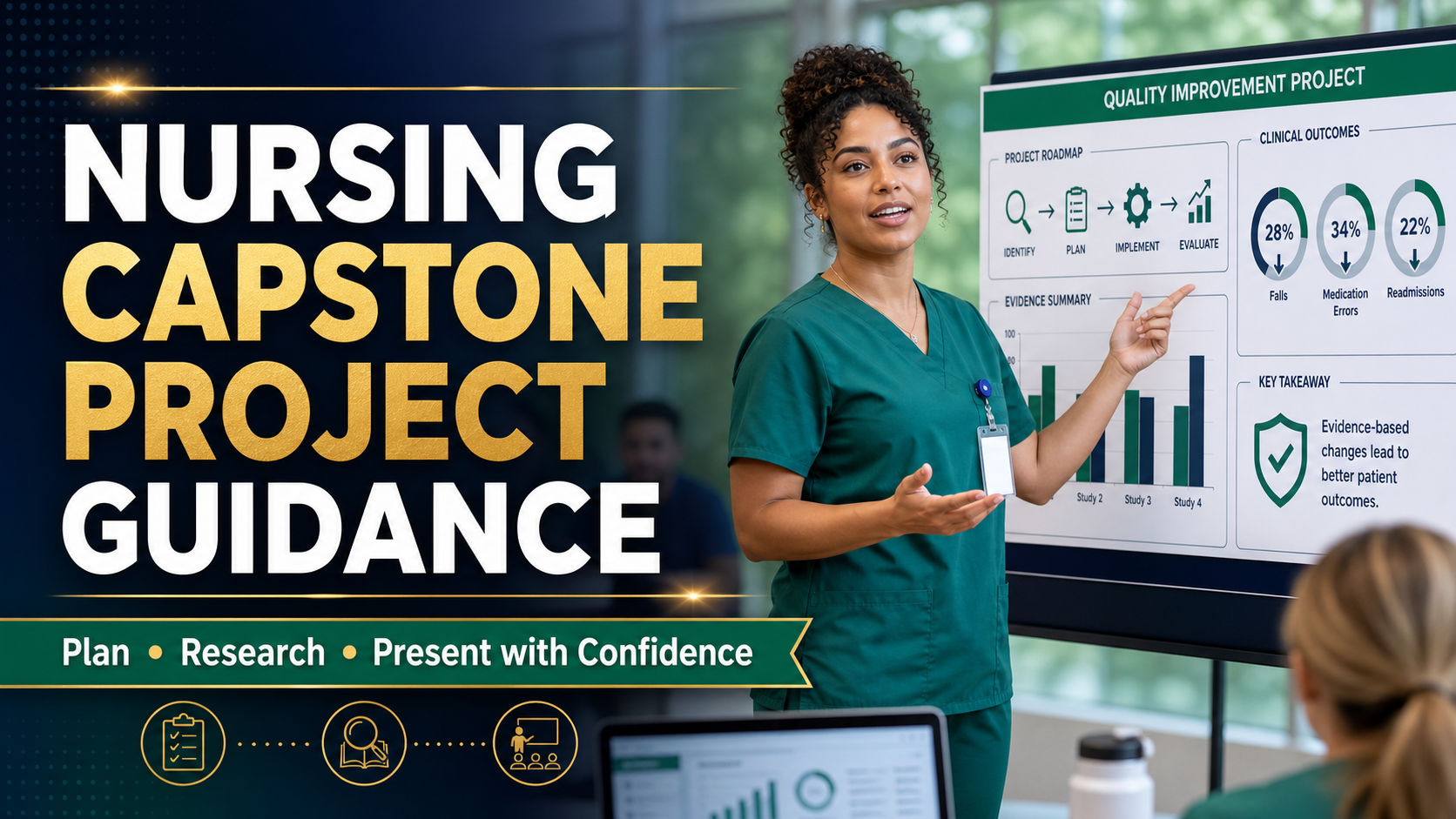
nursing capstone project help and guidance is most useful when it helps a student understand the work, make defensible academic decisions, and produce a paper or project they can explain confidently. Nursing assignments are rarely difficult because of one missing fact. They become difficult when a learner must combine clinical language, current evidence, a rubric, academic formatting, and a realistic deadline. This guide shows how to organize that process without shortcuts that weaken learning or academic integrity.
A nursing capstone asks a student to define a meaningful problem, examine evidence, design or evaluate a realistic improvement, and communicate the result to an academic or clinical audience. The hardest part is usually alignment: the problem, question, evidence, intervention, outcome measures, timeline, and presentation must all describe the same project.
At NurseHomework, tutoring means guided learning, feedback, revision support, research coaching, and clear examples. It does not mean replacing the student’s judgment or submitting work the student cannot defend. The strongest result is a learner who can describe why each source, concept, and recommendation belongs in the final submission.
What students are really trying to solve
Capstones can become overwhelming because they combine project management with scholarly writing. Students may choose a problem that is too large, confuse a quality-improvement project with experimental research, collect evidence without an appraisal plan, or design outcomes that cannot be measured within the course timeline.
A reliable workflow separates the assignment into small decisions. First identify the deliverable and audience. Then translate the rubric into a checklist, define the clinical or academic focus, collect appropriate evidence, build a logical structure, draft section by section, and revise against the marking criteria. This approach is calmer and more accurate than trying to write from the first sentence to the last in one sitting.
1. Define a narrow and consequential problem
Describe the current gap using the population, setting, process, and consequence. Replace broad goals such as improve patient safety with a bounded issue such as inconsistent fall-risk reassessment on one adult unit.
Practical study move: Write a problem statement that includes what is happening, who is affected, where it occurs, and why the gap matters.
2. Align the project question and purpose
Use the framework required by the program, often PICOT for intervention questions or another structure for quality improvement. The purpose statement should mirror the question and name the intended outcome.
Practical study move: Compare every noun in the title, purpose, question, and aim; inconsistent terms usually reveal scope drift.
3. Build an evidence base for the proposed change
Search for guidelines, systematic reviews, implementation studies, and recent primary evidence relevant to the chosen setting and population. Appraise feasibility as well as effectiveness.
Practical study move: Create an evidence table and note which project decision each source supports.
4. Design a feasible intervention
Specify the people, actions, materials, training, workflow, frequency, and duration. Consider stakeholders, approvals, resources, likely resistance, and unintended effects.
Practical study move: Draw the current workflow and proposed workflow side by side to reveal missing steps.
5. Choose meaningful outcome and process measures
Outcome measures show whether the target changed; process measures show whether the intervention was delivered; balancing measures check for new burdens or harms. Define numerator, denominator, data source, timing, and target.
Practical study move: Select a small measurement set that can be collected ethically and interpreted within the course period.
6. Plan implementation and stakeholder communication
Identify who authorizes, delivers, receives, documents, and evaluates the change. Use a realistic timeline with milestones, dependencies, risks, and a plan for feedback.
Practical study move: Prepare a one-page stakeholder brief explaining the problem, evidence, requested action, and benefit.
7. Analyze and present without exaggeration
Choose descriptive or approved analytical methods that match the data. Report limitations, missing data, implementation fidelity, and contextual factors. Improvement during a short project does not automatically prove causation.
Practical study move: Separate results from interpretation, and make recommendations proportionate to the evidence and project design.
How to evaluate evidence and maintain academic integrity
Use the strongest evidence that fits the question rather than the first source that appears in a search result. Check publication date, research design, sample, setting, limitations, and direct relevance. Guidelines and systematic reviews may provide a broad foundation, while primary studies can supply detail about populations and outcomes. Every factual claim should be traceable to its source, and paraphrasing should preserve the source’s meaning without copying its sentence structure.
Keep a simple evidence table with columns for citation, purpose, design, participants, major findings, limitations, and the exact section where the source will be used. This prevents citation dumping and makes synthesis easier. If two credible sources disagree, explain the difference in population, method, or context instead of hiding the disagreement. That comparison is often where higher-level analysis begins.
Common mistakes that lower marks
- Choosing a nationwide problem for a short course: The scope exceeds available authority, data, time, and resources.
- Writing the intervention before understanding the gap: The solution may not address the actual workflow cause.
- Using only outcome measures: A null result cannot be interpreted because nobody knows whether the intervention was implemented.
- Treating quality improvement as clinical research: Purpose, approvals, methods, and claims become misaligned.
- Ignoring stakeholders: A technically sound idea fails because nurses, educators, managers, patients, or IT were not involved.
- Presenting association as causation: The conclusion becomes stronger than the design and data allow.
Another frequent problem is treating revision as proofreading. Proofreading corrects surface errors; revision tests the argument. During revision, ask whether each paragraph has one clear purpose, whether evidence supports the claim, whether transitions show the relationship between ideas, and whether the conclusion answers the original question. Only after those checks should spelling, grammar, citation punctuation, and reference formatting receive final attention.
A practical quality checklist
- The title and introduction match the assignment brief and the intended nursing audience.
- Every major section responds to an explicit rubric requirement.
- Clinical language is precise, respectful, and within the student role.
- Claims are supported by credible, current, and relevant evidence.
- Sources are synthesized by theme or decision rather than summarized one at a time.
- Tables, figures, appendices, and headings are referenced correctly in the text.
- APA 7 citations and references agree with each other.
- The conclusion states the learning or practice implication without introducing unsupported claims.
- The student can explain the logic and evidence in their own words.
What ethical online tutoring should include
Good tutoring begins with questions about the course level, rubric, deadline, approved source types, and the student’s current draft or outline. A tutor may help clarify terminology, demonstrate an approach with a fresh example, comment on organization, identify gaps in reasoning, and explain citation corrections. The student should remain involved in every important decision. Support is most effective when feedback is specific enough to act on and educational enough to transfer to the next assignment.
Before choosing help, ask what deliverables are included, how feedback will be explained, whether revisions are available, how sources are selected, and how the service protects privacy. Avoid promises of guaranteed grades or instant expert completion. Nursing education depends on judgment and accountability; responsible support strengthens both.
Frequently asked questions
How do I choose a manageable nursing capstone topic?
Start with a specific practice or education gap in an accessible setting, then test whether evidence, stakeholders, data, approvals, and time are realistically available.
What is the difference between a capstone and a dissertation?
Requirements vary, but a capstone often emphasizes applied integration or practice improvement, while a dissertation usually requires a larger original research contribution. Follow the program handbook.
Can a tutor develop my intervention for me?
A tutor can explain frameworks, question assumptions, review alignment, and provide feedback. You remain responsible for the project decisions, approvals, data, and final submission.
When should I start the presentation?
Begin the presentation outline when the proposal is stable. Updating slides throughout the project reduces last-minute work and exposes missing links early.
Get focused nursing study support
If your capstone has a promising idea but the pieces do not yet align, guided support can help you narrow the problem, organize the evidence, test feasibility, define measures, and prepare a presentation you can defend.
Explore nursing homework tutoring and study support, or review our nursing research paper guidance and APA 7 nursing editing guide. Bring your rubric, instructions, deadline, and current progress so the session can focus on the decisions that matter most.
Needs help with Nursing Assignment?
We are available 24x7 to deliver the best services and assignment ready within 3-4 hours? Order a custom-written, plagiarism-free paper
 Get Answer Over WhatsApp
 Order Paper Now
