Nursing Citation Help Online: Your Complete Guide to Accurate Referencing and Academic Integrity
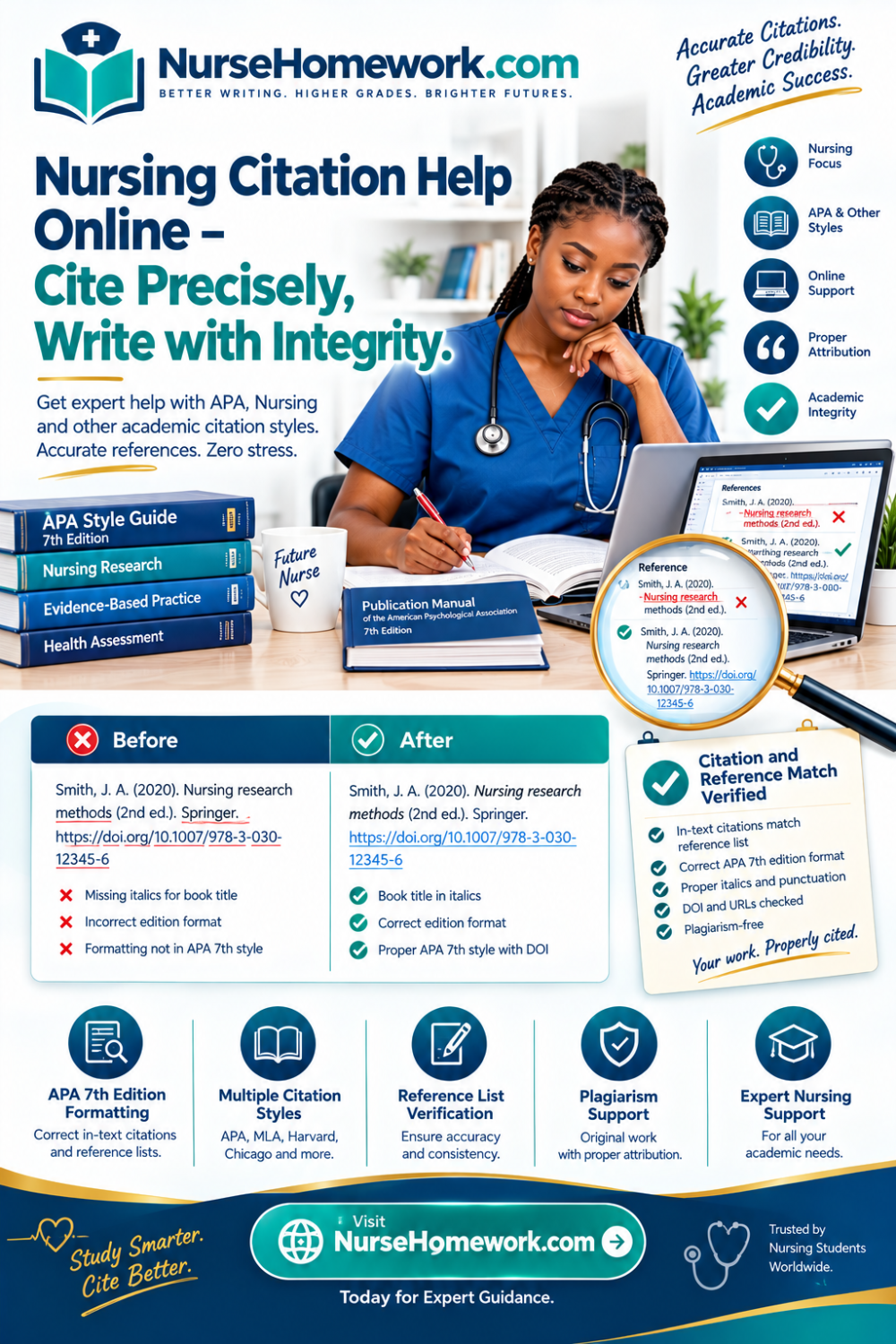
Nursing citation help online is one of the most valuable resources a nursing student can access, because citation accuracy directly affects grades, credibility, and professional accountability. At NurseHomework.com, we understand that nursing writing demands rigorous source attribution across multiple style systems, and that citation errors are among the most common reasons students lose points despite strong clinical reasoning. This comprehensive guide provides nursing citation help online across citation styles, source types, in-text mechanics, reference list construction, and academic integrity boundaries.
What Nursing Citation Help Online Actually Covers
Before going further into nursing citation help online practice, it is essential to understand the scope of the task. Citation work is not a single action but a layered system involving source selection, in-text attribution, reference list construction, formatting mechanics, and verification that the two components correspond perfectly.
Nursing programs typically require APA 7th edition for coursework, though Vancouver and AMA styles appear in research manuscripts and journal submissions. Each system has its own rules for author formatting, date placement, punctuation, and source-type handling. Confusion between systems produces the most damaging citation errors, because a reference list that mixes conventions signals unfamiliarity with the required standard.
A complete nursing citation help online process therefore addresses four domains: choosing credible sources, citing them correctly in text, listing them correctly in the reference list, and verifying reciprocity between the two.
Why Citation Accuracy Carries Unusual Weight in Nursing
Most disciplines enforce citation standards. Nursing enforces them with particular rigor for several converging reasons.
Evidence-based practice foundations. Nursing practice is built on evidence hierarchies. A claim about an intervention must be traceable to a credible source, and citation is the mechanism that makes that traceability possible.
Academic integrity enforcement. Nursing programs treat plagiarism as a professional fitness concern, not merely an academic offense. Citation accuracy is the primary safeguard against unintentional plagiarism.
Clinical credibility. Nurses who cite sources precisely demonstrate the attention to detail expected in documentation. Sloppy referencing undermines perceived competence.
Rubric weighting. Nursing rubrics frequently allocate five to fifteen percent of the grade to APA compliance and citation accuracy.
Professional publication standards. Nurses who pursue publication must meet journal citation requirements precisely, and habits formed in coursework carry forward.
These factors explain why a careful nursing citation help online review produces a disproportionately high return on the time invested.
The Major Citation Styles Used in Nursing
APA 7th Edition
APA is the dominant citation style in nursing education. Its key features include author-date in-text citation, an alphabetized reference list with hanging indents, sentence case for article and chapter titles, and italicization of journal and book titles along with volume numbers.
Parenthetical citation example: (Smith & Jones, 2025)
Narrative citation example: Smith and Jones (2025) reported that…
Reference entry example: Smith, J. A., & Jones, R. B. (2025). Title of article in sentence case. Journal of Nursing Scholarship, *57*(3), 112–120. https://doi.org/10.xxxx/xxxxx
APA requires particular attention to several recurring details: three or more authors use “et al.” from the first citation onward, DOI formatting appears as a full hyperlink, and issue numbers appear in parentheses without italics.
Vancouver Style
Vancouver style uses numbered citations in order of appearance and is common in medical and nursing research journals. In-text citations appear as superscript or bracketed numerals, and the reference list is numbered rather than alphabetized. Author names use surname followed by initials without periods or commas between multiple authors.
Because numbering changes if sources are reordered, Vancouver requires careful sequencing and is a frequent source of citation errors when students draft without planning source order in advance. Reliable nursing citation help online support is particularly valuable here.
AMA Style
AMA style closely resembles Vancouver but has its own specific rules for journal abbreviations, page ranges, and electronic source formatting. It is common in clinical and medical journals and appears in some nursing research contexts.
Harvard Style
Harvard style uses author-date citation similar to APA but differs in punctuation and reference formatting. Some international nursing programs require Harvard, and students transferring between systems frequently struggle with the differences.
Style Comparison at a Glance
APA: Author-date, alphabetized, sentence case titles
Vancouver: Numbered by appearance, numbered list, abbreviated journal titles
AMA: Numbered by appearance, numbered list, specific abbreviation conventions
Harvard: Author-date, alphabetized, varied punctuation rules
Common Source Types in Nursing Papers
Peer-Reviewed Journal Articles
Journal articles are the primary source type in nursing scholarship. Reference entries require author names, publication year, article title in sentence case, journal title in italics, volume in italics, issue in parentheses, page range, and DOI when available.
Clinical Practice Guidelines
Guidelines from organizations such as the World Health Organization, the Centers for Disease Control and Prevention, and professional nursing bodies require group authors, publication years, and often version numbers. Students frequently misattribute guidelines to individuals rather than the issuing body.
Government and Institutional Reports
Reports require the issuing agency as author when no individual author is listed, along with report numbers where applicable and retrieval information.
Books and Edited Chapters
Book entries require title in italics, edition when not the first, and publisher. Chapter entries require chapter authors, chapter title in sentence case, editors, book title in italics, page range, and publisher.
Systematic Reviews and Meta-Analyses
Systematic reviews carry the same reference structure as journal articles but often involve large author groups. Following APA rules for twenty-one or more authors is a common point of failure.
Dissertations and Theses
Dissertations require the institution, database name, and URL or accession number. Unpublished theses follow a different format.
Conference Presentations and Proceedings
Conference formats vary by whether the material was a presentation, poster, or published proceeding, and each requires a distinct entry structure.
Websites and Online Content
Website entries require careful handling of retrieval dates, which APA requires only for sources designed to change over time. This nuance is frequently misunderstood, and it is a recurring topic in nursing citation help online support.
Clinical Databases and Point-of-Care Tools
Point-of-care resources such as clinical reference databases require group authors and specific access information. These entries are among the most frequently misformatted.
In-Text Citation Mechanics
Parenthetical Versus Narrative Citation
The choice between parenthetical and narrative citation is a stylistic decision based on sentence emphasis, not an arbitrary rule. Both are correct when used appropriately. Errors arise when the two are mixed incorrectly within a single citation or when the year is misplaced.
Multiple Authors
One author: (Smith, 2025)
Two authors: (Smith & Jones, 2025); narrative form uses “and”
Three or more authors: (Smith et al., 2025)
A common error is writing “Smith et al. (2025)” with the year separated in parentheses when the citation is already narrative. Another is spelling out all authors on first mention, which APA 7th edition no longer requires.
Group Authors
Group authors are spelled out on first citation with an abbreviation in brackets, then abbreviated thereafter. The reference list entry spells out the full group name. A frequent mistake is abbreviating from the first citation without introducing the abbreviation.
Multiple Works in One Citation
Multiple citations within one set of parentheses are ordered alphabetically and separated by semicolons. This convention is often missed, and inconsistent ordering signals unfamiliarity with the style.
Same Author, Same Year
Works by the same author in the same year are distinguished by lowercase letters assigned alphabetically by title (2025a, 2025b), and the corresponding reference entries carry the same letters.
Secondary Sources
When citing a source you have not read directly, APA requires the phrase “as cited in” with the secondary source listed in the reference list. Students frequently cite the original work as though they had read it, which constitutes a citation misrepresentation.
Direct Quotations
Quotations under 40 words use quotation marks and require page or paragraph numbers. Quotations of 40 words or more become block quotations with a 0.5-inch indent, double spacing, and no quotation marks, with the period placed before the parenthetical citation. This period placement rule is one of the most commonly missed details in nursing writing, and it is a standard item in nursing citation help online review.
Reference List Construction
Ordering and Formatting
The reference list is alphabetized by first author surname, uses a hanging indent of 0.5 inches, and is double spaced throughout without extra spacing between entries. These are purely mechanical requirements that are easy to verify yet frequently violated.
Italics Rules
Italics apply to journal titles, volume numbers, book titles, and standalone work titles. Italics do not apply to article titles, chapter titles, issue numbers, or webpage titles. Mixing these conventions is one of the most frequent error categories in nursing papers.
Capitalization Rules
APA uses title case for journal titles, book titles, and headings. It uses sentence case for article titles, chapter titles, and reference entry titles. Confusion between these conventions is extremely common because many databases export metadata in title case regardless of APA requirements.
DOI and URL Formatting
DOIs appear as full hyperlinks beginning with https://. URLs follow the same rule, with no “Retrieved from” phrase unless a retrieval date is required. Periods should not follow DOIs or URLs, because a trailing period can break the link.
Author Name Formatting
APA uses surname followed by initials, with periods and spaces between initials, and an ampersand before the final author. Up to twenty authors are listed, with the twenty-first onward replaced by an ellipsis and the final author’s name. This rule is frequently misapplied.
Special Cases
Edited volumes, translated works, republished works, and works with no author each require specific handling. Anonymous works begin the reference entry with the title. These edge cases are where professional nursing citation help online support proves especially valuable.
The Most Common Citation Errors in Nursing Papers
Citation and Reference Mismatch
The single most frequent error is a reference list that does not correspond perfectly to the in-text citations. Every citation requires a reference entry, and every entry requires at least one citation. Missing entries, orphaned entries, and inconsistent author spellings all fall into this category.
Incorrect Author Formatting
Errors include spelling out all authors when “et al.” is required, omitting the ampersand in parenthetical citations, and misapplying the twenty-one author rule.
Missing DOIs
DOIs are frequently omitted or presented as plain text rather than hyperlinks. APA requires the hyperlink format.
Incorrect Year Placement
Year placement errors appear in narrative citations, in multiple-author citations, and in citations containing quotations. Each placement rule is specific.
Wrong Capitalization
Database-exported metadata frequently uses title case where APA requires sentence case. Failing to convert these entries is a near-universal problem.
Missing Page or Paragraph Numbers for Quotations
Direct quotations require location information. Omitting page numbers for quotations from paginated sources is a substantive citation error, not a minor oversight.
Citing Secondary Sources Without Attribution
Presenting a secondary source as though read directly is a citation misrepresentation with academic integrity implications.
Fabricated or Inaccessible Sources
Citing sources that do not exist or cannot be located is a serious integrity violation. Every cited source must be real, retrievable, and actually consulted.
Managing Citations with Tools
Reference managers such as Zotero, Mendeley, and EndNote reduce workload substantially and are widely recommended. They generate citations and reference lists automatically and support switching between styles. Their limitations, however, must be understood.
Common generator errors include:
Misclassification of source types
Missing or incorrectly formatted DOIs
Capitalization inherited from database metadata
Incorrect handling of group authors
Failure to apply the twenty-one author rule
Inconsistent punctuation between entries
Because of these limitations, generated references must always be manually verified. A reference manager is a drafting aid, not a substitute for understanding the style rules. This is one reason even students who use reference managers benefit from nursing citation help online verification before submission.
Citation Practices in Clinical and Professional Writing
Citation conventions differ between academic work and clinical documentation. Clinical documentation generally does not use formal citations, because the record documents care rather than scholarship. However, when nurses develop policies, patient education materials, or clinical protocols, source attribution becomes essential.
Patient education materials should cite the evidence base so that clinicians and patients can verify accuracy. Policy documents require full references. Manuscripts submitted to journals must follow the journal’s specified style precisely, which may differ from the style used in coursework. Understanding these genre distinctions is part of professional citation competence.
Academic Integrity and Citation Ethics
Citation serves both attribution and verification. Its ethical dimensions include:
Acknowledging the intellectual work of others
Enabling readers to locate and evaluate sources
Avoiding plagiarism in all its forms, including mosaic and self-plagiarism
Representing sources accurately without distortion
Not fabricating, falsifying, or misattributing sources
Following institutional policy on permitted assistance and disclosure
Students should confirm whether their program permits proofreading or citation-formatting assistance and whether disclosure is required. Citation formatting support occupies a clear ethical position: verifying that your citations follow the required style is mechanics, not content generation. Fabricating sources or generating content is not.
How NurseHomework.com Can Help with Citations
At NurseHomework.com, we provide comprehensive nursing citation help online support tailored to the demands of nursing coursework and professional writing. Our services include:
Full APA 7th edition citation verification, including in-text citations and reference lists
Vancouver and AMA formatting support for research manuscripts
Citation-to-reference reciprocity checks to eliminate mismatches
DOI and URL hyperlink verification
Author formatting review, including the twenty-one author rule and group authors
Capitalization correction for sentence case and title case requirements
Quotation formatting verification including block quotation mechanics
Source type classification for guidelines, reports, dissertations, and databases
Reference manager output verification
Academic integrity guidance on permitted support levels
Whether you are finalizing a care plan, a literature review, or a doctoral manuscript, NurseHomework.com is here to support your development as a precise, credible nursing writer.
Frequently Asked Questions About Nursing Citation Help Online
What is nursing citation help online?
It is structured support for citing sources correctly in nursing writing, covering in-text citations, reference list construction, source type formatting, and verification that citations and references correspond perfectly.
Which citation style do nursing programs use?
APA 7th edition is most common in coursework. Vancouver and AMA styles appear in research manuscripts, and some international programs require Harvard style.
What is the most common citation error in nursing papers?
Mismatched citations and references. Every in-text citation needs a reference entry, and every reference entry needs at least one in-text citation.
How do I cite a source with three or more authors in APA 7th edition?
Use “et al.” from the first citation onward, for example (Smith et al., 2025).
How should DOIs be formatted in APA 7th edition?
DOIs appear as full hyperlinks beginning with https:// and are not followed by a period.
When is a retrieval date required in APA?
Only for sources designed to change over time, such as wikis or continually updated webpages. Most sources do not require a retrieval date.
How do I cite a source I have not read directly?
Use the phrase “as cited in” and list the secondary source you actually consulted in the reference list.
Can citation generators be trusted?
They are useful drafting tools but must always be verified manually, because they frequently misclassify source types, mishandle DOIs, and inherit capitalization errors.
Is citation formatting help a violation of academic integrity?
Verifying that your citations follow the required style is mechanics and is generally permitted. Fabricating sources or generating content is not. Confirm your program’s policy first.
Can NurseHomework.com help me with nursing citation help online?
Absolutely. NurseHomework.com offers expert APA, Vancouver, and AMA verification with personalized feedback for nursing students needing nursing citation help online.
Mastering nursing citation help online is one of the highest-yield investments a nursing student can make, because citation accuracy protects your grade, your credibility, and your professional standing. By understanding the major citation styles, learning the specific requirements for each source type, applying in-text and reference list mechanics correctly, verifying reciprocity between citations and references, and respecting the ethical boundaries of citation support, you ensure that your scholarly work meets the standards the nursing profession expects.
At NurseHomework.com, we are committed to helping you succeed. Our expert guidance, comprehensive resources, and personalized support make nursing citation help online easier and more effective. Don’t let citation errors undermine otherwise excellent work. Visit NurseHomework.com today and discover how we can help you master nursing citation help online and excel in your nursing studies.
- Nursing citation help online
- Nursing citation help online
- Nursing citation help online
- Nursing citation help online
- Nursing citation help online
- Nursing citation help online
- Nursing citation help online
- Nursing citation help online
- Nursing citation help online
- Nursing citation help online
- Nursing citation help online
Needs help with Nursing Assignment?
We are available 24x7 to deliver the best services and assignment ready within 3-4 hours? Order a custom-written, plagiarism-free paper
 Get Answer Over WhatsApp
 Order Paper Now
