
Nursing Differential Diagnosis Study Support: Compare Cues and Alternatives
Nursing Differential Diagnosis Study Support is designed for advanced nursing learners practising structured diagnostic reasoning for coursework or simulation. Effective tutoring does not replace a learner’s work. It creates a structured way to understand the task, practise the underlying skill, receive feedback and revise independently.
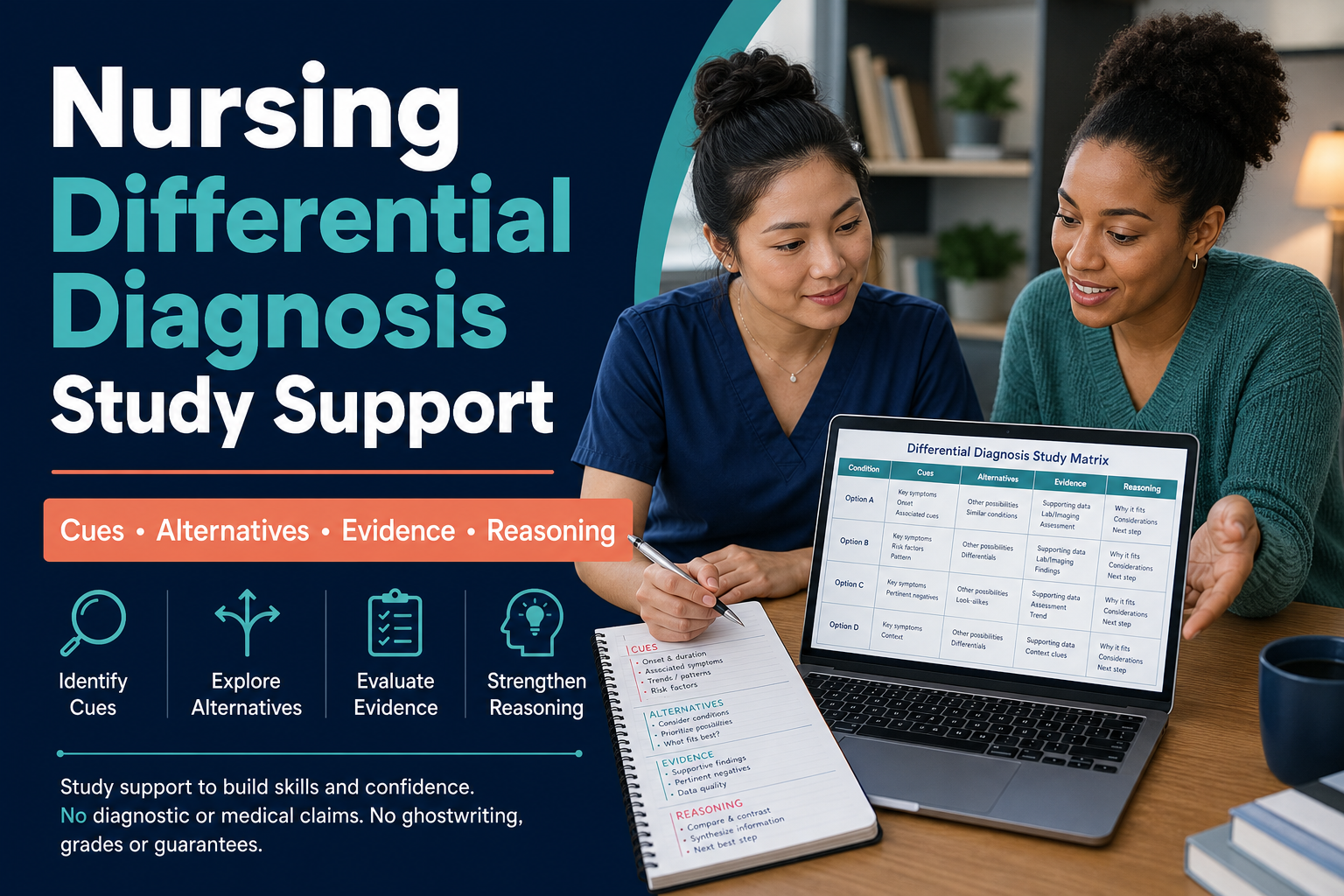
prematurely settling on one explanation can lead students to ignore conflicting cues, alternative causes and the evidence needed to distinguish possibilities. The solution is not a shortcut or a pre-written submission. It is guided learning that makes the reasoning process visible and repeatable.
What this tutoring topic covers
- organising subjective and objective cues: define what good execution looks like, which records are required, who is responsible and how exceptions will be handled.
- building a reasoned problem list: define what good execution looks like, which records are required, who is responsible and how exceptions will be handled.
- generating plausible alternatives: define what good execution looks like, which records are required, who is responsible and how exceptions will be handled.
- identifying supporting and conflicting evidence: define what good execution looks like, which records are required, who is responsible and how exceptions will be handled.
- planning educational next-step questions: define what good execution looks like, which records are required, who is responsible and how exceptions will be handled.
- explaining uncertainty and reasoning clearly: define what good execution looks like, which records are required, who is responsible and how exceptions will be handled.
What a productive session should achieve
- more organised case analysis
- less premature closure
- stronger comparison of alternatives
- clearer reasoning explanations
Progress depends on preparation, active participation, practice and revision. No ethical tutor can guarantee a grade, examination result, registration decision or clinical outcome.
How the tutoring process works
- Share the learning goal: identify the module, prompt, rubric, deadline and skill that needs attention.
- Diagnose the difficulty: separate knowledge gaps from problems with analysis, organisation, evidence or academic communication.
- Model the process: the tutor explains a framework using examples or practice material rather than completing the assessed work.
- Practise actively: the learner applies the framework, explains decisions and asks questions.
- Receive feedback: feedback identifies strengths, gaps and specific revision actions.
- Revise independently: the learner remains the author and checks the final work against institutional rules.
Questions to ask before choosing support
- Does the tutor understand the nursing level, task type and relevant academic expectations?
- Will the session build transferable skills instead of supplying answers?
- Are confidentiality and professional boundaries respected in any scenario discussed?
- Can the learner request feedback on reasoning, structure, evidence and referencing?
- Are limitations stated clearly, including that tutoring is not medical advice or clinical supervision?
Academic integrity and professional boundaries
NurseHomework offers educational tutoring, guided practice and feedback that help nursing learners build their own knowledge, reasoning and academic skills. Tutoring must not involve impersonation, fabricated evidence, falsified placement records, examination assistance or completion of an assessment on a student’s behalf. Any case material should be anonymised. Clinical decisions must follow authorised educators, supervisors, local policy and qualified practitioners.
How to prepare for a session
Bring the official task instructions, marking criteria, permitted resources, your own notes and a list of questions. If you have attempted an outline or practice response, share it so feedback can focus on your reasoning. Remove names and identifying details from patient or placement material.
How to turn feedback into lasting improvement
Finish each session with a short learning plan. Record the concept that became clearer, the mistake you want to avoid, the framework you will use and one task you will complete without assistance. Revisit the same skill with a different practice scenario so that you are learning a method rather than memorising one answer. A useful tutor should be able to explain why a change is needed and invite you to explain the reasoning back in your own words.
Measure progress through the quality of your process: Can you interpret a new prompt, identify relevant evidence, justify choices, organise an argument and revise using a checklist? Keep earlier drafts or practice notes and compare them with later work. This gives you concrete evidence of development even though no tutoring service can predict an assessor’s judgment.
Frequently asked questions
Will a tutor write my assessment?
No. Ethical support explains concepts, demonstrates methods, provides practice and comments on learner-created work. You retain authorship and responsibility for the final submission.
Can tutoring guarantee my grade?
No. Results depend on your work, course rules, assessment standards and evaluator judgment. Tutoring aims to improve understanding and independent performance.
Can I use real patient information?
Do not share identifying patient or service-user information. Use anonymised or fictional educational scenarios and follow your institution’s confidentiality rules.
Is this clinical advice?
No. The service is educational. Clinical questions and decisions should be handled through authorised supervisors, educators and qualified healthcare professionals.
Take the next step
Book a nursing study-support session. Share the learning objective and official instructions, and explain the skill you want to strengthen.
Needs help with Nursing Assignment?
We are available 24x7 to deliver the best services and assignment ready within 3-4 hours? Order a custom-written, plagiarism-free paper
 Get Answer Over WhatsApp
 Order Paper Now

