Nursing Homework Tips – Best Strategies for Nursing Students
nursing thesis help
Nursing Homework Tips: How to Excel in Your Assignments
Completing nursing assignments can be challenging, especially with the rigorous demands of your coursework. Using effective nursing homework tips can help you stay organized, improve your understanding, and achieve better grades. Whether you’re a nursing student struggling with clinical reports or research papers, these tips will guide you toward success.
1. Understand the Assignment Requirements
Before starting any assignment, carefully read the instructions. Ask yourself:
What is the topic or problem I need to address?
Are there specific formatting or citation guidelines?
What is the expected word count or structure?
Understanding the requirements will help you focus on relevant information and avoid wasting time.
2. Create a Clear Plan
Planning is crucial for completing nursing assignments efficiently. Break down your homework into smaller steps:
Research the topic thoroughly.
Create an outline of your main points.
Schedule time for writing, revising, and proofreading.
A structured plan ensures you cover all aspects of your assignment and reduces last-minute stress.
3. Use Credible Sources
In nursing, accuracy is critical. Always refer to reputable sources such as:
Peer-reviewed journals
Nursing textbooks
Official medical websites (e.g., WHO, CDC)
Avoid unreliable websites, as incorrect information can affect the quality of your work and your grades.
4. Practice Proper Time Management
Procrastination is a common challenge for nursing students. To avoid it:
Set specific deadlines for each part of your assignment.
Use productivity techniques like Pomodoro (25 minutes work, 5 minutes break).
Prioritize assignments based on urgency and complexity.
Good time management allows you to produce high-quality work without stress.
5. Take Notes and Summarize Key Points
When researching, take concise notes and summarize key points in your own words. This makes it easier to:
Understand complex nursing concepts
Avoid plagiarism
Refer back to critical information when writing your assignment
Organized notes save time and help you retain important knowledge for exams and clinical practice.
6. Focus on Critical Thinking
Nursing assignments often require more than memorization; you need to apply critical thinking. Ask yourself:
How does this information apply to patient care?
What are the implications of this treatment or procedure?
Are there alternative approaches supported by evidence?
Critical thinking enhances the quality of your assignments and demonstrates your understanding of nursing practice.
7. Edit and Proofread Thoroughly
Never submit your assignment without reviewing it carefully. Check for:
Spelling and grammar errors
Logical flow of ideas
Correct citation and referencing style
Editing ensures your work is professional, clear, and easy to read, which can improve your grade significantly.
8. Seek Help When Needed
If you encounter difficulties, don’t hesitate to ask for help:
Discuss concepts with classmates or instructors
Use online resources and nursing forums
Consider professional tutoring services
Getting guidance early prevents mistakes and keeps you on track.
9. Practice Consistency
Consistency in your study and assignment habits pays off. Regularly:
Review lecture notes
Read nursing journals
Practice writing sample assignments
Consistent effort builds your knowledge base and reduces stress during busy academic periods.
Conclusion
By implementing these nursing homework tips, you can tackle assignments confidently, improve your academic performance, and build a solid foundation for your future nursing career. Remember, success in nursing homework is not just about completing tasks—it’s about understanding, applying knowledge, and developing strong critical thinking skills.
10. Use Nursing Software and Apps
Technology can make your homework faster and more accurate. Consider using:
Reference management tools like Zotero or Mendeley for citations
Medical calculators for dosage and clinical calculations
Note-taking apps like OneNote or Evernote to organize research
These tools save time and reduce errors, especially for complex assignments involving patient care scenarios.
11. Incorporate Evidence-Based Practice
Nursing is an evidence-based profession. Strengthen your assignments by:
Citing recent research and clinical studies
Including case studies to illustrate points
Comparing guidelines from recognized health authorities
Evidence-based content shows your professor that you understand current best practices and can apply them to real-world situations.
12. Develop Strong Writing Skills
Good writing is essential for nursing homework. Focus on:
Clear and concise language
Avoiding jargon unless necessary
Using active voice and proper sentence structure
Strong writing improves readability and demonstrates professionalism. Remember, your ability to communicate effectively is as important as your clinical knowledge.
13. Create a Study-Friendly Environment
Your environment affects productivity. Tips include:
Working in a quiet space with minimal distractions
Using good lighting and an ergonomic setup
Keeping study materials organized and accessible
A focused environment reduces mistakes and helps you complete assignments efficiently.
14. Collaborate with Classmates
Group study and collaboration can enhance learning:
Discuss challenging concepts and case studies
Exchange resources and notes
Peer review each other’s assignments for feedback
Collaboration exposes you to diverse perspectives and can improve the quality of your homework.
15. Take Care of Your Mental and Physical Health
Nursing school is demanding. Your ability to do homework effectively depends on your well-being:
Get enough sleep and take regular breaks
Eat nutritious meals and stay hydrated
Practice stress-relief techniques like mindfulness or exercise
Healthy habits improve focus, retention, and overall performance.
16. Review Feedback and Learn from Mistakes
Always analyze the feedback you receive from instructors:
Identify recurring errors
Understand where your reasoning or research fell short
Apply lessons learned to future assignments
Continuous improvement helps you become a more competent student and nurse.
17. Plan for Long-Term Assignments Early
Some nursing assignments, like research projects or dissertations, require weeks or months:
Start early to avoid last-minute pressure
Break tasks into weekly goals
Regularly check your progress against deadlines
Early planning ensures you have enough time for thorough research and refinement.
18. Stay Updated with Nursing Trends
The healthcare field evolves rapidly. Staying informed improves the relevance of your homework:
Follow nursing journals, blogs, and professional associations
Keep up with new treatment protocols and guidelines
Attend webinars or workshops if possible
Assignments that reflect current practices demonstrate professionalism and initiative.
Nursing Homework Tips: The Ultimate Guide for Nursing Students
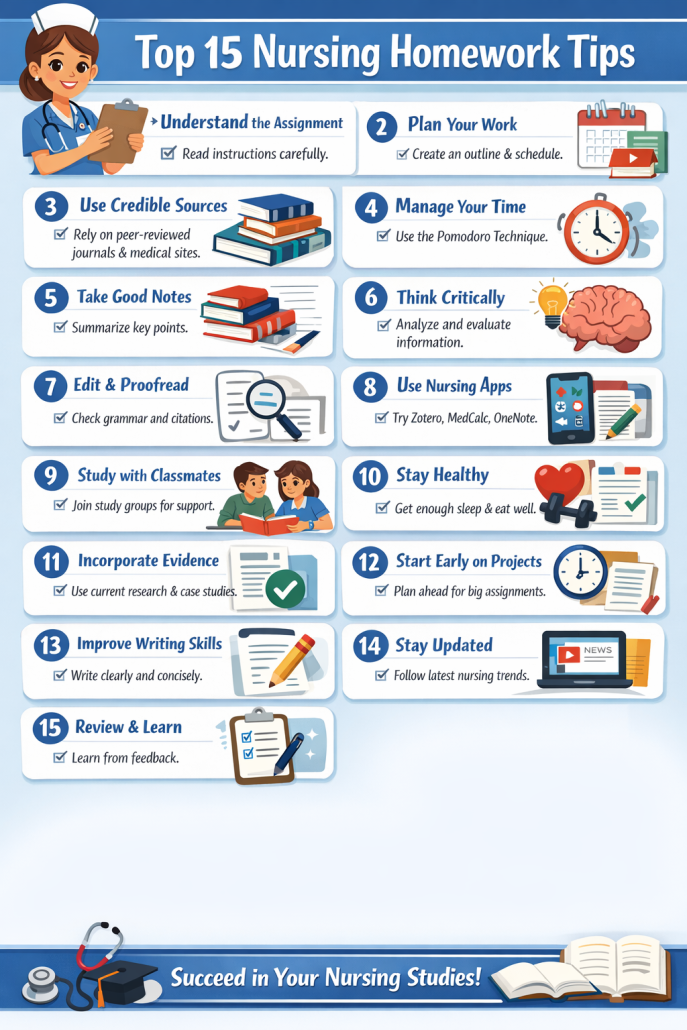
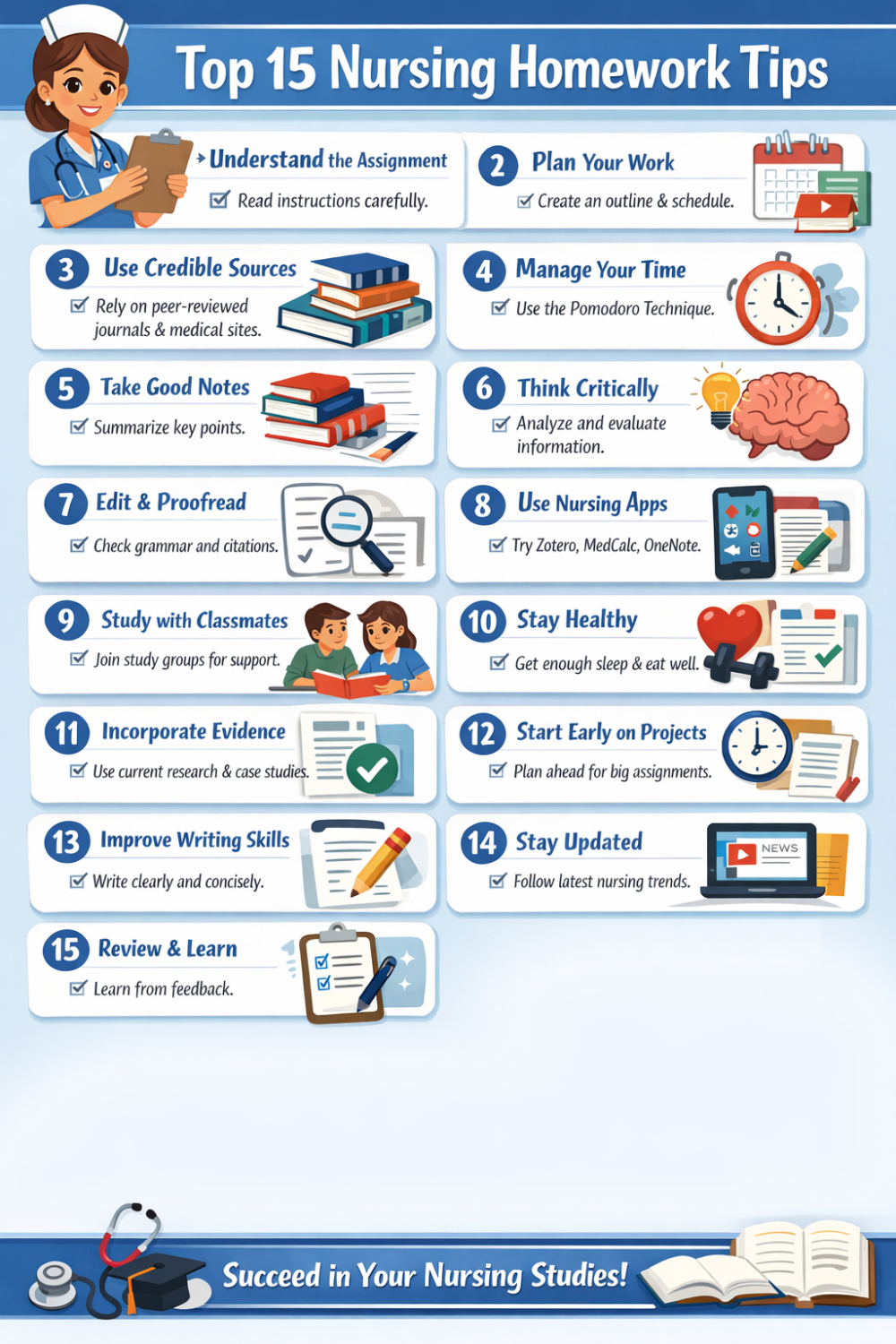
Completing nursing assignments can be a daunting task, especially with clinical responsibilities, exams, and practical rotations. Using effective nursing homework tips can help you manage time, stay organized, and improve grades. This guide covers everything from research strategies to time management and critical thinking, giving you a roadmap for academic success.
Why Nursing Homework Tips Matter
Nursing is more than memorizing facts; it involves applying knowledge to real-life scenarios. Homework assignments are a vital part of learning, helping students:
Understand complex medical concepts
Develop critical thinking and problem-solving skills
Apply theoretical knowledge to clinical practice
Following nursing homework tips ensures your assignments are accurate, evidence-based, and professionally written.
1. Understand the Assignment Requirements
The first step to completing any assignment successfully is understanding the instructions. Ask yourself:
What is the main topic or problem?
Are there specific formatting or citation guidelines?
What is the expected structure (introduction, body, conclusion)?
What is the submission deadline?
Tip: Highlight keywords in the instructions, and create a checklist to ensure you meet all requirements.
2. Plan Your Homework Effectively
A clear plan is essential for efficient completion. Steps include:
Research: Collect credible sources and take notes.
Outline: Organize your ideas into sections.
Writing: Draft each section with clarity and proper references.
Editing: Review and refine for grammar, flow, and accuracy.
Pro Tip: Use a planner or digital tool like Trello or Notion to track progress.
3. Research Using Credible Sources
Accuracy is critical in nursing. Use reputable sources such as:
Peer-reviewed journals (e.g., Journal of Nursing Scholarship)
Nursing textbooks and clinical manuals
Official health websites (WHO, CDC, NIH)
Avoid unverified websites or outdated resources, as misinformation can reduce the credibility of your work.
4. Master Time Management
Procrastination is a common pitfall. Use strategies like:
Pomodoro Technique: 25 minutes of work, 5 minutes break
Prioritization: Complete urgent assignments first
Time Blocking: Allocate specific hours for research, writing, and editing
Consistent scheduling reduces stress and ensures higher-quality work.
5. Take Organized Notes
Effective note-taking saves time during writing:
Summarize key points in your own words
Highlight clinical examples and research findings
Keep notes digital for easy retrieval
Tip: Tools like OneNote or Evernote can help you categorize notes by topic.
6. Apply Critical Thinking
Nursing homework isn’t just about recalling information—it’s about analyzing and applying it:
Ask how theory applies to patient care
Consider alternative treatments supported by research
Evaluate the benefits and risks of clinical interventions
Assignments that demonstrate critical thinking stand out to instructors.
7. Edit and Proofread Thoroughly
Editing is as important as writing:
Check spelling, grammar, and punctuation
Ensure logical flow and clarity
Verify citations and references
Pro Tip: Read your work aloud to catch awkward phrasing or errors.
8. Use Technology to Your Advantage
Several apps and tools can make homework easier:
Citation tools: Zotero, Mendeley
Medical calculators: For dosages and conversions
Note-taking apps: OneNote, Notion
These tools improve efficiency and reduce errors in clinical assignments.
9. Collaborate with Classmates
Peer collaboration can enhance learning:
Discuss challenging concepts and case studies
Share resources and notes
Peer-review assignments before submission
Collaboration also exposes you to diverse perspectives and strategies.
10. Maintain Physical and Mental Health
A healthy body supports a healthy mind:
Sleep 7–9 hours per night
Eat nutritious meals
Take breaks during study sessions
Practice stress-relief methods like meditation
Well-being improves focus, retention, and assignment quality.
11. Incorporate Evidence-Based Practice
Evidence-based nursing ensures accuracy and relevance:
Use recent studies and clinical trials
Include case studies for practical illustration
Cite recognized guidelines (e.g., WHO, ANA standards)
Assignments grounded in evidence demonstrate professionalism and competence.
12. Strengthen Writing Skills
Strong writing skills improve readability and grades:
Use clear, concise language
Avoid unnecessary jargon
Prefer active voice over passive voice
Tip: Practice writing summaries of journal articles to improve clarity and flow.
13. Start Long-Term Projects Early
For dissertations or extended research projects:
Break tasks into manageable weekly goals
Conduct early research to find credible sources
Leave time for revisions and feedback
Early preparation reduces stress and allows more in-depth analysis.
14. Stay Updated with Nursing Trends
Healthcare evolves rapidly, and your homework should reflect current standards:
Follow nursing journals and blogs
Attend workshops or webinars
Apply the latest guidelines in assignments
Being informed ensures your work is relevant and evidence-based.
15. Review Feedback and Improve
Always learn from feedback:
Identify patterns in errors
Adjust research or writing strategies
Apply improvements in future assignments
Continuous learning enhances academic growth and clinical knowledge.
Bonus Tip: Create a Homework Routine
A consistent routine reinforces discipline:
Dedicate specific times for reading, research, and writing
Keep a distraction-free study space
Reward yourself after completing tasks
A steady routine turns homework from a chore into a manageable habit.
Conclusion
Following these nursing homework tips helps you complete assignments efficiently, enhance critical thinking, and improve academic performance. Success in nursing homework is about more than finishing tasks—it’s about learning, applying knowledge, and developing professional skills that will benefit your career.
Needs help with Nursing Assignment?
We are available 24x7 to deliver the best services and assignment ready within 3-4 hours? Order a custom-written, plagiarism-free paper
 Get Answer Over WhatsApp
 Order Paper Now

