Nursing Skills Checklist Study Guide
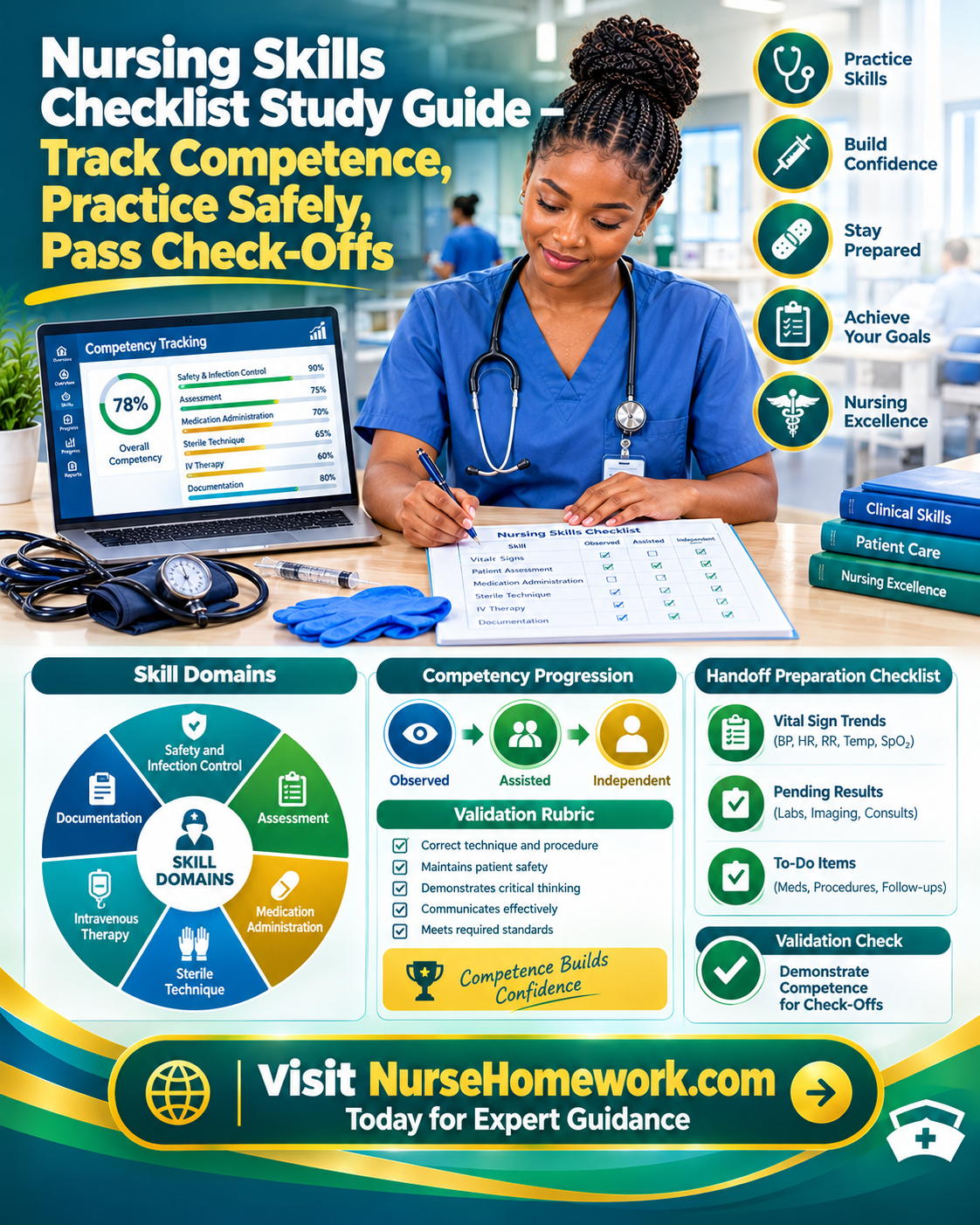
A nursing skills checklist study guide is one of the most practical tools a nursing student can build, because clinical competence is demonstrated through performance rather than recognition, and performance requires deliberate practice against a defined standard. At NurseHomework.com, we understand that a well-constructed nursing skills checklist study guide converts an overwhelming list of procedures into a structured progression from observation to assisted performance to independent competence. This comprehensive nursing skills checklist study guide covers skill domains, competency tracking, validation preparation, and safe practice conventions.
Why a Nursing Skills Checklist Study Guide Matters
Before going further into this nursing skills checklist study guide, it is essential to understand why checklists occupy such a central place in nursing education. Nursing programs must verify that graduates can perform essential skills safely before they enter practice. Accreditation bodies, state boards, and clinical agencies all require documented competency validation.
The volume of skills requiring verification is substantial. Students must demonstrate competence in vital signs, medication administration, sterile technique, wound care, catheterization, intravenous therapy, assessment sequences, documentation, and dozens of additional procedures. Attempting to remember which skills have been validated, which require additional practice, and which have not yet been attempted is impossible without a structured record.
This is precisely why a nursing skills checklist study guide is essential rather than optional. It provides a single reference point that tracks progress across the entire program, identifies gaps before check-offs, and documents competency for future employers and licensure verification.
How Skills Checklists Differ Across Programs
Understanding variation across programs prevents confusion when comparing resources. Every nursing skills checklist study guide reflects the framework its program uses.
Fundamentals Checklists
Fundamentals courses typically introduce 50 to 100 foundational skills including hand hygiene, vital signs, bed making, positioning, mobility assistance, hygiene care, intake and output measurement, specimen collection, and basic assessment.
Medical-Surgical Checklists
Medical-surgical courses add medication administration, sterile dressing changes, nasogastric tube management, oxygen delivery, tracheostomy care, chest tube monitoring, and postoperative assessment.
Maternal-Newborn Checklists
Maternal-newborn courses add fetal monitoring interpretation, newborn assessment, postpartum assessment, breastfeeding support, and fundal assessment.
Pediatric Checklists
Pediatric courses add weight-based medication calculation, developmental assessment, pediatric vital sign interpretation, and family-centered care techniques.
Mental Health Checklists
Mental health courses add therapeutic communication, suicide risk assessment, mental status examination, and de-escalation techniques.
Critical Care Checklists
Critical care courses add hemodynamic monitoring, ventilator management, vasoactive drip titration, arterial line management, and advanced dysrhythmia interpretation.
Each program structures its nursing skills checklist study guide according to its curriculum sequence, so students should always use the version their program provides rather than a generic template.
Core Skill Domains in a Nursing Skills Checklist Study Guide
A comprehensive nursing skills checklist study guide organizes skills into domains because grouping by function aids retention and reveals patterns.
Safety and Infection Control
This domain includes hand hygiene, standard precautions, isolation precautions, personal protective equipment donning and doffing, safe patient handling, fall prevention, and sharps disposal.
Hand hygiene is the single most important skill in this domain because it is the most frequently performed and most frequently assessed. A nursing skills checklist study guide should require demonstration of both soap-and-water and alcohol-based hand hygiene technique with correct timing before and after patient contact.
Assessment Skills
Assessment skills include vital signs, head-to-toe assessment, focused system assessments, neurological checks, pain assessment, and fall risk screening.
Assessment sequences should become automatic, because fluency frees attention for recognizing abnormal findings rather than recalling the sequence. This principle is central to any effective nursing skills checklist study guide approach.
Medication Administration
Medication skills include the rights of administration, oral administration, subcutaneous and intramuscular injection, intravenous push, intravenous piggyback, topical application, ophthalmic and otic administration, and documentation.
This domain carries the highest safety stakes. Safe formatting conventions include always using a leading zero such as 0.5 mg, never using a trailing zero such as 5.0 mg, and never using the letter U for units. A rigorous nursing skills checklist study guide requires these conventions to be demonstrated consistently rather than occasionally.
Aseptic and Sterile Technique
This domain includes sterile field setup, sterile glove application, wound dressing change, urinary catheter insertion, and central line dressing change.
Sterile technique errors are among the most consequential in clinical practice, and checklists typically require demonstration without any break in technique rather than a percentage of correct steps.
Intravenous Therapy
Intravenous skills include peripheral IV insertion, IV fluid administration, IV pump programming, site assessment, dressing change, and complication recognition.
Calculation accuracy is essential in this domain. Flow rate, drop factor, and dosage calculations should be practiced until the method is automatic, which is a consistent emphasis in any nursing skills checklist study guide.
Elimination and Specimen Collection
This domain includes urinary catheter insertion, catheter care, bladder scanning, ostomy care, enema administration, stool specimen collection, and urine specimen collection.
Nutrition and Hydration
Nutrition skills include nasogastric tube insertion, nasogastric tube feeding, tube patency verification, aspiration risk management, and parenteral nutrition monitoring.
Respiratory Skills
Respiratory skills include oxygen delivery device selection and application, pulse oximetry, incentive spirometry instruction, suctioning, tracheostomy care, and chest tube monitoring.
Documentation and Communication
This domain includes charting accuracy, objective language, SBAR handoff, I-PASS handoff, telephone order documentation, and incident reporting.
Building a Personal Competency Tracking System
A generic nursing skills checklist study guide becomes genuinely useful only when it tracks your individual progress.
Rate Each Skill by Independence Level
Use a consistent scale. Common levels include observed only, performed with assistance, performed independently with supervision, and performed independently without prompting.
Record the Date and Setting
Note when and where each skill was performed. This record becomes valuable during employment applications and competency verification.
Track the Number of Performances
Single performances do not produce competence. Note how many times you have performed each skill, because fluency develops through repetition.
Identify Skill Gaps Early
Review your nursing skills checklist study guide monthly to identify skills that remain at the observed-only level. Skills left unpracticed tend to remain unpracticed until a check-off deadline creates panic.
Seek Deliberate Opportunities
Request assignments that provide practice with skills you have not yet performed. Preceptors and instructors respond to students who articulate specific practice needs.
Note Difficulty Areas
Record which skills consistently feel difficult. These require deliberate practice rather than avoidance, and awareness of them is central to using a nursing skills checklist study guide effectively.
Preparing for Skills Check-Offs
Skills validations are high-stakes because failure delays progression. Preparation determines outcomes.
Read the Validation Rubric
Every check-off has a rubric identifying required steps, critical safety elements, and automatic failure criteria. Reading the rubric before practicing ensures you practice the correct sequence rather than a remembered version.
Practice the Full Sequence
Isolated step practice does not produce competence. Practice the complete sequence from preparation through documentation, because check-offs evaluate the whole process.
Verbalize Your Reasoning
Many programs require students to state the rationale for each step. Practicing verbalization while performing builds fluency for the check-off.
Identify Critical Safety Steps
Every skill has steps that cannot be missed. Sterile technique breaks, medication rights violations, and safety omissions typically trigger automatic failure. A thorough nursing skills checklist study guide highlights these critical steps explicitly.
Practice Under Observation
Practicing alone produces confidence that may not survive observation. Practice with a peer, preceptor, or instructor watching, because performing under observation is a distinct skill.
Simulate Time Pressure
Many check-offs are timed. Practicing with a timer prevents the panic that occurs when a sequence takes longer than expected.
Review Errors Immediately
After each practice session, identify what went wrong and practice the corrected sequence immediately rather than waiting.
Integrating Skills Practice With Clinical Judgment
Skills performance is not merely psychomotor. Every skill requires clinical reasoning about when to perform it, what to assess before and after, and what findings would indicate a complication.
Assess Before Performing
Determine whether the skill is appropriate for the patient’s current status. A medication that lowered blood pressure significantly last shift may require reassessment before the next dose.
Anticipate Complications
Identify what could go wrong and what you would do about it. Anticipating complications is the strongest demonstration of clinical judgment available to a student nurse.
Evaluate After Performing
Assess the patient’s response rather than completing the task and moving on. Evaluation is the step most frequently omitted under time pressure.
Document Accurately
Objective documentation of the skill performed, the patient’s response, and any complications is a professional obligation. Inaccurate documentation is a serious concern regardless of skill performance quality.
Connect Skills to Underlying Concepts
Understanding why a skill is performed reinforces retention far better than memorizing the steps. This connection between psychomotor skill and theoretical understanding is what distinguishes a competent nurse from a task completer, and it is a consistent theme in any comprehensive nursing skills checklist study guide.
Common Skills Checklist Mistakes
Treating the checklist as a compliance document. A checklist completed without genuine practice provides no competence.
Practicing steps in isolation. Isolated practice does not prepare you for the full sequence evaluated during check-offs.
Skipping verbalization practice. Programs that require rationale statements penalize students who cannot articulate reasoning.
Ignoring critical safety steps. Automatic failure criteria are frequently related to safety rather than technical accuracy.
Avoiding difficult skills. Skills that feel uncomfortable are precisely the ones requiring deliberate practice.
Not recording performance dates. Undocumented competence cannot be verified later.
Practicing only immediately before check-offs. Massed practice produces fragile competence that deteriorates under observation.
Neglecting documentation skills. Documentation is a skill domain in itself and is frequently evaluated.
Forgetting safe formatting conventions. Leading zeros, trailing zeros, and unit abbreviations are consistently assessed.
Failing to practice under observation. Performing while watched is a distinct skill requiring deliberate rehearsal.
Using Simulation to Build Skills
Simulation laboratories provide the safest environment for deliberate skill practice.
Practice Repeatedly Without Patient Risk
Simulation allows unlimited repetition, which is how fluency develops. Repetition without risk is the primary advantage of simulation over clinical practice.
Request Specific Scenarios
Ask simulation faculty to run scenarios targeting your weakest skills. A nursing skills checklist study guide becomes far more effective when paired with targeted simulation.
Debrief Deliberately
Simulation debriefing converts experience into learning. Participate actively, examine your reasoning, and record what you would do differently.
Practice Communication Alongside Skills
Simulation allows practicing patient teaching, family communication, and handoff alongside technical skills, which reflects real clinical practice.
Repeat Until Automatic
Continue practicing a skill until the sequence no longer requires conscious recall. Automaticity frees attention for clinical judgment.
Skills Checklists and NCLEX Preparation
Psychomotor skills do not appear directly on the NCLEX, but the knowledge underlying them does.
Medication Calculations
Calculation accuracy is tested. Practice dosage calculation until the method is automatic, and apply safe formatting conventions consistently.
Safety Conventions
Questions addressing medication safety, infection control, and fall prevention reflect the same standards embedded in skills checklists.
Prioritization
Knowing which skill to perform first and for which patient is a clinical judgment skill tested through case-based items.
Delegation
Understanding which skills can be delegated and to whom is a management of care competency that appears frequently.
Complication Recognition
Recognizing when a skill has produced a complication is tested through assessment-based questions.
How NurseHomework.com Supports Skills Development
At NurseHomework.com, we provide comprehensive support for nursing students working through a nursing skills checklist study guide. Our services include:
Skills domain organization covering safety, assessment, medication administration, sterile technique, and intravenous therapy
Competency tracking frameworks with independence-level rating
Validation rubric interpretation and check-off preparation
Safe medication formatting convention review including leading zeros and unit abbreviations
Clinical judgment integration for anticipating and evaluating complications
Documentation accuracy guidance for objective language and completeness
Simulation debriefing frameworks to convert practice into learning
Calculation method tutoring for flow rate, drop factor, and dosage problems
Handoff communication practice using SBAR and I-PASS
Error log development to eliminate recurring performance mistakes
Whether you are preparing for your first fundamentals check-off or finalizing competencies before graduation, NurseHomework.com is here to support your clinical development.
Frequently Asked Questions About Nursing Skills Checklist Study Guides
What is a nursing skills checklist study guide?
It is a structured document listing the clinical skills you must perform, with space to track your independence level, performance dates, and practice needs across your nursing program.
How many skills are on a typical nursing skills checklist?
Programs vary, but most require validation of 100 to 200 skills across fundamentals, medical-surgical, maternal-newborn, pediatric, mental health, and critical care courses.
What is the difference between observed and independent performance?
Observed means you watched the skill performed. Independent means you performed the skill without prompting or assistance. Competence requires independent performance.
Which skills are most frequently failed during check-offs?
Sterile technique skills, medication administration, and catheter insertion are frequently failed because they contain automatic failure criteria related to safety rather than technical accuracy.
What are automatic failure criteria?
Steps that cannot be missed, such as breaks in sterile technique, medication rights violations, or safety omissions. Failing any one of these typically fails the entire check-off.
How many times should I practice a skill before a check-off?
There is no fixed number, but most students require multiple full-sequence practices with observation before demonstrating competence reliably.
Can NurseHomework.com help with a nursing skills checklist study guide?
Yes. NurseHomework.com offers skills domain organization, competency tracking frameworks, and check-off preparation support for a nursing skills checklist study guide.
How should I record my competency progress?
Rate each skill by independence level, record dates and settings, note the number of performances, and review monthly to identify gaps.
What are safe medication formatting conventions?
Always use a leading zero such as 0.5 mg, never use a trailing zero such as 5.0 mg, use standard abbreviations such as mg and mL, and never use the letter U for units.
How do skills checklists relate to the NCLEX?
Psychomotor skills do not appear directly, but the underlying knowledge including calculation accuracy, safety conventions, prioritization, delegation, and complication recognition is tested extensively.
Building and using a nursing skills checklist study guide is ultimately about converting a list of procedures into documented clinical competence. By organizing skills into domains, tracking independence levels and performance dates, identifying gaps early, reading validation rubrics before practicing, rehearsing full sequences under observation, integrating clinical judgment into every performance, applying safe formatting conventions consistently, and using simulation for deliberate repetition, you develop the psychomotor fluency and reasoning that clinical practice and licensure both require.
At NurseHomework.com, we are committed to helping nursing students master clinical skills. Our skills domain organization, competency tracking frameworks, and check-off preparation support make any nursing skills checklist study guide structured, practical, and genuinely developmental. Don’t let a checklist become a document you complete rather than a tool you use. Visit NurseHomework.com today and discover how we can help you master your nursing skills checklist study guide and walk into every check-off prepared.
Needs help with Nursing Assignment?
We are available 24x7 to deliver the best services and assignment ready within 3-4 hours? Order a custom-written, plagiarism-free paper
 Get Answer Over WhatsApp
 Order Paper Now
