Preceptor Evaluation Self-Reflection Nursing Guide
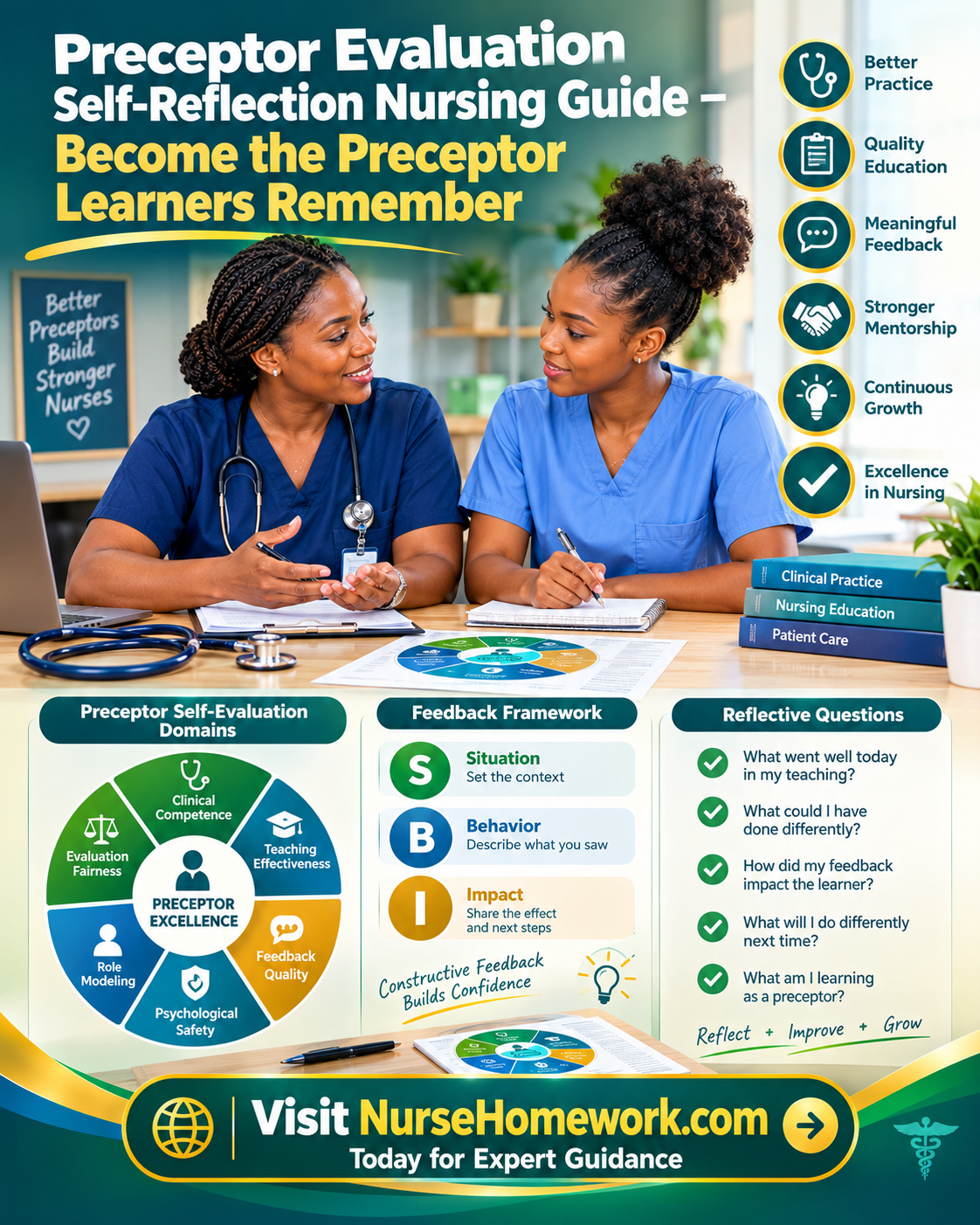
A preceptor evaluation self-reflection nursing guide is one of the most valuable resources a practicing nurse can use, because becoming an effective preceptor requires deliberate self-examination rather than the assumption that clinical competence automatically transfers to teaching ability. At NurseHomework.com, we understand that this preceptor evaluation self-reflection nursing guide addresses a genuine gap in nursing professional development, since most nurses receive little formal preparation for the preceptor role before being asked to supervise students and new graduates. This comprehensive preceptor evaluation self-reflection nursing guide covers evaluation domains, reflective models, feedback frameworks, and structured self-assessment tools.
Why a Preceptor Evaluation Self-Reflection Nursing Guide Matters
Before going further into this preceptor evaluation self-reflection nursing guide, it is essential to understand why self-reflection is central to preceptor effectiveness. Preceptors shape the next generation of nurses, and their influence extends far beyond task instruction. A preceptor who never examines their own practice transmits both strengths and unexamined habits to every learner they supervise.
Precepting also exposes gaps that clinical practice alone does not reveal. A nurse who performs a skill fluently may struggle to explain why the steps matter. A nurse who manages a heavy assignment efficiently may not know how to sequence learning for someone who cannot yet manage that load. A nurse confident in their own judgment may inadvertently silence learners who need to develop their own. Following a structured preceptor evaluation self-reflection nursing guide prevents these gaps from persisting unnoticed.
Self-reflection is the mechanism through which preceptors identify these gaps and address them deliberately. Without reflection, preceptors repeat the same approach indefinitely, and learners experience the same limitations semester after semester. This is precisely why a written preceptor evaluation self-reflection nursing guide is more effective than informal self-assessment alone.
The Dual Purpose of Preceptor Evaluation
Understanding what evaluation is for clarifies what self-reflection should examine.
Evaluating the Learner
Preceptors evaluate learners against competency frameworks, clinical objectives, and program expectations. This evaluation determines progression, identifies learning needs, and documents performance.
Evaluating the Preceptor
Less frequently discussed is the preceptor’s evaluation of their own performance. Effective preceptors assess whether their teaching produced learning, whether their feedback changed behavior, and whether their supervision created safety or anxiety.
This preceptor evaluation self-reflection nursing guide focuses primarily on the second purpose, because preceptor self-assessment is systematically underdeveloped in most clinical settings.
Evaluating the Preceptorship Relationship
The relationship itself is a third evaluation target. Preceptors assess whether communication was effective, whether expectations were clear, and whether the learner felt supported enough to ask questions.
Core Domains of Preceptor Self-Evaluation
A structured preceptor evaluation self-reflection nursing guide addresses multiple domains, because precepting competence is multidimensional.
Clinical Competence
Assess whether your own clinical knowledge was sufficient for the situations you supervised. Identify moments when you were uncertain and how you handled that uncertainty in front of the learner. Acknowledging uncertainty honestly models professional behavior, while concealing it models false confidence.
Teaching Effectiveness
Assess whether your explanations produced understanding. A learner who nods may not understand. Consider whether you verified comprehension through teach-back, return demonstration, or questioning rather than assuming. This dimension of the preceptor evaluation self-reflection nursing guide is frequently overlooked.
Feedback Quality
Assess whether your feedback was specific, timely, and behaviorally focused. Vague feedback such as “good job” provides no direction. Delayed feedback loses relevance. Judgment-laden feedback such as “you’re careless” attacks character rather than behavior.
Psychological Safety
Assess whether the learner felt safe asking questions, reporting uncertainty, and admitting mistakes. Learners who fear judgment withhold information that preceptors need to supervise safely.
Role Modeling
Assess what you modeled, not only what you taught. Learners absorb how you speak to patients, how you handle interruptions, how you respond to criticism, and how you manage stress.
Evaluation Fairness
Assess whether your evaluations of the learner were based on observed behavior and stated criteria rather than personal chemistry or assumptions.
Professional Development
Assess whether you grew as a preceptor during the experience and what you would do differently with the next learner. This final domain of the preceptor evaluation self-reflection nursing guide determines whether improvement continues.
Reflective Models for Preceptor Self-Reflection
Applying a structured model prevents reflection from becoming vague self-assessment.
Gibbs’ Reflective Cycle for Precepting
Description. What occurred during the preceptorship experience or a specific supervision moment?
Feelings. What were you thinking and feeling during the interaction?
Evaluation. What went well and what did not?
Analysis. Why did it go that way, and what does it reveal about your precepting practice?
Conclusion. What could you have done differently?
Action plan. What will you change with your next learner?
Driscoll’s What, So What, Now What
What? Describe the precepting situation.
So what? Analyze its significance for your teaching practice.
Now what? Identify specific changes for future precepting.
The Clinical Judgment Measurement Model as a Precepting Framework
The Clinical Judgment Measurement Model provides a structure for preceptor self-reflection because it mirrors what you are teaching.
Recognizing cues. Did you notice the learner’s confusion, anxiety, or overconfidence?
Analyzing cues. Did you interpret those cues accurately, or did you misread them?
Prioritizing hypotheses. Did you identify the underlying learning need?
Generating solutions. Did you select an appropriate teaching strategy?
Taking action. Did you implement the strategy effectively?
Evaluating outcomes. Did the learner’s performance improve?
Self-Assessment Questions for Preceptors
A practical preceptor evaluation self-reflection nursing guide includes specific questions that prompt genuine examination.
Before the Preceptorship
What are my goals for this learner?
What do I want them to be able to do independently by the end?
What do I know about their prior experience and learning needs?
What are my own strengths and limitations as a preceptor?
How will I balance patient care responsibilities with teaching?
During the Preceptorship
Did I explain the reasoning behind actions, or only the actions themselves?
Did I give the learner opportunities to practice skills rather than only observe?
Did I provide feedback close to the event?
Did I create space for questions?
Did I adjust my approach when the learner struggled?
Did I allow appropriate independence, or did I hover?
Did I intervene too quickly when the learner hesitated?
After the Preceptorship
Did the learner meet the stated objectives?
Did my feedback produce behavior change?
What did I learn about my own teaching?
What would I do differently with the next learner?
Did I complete evaluations fairly and on time?
Did I communicate with the faculty or unit educator effectively?
Feedback Frameworks for Preceptors
Feedback quality is one of the most frequently assessed dimensions of preceptor performance.
The Ask-Tell-Ask Model
Ask what the learner thinks they did well. Tell them what you observed. Ask what they will do differently next time. This sequence engages the learner’s own reflection before delivering your assessment.
The Feedback Sandwich and Its Limitations
The traditional sandwich approach—praise, criticism, praise—is widely used but frequently ineffective because learners learn to wait for the criticism and discount the praise. Structured frameworks with clear behavioral specificity produce better results.
Situation-Behavior-Impact
Describe the situation, describe the specific behavior observed, and describe the impact. “During the medication pass, you verified the dose twice before administering, which prevented a potential error” is more useful than “you did well.”
Immediate and Specific
Feedback delivered within minutes of the event and focused on observable behavior produces the strongest learning. Delayed feedback loses context, and generic feedback provides no direction.
Evaluating Learner Competence Fairly
Preceptor self-reflection must address evaluation fairness because biased evaluation harms learners and the profession.
Assess Against Stated Criteria
Base evaluations on program objectives, competency frameworks, and observed behavior rather than personal impressions.
Distinguish Personality From Performance
A learner whose communication style differs from yours is not necessarily less competent. Examine whether your assessment reflects performance or chemistry.
Consider Unconscious Bias
Reflect honestly on whether learner characteristics influenced your judgment. Research consistently documents that evaluation varies by learner demographics, and preceptors should examine their own patterns deliberately.
Document Behaviorally
Write evaluation comments that describe observed behavior rather than subjective impressions. Behavioral documentation is defensible and useful for the learner.
Verify Your Assessment
Ask a colleague or unit educator to review your evaluations when a learner’s performance is borderline.
Common Preceptor Self-Reflection Mistakes
Assuming clinical competence equals teaching competence. The skills are distinct, and strong clinicians frequently need deliberate development as educators.
Reflecting only on the learner’s performance. Preceptor self-reflection examines your own teaching, not only the learner’s progress.
Avoiding difficult self-assessment. Reflecting only on successes produces no growth.
Attributing all difficulties to the learner. Some difficulties originate in the precepting approach.
Providing feedback without verifying understanding. A learner who nods may not have understood.
Over-supervising or under-supervising. Both extremes impede learning, and identifying which pattern you default toward is valuable.
Neglecting psychological safety. Learners who fear judgment withhold information that makes supervision unsafe.
Evaluating without criteria. Evaluation based on impressions rather than stated objectives is unfair and indefensible.
Failing to document. Undocumented feedback and concerns cannot be addressed or defended later.
Structuring a Written Preceptor Self-Reflection
Many preceptor development programs require written self-reflection.
Context
Describe the setting, the learner’s level, and the duration of the preceptorship.
What Occurred
Describe specific supervision moments rather than the experience generally.
Your Response and Reasoning
Examine your decisions as a preceptor, including the reasoning behind your teaching choices.
Learner Response
Describe how the learner responded to your teaching and feedback.
Analysis
Connect your experience to teaching theory, adult learning principles, or competency frameworks.
Learning Identified
State specifically what you learned about your own precepting practice.
Action Plan
Commit to specific behavioral changes for your next preceptorship.
Confidentiality
De-identify learner details and state explicitly that confidentiality has been maintained.
Adult Learning Principles for Preceptors
Understanding how adults learn strengthens preceptor practice.
Adults Are Self-Directed
Adult learners want to participate in goal-setting and prefer guidance over direction. Preceptors who invite learner input produce stronger engagement.
Adults Bring Experience
Learners arrive with prior experience, sometimes substantial. Preceptors who acknowledge and build on that experience are more effective than those who assume a blank slate.
Adults Need Relevance
Adult learners engage when they understand why something matters. Explaining rationale rather than only steps increases retention.
Adults Are Problem-Centered
Adults learn best when learning solves a real problem. Supervising real patient care with deliberate debriefing uses this principle naturally.
Adults Need Respect
Learners who feel disrespected disengage. Tone, language, and willingness to answer questions all communicate respect.
The Role of Deliberate Practice in Precepting
Effective precepting improves through deliberate practice rather than experience alone.
Identify Specific Teaching Skills to Improve
Choose one skill per preceptorship, such as delivering specific feedback or asking open-ended questions.
Practice Deliberately
Use simulation, role-play, or recorded debriefings to practice the skill.
Seek Feedback on Your Precepting
Ask learners, unit educators, and colleagues to assess your precepting practice.
Track Progress
Record what you practiced and what changed. Documented progress sustains improvement.
How NurseHomework.com Supports Preceptor Development
At NurseHomework.com, we provide comprehensive support for nurses developing as clinical educators. Our services include:
Preceptor self-reflection frameworks using Gibbs, Driscoll, and the Clinical Judgment Measurement Model
Feedback technique development including Ask-Tell-Ask and Situation-Behavior-Impact
Evaluation fairness and bias awareness guidance
Written self-reflection structuring and analysis development
Adult learning principle application to clinical teaching
Competency assessment alignment with program objectives
Debriefing technique development for post-clinical review
Confidentiality and documentation guidance
Rubric alignment checks for preceptor development assignments
APA 7th edition citation and reference verification
Whether you are completing preceptor training, refining your teaching practice, or writing a preceptor self-evaluation, NurseHomework.com is here to support your development as a clinical educator.
Frequently Asked Questions About Preceptor Evaluation Self-Reflection Nursing Guide
What is preceptor evaluation self-reflection?
It is the deliberate examination of your own precepting practice, including clinical competence, teaching effectiveness, feedback quality, psychological safety, role modeling, and evaluation fairness.
Why is self-reflection important for preceptors?
Preceptors shape the next generation of nurses, and without reflection they transmit both strengths and unexamined habits to every learner they supervise.
Which reflective model works best for preceptor self-reflection?
Gibbs’ Reflective Cycle is most widely used. Driscoll’s What, So What, Now What suits shorter reflections. The Clinical Judgment Measurement Model suits reflection focused on clinical reasoning development.
What is the Ask-Tell-Ask feedback model?
Ask what the learner thinks they did well, tell them what you observed, then ask what they will do differently next time. This engages the learner’s own reflection before you deliver your assessment.
What is Situation-Behavior-Impact feedback?
A framework describing the situation, the specific behavior observed, and the impact of that behavior. It is more useful than generic praise or criticism.
How do I evaluate a learner fairly?
Base evaluations on stated criteria and observed behavior rather than personal impressions, examine your own potential biases, and document behaviorally.
What is the most common preceptor mistake?
Assuming that clinical competence automatically produces teaching competence. The skills are distinct and require deliberate development.
Can NurseHomework.com help with preceptor evaluation self-reflection?
Yes. NurseHomework.com offers reflective framework application, feedback technique development, and evaluation fairness guidance for preceptor evaluation self-reflection nursing guide support.
How do I create psychological safety for learners?
Invite questions explicitly, respond to uncertainty without judgment, model admitting your own mistakes, and provide feedback focused on behavior rather than character.
What should I include in a written preceptor self-reflection?
Context, specific supervision moments, your response and reasoning, learner response, analysis connected to teaching theory, learning identified, action plan, and confidentiality statement.
Learning preceptor evaluation self-reflection nursing guide practice is ultimately about recognizing that teaching is a skill developed deliberately rather than a role assumed automatically. By understanding the multiple domains of precepting competence, applying a structured reflective model, asking specific self-assessment questions before, during, and after each preceptorship, developing feedback techniques that produce behavior change, evaluating learners fairly against stated criteria, examining your own biases honestly, committing to concrete changes for the next learner, and documenting your reflections in writing, you become the preceptor that learners remember for the right reasons.
At NurseHomework.com, we are committed to helping nurses develop as clinical educators. Our reflective framework application, feedback technique development, and evaluation fairness guidance make preceptor evaluation self-reflection nursing guide practice structured, honest, and genuinely developmental. Don’t assume that clinical expertise makes you an effective preceptor. Visit NurseHomework.com today and discover how we can help you master preceptor evaluation self-reflection nursing guide practice and shape the next generation of nursing with intention.
- preceptor evaluation self-reflection nursing guide
- preceptor evaluation self-reflection nursing guide
- preceptor evaluation self-reflection nursing guide
- preceptor evaluation self-reflection nursing guide
- preceptor evaluation self-reflection nursing guide
- preceptor evaluation self-reflection nursing guide
- preceptor evaluation self-reflection nursing guide
- preceptor evaluation self-reflection nursing guide
Needs help with Nursing Assignment?
We are available 24x7 to deliver the best services and assignment ready within 3-4 hours? Order a custom-written, plagiarism-free paper
 Get Answer Over WhatsApp
 Order Paper Now
