SBAR Report Writing for Nursing Students: Your Complete Guide to Clinical Communication
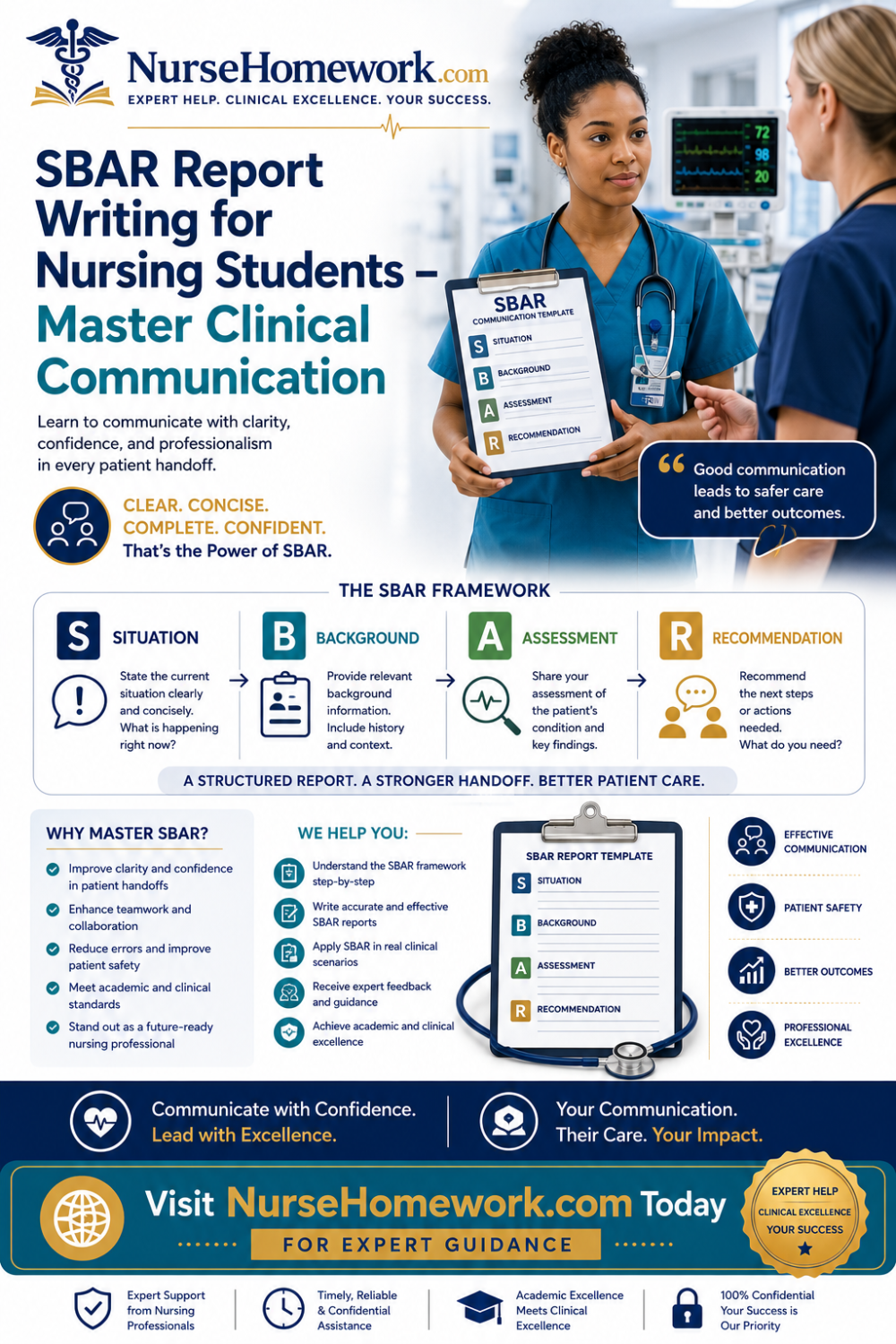
SBAR report writing for nursing students is an essential skill that every nursing student must master to ensure effective communication and patient safety. At NurseHomework.com, we understand that learning SBAR report writing for nursing students is fundamental to clinical practice and professional development. This comprehensive guide will walk you through SBAR report writing for nursing students using established frameworks and best practices.
Understanding SBAR Report Writing for Nursing Students
Before diving into SBAR report writing for nursing students, it is essential to understand what SBAR is and why it matters. SBAR, which stands for Situation, Background, Assessment, and Recommendation, is a well-established handover and communication tool used by nurses. The use of SBAR in simulated client scenarios improves the communication, teamwork, and interventions of the student nurse.
SBAR is a structured communication framework that can help teams share information about the condition of a patient. It provides a vehicle for individuals to speak up and express concern in a concise manner. For nursing students, mastering SBAR report writing for nursing students is critical because the SBAR format is reviewed in classroom prior to clinical rotations to allow students to learn how to appropriately use the format to facilitate communication with providers and nurses. Students are required to use the SBAR format to report a patient case.
The Four Components of SBAR Report Writing for Nursing Students
The SBAR report writing for nursing students framework consists of four key components. Let us explore each component in detail.
Situation: Setting the Stage
The first step in SBAR report writing for nursing students is the Situation. This component states what is currently happening with the patient. It usually begins with the identity of the person communicating the SBAR, patient identifiers such as age and gender, and a brief statement of the current problem or situation.
When learning SBAR report writing for nursing students, the Situation should answer the question: “What is happening to the patient at the moment?”. This is where you provide a brief overview of the patient’s current status and any pertinent context.
Example: “This is Mary RN, from the Med-Surg floor. I’m calling about Mr. Jones in room 101. He is complaining of shortness of breath and chest pain. His BP is 100/58, HR 124, RR 30, Temp 98.6 °F/37 °C”.
When following SBAR report writing for nursing students, remember to introduce yourself first. You should not assume that everyone knows who you are.
Background: Providing Context
The second step in SBAR report writing for nursing students is Background. This component covers the clinical background or context. It includes relevant background information such as the patient’s medical history, reason for admission, and recent developments.
When learning SBAR report writing for nursing students, the Background should answer the question: “What are the circumstances leading to the situation?”. This is where you share relevant background information such as the patient’s medical history, reason for admission, and recent developments.
Example: “Mr. Jones had a myocardial infarction two weeks ago and was admitted yesterday for observation due to new reports of chest pain. He is restless and experiencing rapid, shallow breathing”.
In SBAR report writing for nursing students, background information includes diagnosis, medications, allergies, labs, code status, pain level, interventions, and any other pertinent clinical information.
Assessment: Clinical Judgment
The third step in SBAR report writing for nursing students is Assessment. This component reports what the person communicating the SBAR thinks the problem is. It states what the nurse or other provider has assessed based on the background information, patient history, and observations.
When learning SBAR report writing for nursing students, the Assessment should answer the question: “What do you think the problem is?”. This is where you state your clinical assessment findings, including vital signs, changes in condition, and response to treatment so far.
Example: “Given his history, I am concerned he may be experiencing a new cardiac event”.
Effective SBAR report writing for nursing students requires that nurses are clear on what they need from the professional to whom they are reporting. The efficacy of SBAR is limited to the nurse’s ability to recognize the important features of a clinical situation.
Recommendation: Taking Action
The fourth step in SBAR report writing for nursing students is Recommendation. This component states an initial recommendation, what is needed and when. The SBAR template is a communication technique used in nursing to communicate critical information.
When following SBAR report writing for nursing students, the Recommendation should include:
State your request, if you have one
Ask what the provider wants you to do
Read back and verify all verbal or telephone orders
Request a read-back when reporting critical lab values
Example: “I’ve initiated 2L oxygen as per standing order. I am requesting an order for an EKG and for you to assess him immediately please. Is this agreeable to you? Do you have any further orders? Let me read these orders back to you”.
ISBAR: An Enhanced Version for SBAR Report Writing for Nursing Students
For SBAR report writing for nursing students, some healthcare settings use an enhanced version called ISBAR, which adds an Introduction component. ISBAR stands for Introduction, Situation, Background, Assessment, and Request/Recommendations.
The Introduction component in ISBAR includes:
Introduce your name
Your role
The agency from which you are calling
The “I” in ISBAR emphasizes self-identification and is recommended for integration into nursing curricula.
SBAR Report Templates for Nursing Students
Using templates is an effective way to practice SBAR report writing for nursing students. The SBAR report template helps structure communication and ensures all essential elements are covered.
Basic SBAR Report Template
Situation:
“This is __, nurse on floor/unit. I am calling about (patient name and location). The problem I am calling about is . Most recent vital signs are: BP, HR, RR, Temp.”
Background:
Provide background information related to the situation (diagnosis, medications, allergies, labs, code status, pain level, interventions, and any other pertinent clinical information).
Assessment:
“I think the problem is ___________” OR “I am not sure what the problem is, but the client is deteriorating.”
Recommendation:
State your request and ask what the provider wants you to do. Read back and verify all verbal or telephone orders.
Common Mistakes in SBAR Report Writing for Nursing Students
When learning SBAR report writing for nursing students, avoid these common errors:
1. Forgetting to Introduce Yourself
You should not assume that everyone knows who you are. Always start with your name, role, and unit.
2. Providing Too Much or Too Little Information
SBAR is designed for concise communication of the most essential information. Students often struggle with determining what information is necessary to give providers.
3. Failing to Analyze Data Effectively
SBAR is only as effective as the data analysis that precedes it. Assessment and clinical reasoning are fundamental to the process of effective reporting. The nurse needs to be clear on what they need from the professional to whom they are reporting.
4. Not Requesting Read-Back
Always request a read-back when reporting critical lab values or verbal orders.
5. Being Vague in the Recommendation
State your request clearly and ask what the provider wants you to do.
Practical Tips for SBAR Report Writing for Nursing Students
Before the Report
Gather Your Data:
Effective SBAR report writing for nursing students requires careful data collection. The ADII method can help students better align abnormal data and their analysis with subsequent interprofessional communication. ADII stands for abnormal data (AD), issues (I), and interventions (I).
Organize Your Thoughts:
Identify the relevant data of an assessment as a necessary prerequisite for the development of an effective report.
During the Report
Use Starter Phrases:
Consider saying the actual words to keep yourself on track: “The situation is…, The background is…, My assessment is…, I recommend…”
Be Concise:
SBAR is a method used for concise communication of the most essential information in the health care field.
Stay Focused:
SBAR is particularly effective in high-acuity settings. It is useful for framing any conversation, especially critical ones requiring a team’s immediate attention and action.
After the Report
Document:
The utilization of SBAR when recording accurate information within the notes is necessary to paint a clear picture of the situation.
Seek Feedback:
Nursing students who develop the skill of using SBAR efficiently will be able to minimize miscommunication errors with providers.
How NurseHomework.com Can Help with SBAR Report Writing for Nursing Students
At NurseHomework.com, we provide comprehensive support for nursing students learning SBAR report writing for nursing students. Our services include:
Step-by-step guidance on SBAR report writing for nursing students for any clinical scenario
Expert review of your SBAR reports with personalized feedback
Templates and examples for various clinical situations
Practice scenarios and simulations
Tips for effective communication with providers
Help with documentation and handoff communication
Whether you are a nursing student struggling with SBAR report writing for nursing students assignments or a practicing nurse seeking to refine your skills, NurseHomework.com is here to support your professional development.
Frequently Asked Questions About SBAR Report Writing for Nursing Students
What does SBAR stand for in nursing?
SBAR stands for Situation, Background, Assessment, and Recommendation (or Request).
What is the purpose of SBAR report writing for nursing students?
The purpose of SBAR is to provide a structured framework for communicating critical information about patient conditions, ensuring clear and concise exchange of information between healthcare team members.
When should nursing students use SBAR?
SBAR should be used when communicating patient information to providers and other members of the healthcare team. It is particularly useful in acute situations requiring rapid action and during handoffs between nurses.
What is the difference between SBAR and ISBAR?
ISBAR adds an Introduction component to the standard SBAR format, emphasizing self-identification.
What should be included in the Assessment component of SBAR?
The Assessment component should include what you think the problem is based on your clinical judgment, patient history, and observations. It may also include objective data such as vital signs.
Can NurseHomework.com help me with SBAR report writing?
Absolutely! NurseHomework.com offers expert guidance, templates, and personalized support for nursing students learning SBAR report writing for nursing students.
How can I practice SBAR report writing?
Practice by using SBAR templates, participating in simulations, creating SBAR reports after clinical days, and seeking feedback from instructors and peers.
Mastering SBAR report writing for nursing students is essential for nursing students and professionals alike. SBAR provides a vehicle for individuals to speak up and express concern in a concise manner. By following the structured approach outlined in this guide—Situation, Background, Assessment, and Recommendation—you can create effective reports that promote patient safety and clear communication. At NurseHomework.com, we are committed to helping you succeed in your nursing education and career. Our expert guidance, templates, and personalized support make learning SBAR report writing for nursing students easier and more effective. Don’t let the challenges of clinical communication hold you back. Visit NurseHomework.com today and discover how we can help you master SBAR report writing for nursing students and excel in your nursing studies.
Needs help with Nursing Assignment?
We are available 24x7 to deliver the best services and assignment ready within 3-4 hours? Order a custom-written, plagiarism-free paper
 Get Answer Over WhatsApp
 Order Paper Now