What Is Medical-Surgical Nursing? Core Skills, Conditions and Study Guide
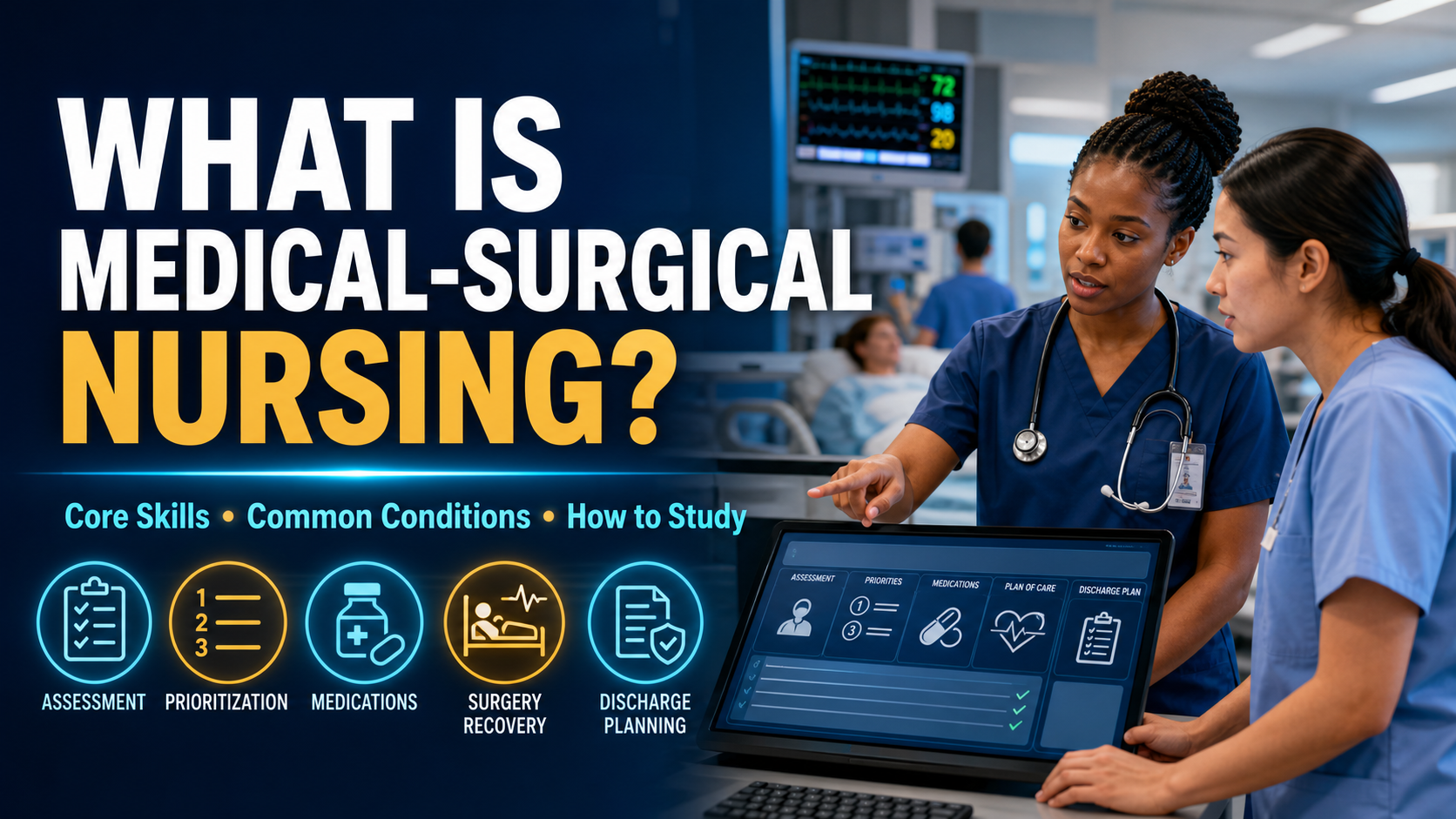
What is medical-surgical nursing? Medical-surgical nursing is the care of adults with acute and chronic health problems, including people preparing for or recovering from surgery. It is one of the broadest nursing areas because it combines assessment, pathophysiology, pharmacology, prioritization, patient education, safety, coordination, and evaluation across many body systems.
Students search this question for more than a dictionary definition. Many want to know what the course covers, why it feels difficult, what a medical-surgical nurse does, and how to study for case-based exams. This guide answers those questions and shows how tutoring can help a learner connect large amounts of content into practical clinical reasoning.
What does a medical-surgical nurse do?
A medical-surgical nurse assesses patients, monitors changes, administers medications, performs and coordinates treatments, prevents complications, educates patients and families, supports recovery, prepares discharge plans, and communicates with the wider healthcare team. The nurse may care for several patients with different diagnoses, so organization and prioritization are central skills.
The specialty is sometimes misunderstood as routine bedside care. In reality, patients may have multiple comorbidities, rapidly changing conditions, complex medication schedules, postoperative risks, mobility limitations, wounds, drains, oxygen needs, nutrition problems, or social barriers affecting discharge. Nurses must recognize expected findings, identify deterioration, and act within the appropriate scope and escalation pathway.
Common conditions covered in medical-surgical nursing
- Cardiovascular conditions such as heart failure, hypertension, dysrhythmias, and coronary syndromes.
- Respiratory problems including pneumonia, COPD, asthma, pulmonary embolism, and oxygenation failure.
- Diabetes, thyroid disorders, adrenal disorders, and fluid or electrolyte imbalance.
- Renal and urinary conditions, acute kidney injury, chronic kidney disease, and urinary obstruction.
- Gastrointestinal and hepatic disorders, bleeding, inflammatory conditions, and nutrition problems.
- Neurological conditions such as stroke, seizures, altered consciousness, and spinal disorders.
- Musculoskeletal injuries, joint replacement, mobility problems, and postoperative rehabilitation.
- Infection, inflammation, immune disorders, cancer care, pain, wounds, and perioperative recovery.
The core skills students must develop
1. Focused assessment
Assessment is more than collecting normal and abnormal findings. Students must know which data matter for the condition, which trend is changing, and what requires immediate action. A useful study habit is to ask what you would assess first, what finding would worry you most, and what additional data would confirm the concern.
2. Prioritization
Medical-surgical questions frequently present several correct actions. The challenge is selecting the safest first action. Use airway, breathing, circulation, acute change, instability, safety, and the nursing process as reasoning tools—not as slogans that replace reading the case. Compare who is most unstable and what delay could cause the greatest harm.
3. Pathophysiology
Memorized lists are fragile. Understanding the mechanism helps predict symptoms, laboratory changes, complications, and rationales. Trace each condition from cause to physiologic disruption, compensatory response, assessment findings, diagnostics, treatment, and evaluation.
4. Medication safety
Learn why a medication is used, its major effect, high-risk adverse reactions, required assessment, relevant laboratory monitoring, patient education, and evaluation. Avoid studying medications as isolated flashcards; connect them to the condition and patient data.
5. Clinical judgment and evaluation
After an intervention, determine what should improve, how quickly, and which finding indicates deterioration or an unintended effect. Evaluation closes the nursing process and appears frequently in unfolding case studies.
Why medical-surgical nursing feels difficult
The course covers many systems while expecting integration. A learner may understand cardiac, respiratory, renal, and medication content separately but struggle when one patient has heart failure, kidney disease, diabetes, and a new infection. Questions then test competing priorities, interaction effects, and safety rather than simple recall.
Another difficulty is volume. Students sometimes respond by reading chapters repeatedly or highlighting everything. These methods feel productive but provide little evidence of retrieval. A better strategy organizes content around recurring decisions: recognition, priority, intervention, monitoring, education, and complications.
How to study medical-surgical nursing effectively
- Use system maps: connect anatomy, disease mechanism, findings, diagnostics, medications, interventions, and complications on one page.
- Compare similar conditions: create tables showing how conditions differ in onset, symptoms, tests, priorities, and treatment.
- Practise retrieval: close the notes and explain the condition, then check what was missed.
- Work through case questions: justify why the best option is first and why the alternatives are less appropriate.
- Track errors: classify mistakes as missing knowledge, misreading, priority confusion, calculation error, or changed answer without evidence.
- Use spaced review: revisit high-risk concepts across several days.
A simple framework for any medical-surgical condition
Ask nine questions: What caused the problem? What changed physiologically? What findings should I expect? What findings signal danger? Which tests confirm or monitor it? What is the immediate nursing priority? Which treatments are likely? What must the nurse monitor or teach? How will I know the patient improved?
Completing this framework for major conditions creates a consistent mental structure. During an exam or clinical discussion, the learner can retrieve the structure and apply patient-specific details rather than searching through disconnected facts.
When medical-surgical nursing tutoring helps
Tutoring is helpful when the student cannot identify why practice questions are being missed, needs pathophysiology explained more clearly, struggles with prioritization, or has fallen behind in a fast course. A tutor can diagnose the learning gap, model reasoning with a fresh example, supervise practice, and create a realistic review plan.
Ethical tutoring does not replace coursework or complete graded clinical decisions for the student. It provides explanations, practice, feedback, study planning, and assignment guidance while preserving student responsibility.
Frequently asked questions
Is medical-surgical nursing the same as surgical nursing?
No. It includes adults with medical conditions as well as preoperative and postoperative care. Its scope is much broader than the operating room.
Is medical-surgical nursing hard?
It can be demanding because of the breadth and emphasis on integration. Consistent concept mapping, retrieval practice, case questions, and error analysis make the workload more manageable.
What should I study first?
Begin with assessment, safety, fluids and electrolytes, oxygenation, perfusion, infection, diabetes, pain, and core medication principles, then align the order with your syllabus.
Can an online tutor help with medical-surgical nursing?
Yes. A tutor can explain conditions, connect pathophysiology to findings, practise prioritization, review mistakes, and help build a study plan matched to the course.
Build stronger medical-surgical nursing reasoning
If you understand individual facts but struggle to connect them in cases, focused tutoring can make the reasoning visible. Bring your syllabus, learning objectives, attempted questions, and error patterns.
Request nursing tutoring support, explore pathophysiology concept-map tutoring, or practise with our clinical reasoning case-study guide.
Needs help with Nursing Assignment?
We are available 24x7 to deliver the best services and assignment ready within 3-4 hours? Order a custom-written, plagiarism-free paper
 Get Answer Over WhatsApp
 Order Paper Now
