Nursing Clinical Case Study Analysis: Complete Guide for Nursing Students
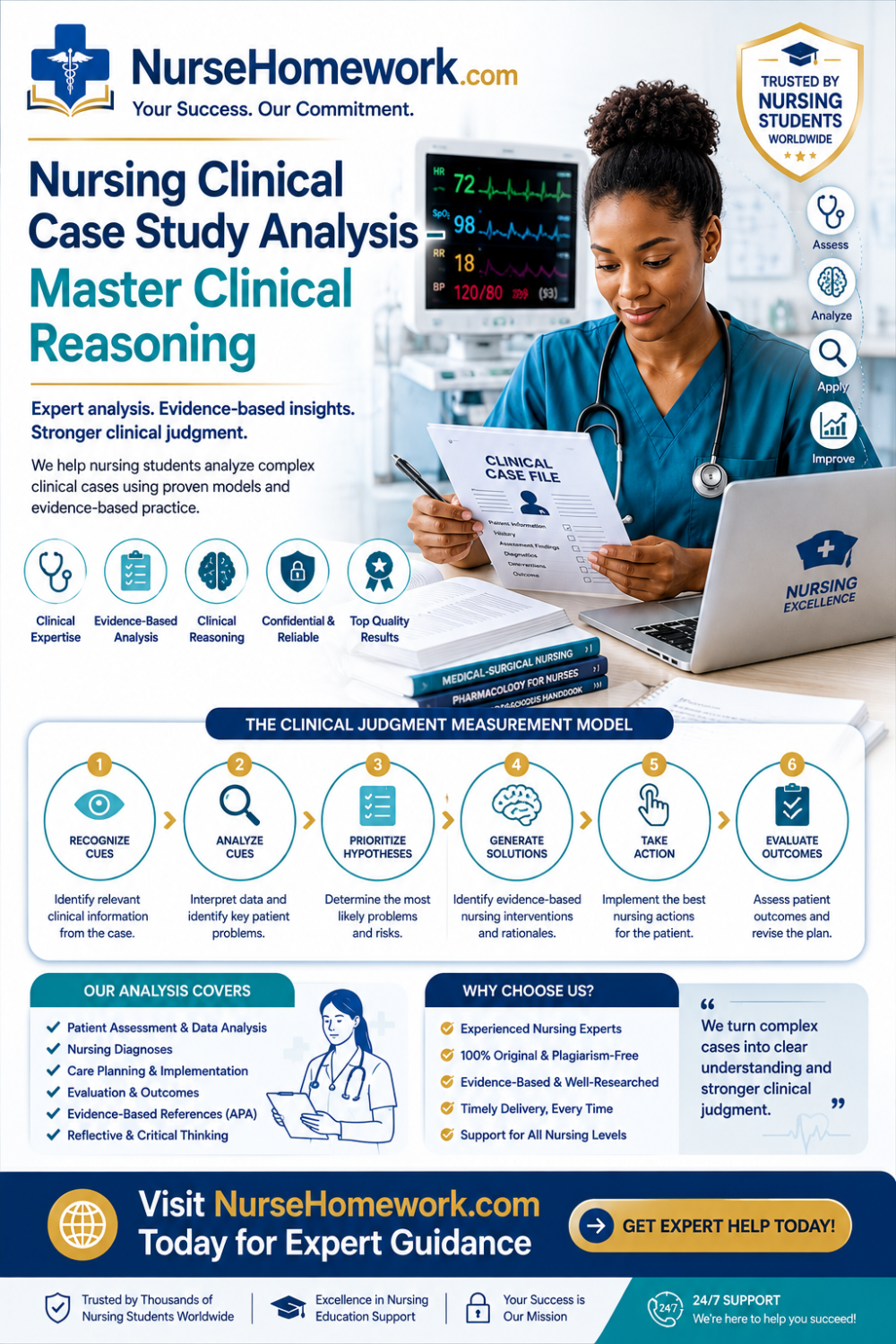
Nursing clinical case study analysis is an essential skill that every nursing student and professional must master to demonstrate clinical reasoning and evidence-based practice. At NurseHomework.com, we understand that mastering nursing clinical case study analysis is fundamental to nursing education and professional development. This comprehensive guide will walk you through nursing clinical case study analysis using established frameworks and best practices.
Understanding Nursing Clinical Case Study Analysis
Before diving into nursing clinical case study analysis, it’s essential to understand what a nursing case study is and why analysis is critical. A nursing case study is a detailed report of a patient’s clinical situation that demonstrates the application of the nursing process and critical thinking skills . The purpose of nursing clinical case study analysis is to document the comprehensive care provided, analyze patient outcomes, and contribute to nursing knowledge .
Case studies in nursing have gained significant importance in scientific publications and educational settings, as they allow nurses to share clinical experiences and evidence-based interventions . Mastering nursing clinical case study analysis enhances clinical reasoning and prepares you for professional practice and examinations like the Next Generation NCLEX .
The Nursing Process for Clinical Case Study Analysis
The nursing process provides the framework for nursing clinical case study analysis. This systematic approach is based on critical thinking and the scientific method of problem solving. The nursing clinical case study analysis follows the ADPIE framework:
Assessment
Diagnosis
Planning
Implementation
Evaluation
Let’s explore each step in detail to master nursing clinical case study analysis.
Step 1: Comprehensive Patient Assessment
The first step in nursing clinical case study analysis is thorough patient assessment. This is the data collection phase where nurses gather both subjective and objective information .
Subjective Data Collection
Subjective data is patient-reported information, including symptoms, complaints, feelings, and personal history . Examples include:
“My chest feels tight, and I can’t catch my breath”
“I’m experiencing pain that’s different from my incision pain”
“I feel shaky and cold”
When conducting nursing clinical case study analysis, these verbal reports provide essential context.
Objective Data Collection
Objective data is measurable and observable information, including vital signs, lab results, physical examination findings, and intake/output totals . Examples include:
Vital signs: Temperature, heart rate, respiratory rate, blood pressure, oxygen saturation
Laboratory results: WBC, lactate, blood glucose, electrolytes
Physical assessment findings: Wound characteristics, edema, neurological status
When learning nursing clinical case study analysis, remember that assessment data comes from multiple sources including the patient, family members, medical records, and interdisciplinary team members .
Recognizing and Analyzing Cues
A critical component of nursing clinical case study analysis is recognizing relevant cues and distinguishing them from expected findings. The NCSBN Clinical Judgment Measurement Model (CJMM) provides a framework for this process .
Recognize Cues: Which findings matter right now? The skill here is separating signal from expected post-operative noise . For example, in a post-operative bowel surgery patient:
Expected: Some incisional discomfort on day 2
Concerning: New fever, increased heart rate with falling blood pressure, rising WBC, elevated lactate, purulent drainage, and pain described as “different from incision pain”
Analyze Cues: What do those findings suggest? This involves interpreting the clinical picture . In the example above, the cues together sketch a pattern suggesting sepsis.
Step 2: Nursing Diagnosis Formulation
The second step in nursing clinical case study analysis is identifying nursing diagnoses. This is the nurse’s clinical judgment about the patient’s response to actual or potential health conditions or needs .
Nursing Diagnosis vs. Medical Diagnosis
It’s crucial to understand that a nursing diagnosis differs from a medical diagnosis. While a medical diagnosis identifies the patient’s illness, a nursing diagnosis focuses on how the illness affects the patient’s daily life .
Using NANDA-I Taxonomies
When following nursing clinical case study analysis, use NANDA-I standardized terminology for nursing diagnoses . The PES format is commonly used:
Problem: The nursing diagnosis
Etiology: The cause or contributing factors
Signs/Symptoms: Defining characteristics
Example from a real case: “Decision-conflict: decision-making in relation to tracheotomy procedure” for a mother facing a difficult medical decision for her child .
Prioritizing Diagnoses
When conducting nursing clinical case study analysis, using Maslow’s Hierarchy of Needs helps prioritize which diagnoses to address first . Airway, breathing, and circulation take priority over safety and psychosocial needs .
Example: A patient with stroke symptoms would have airway and breathing as top priorities, with pain management addressed later .
Step 3: Planning and Goal Setting
The third step in nursing clinical case study analysis is creating measurable goals and expected outcomes.
SMART Goals Framework
Effective goals in your nursing clinical case study analysis should follow the SMART framework:
Specific: Well-defined and unambiguous
Measurable: Set specific metrics to measure progress
Achievable: Within the patient’s capability
Realistic: Relevant to the care plan
Time-bound: With a start time and end date
Short-term and Long-term Goals
Short-term goal example: “The patient will maintain oxygen saturation above 94% with supplemental oxygen within 2 hours of admission” .
Long-term goal example: “The patient will demonstrate progressive ambulation from bed to chair by day 3 post-admission” .
Step 4: Implementation and Nursing Interventions
The fourth step in nursing clinical case study analysis is implementing nursing interventions.
Types of Nursing Interventions
1. Independent Nursing Interventions: Actions the nurse can provide without a prescription .
Example: “Performing frequent neurological checks”
Example: “Repositioning the client frequently”
2. Dependent Nursing Interventions: Actions requiring a prescription or order .
Example: “Administering prescribed medications”
Example: “Applying supplemental oxygen based on provider order”
3. Collaborative Nursing Interventions: Actions carried out in collaboration with other health team members .
Example: “Coordinating with wound care team”
Example: “Consulting with physical therapy”
Evidence-Based Interventions
When documenting nursing clinical case study analysis, interventions should reflect best practices and be supported by literature . Use the Nursing Interventions Classification (NIC) system for standardized, evidence-based interventions .
Documentation Guidelines
Documentation requirements for nursing clinical case study analysis include :
Comprehensive health history
Physical assessment findings
Summary of diagnostic and laboratory data
Patient values, goals, and expectations regarding healthcare
Appropriate use of medical terminology
Step 5: Evaluation and Reassessment
The final step in nursing clinical case study analysis is evaluation.
Evaluation Process
The evaluation process covers four key steps :
Setting up evaluation criteria
Comparing the patient’s response to the evaluation criteria
Checking differences in objective completion that affect expected results
Revising the care plan as needed
Example evaluation from an unfolding case: “Patient reported pain as 2/10 at 10:00, 1 hour after medication administration. Plan continues with PRN pain management” .
Evaluation Outcomes
There are three possible outcomes for goals in your nursing clinical case study analysis: met, ongoing, or not met . If goals aren’t met, revisions are made to the care plan.
Using the Clinical Judgment Measurement Model (CJMM)
The NCSBN Clinical Judgment Measurement Model (CJMM) provides an excellent framework for nursing clinical case study analysis . The model follows six steps:
Step 1: Recognize Cues
Which findings matter right now? This involves identifying relevant data from the case study .
Step 2: Analyze Cues
What do those findings suggest? This involves interpreting the clinical picture .
Step 3: Prioritize Hypotheses
Which explanation is most likely – and most dangerous? This involves clinical reasoning to determine the most likely diagnosis .
Step 4: Generate Solutions
What are the appropriate interventions? This involves identifying potential actions .
Step 5: Take Action
What do you do first / what do you implement? This involves selecting and implementing interventions .
Step 6: Evaluate Outcomes
Did it work? Which findings show progress? This involves assessing the effectiveness of interventions .
This CJMM framework is particularly valuable because it maps directly onto Next Generation NCLEX questions .
Unfolding Case Study Analysis
Unfolding case studies are increasingly used in nursing education and examination . These involve a patient scenario that unfolds across multiple questions, with the left side of the screen holding the patient chart and the right side holding the current question .
Key Features of Unfolding Case Studies
Realistic Patient Scenarios: Case study analysis involves realistic clinical scenarios that test clinical reasoning .
Evolving Information: The patient chart updates as the scenario progresses, requiring ongoing assessment and adjustment .
Fixed Question Sequence: Questions follow a fixed order that mirrors clinical decision-making processes .
Example: Unfolding Case Study Analysis for Stroke
Scenario Opening – Patient Presentation :
68-year-old female, falls at home and hits head
Alert and oriented only to self
Slurred speech, slight right facial droop
Rapid, thready pulse
Decreased muscle strength and sensation on right side
Analysis Using CJMM Steps:
Recognize Cues: The nurse recognizes stroke symptoms using FAST assessment .
Analyze Cues: Symptoms consistent with cerebrovascular accident (stroke). Patient history includes hypertension, atrial fibrillation, and type 2 diabetes – all risk factors for stroke .
Prioritize Hypotheses: Ischemic stroke most likely. The nurse activates code stroke protocol immediately .
Generate Solutions: STAT head CT, frequent neurological checks, point-of-care glucose, labs, 12-lead ECG .
Take Action: Initiate NPO orders, transport to imaging, notify stroke team .
Evaluate Outcomes: CT report shows ischemic stroke on left side of brain, consistent with right-sided symptoms .
Subject-Specific Clinical Case Study Analysis
Post-Operative Complication Case Analysis
When conducting nursing clinical case study analysis for post-operative patients, consider:
Monitoring for signs of infection (fever, WBC elevation, purulent drainage)
Recognizing sepsis clusters (falling blood pressure, elevated lactate)
Regular reassessment of pain and distinguishing incision pain from new symptoms
Neurological Emergency Case Analysis
For stroke patients, nursing clinical case study analysis should include :
FAST assessment for stroke recognition
Time-sensitive interventions (last seen normal)
Neurological checks and monitoring for deterioration
Communication with family about treatment decisions
Complex Decision-Making Case Analysis
Some case studies focus on decision-making conflicts :
Example: A mother facing tracheostomy decision for her 17-month-old child
Nursing diagnosis: Decision-conflict
Nursing process: Escape period, conflict period, coping period after decision-making
Nursing approach: Using Watson’s Caring Theory to establish trust, listen, and provide information
How NurseHomework.com Can Help with Clinical Case Study Analysis
At NurseHomework.com, we provide comprehensive support for nursing students learning nursing clinical case study analysis. Our services include:
Step-by-step guidance on nursing clinical case study analysis for any clinical scenario
Expert review of your case studies with personalized feedback
Templates following CJMM, ADPIE, and CARE guidelines
Assistance with NANDA-I diagnosis selection and PES formatting
Evidence-based intervention suggestions using NIC
Help with APA or Vancouver formatting for case studies
Practice with unfolding case study formats
Whether you are a nursing student struggling with nursing clinical case study analysis assignments or a practicing nurse preparing for publication, NurseHomework.com is here to support your professional development.
Frequently Asked Questions About Nursing Clinical Case Study Analysis
What is the difference between a nursing case study and a clinical case study analysis?
A nursing case study presents the patient’s story. Clinical case study analysis involves examining and interpreting that story using clinical judgment frameworks to demonstrate reasoning and evidence-based practice .
What structure should I follow for nursing clinical case study analysis?
Follow the ADPIE structure: Assessment, Diagnosis, Planning, Implementation, Evaluation. The CJMM provides a complementary six-step framework: Recognize Cues, Analyze Cues, Prioritize Hypotheses, Generate Solutions, Take Action, Evaluate Outcomes .
What nursing taxonomies should I use in a case study analysis?
Use NANDA-I for nursing diagnoses, NIC for interventions, and NOC for outcomes . This contributes to the scientific quality and standardization of your case study .
Can NurseHomework.com help me with nursing clinical case study analysis?
Absolutely! NurseHomework.com offers expert guidance, templates, and personalized support for nursing students learning nursing clinical case study analysis.
What are the CARE guidelines for case studies?
The CARE guidelines provide standards for reporting clinical cases, including patient information, clinical context, timeline, diagnostic assessment, interventions, follow-up, and patient perspective .
How do I ensure patient confidentiality in a nursing case study analysis?
Use a pseudonym or patient initials. Explicitly state this in the text. Avoid references to specific locations or details that could identify the patient .
What should be included in the assessment section of a case study analysis?
Include comprehensive health history, physical assessment findings, diagnostic and laboratory data, and patient values, goals, and expectations regarding healthcare .
Mastering nursing clinical case study analysis is essential for nursing students and professionals alike. By following the structured approach outlined in this guide—using ADPIE, CJMM, and standardized nursing taxonomies—you can create comprehensive case study analyses that demonstrate clinical competence and contribute to nursing knowledge. At NurseHomework.com, we’re committed to helping you succeed in your nursing education and career. Our expert guidance, templates, and personalized support make learning nursing clinical case study analysis easier and more effective. Don’t let the challenges of nursing education hold you back. Visit NurseHomework.com today and discover how we can help you master nursing clinical case study analysis and excel in your nursing studies.
Needs help with Nursing Assignment?
We are available 24x7 to deliver the best services and assignment ready within 3-4 hours? Order a custom-written, plagiarism-free paper
 Get Answer Over WhatsApp
 Order Paper Now
