Nursing Grammar and Spell Check: Your Complete Guide to Error-Free Clinical and Academic Writing
Nursing grammar and spell check is one of the most consequential steps in nursing education, because writing errors in nursing carry risks that go far beyond a lost point on a rubric. At NurseHomework.com, we understand that nursing writing must satisfy two demanding standards at once: the academic rubric and the precision required in clinical documentation. This comprehensive guide provides nursing grammar and spell check guidance across error categories, terminology accuracy, dangerous abbreviations, APA mechanics, and practical self-editing systems.
What Nursing Grammar and Spell Check Really Means
Before going further into nursing grammar and spell check practice, it is essential to understand what the task actually involves. Grammar and spell checking in nursing is not merely running a word processor’s built-in tool and accepting every suggestion. It is a discipline-aware review that evaluates sentence structure, word choice, terminology accuracy, abbreviation safety, number and unit formatting, and consistency across an entire document.
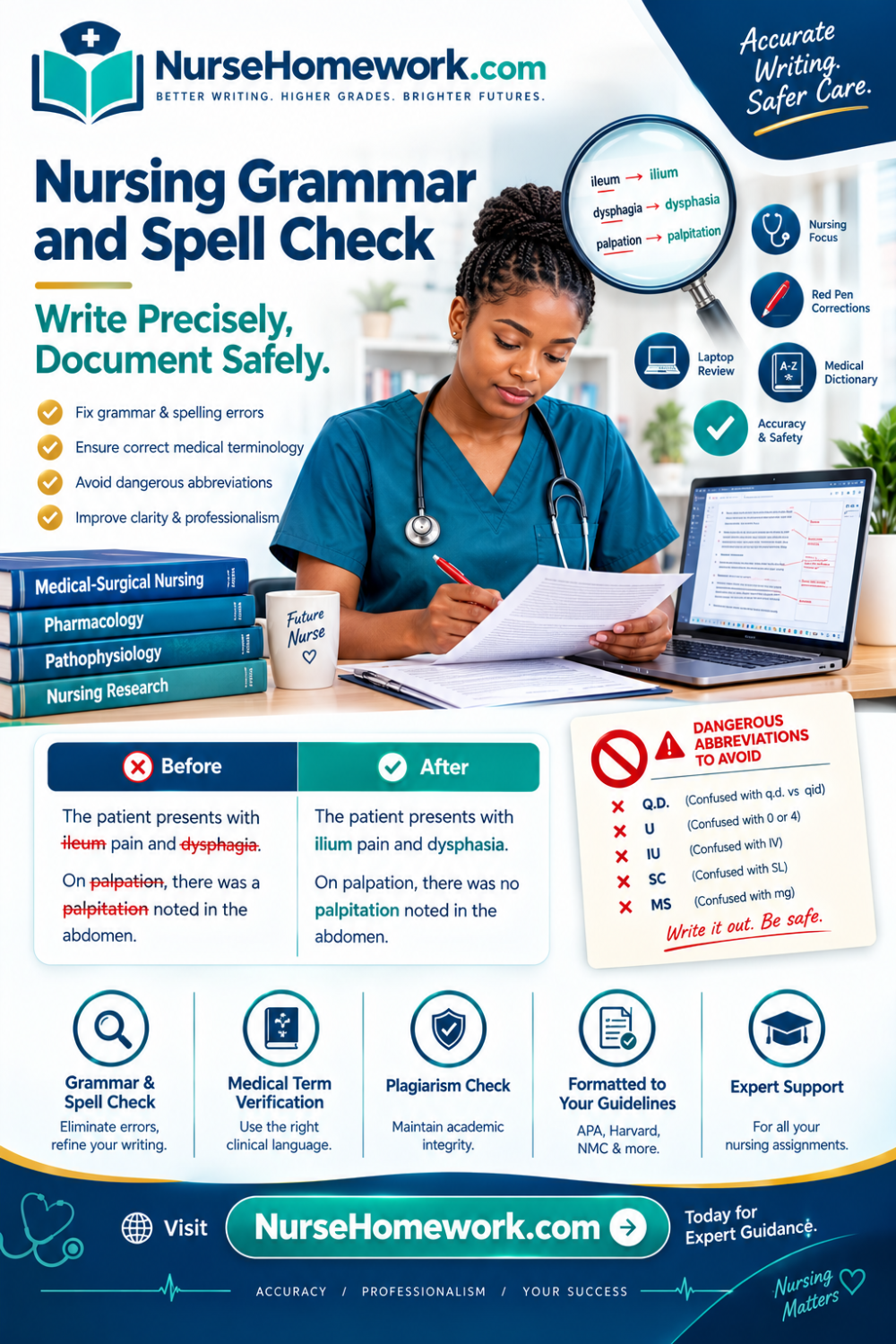
Standard spell checkers fail nursing writers in predictable ways. They do not flag “ileum” when you meant “ilium.” They do not notice that “dysphagia” and “dysphasia” are different conditions. They do not catch “palpation” written where “palpitation” belongs. They accept “5.0 mg” and “.5 mg” without warning, both of which violate safe medication documentation conventions. They cannot detect person-first language violations or APA citation errors.
This is why nursing grammar and spell check must be understood as a human, discipline-specific process supported by tools rather than a process performed by tools alone. The stakes are real, because writing errors in nursing often mirror documentation errors that contribute to patient harm.
Why Grammar and Spelling Matter More in Nursing
Most disciplines penalize writing errors. Nursing penalizes them with unusual severity for several converging reasons.
Patient safety. A misplaced decimal, a dropped word in an order, or a misused abbreviation can contribute directly to medication error. The Institute for Safe Medication Practices maintains a formal list of error-prone abbreviations precisely because these writing choices have caused harm.
Legal documentation. The health record is a legal document. Grammatically ambiguous or imprecise statements weaken its defensibility and can obscure what actually occurred.
Interdisciplinary credibility. Nurses communicate in writing with physicians, pharmacists, therapists, and administrators. Writing that contains errors undermines the perception of clinical competence, regardless of actual skill.
Academic weight. Nursing rubrics commonly allocate five to fifteen percent of the grade to mechanics, grammar, and spelling. A well-reasoned paper riddled with errors will not receive the grade its reasoning merits.
Professional standards. Accrediting bodies expect demonstrated written communication competence. Grammar accuracy is measurable evidence of that competence.
Understanding these stakes is what transforms nursing grammar and spell check from a chore into a professional obligation.
The Grammar Errors That Appear Most Often in Nursing Writing
Run-On Sentences and Comma Splices
Nursing students write about complex, multi-causal phenomena, which naturally produces long sentences. The frequent result is a run-on sentence or a comma splice, where two independent clauses are joined by a comma alone. The fix is a period, a semicolon, or a coordinating conjunction.
Subject-Verb Disagreement
Disagreement often occurs when a long phrase separates the subject from the verb. The collection of assessment findings, including vital signs and laboratory values, was documented, not were documented. Careful reading of the sentence skeleton resolves most instances.
Faulty Parallelism
Parallelism errors cluster in lists of interventions, goals, and outcomes. “The nurse will assess pain, monitor vital signs, and documentation of intake” breaks parallel structure. Lists should use a consistent grammatical form throughout.
Dangling and Misplaced Modifiers
Sentences beginning with participial phrases are especially vulnerable. “After administering the medication, the patient’s pain decreased” implies the patient administered the medication. The corrected version names the nurse as the actor.
Passive Voice Overuse
Passive voice is occasionally appropriate in scientific writing when the actor is unknown or unimportant. Its overuse, however, obscures accountability. In nursing documentation, who performed the action often matters enormously.
Tense Inconsistency
Mixing past and present tense within a single paragraph is a common error. Literature reviews generally use past tense for study findings, while care plan interventions typically use future or present tense.
Pronoun Agreement and Ambiguous Reference
Sentences containing multiple nouns create ambiguity when “it,” “they,” or “this” could refer to more than one antecedent.
The Sound-Alike and Look-Alike Errors That Spell Check Misses
The most dangerous spelling errors in nursing are those that produce a real word. Spell checkers pass them without comment. This category demands dedicated attention in any nursing grammar and spell check process.
Frequently confused pairs include:
affect / effect — affect is usually a verb meaning to influence; effect is usually a noun meaning result
adverse / averse — adverse means harmful; averse means having a dislike of
incidence / prevalence — incidence is new cases over time; prevalence is existing cases at a point
dosage / dose — dose is the amount given at one time; dosage is the regimen
principle / principal — principle is a rule; principal means primary or chief
complement / compliment — complement completes; compliment praises
palpation / palpitation — palpation is examination by touch; palpitation is a perceived heartbeat
dysphagia / dysphasia — dysphagia is difficulty swallowing; dysphasia is impaired language
ileum / ilium — ileum is the distal small intestine; ilium is part of the pelvis
abduction / adduction — abduction moves away from midline; adduction moves toward
mucous / mucus — mucous is the adjective; mucus is the noun
systolic / systematic — entirely unrelated terms
cervical / cervical — context-dependent, referring to the neck or the cervix
meter / metre — measurement instrument versus unit of length
flare / flair — a flare is a worsening of symptoms; flair is talent
peak / peek / pique — peak flow versus peek versus pique
through / threw / thorough — commonly confused in transcription
site / sight / cite — insertion site, vision, and citation
discrete / discreet — separate versus judicious
eminent / imminent — prominent versus about to happen
Errors of this type are especially damaging because they are invisible to automated tools while being perfectly visible to faculty and clinical colleagues. This single category justifies much of the value of deliberate nursing grammar and spell check effort.
Clinical Terminology and Abbreviation Accuracy
Spelling Accuracy for Medication Names
Medication names are the highest-risk words in nursing writing. Many drugs have look-alike and sound-alike names that are formally tracked as sources of error. Examples include hydralazine and hydroxyzine, Celexa and Celebrex, and Zantac and Xanax. Every medication name in a written assignment should be verified against a current authoritative source, and the generic name should be used where possible.
Abbreviation Discipline
Abbreviation errors are both academic and clinical problems. Correct practice requires spelling out a term on first use with the abbreviation in parentheses, then using the abbreviation consistently afterward. Beyond that, certain abbreviations should never appear in nursing writing at all.
The ISMP Do-Not-Use List
The Institute for Safe Medication Practices maintains a list of abbreviations that should be avoided because they have contributed to medication errors. Frequently flagged examples include:
U for units — can be misread as zero or four
IU for international units — can be misread as IV
q.d. and QD for daily — can be misread as qid
q.o.d. for every other day — can be misread as qid or daily
MS for morphine sulfate — can be confused with magnesium sulfate
MSO4 and MgSO4 — frequently confused with each other
Trailing zeros such as 5.0 mg — can be misread as 50 mg
Missing leading zeros such as .5 mg — can be misread as 5 mg
@ for at
< and > for less than and greater than
Verifying these conventions is a core component of any serious nursing grammar and spell check process.
Number, Unit, and Dosage Formatting Rules
Grammar and spelling intersect directly with number formatting in nursing writing. The conventions are specific and non-negotiable.
Spell out numbers below ten in narrative text; use numerals for ten and above
Never begin a sentence with a numeral; restructure the sentence instead
Use numerals for all measurements, dosages, statistics, percentages, and times
Always use a leading zero for values below one: 0.5 mg
Never use a trailing zero: write 5 mg, not 5.0 mg
Use standard unit abbreviations: mg, mL, mcg, g, mEq, mmol, gtt
Write mL, not ml or ML
Write mg, not mgs
Use lowercase for spelled-out units when they follow a number
Insert a space between the numeral and the unit in most cases, with the exception of degree and percentage symbols
These rules exist because they reduce misreading. A nursing grammar and spell check that enforces them is simultaneously reinforcing medication safety behavior.
APA Mechanics: Where Grammar and Formatting Overlap
APA compliance is a substantial subset of grammar and spelling review in nursing education, because many APA rules govern sentence-level and word-level choices rather than layout alone.
Key APA language rules include:
Use “and” in narrative citations and “&” inside parentheses
Use “et al.” for three or more authors from the first citation onward
Use past tense for literature review findings and present tense for established facts
Use first person sparingly and only where the assignment permits it
Avoid contractions in formal academic writing
Use numerals for all numbers in the abstract, tables, and figures
Format direct quotations under 40 words with quotation marks; format block quotations of 40 words or more with a 0.5-inch indent and no quotation marks
Use person-first, bias-free language throughout
Bias-free language requirements overlap directly with nursing values. Preferred forms include “older adults” rather than “the elderly,” “people with diabetes” rather than “diabetics,” and “patients who use wheelchairs” rather than “wheelchair-bound.” Catching these substitutions is a hallmark of competent nursing grammar and spell check practice.
Consistency: The Most Overlooked Grammar Dimension
Consistency errors are subtle and cumulative. Individually each is minor; collectively they signal carelessness.
Consistency areas to verify:
Terminology: patient versus client, nurse versus RN, healthcare versus health care
Tense: consistent treatment of literature findings and clinical interventions
Voice: consistent use of active or passive construction
Capitalization: proper nouns, job titles, and department names
Spelling convention: American versus British English used consistently
Heading structure: parallel grammatical form across headings at the same level
Abbreviation use: each abbreviation introduced once and then used consistently
A dedicated consistency pass belongs in every nursing grammar and spell check routine.
Grammar and Spelling in Clinical Documentation Versus Academic Writing
The grammar standards differ meaningfully between these two genres, and applying the wrong standard produces poor results in both.
Academic writing permits longer sentences, extensive hedging such as “may suggest” or “appears consistent with,” and detailed literature integration. Formal transitions and third-person narration are common.
Clinical documentation demands brevity, objectivity, and specificity. It avoids speculation, uses approved abbreviations only, documents what was observed and performed, and follows chronological or systematic structure. Vague terms such as “seems anxious” or “doing well” are replaced with observable descriptors.
Understanding this distinction prevents a student from applying academic grammar conventions to a clinical note or, conversely, writing an academic paper in the clipped fragments appropriate to charting. A capable nursing grammar and spell check is always genre-aware.
Practical Self-Editing Strategies That Work
Read Aloud
Reading aloud is the single highest-yield strategy. It exposes missing words, awkward constructions, repetition, and comma problems that silent reading conceals.
Read Backward
Reading sentence by sentence from the end of the document disrupts your brain’s tendency to auto-correct and forces attention to surface detail.
Change the Visual Format
Increase the font size, switch typeface, or print the document. Unfamiliar formatting reduces automatic error blindness.
Use Targeted Search Commands
Search deliberately for high-risk terms:
” U ” to catch dangerous unit abbreviations
“.5” to find missing leading zeros
“5.0” to find trailing zeros
“alot”, “definately”, “occured”, “recieve” for common misspellings
“q.d.”, “MS”, “MSO4”, “MgSO4” for flagged abbreviations
Double spaces and space-before-period
Your own recurring personal errors
Proofread One Error Category Per Pass
Read once looking only for comma errors. Read again looking only for number formatting. Read again looking only for abbreviation conventions. Multi-pass review is far more reliable than attempting to catch everything simultaneously.
Maintain a Personal Error Log
Most writers have a stable set of five to ten recurring mistakes. Recording them and reviewing before submission converts nursing grammar and spell check from general anxiety into a targeted, efficient process.
Allow Distance Between Writing and Reviewing
A draft reviewed immediately after writing yields far fewer catches than the same draft reviewed the next day.
The Limits of Automated Tools
Grammar and spelling tools are useful but insufficient for nursing writing. Their specific limitations include:
They pass sound-alike errors because the resulting word is valid
They do not know nursing conventions for zeros and unit abbreviations
They cannot detect person-first language violations
They do not verify citation and reference reciprocity
They frequently misapply style rules to scientific constructions
They cannot distinguish a correct technical term from a contextually wrong one
Understanding these limits is essential, because over-reliance on automated checking produces false confidence. Effective nursing grammar and spell check pairs tool output with disciplined human review.
Building a Pre-Submission Grammar and Spelling Checklist
A reliable routine converts memory into a written system. A practical sequence follows.
Sentence-level
Each sentence contains a complete subject and verb
No comma splices or fused sentences
Parallel structure in all lists
Modifiers clearly attach to what they modify
Tense and voice consistent
Word-level
Sound-alike pairs verified against meaning
Medication names checked against an authoritative source
Terminology used consistently
Person-first language throughout
Abbreviations
Every abbreviation spelled out on first use
No ISMP do-not-use abbreviations present
Unit abbreviations in standard form
Numbers and units
Leading zeros present, trailing zeros absent
Numerals used for all measurements
Units spaced and capitalized correctly
APA mechanics
In-text citation format correct
Reference list complete and matching
Quotation formatting correct
Headings correctly leveled
Read-through
Document read aloud once in full
Final read completed after all corrections
Academic Integrity and the Ethical Line
Grammar and spelling support occupies a clear ethical position. Correcting spelling, punctuation, grammar, and formatting mechanics is universally acceptable and mirrors what writing centers do. Problems arise only when support crosses into content generation, fabricated sources, invented data, or rewriting that replaces the student’s own reasoning.
Students should confirm their program’s policy on permitted assistance and disclose support where required. Reputable nursing grammar and spell check services operate strictly on the mechanics side of that boundary, because the goal is to improve the writer, not to substitute for them.
How NurseHomework.com Can Help with Grammar and Spell Check
At NurseHomework.com, we provide comprehensive nursing grammar and spell check support designed specifically for the demands of nursing coursework and professional writing. Our services include:
Full grammar and spelling review of care plans, case studies, literature reviews, and capstone projects
Sound-alike and look-alike word verification, including the pairs automated tools miss
Medication name and clinical terminology accuracy checks against authoritative sources
ISMP do-not-use abbreviation screening
Number, unit, and dosage formatting verification aligned with safe medication practice
APA 7th edition language and mechanics verification
Person-first and bias-free language review
Consistency checks across terminology, tense, voice, and capitalization
Genre-aware review distinguishing academic writing from clinical documentation
Personal error log development so you improve with each submission
Whether you are finalizing a care plan, a case study, or a doctoral manuscript, NurseHomework.com is here to support your development as a precise, credible nursing writer.
Frequently Asked Questions About Nursing Grammar and Spell Check
What is nursing grammar and spell check?
It is a discipline-specific review of nursing writing focused on sentence structure, spelling accuracy including sound-alike pairs, clinical terminology, abbreviation safety, number and unit conventions, APA mechanics, and consistency.
Why is spell check insufficient for nursing writing?
Standard spell checkers pass real-word errors such as “ileum” for “ilium,” do not know safe dosage formatting conventions, cannot detect person-first language violations, and do not verify citations.
What are the most dangerous spelling errors in nursing writing?
Sound-alike pairs such as dysphagia and dysphasia, palpation and palpitation, ileum and ilium, adverse and averse, and incidence and prevalence, along with look-alike medication names.
Which abbreviations should never appear in nursing writing?
The ISMP do-not-use list includes “U” for units, “IU,” “q.d.,” “q.o.d.,” “MS,” “MSO4,” and “MgSO4,” along with trailing zeros and missing leading zeros in dosages.
How should dosages be written correctly?
Always use a leading zero (0.5 mg), never use a trailing zero (5 mg, not 5.0 mg), use standard abbreviations such as mg, mL, and mcg, and avoid the letter “U” for units.
What grammar errors appear most often in nursing papers?
Run-on sentences, comma splices, subject-verb disagreement across long phrases, faulty parallelism in lists, dangling modifiers, passive voice overuse, and tense inconsistency.
How can I catch errors my spell checker misses?
Read aloud, read backward, change the font or print the document, search for specific high-risk terms, proofread one error category per pass, and maintain a personal error log.
Is professional grammar and spell check allowed in nursing programs?
Mechanics-only support is generally permitted, while content generation is not. Always confirm your program’s policy on permitted assistance and disclosure requirements.
Can NurseHomework.com help me with nursing grammar and spell check?
Absolutely. NurseHomework.com offers expert grammar, spelling, terminology, abbreviation, and APA verification for nursing students needing nursing grammar and spell check support.
How early should I request a grammar and spell check?
Complete your content first, then request the check at least 48 hours before the deadline so you have time to review the corrections and read the document once more after changes.
Mastering nursing grammar and spell check is one of the highest-yield habits a nursing student can build. By understanding the error categories that matter most, verifying sound-alike word pairs, enforcing abbreviation and dosage safety conventions, applying APA mechanics correctly, and following a written multi-pass review system, you ensure that your clinical reasoning is judged on its merits rather than obscured by preventable errors. At NurseHomework.com, we are committed to helping you succeed.
Our expert guidance, comprehensive resources, and personalized support make nursing grammar and spell check easier and more effective. Don’t let avoidable errors cost you points or credibility. Visit NurseHomework.com today and discover how we can help you master nursing grammar and spell check and excel in your nursing studies.
- Nursing grammar and spell check
- Nursing grammar and spell check
- Nursing grammar and spell check
- Nursing grammar and spell check
- Nursing grammar and spell check
- Nursing grammar and spell check
Needs help with Nursing Assignment?
We are available 24x7 to deliver the best services and assignment ready within 3-4 hours? Order a custom-written, plagiarism-free paper
 Get Answer Over WhatsApp
 Order Paper Now

