Nursing Dosage Calculations: Practice Problems, Formulas and Answers

Nursing dosage calculations become easier when students use one consistent method and check every unit before accepting an answer. This study guide explains the main formulas, provides worked examples, and highlights the safety checks expected in nursing school. Use it for guided practice, then follow the calculation method required by your program and clinical instructor.

Core dosage calculation formula

A common approach is Desired dose ÷ dose on hand × quantity supplied. Before calculating, convert the desired dose and stock dose to the same unit. For dimensional analysis, arrange conversion factors so unwanted units cancel and the required unit remains.

Essential conversions nursing students should know

  • 1 kilogram = 1,000 grams
  • 1 gram = 1,000 milligrams
  • 1 milligram = 1,000 micrograms
  • 1 liter = 1,000 milliliters
  • 1 kilogram is approximately 2.2 pounds

Never move a decimal by memory alone. Write the conversion factor, label each unit, and perform a reasonableness check.

Practice problem 1: tablets

Order: 500 mg. Available: 250 mg per tablet. Calculation: 500 ÷ 250 × 1 = 2 tablets.

Practice problem 2: liquid medication

Order: 375 mg. Available: 250 mg in 5 mL. Calculation: 375 ÷ 250 × 5 = 7.5 mL.

Practice problem 3: weight-based dose

A patient weighs 44 lb and the order is 5 mg/kg. Convert weight first: 44 ÷ 2.2 = 20 kg. Then calculate 20 × 5 = 100 mg. A weight-based problem may also provide a safe range; compare the ordered dose with that range before proceeding.

Practice problem 4: IV flow rate

For 1,000 mL over 8 hours, the pump rate is 1,000 ÷ 8 = 125 mL/hour. For gravity tubing, use total volume × drop factor ÷ time in minutes, then round drops per minute to a whole number.

How to prevent common calculation errors

  1. Identify what the question asks for.
  2. Write all values with units.
  3. Convert units before applying the formula.
  4. Estimate the likely answer.
  5. Calculate and round only at the final step.
  6. Recheck decimals and leading zeros.

These examples are for education, not medication administration. In clinical practice, follow institutional policy and obtain the required independent check. Students who need help understanding their method can use nursing tutoring for guided practice and feedback.


Comprehensive Student Learning Guide

This expanded guide develops nursing dosage calculations in depth for nursing students who want a clear, repeatable way to study, practice and write about safe medication mathematics. It combines clinical-reasoning habits with academic-writing discipline. The examples remain educational and fictional; real care must follow current orders, institutional policy, professional scope and qualified supervision.

Why this topic matters in nursing education

In the context of why this topic matters in nursing education, a strong understanding of nursing dosage calculations begins with a defined purpose. Students should identify the question being answered, collect the ordered dose, dose on hand, quantity supplied, patient weight, time, volume and institutional safety limits, and separate facts from assumptions. This prevents a familiar but unsafe pattern: choosing an answer first and searching for evidence afterward. During study, write the central problem in one sentence, list the supporting cues, and note what additional information would be needed. That small routine makes safe medication mathematics more transparent and gives an instructor a clear view of the reasoning behind the final response.

Learning objectives for nursing students

For learning objectives for nursing students, the core abilities include unit conversion, dimensional analysis, tablet and liquid calculations, weight-based dosing, IV rates, rounding and reasonableness checks. Practice them as connected steps rather than isolated definitions. Begin with a fictional scenario, identify relevant information, explain what it means, choose a defensible response, and specify how the result would be evaluated. If a step cannot be explained in plain language, return to the evidence and course reference. Good nursing work is not merely a correct-looking answer; it is a traceable process that another learner or instructor can review and discuss.

A structured assessment framework

When considering a structured assessment framework, students commonly lose marks or create safety concerns by mixing units, moving decimals without a written conversion, rounding too early, omitting leading zeros and failing to compare the answer with an expected range. A useful correction is to slow the process at decision points. Ask what is known, what is inferred, what rule or evidence supports the choice, and what finding would require the plan to change. This supports careful clinical thinking and stronger academic paragraphs. It also makes revision efficient because the student can locate the weak link rather than rewriting an entire response without direction.

Connecting evidence to clinical reasoning

To strengthen connecting evidence to clinical reasoning, deliberate practice should be specific: work each problem on paper, label every unit, estimate before calculating, solve with a second method and explain the safety check aloud. After the exercise, compare the work with the course rubric and an approved clinical reference. Mark omissions, rewrite one weak rationale, and repeat the skill with a new scenario. Short, focused repetitions usually build more reliable performance than passively rereading a chapter. Reflection should name one strength, one error pattern, and one concrete goal for the next attempt.

How to organize an academic response

In the context of how to organize an academic response, a strong understanding of nursing dosage calculations begins with a defined purpose. Students should identify the question being answered, collect the ordered dose, dose on hand, quantity supplied, patient weight, time, volume and institutional safety limits, and separate facts from assumptions. This prevents a familiar but unsafe pattern: choosing an answer first and searching for evidence afterward. During study, write the central problem in one sentence, list the supporting cues, and note what additional information would be needed. That small routine makes safe medication mathematics more transparent and gives an instructor a clear view of the reasoning behind the final response.

Step-by-step study method

For step-by-step study method, the core abilities include unit conversion, dimensional analysis, tablet and liquid calculations, weight-based dosing, IV rates, rounding and reasonableness checks. Practice them as connected steps rather than isolated definitions. Begin with a fictional scenario, identify relevant information, explain what it means, choose a defensible response, and specify how the result would be evaluated. If a step cannot be explained in plain language, return to the evidence and course reference. Good nursing work is not merely a correct-looking answer; it is a traceable process that another learner or instructor can review and discuss.

Using patient-centered language

When considering using patient-centered language, students commonly lose marks or create safety concerns by mixing units, moving decimals without a written conversion, rounding too early, omitting leading zeros and failing to compare the answer with an expected range. A useful correction is to slow the process at decision points. Ask what is known, what is inferred, what rule or evidence supports the choice, and what finding would require the plan to change. This supports careful clinical thinking and stronger academic paragraphs. It also makes revision efficient because the student can locate the weak link rather than rewriting an entire response without direction.

Writing measurable outcomes

To strengthen writing measurable outcomes, deliberate practice should be specific: work each problem on paper, label every unit, estimate before calculating, solve with a second method and explain the safety check aloud. After the exercise, compare the work with the course rubric and an approved clinical reference. Mark omissions, rewrite one weak rationale, and repeat the skill with a new scenario. Short, focused repetitions usually build more reliable performance than passively rereading a chapter. Reflection should name one strength, one error pattern, and one concrete goal for the next attempt.

Selecting and justifying nursing actions

In the context of selecting and justifying nursing actions, a strong understanding of nursing dosage calculations begins with a defined purpose. Students should identify the question being answered, collect the ordered dose, dose on hand, quantity supplied, patient weight, time, volume and institutional safety limits, and separate facts from assumptions. This prevents a familiar but unsafe pattern: choosing an answer first and searching for evidence afterward. During study, write the central problem in one sentence, list the supporting cues, and note what additional information would be needed. That small routine makes safe medication mathematics more transparent and gives an instructor a clear view of the reasoning behind the final response.

Evaluation and reassessment

For evaluation and reassessment, the core abilities include unit conversion, dimensional analysis, tablet and liquid calculations, weight-based dosing, IV rates, rounding and reasonableness checks. Practice them as connected steps rather than isolated definitions. Begin with a fictional scenario, identify relevant information, explain what it means, choose a defensible response, and specify how the result would be evaluated. If a step cannot be explained in plain language, return to the evidence and course reference. Good nursing work is not merely a correct-looking answer; it is a traceable process that another learner or instructor can review and discuss.

Safety, scope and escalation

When considering safety, scope and escalation, students commonly lose marks or create safety concerns by mixing units, moving decimals without a written conversion, rounding too early, omitting leading zeros and failing to compare the answer with an expected range. A useful correction is to slow the process at decision points. Ask what is known, what is inferred, what rule or evidence supports the choice, and what finding would require the plan to change. This supports careful clinical thinking and stronger academic paragraphs. It also makes revision efficient because the student can locate the weak link rather than rewriting an entire response without direction.

Documentation principles

To strengthen documentation principles, deliberate practice should be specific: work each problem on paper, label every unit, estimate before calculating, solve with a second method and explain the safety check aloud. After the exercise, compare the work with the course rubric and an approved clinical reference. Mark omissions, rewrite one weak rationale, and repeat the skill with a new scenario. Short, focused repetitions usually build more reliable performance than passively rereading a chapter. Reflection should name one strength, one error pattern, and one concrete goal for the next attempt.

Evidence-based source selection

In the context of evidence-based source selection, a strong understanding of nursing dosage calculations begins with a defined purpose. Students should identify the question being answered, collect the ordered dose, dose on hand, quantity supplied, patient weight, time, volume and institutional safety limits, and separate facts from assumptions. This prevents a familiar but unsafe pattern: choosing an answer first and searching for evidence afterward. During study, write the central problem in one sentence, list the supporting cues, and note what additional information would be needed. That small routine makes safe medication mathematics more transparent and gives an instructor a clear view of the reasoning behind the final response.

Applying the concept in simulation

For applying the concept in simulation, the core abilities include unit conversion, dimensional analysis, tablet and liquid calculations, weight-based dosing, IV rates, rounding and reasonableness checks. Practice them as connected steps rather than isolated definitions. Begin with a fictional scenario, identify relevant information, explain what it means, choose a defensible response, and specify how the result would be evaluated. If a step cannot be explained in plain language, return to the evidence and course reference. Good nursing work is not merely a correct-looking answer; it is a traceable process that another learner or instructor can review and discuss.

Common mistakes and corrections

When considering common mistakes and corrections, students commonly lose marks or create safety concerns by mixing units, moving decimals without a written conversion, rounding too early, omitting leading zeros and failing to compare the answer with an expected range. A useful correction is to slow the process at decision points. Ask what is known, what is inferred, what rule or evidence supports the choice, and what finding would require the plan to change. This supports careful clinical thinking and stronger academic paragraphs. It also makes revision efficient because the student can locate the weak link rather than rewriting an entire response without direction.

Time management during assignments

To strengthen time management during assignments, deliberate practice should be specific: work each problem on paper, label every unit, estimate before calculating, solve with a second method and explain the safety check aloud. After the exercise, compare the work with the course rubric and an approved clinical reference. Mark omissions, rewrite one weak rationale, and repeat the skill with a new scenario. Short, focused repetitions usually build more reliable performance than passively rereading a chapter. Reflection should name one strength, one error pattern, and one concrete goal for the next attempt.

Working with rubrics and instructor feedback

In the context of working with rubrics and instructor feedback, a strong understanding of nursing dosage calculations begins with a defined purpose. Students should identify the question being answered, collect the ordered dose, dose on hand, quantity supplied, patient weight, time, volume and institutional safety limits, and separate facts from assumptions. This prevents a familiar but unsafe pattern: choosing an answer first and searching for evidence afterward. During study, write the central problem in one sentence, list the supporting cues, and note what additional information would be needed. That small routine makes safe medication mathematics more transparent and gives an instructor a clear view of the reasoning behind the final response.

Building confidence through deliberate practice

For building confidence through deliberate practice, the core abilities include unit conversion, dimensional analysis, tablet and liquid calculations, weight-based dosing, IV rates, rounding and reasonableness checks. Practice them as connected steps rather than isolated definitions. Begin with a fictional scenario, identify relevant information, explain what it means, choose a defensible response, and specify how the result would be evaluated. If a step cannot be explained in plain language, return to the evidence and course reference. Good nursing work is not merely a correct-looking answer; it is a traceable process that another learner or instructor can review and discuss.

Academic integrity and responsible support

When considering academic integrity and responsible support, students commonly lose marks or create safety concerns by mixing units, moving decimals without a written conversion, rounding too early, omitting leading zeros and failing to compare the answer with an expected range. A useful correction is to slow the process at decision points. Ask what is known, what is inferred, what rule or evidence supports the choice, and what finding would require the plan to change. This supports careful clinical thinking and stronger academic paragraphs. It also makes revision efficient because the student can locate the weak link rather than rewriting an entire response without direction.

Final study checklist

To strengthen final study checklist, deliberate practice should be specific: work each problem on paper, label every unit, estimate before calculating, solve with a second method and explain the safety check aloud. After the exercise, compare the work with the course rubric and an approved clinical reference. Mark omissions, rewrite one weak rationale, and repeat the skill with a new scenario. Short, focused repetitions usually build more reliable performance than passively rereading a chapter. Reflection should name one strength, one error pattern, and one concrete goal for the next attempt.

Frequently Asked Questions

What should a student assess first?

For this question, begin by returning to the purpose of nursing dosage calculations. Identify the ordered dose, dose on hand, quantity supplied, patient weight, time, volume and institutional safety limits, then decide which information is most relevant to safe medication mathematics. State the reasoning directly and avoid adding facts that the scenario does not provide. When information is missing, name the gap instead of guessing. This produces a safer and more academically defensible response.

How can a student identify the priority?

A high-quality answer to this question connects a specific cue to an interpretation, a nursing action, and an evaluation point. It uses the abilities involved in unit conversion, dimensional analysis, tablet and liquid calculations, weight-based dosing, IV rates, rounding and reasonableness checks while remaining within the scenario and nursing scope. The explanation should show why the choice fits this patient or case, not merely repeat a memorized definition.

What makes an answer patient centered?

A useful approach is to practice deliberately: work each problem on paper, label every unit, estimate before calculating, solve with a second method and explain the safety check aloud. Review the result against the rubric, current course materials and an authoritative nursing source. Correct one error at a time, especially patterns such as mixing units, moving decimals without a written conversion, rounding too early, omitting leading zeros and failing to compare the answer with an expected range. This turns feedback into a practical next step and supports durable learning.

How should evidence be documented?

Patient-centered work uses respectful language, recognizes preferences and strengths, and distinguishes a person’s report from the writer’s observation. In nursing dosage calculations, make the evidence visible, explain uncertainty honestly, and include reassessment. A plan is incomplete if it states an action but never explains how the response will be checked.

What belongs in a strong rationale?

For this question, begin by returning to the purpose of nursing dosage calculations. Identify the ordered dose, dose on hand, quantity supplied, patient weight, time, volume and institutional safety limits, then decide which information is most relevant to safe medication mathematics. State the reasoning directly and avoid adding facts that the scenario does not provide. When information is missing, name the gap instead of guessing. This produces a safer and more academically defensible response.

How can vague writing be improved?

A high-quality answer to this question connects a specific cue to an interpretation, a nursing action, and an evaluation point. It uses the abilities involved in unit conversion, dimensional analysis, tablet and liquid calculations, weight-based dosing, IV rates, rounding and reasonableness checks while remaining within the scenario and nursing scope. The explanation should show why the choice fits this patient or case, not merely repeat a memorized definition.

When should a student seek clarification?

A useful approach is to practice deliberately: work each problem on paper, label every unit, estimate before calculating, solve with a second method and explain the safety check aloud. Review the result against the rubric, current course materials and an authoritative nursing source. Correct one error at a time, especially patterns such as mixing units, moving decimals without a written conversion, rounding too early, omitting leading zeros and failing to compare the answer with an expected range. This turns feedback into a practical next step and supports durable learning.

How can a learner avoid assumptions?

Patient-centered work uses respectful language, recognizes preferences and strengths, and distinguishes a person’s report from the writer’s observation. In nursing dosage calculations, make the evidence visible, explain uncertainty honestly, and include reassessment. A plan is incomplete if it states an action but never explains how the response will be checked.

What is the role of reassessment?

For this question, begin by returning to the purpose of nursing dosage calculations. Identify the ordered dose, dose on hand, quantity supplied, patient weight, time, volume and institutional safety limits, then decide which information is most relevant to safe medication mathematics. State the reasoning directly and avoid adding facts that the scenario does not provide. When information is missing, name the gap instead of guessing. This produces a safer and more academically defensible response.

How should safety concerns be handled?

A high-quality answer to this question connects a specific cue to an interpretation, a nursing action, and an evaluation point. It uses the abilities involved in unit conversion, dimensional analysis, tablet and liquid calculations, weight-based dosing, IV rates, rounding and reasonableness checks while remaining within the scenario and nursing scope. The explanation should show why the choice fits this patient or case, not merely repeat a memorized definition.

How can students study this topic efficiently?

A useful approach is to practice deliberately: work each problem on paper, label every unit, estimate before calculating, solve with a second method and explain the safety check aloud. Review the result against the rubric, current course materials and an authoritative nursing source. Correct one error at a time, especially patterns such as mixing units, moving decimals without a written conversion, rounding too early, omitting leading zeros and failing to compare the answer with an expected range. This turns feedback into a practical next step and supports durable learning.

What sources are appropriate for an assignment?

Patient-centered work uses respectful language, recognizes preferences and strengths, and distinguishes a person’s report from the writer’s observation. In nursing dosage calculations, make the evidence visible, explain uncertainty honestly, and include reassessment. A plan is incomplete if it states an action but never explains how the response will be checked.

How can a rubric guide the response?

For this question, begin by returning to the purpose of nursing dosage calculations. Identify the ordered dose, dose on hand, quantity supplied, patient weight, time, volume and institutional safety limits, then decide which information is most relevant to safe medication mathematics. State the reasoning directly and avoid adding facts that the scenario does not provide. When information is missing, name the gap instead of guessing. This produces a safer and more academically defensible response.

What should be included in a fictional example?

A high-quality answer to this question connects a specific cue to an interpretation, a nursing action, and an evaluation point. It uses the abilities involved in unit conversion, dimensional analysis, tablet and liquid calculations, weight-based dosing, IV rates, rounding and reasonableness checks while remaining within the scenario and nursing scope. The explanation should show why the choice fits this patient or case, not merely repeat a memorized definition.

How can students protect academic integrity?

A useful approach is to practice deliberately: work each problem on paper, label every unit, estimate before calculating, solve with a second method and explain the safety check aloud. Review the result against the rubric, current course materials and an authoritative nursing source. Correct one error at a time, especially patterns such as mixing units, moving decimals without a written conversion, rounding too early, omitting leading zeros and failing to compare the answer with an expected range. This turns feedback into a practical next step and supports durable learning.

Why are measurable outcomes important?

Patient-centered work uses respectful language, recognizes preferences and strengths, and distinguishes a person’s report from the writer’s observation. In nursing dosage calculations, make the evidence visible, explain uncertainty honestly, and include reassessment. A plan is incomplete if it states an action but never explains how the response will be checked.

How does reflection improve performance?

For this question, begin by returning to the purpose of nursing dosage calculations. Identify the ordered dose, dose on hand, quantity supplied, patient weight, time, volume and institutional safety limits, then decide which information is most relevant to safe medication mathematics. State the reasoning directly and avoid adding facts that the scenario does not provide. When information is missing, name the gap instead of guessing. This produces a safer and more academically defensible response.

What makes documentation objective?

A high-quality answer to this question connects a specific cue to an interpretation, a nursing action, and an evaluation point. It uses the abilities involved in unit conversion, dimensional analysis, tablet and liquid calculations, weight-based dosing, IV rates, rounding and reasonableness checks while remaining within the scenario and nursing scope. The explanation should show why the choice fits this patient or case, not merely repeat a memorized definition.

How can a student prepare for simulation?

A useful approach is to practice deliberately: work each problem on paper, label every unit, estimate before calculating, solve with a second method and explain the safety check aloud. Review the result against the rubric, current course materials and an authoritative nursing source. Correct one error at a time, especially patterns such as mixing units, moving decimals without a written conversion, rounding too early, omitting leading zeros and failing to compare the answer with an expected range. This turns feedback into a practical next step and supports durable learning.

What is a useful final quality check?

Patient-centered work uses respectful language, recognizes preferences and strengths, and distinguishes a person’s report from the writer’s observation. In nursing dosage calculations, make the evidence visible, explain uncertainty honestly, and include reassessment. A plan is incomplete if it states an action but never explains how the response will be checked.

Conclusion

Mastery of nursing dosage calculations develops through structured observation, explicit reasoning, evidence-informed decisions, careful documentation and repeated evaluation. Use this guide as a learning framework, then adapt every response to the assignment instructions and fictional case data. For real patient care, follow institutional policy and qualified clinical supervision. Nursing tutoring can help students practice the reasoning process, interpret feedback and improve original work without replacing their academic responsibilities.

Needs help with Nursing Assignment?

We are available 24x7 to deliver the best services and assignment ready within 3-4 hours? Order a custom-written, plagiarism-free paper

Get Answer Over WhatsApp Order Paper Now

Nursing Statistics Tutoring Online

Nursing Statistics Tutoring Online: Interpret Results with Confidence

Nursing Statistics Tutoring Online is designed for nursing students studying research methods, evidence-based practice or project data. Effective tutoring does not replace a learner’s work. It creates a structured way to understand the task, practise the underlying skill, receive feedback and revise independently.

Nursing Statistics Tutoring Online
Illustrative educational visual for Nursing Statistics Tutoring Online; it is not presented as a claimed student result or clinical service.

statistical results remain meaningless when learners can name a test but cannot explain the variables, assumptions, uncertainty or clinical relevance. The solution is not a shortcut or a pre-written submission. It is guided learning that makes the reasoning process visible and repeatable.

What this tutoring topic covers

  • types of variables and measurement: define what good execution looks like, which records are required, who is responsible and how exceptions will be handled.
  • descriptive statistics and distributions: define what good execution looks like, which records are required, who is responsible and how exceptions will be handled.
  • research questions and test choice: define what good execution looks like, which records are required, who is responsible and how exceptions will be handled.
  • confidence intervals and significance: define what good execution looks like, which records are required, who is responsible and how exceptions will be handled.
  • tables, graphs and result interpretation: define what good execution looks like, which records are required, who is responsible and how exceptions will be handled.
  • practice with transparent example datasets: define what good execution looks like, which records are required, who is responsible and how exceptions will be handled.

What a productive session should achieve

  • clearer statistical vocabulary
  • better test-selection reasoning
  • more accurate result interpretation
  • confidence reading nursing research

Progress depends on preparation, active participation, practice and revision. No ethical tutor can guarantee a grade, examination result, registration decision or clinical outcome.

How the tutoring process works

  1. Share the learning goal: identify the module, prompt, rubric, deadline and skill that needs attention.
  2. Diagnose the difficulty: separate knowledge gaps from problems with analysis, organisation, evidence or academic communication.
  3. Model the process: the tutor explains a framework using examples or practice material rather than completing the assessed work.
  4. Practise actively: the learner applies the framework, explains decisions and asks questions.
  5. Receive feedback: feedback identifies strengths, gaps and specific revision actions.
  6. Revise independently: the learner remains the author and checks the final work against institutional rules.

Questions to ask before choosing support

  • Does the tutor understand the nursing level, task type and relevant academic expectations?
  • Will the session build transferable skills instead of supplying answers?
  • Are confidentiality and professional boundaries respected in any scenario discussed?
  • Can the learner request feedback on reasoning, structure, evidence and referencing?
  • Are limitations stated clearly, including that tutoring is not medical advice or clinical supervision?

Academic integrity and professional boundaries

NurseHomework offers educational tutoring, guided practice and feedback that help nursing learners build their own knowledge, reasoning and academic skills. Tutoring must not involve impersonation, fabricated evidence, falsified placement records, examination assistance or completion of an assessment on a student’s behalf. Any case material should be anonymised. Clinical decisions must follow authorised educators, supervisors, local policy and qualified practitioners.

How to prepare for a session

Bring the official task instructions, marking criteria, permitted resources, your own notes and a list of questions. If you have attempted an outline or practice response, share it so feedback can focus on your reasoning. Remove names and identifying details from patient or placement material.

How to turn feedback into lasting improvement

Finish each session with a short learning plan. Record the concept that became clearer, the mistake you want to avoid, the framework you will use and one task you will complete without assistance. Revisit the same skill with a different practice scenario so that you are learning a method rather than memorising one answer. A useful tutor should be able to explain why a change is needed and invite you to explain the reasoning back in your own words.

Measure progress through the quality of your process: Can you interpret a new prompt, identify relevant evidence, justify choices, organise an argument and revise using a checklist? Keep earlier drafts or practice notes and compare them with later work. This gives you concrete evidence of development even though no tutoring service can predict an assessor’s judgment.

Frequently asked questions

Will a tutor write my assessment?

No. Ethical support explains concepts, demonstrates methods, provides practice and comments on learner-created work. You retain authorship and responsibility for the final submission.

Can tutoring guarantee my grade?

No. Results depend on your work, course rules, assessment standards and evaluator judgment. Tutoring aims to improve understanding and independent performance.

Can I use real patient information?

Do not share identifying patient or service-user information. Use anonymised or fictional educational scenarios and follow your institution’s confidentiality rules.

Is this clinical advice?

No. The service is educational. Clinical questions and decisions should be handled through authorised supervisors, educators and qualified healthcare professionals.

Take the next step

Book a nursing study-support session. Share the learning objective and official instructions, and explain the skill you want to strengthen.

Needs help with Nursing Assignment?

We are available 24x7 to deliver the best services and assignment ready within 3-4 hours? Order a custom-written, plagiarism-free paper

Get Answer Over WhatsApp Order Paper Now
Pathophysiology Tutoring for Nursing Students

Pathophysiology Tutoring for Nursing Students: Understand Cause and Effect

Pathophysiology Tutoring for Nursing Students is designed for nursing learners who want to understand disease processes instead of memorising disconnected lists. Effective tutoring does not replace a learner’s work. It creates a structured way to understand the task, practise the underlying skill, receive feedback and revise independently.

Pathophysiology Tutoring for Nursing Students
Illustrative educational visual for Pathophysiology Tutoring for Nursing Students; it is not presented as a claimed student result or clinical service.

pathophysiology becomes difficult when causes, mechanisms, compensation, manifestations and assessment findings are studied as separate facts. The solution is not a shortcut or a pre-written submission. It is guided learning that makes the reasoning process visible and repeatable.

What this tutoring topic covers

  • normal-function review: define what good execution looks like, which records are required, who is responsible and how exceptions will be handled.
  • cause and risk-factor context: define what good execution looks like, which records are required, who is responsible and how exceptions will be handled.
  • cellular and body-system changes: define what good execution looks like, which records are required, who is responsible and how exceptions will be handled.
  • compensation and progression: define what good execution looks like, which records are required, who is responsible and how exceptions will be handled.
  • sign and symptom connections: define what good execution looks like, which records are required, who is responsible and how exceptions will be handled.
  • concept maps and retrieval practice: define what good execution looks like, which records are required, who is responsible and how exceptions will be handled.

What a productive session should achieve

  • deeper cause-and-effect understanding
  • better symptom connections
  • stronger concept-map skills
  • more efficient revision

Progress depends on preparation, active participation, practice and revision. No ethical tutor can guarantee a grade, examination result, registration decision or clinical outcome.

How the tutoring process works

  1. Share the learning goal: identify the module, prompt, rubric, deadline and skill that needs attention.
  2. Diagnose the difficulty: separate knowledge gaps from problems with analysis, organisation, evidence or academic communication.
  3. Model the process: the tutor explains a framework using examples or practice material rather than completing the assessed work.
  4. Practise actively: the learner applies the framework, explains decisions and asks questions.
  5. Receive feedback: feedback identifies strengths, gaps and specific revision actions.
  6. Revise independently: the learner remains the author and checks the final work against institutional rules.

Questions to ask before choosing support

  • Does the tutor understand the nursing level, task type and relevant academic expectations?
  • Will the session build transferable skills instead of supplying answers?
  • Are confidentiality and professional boundaries respected in any scenario discussed?
  • Can the learner request feedback on reasoning, structure, evidence and referencing?
  • Are limitations stated clearly, including that tutoring is not medical advice or clinical supervision?

Academic integrity and professional boundaries

NurseHomework offers educational tutoring, guided practice and feedback that help nursing learners build their own knowledge, reasoning and academic skills. Tutoring must not involve impersonation, fabricated evidence, falsified placement records, examination assistance or completion of an assessment on a student’s behalf. Any case material should be anonymised. Clinical decisions must follow authorised educators, supervisors, local policy and qualified practitioners.

How to prepare for a session

Bring the official task instructions, marking criteria, permitted resources, your own notes and a list of questions. If you have attempted an outline or practice response, share it so feedback can focus on your reasoning. Remove names and identifying details from patient or placement material.

How to turn feedback into lasting improvement

Finish each session with a short learning plan. Record the concept that became clearer, the mistake you want to avoid, the framework you will use and one task you will complete without assistance. Revisit the same skill with a different practice scenario so that you are learning a method rather than memorising one answer. A useful tutor should be able to explain why a change is needed and invite you to explain the reasoning back in your own words.

Measure progress through the quality of your process: Can you interpret a new prompt, identify relevant evidence, justify choices, organise an argument and revise using a checklist? Keep earlier drafts or practice notes and compare them with later work. This gives you concrete evidence of development even though no tutoring service can predict an assessor’s judgment.

Frequently asked questions

Will a tutor write my assessment?

No. Ethical support explains concepts, demonstrates methods, provides practice and comments on learner-created work. You retain authorship and responsibility for the final submission.

Can tutoring guarantee my grade?

No. Results depend on your work, course rules, assessment standards and evaluator judgment. Tutoring aims to improve understanding and independent performance.

Can I use real patient information?

Do not share identifying patient or service-user information. Use anonymised or fictional educational scenarios and follow your institution’s confidentiality rules.

Is this clinical advice?

No. The service is educational. Clinical questions and decisions should be handled through authorised supervisors, educators and qualified healthcare professionals.

Take the next step

Book a nursing study-support session. Share the learning objective and official instructions, and explain the skill you want to strengthen.

Needs help with Nursing Assignment?

We are available 24x7 to deliver the best services and assignment ready within 3-4 hours? Order a custom-written, plagiarism-free paper

Get Answer Over WhatsApp Order Paper Now
Dosage Calculation Tutoring for Nursing Students

Dosage Calculation Tutoring for Nursing Students: Set Up and Check Every Step

Dosage Calculation Tutoring for Nursing Students is designed for nursing students building confidence with medication-mathematics exercises. Effective tutoring does not replace a learner’s work. It creates a structured way to understand the task, practise the underlying skill, receive feedback and revise independently.

Dosage Calculation Tutoring for Nursing Students
Illustrative educational visual for Dosage Calculation Tutoring for Nursing Students; it is not presented as a claimed student result or clinical service.

learners may know arithmetic but still make errors by mixing units, copying the wrong value, rounding too early or accepting an implausible answer. The solution is not a shortcut or a pre-written submission. It is guided learning that makes the reasoning process visible and repeatable.

What this tutoring topic covers

  • metric conversion review: define what good execution looks like, which records are required, who is responsible and how exceptions will be handled.
  • desired-over-have setup: define what good execution looks like, which records are required, who is responsible and how exceptions will be handled.
  • dimensional analysis practice: define what good execution looks like, which records are required, who is responsible and how exceptions will be handled.
  • oral and injectable dose scenarios: define what good execution looks like, which records are required, who is responsible and how exceptions will be handled.
  • infusion and rate practice: define what good execution looks like, which records are required, who is responsible and how exceptions will be handled.
  • estimation, rounding and independent checks: define what good execution looks like, which records are required, who is responsible and how exceptions will be handled.

What a productive session should achieve

  • a consistent setup method
  • fewer unit errors in practice
  • better plausibility checking
  • targeted revision from error patterns

Progress depends on preparation, active participation, practice and revision. No ethical tutor can guarantee a grade, examination result, registration decision or clinical outcome.

How the tutoring process works

  1. Share the learning goal: identify the module, prompt, rubric, deadline and skill that needs attention.
  2. Diagnose the difficulty: separate knowledge gaps from problems with analysis, organisation, evidence or academic communication.
  3. Model the process: the tutor explains a framework using examples or practice material rather than completing the assessed work.
  4. Practise actively: the learner applies the framework, explains decisions and asks questions.
  5. Receive feedback: feedback identifies strengths, gaps and specific revision actions.
  6. Revise independently: the learner remains the author and checks the final work against institutional rules.

Questions to ask before choosing support

  • Does the tutor understand the nursing level, task type and relevant academic expectations?
  • Will the session build transferable skills instead of supplying answers?
  • Are confidentiality and professional boundaries respected in any scenario discussed?
  • Can the learner request feedback on reasoning, structure, evidence and referencing?
  • Are limitations stated clearly, including that tutoring is not medical advice or clinical supervision?

Academic integrity and professional boundaries

NurseHomework offers educational tutoring, guided practice and feedback that help nursing learners build their own knowledge, reasoning and academic skills. Tutoring must not involve impersonation, fabricated evidence, falsified placement records, examination assistance or completion of an assessment on a student’s behalf. Any case material should be anonymised. Clinical decisions must follow authorised educators, supervisors, local policy and qualified practitioners.

How to prepare for a session

Bring the official task instructions, marking criteria, permitted resources, your own notes and a list of questions. If you have attempted an outline or practice response, share it so feedback can focus on your reasoning. Remove names and identifying details from patient or placement material.

How to turn feedback into lasting improvement

Finish each session with a short learning plan. Record the concept that became clearer, the mistake you want to avoid, the framework you will use and one task you will complete without assistance. Revisit the same skill with a different practice scenario so that you are learning a method rather than memorising one answer. A useful tutor should be able to explain why a change is needed and invite you to explain the reasoning back in your own words.

Measure progress through the quality of your process: Can you interpret a new prompt, identify relevant evidence, justify choices, organise an argument and revise using a checklist? Keep earlier drafts or practice notes and compare them with later work. This gives you concrete evidence of development even though no tutoring service can predict an assessor’s judgment.

Frequently asked questions

Will a tutor write my assessment?

No. Ethical support explains concepts, demonstrates methods, provides practice and comments on learner-created work. You retain authorship and responsibility for the final submission.

Can tutoring guarantee my grade?

No. Results depend on your work, course rules, assessment standards and evaluator judgment. Tutoring aims to improve understanding and independent performance.

Can I use real patient information?

Do not share identifying patient or service-user information. Use anonymised or fictional educational scenarios and follow your institution’s confidentiality rules.

Is this clinical advice?

No. The service is educational. Clinical questions and decisions should be handled through authorised supervisors, educators and qualified healthcare professionals.

Take the next step

Book a nursing study-support session. Share the learning objective and official instructions, and explain the skill you want to strengthen.

Needs help with Nursing Assignment?

We are available 24x7 to deliver the best services and assignment ready within 3-4 hours? Order a custom-written, plagiarism-free paper

Get Answer Over WhatsApp Order Paper Now
Nursing Pharmacology Tutoring Online

Nursing Pharmacology Tutoring Online: Connect Classes, Actions and Safety

Nursing Pharmacology Tutoring Online is designed for nursing students who want structured, concept-based pharmacology study support. Effective tutoring does not replace a learner’s work. It creates a structured way to understand the task, practise the underlying skill, receive feedback and revise independently.

Nursing Pharmacology Tutoring Online
Illustrative educational visual for Nursing Pharmacology Tutoring Online; it is not presented as a claimed student result or clinical service.

memorising isolated drug facts becomes overwhelming when learners cannot connect class, mechanism, therapeutic purpose, monitoring and major safety concerns. The solution is not a shortcut or a pre-written submission. It is guided learning that makes the reasoning process visible and repeatable.

What this tutoring topic covers

  • medication class frameworks: define what good execution looks like, which records are required, who is responsible and how exceptions will be handled.
  • mechanism and therapeutic effect: define what good execution looks like, which records are required, who is responsible and how exceptions will be handled.
  • high-level indication patterns: define what good execution looks like, which records are required, who is responsible and how exceptions will be handled.
  • contraindication and precaution concepts: define what good execution looks like, which records are required, who is responsible and how exceptions will be handled.
  • adverse-effect and monitoring patterns: define what good execution looks like, which records are required, who is responsible and how exceptions will be handled.
  • retrieval practice and spaced review: define what good execution looks like, which records are required, who is responsible and how exceptions will be handled.

What a productive session should achieve

  • better organisation of drug knowledge
  • stronger mechanism-to-effect connections
  • more focused revision
  • confidence explaining safety reasoning

Progress depends on preparation, active participation, practice and revision. No ethical tutor can guarantee a grade, examination result, registration decision or clinical outcome.

How the tutoring process works

  1. Share the learning goal: identify the module, prompt, rubric, deadline and skill that needs attention.
  2. Diagnose the difficulty: separate knowledge gaps from problems with analysis, organisation, evidence or academic communication.
  3. Model the process: the tutor explains a framework using examples or practice material rather than completing the assessed work.
  4. Practise actively: the learner applies the framework, explains decisions and asks questions.
  5. Receive feedback: feedback identifies strengths, gaps and specific revision actions.
  6. Revise independently: the learner remains the author and checks the final work against institutional rules.

Questions to ask before choosing support

  • Does the tutor understand the nursing level, task type and relevant academic expectations?
  • Will the session build transferable skills instead of supplying answers?
  • Are confidentiality and professional boundaries respected in any scenario discussed?
  • Can the learner request feedback on reasoning, structure, evidence and referencing?
  • Are limitations stated clearly, including that tutoring is not medical advice or clinical supervision?

Academic integrity and professional boundaries

NurseHomework offers educational tutoring, guided practice and feedback that help nursing learners build their own knowledge, reasoning and academic skills. Tutoring must not involve impersonation, fabricated evidence, falsified placement records, examination assistance or completion of an assessment on a student’s behalf. Any case material should be anonymised. Clinical decisions must follow authorised educators, supervisors, local policy and qualified practitioners.

How to prepare for a session

Bring the official task instructions, marking criteria, permitted resources, your own notes and a list of questions. If you have attempted an outline or practice response, share it so feedback can focus on your reasoning. Remove names and identifying details from patient or placement material.

How to turn feedback into lasting improvement

Finish each session with a short learning plan. Record the concept that became clearer, the mistake you want to avoid, the framework you will use and one task you will complete without assistance. Revisit the same skill with a different practice scenario so that you are learning a method rather than memorising one answer. A useful tutor should be able to explain why a change is needed and invite you to explain the reasoning back in your own words.

Measure progress through the quality of your process: Can you interpret a new prompt, identify relevant evidence, justify choices, organise an argument and revise using a checklist? Keep earlier drafts or practice notes and compare them with later work. This gives you concrete evidence of development even though no tutoring service can predict an assessor’s judgment.

Frequently asked questions

Will a tutor write my assessment?

No. Ethical support explains concepts, demonstrates methods, provides practice and comments on learner-created work. You retain authorship and responsibility for the final submission.

Can tutoring guarantee my grade?

No. Results depend on your work, course rules, assessment standards and evaluator judgment. Tutoring aims to improve understanding and independent performance.

Can I use real patient information?

Do not share identifying patient or service-user information. Use anonymised or fictional educational scenarios and follow your institution’s confidentiality rules.

Is this clinical advice?

No. The service is educational. Clinical questions and decisions should be handled through authorised supervisors, educators and qualified healthcare professionals.

Take the next step

Book a nursing study-support session. Share the learning objective and official instructions, and explain the skill you want to strengthen.

Needs help with Nursing Assignment?

We are available 24x7 to deliver the best services and assignment ready within 3-4 hours? Order a custom-written, plagiarism-free paper

Get Answer Over WhatsApp Order Paper Now
NCLEX NGN Clinical Judgment Tutoring Online

NCLEX NGN Clinical Judgment Tutoring Online: Practise the Reasoning Process

NCLEX NGN Clinical Judgment Tutoring Online is designed for nursing learners preparing independently for Next Generation NCLEX-style clinical judgment tasks. Effective tutoring does not replace a learner’s work. It creates a structured way to understand the task, practise the underlying skill, receive feedback and revise independently.

NCLEX NGN Clinical Judgment Tutoring Online
Illustrative educational visual for NCLEX NGN Clinical Judgment Tutoring Online; it is not presented as a claimed student result or clinical service.

answer memorisation does not transfer well when a new case presents unfamiliar cues, competing risks and several plausible nursing actions. The solution is not a shortcut or a pre-written submission. It is guided learning that makes the reasoning process visible and repeatable.

What this tutoring topic covers

  • recognising relevant and irrelevant cues: define what good execution looks like, which records are required, who is responsible and how exceptions will be handled.
  • connecting cues to possible concerns: define what good execution looks like, which records are required, who is responsible and how exceptions will be handled.
  • prioritising hypotheses and risks: define what good execution looks like, which records are required, who is responsible and how exceptions will be handled.
  • selecting and justifying actions: define what good execution looks like, which records are required, who is responsible and how exceptions will be handled.
  • evaluating outcomes and changes: define what good execution looks like, which records are required, who is responsible and how exceptions will be handled.
  • reviewing mistakes by reasoning step: define what good execution looks like, which records are required, who is responsible and how exceptions will be handled.

What a productive session should achieve

  • a repeatable clinical-judgment method
  • better cue organisation
  • clearer prioritisation rationale
  • more effective practice review

Progress depends on preparation, active participation, practice and revision. No ethical tutor can guarantee a grade, examination result, registration decision or clinical outcome.

How the tutoring process works

  1. Share the learning goal: identify the module, prompt, rubric, deadline and skill that needs attention.
  2. Diagnose the difficulty: separate knowledge gaps from problems with analysis, organisation, evidence or academic communication.
  3. Model the process: the tutor explains a framework using examples or practice material rather than completing the assessed work.
  4. Practise actively: the learner applies the framework, explains decisions and asks questions.
  5. Receive feedback: feedback identifies strengths, gaps and specific revision actions.
  6. Revise independently: the learner remains the author and checks the final work against institutional rules.

Questions to ask before choosing support

  • Does the tutor understand the nursing level, task type and relevant academic expectations?
  • Will the session build transferable skills instead of supplying answers?
  • Are confidentiality and professional boundaries respected in any scenario discussed?
  • Can the learner request feedback on reasoning, structure, evidence and referencing?
  • Are limitations stated clearly, including that tutoring is not medical advice or clinical supervision?

Academic integrity and professional boundaries

NurseHomework offers educational tutoring, guided practice and feedback that help nursing learners build their own knowledge, reasoning and academic skills. Tutoring must not involve impersonation, fabricated evidence, falsified placement records, examination assistance or completion of an assessment on a student’s behalf. Any case material should be anonymised. Clinical decisions must follow authorised educators, supervisors, local policy and qualified practitioners.

How to prepare for a session

Bring the official task instructions, marking criteria, permitted resources, your own notes and a list of questions. If you have attempted an outline or practice response, share it so feedback can focus on your reasoning. Remove names and identifying details from patient or placement material.

How to turn feedback into lasting improvement

Finish each session with a short learning plan. Record the concept that became clearer, the mistake you want to avoid, the framework you will use and one task you will complete without assistance. Revisit the same skill with a different practice scenario so that you are learning a method rather than memorising one answer. A useful tutor should be able to explain why a change is needed and invite you to explain the reasoning back in your own words.

Measure progress through the quality of your process: Can you interpret a new prompt, identify relevant evidence, justify choices, organise an argument and revise using a checklist? Keep earlier drafts or practice notes and compare them with later work. This gives you concrete evidence of development even though no tutoring service can predict an assessor’s judgment.

Frequently asked questions

Will a tutor write my assessment?

No. Ethical support explains concepts, demonstrates methods, provides practice and comments on learner-created work. You retain authorship and responsibility for the final submission.

Can tutoring guarantee my grade?

No. Results depend on your work, course rules, assessment standards and evaluator judgment. Tutoring aims to improve understanding and independent performance.

Can I use real patient information?

Do not share identifying patient or service-user information. Use anonymised or fictional educational scenarios and follow your institution’s confidentiality rules.

Is this clinical advice?

No. The service is educational. Clinical questions and decisions should be handled through authorised supervisors, educators and qualified healthcare professionals.

Take the next step

Book a nursing study-support session. Share the learning objective and official instructions, and explain the skill you want to strengthen.

Needs help with Nursing Assignment?

We are available 24x7 to deliver the best services and assignment ready within 3-4 hours? Order a custom-written, plagiarism-free paper

Get Answer Over WhatsApp Order Paper Now
Nursing Ethics Case Analysis Tutoring

Nursing Ethics Case Analysis Tutoring: Reason Through Difficult Scenarios

Nursing Ethics Case Analysis Tutoring is designed for nursing students studying ethical dilemmas in coursework or case-based learning. Effective tutoring does not replace a learner’s work. It creates a structured way to understand the task, practise the underlying skill, receive feedback and revise independently.

Nursing Ethics Case Analysis Tutoring
Illustrative educational visual for Nursing Ethics Case Analysis Tutoring; it is not presented as a claimed student result or clinical service.

ethical cases feel ambiguous because several duties, rights, risks and professional responsibilities may conflict at the same time. The solution is not a shortcut or a pre-written submission. It is guided learning that makes the reasoning process visible and repeatable.

What this tutoring topic covers

  • identifying the core dilemma: define what good execution looks like, which records are required, who is responsible and how exceptions will be handled.
  • mapping stakeholders and perspectives: define what good execution looks like, which records are required, who is responsible and how exceptions will be handled.
  • applying ethical principles: define what good execution looks like, which records are required, who is responsible and how exceptions will be handled.
  • checking professional and legal context: define what good execution looks like, which records are required, who is responsible and how exceptions will be handled.
  • comparing options and consequences: define what good execution looks like, which records are required, who is responsible and how exceptions will be handled.
  • writing a balanced evidence-led rationale: define what good execution looks like, which records are required, who is responsible and how exceptions will be handled.

What a productive session should achieve

  • deeper ethical reasoning
  • more balanced analysis
  • clearer justification
  • confidence discussing competing duties

Progress depends on preparation, active participation, practice and revision. No ethical tutor can guarantee a grade, examination result, registration decision or clinical outcome.

How the tutoring process works

  1. Share the learning goal: identify the module, prompt, rubric, deadline and skill that needs attention.
  2. Diagnose the difficulty: separate knowledge gaps from problems with analysis, organisation, evidence or academic communication.
  3. Model the process: the tutor explains a framework using examples or practice material rather than completing the assessed work.
  4. Practise actively: the learner applies the framework, explains decisions and asks questions.
  5. Receive feedback: feedback identifies strengths, gaps and specific revision actions.
  6. Revise independently: the learner remains the author and checks the final work against institutional rules.

Questions to ask before choosing support

  • Does the tutor understand the nursing level, task type and relevant academic expectations?
  • Will the session build transferable skills instead of supplying answers?
  • Are confidentiality and professional boundaries respected in any scenario discussed?
  • Can the learner request feedback on reasoning, structure, evidence and referencing?
  • Are limitations stated clearly, including that tutoring is not medical advice or clinical supervision?

Academic integrity and professional boundaries

NurseHomework offers educational tutoring, guided practice and feedback that help nursing learners build their own knowledge, reasoning and academic skills. Tutoring must not involve impersonation, fabricated evidence, falsified placement records, examination assistance or completion of an assessment on a student’s behalf. Any case material should be anonymised. Clinical decisions must follow authorised educators, supervisors, local policy and qualified practitioners.

How to prepare for a session

Bring the official task instructions, marking criteria, permitted resources, your own notes and a list of questions. If you have attempted an outline or practice response, share it so feedback can focus on your reasoning. Remove names and identifying details from patient or placement material.

How to turn feedback into lasting improvement

Finish each session with a short learning plan. Record the concept that became clearer, the mistake you want to avoid, the framework you will use and one task you will complete without assistance. Revisit the same skill with a different practice scenario so that you are learning a method rather than memorising one answer. A useful tutor should be able to explain why a change is needed and invite you to explain the reasoning back in your own words.

Measure progress through the quality of your process: Can you interpret a new prompt, identify relevant evidence, justify choices, organise an argument and revise using a checklist? Keep earlier drafts or practice notes and compare them with later work. This gives you concrete evidence of development even though no tutoring service can predict an assessor’s judgment.

Frequently asked questions

Will a tutor write my assessment?

No. Ethical support explains concepts, demonstrates methods, provides practice and comments on learner-created work. You retain authorship and responsibility for the final submission.

Can tutoring guarantee my grade?

No. Results depend on your work, course rules, assessment standards and evaluator judgment. Tutoring aims to improve understanding and independent performance.

Can I use real patient information?

Do not share identifying patient or service-user information. Use anonymised or fictional educational scenarios and follow your institution’s confidentiality rules.

Is this clinical advice?

No. The service is educational. Clinical questions and decisions should be handled through authorised supervisors, educators and qualified healthcare professionals.

Take the next step

Book a nursing study-support session. Share the learning objective and official instructions, and explain the skill you want to strengthen.

Needs help with Nursing Assignment?

We are available 24x7 to deliver the best services and assignment ready within 3-4 hours? Order a custom-written, plagiarism-free paper

Get Answer Over WhatsApp Order Paper Now
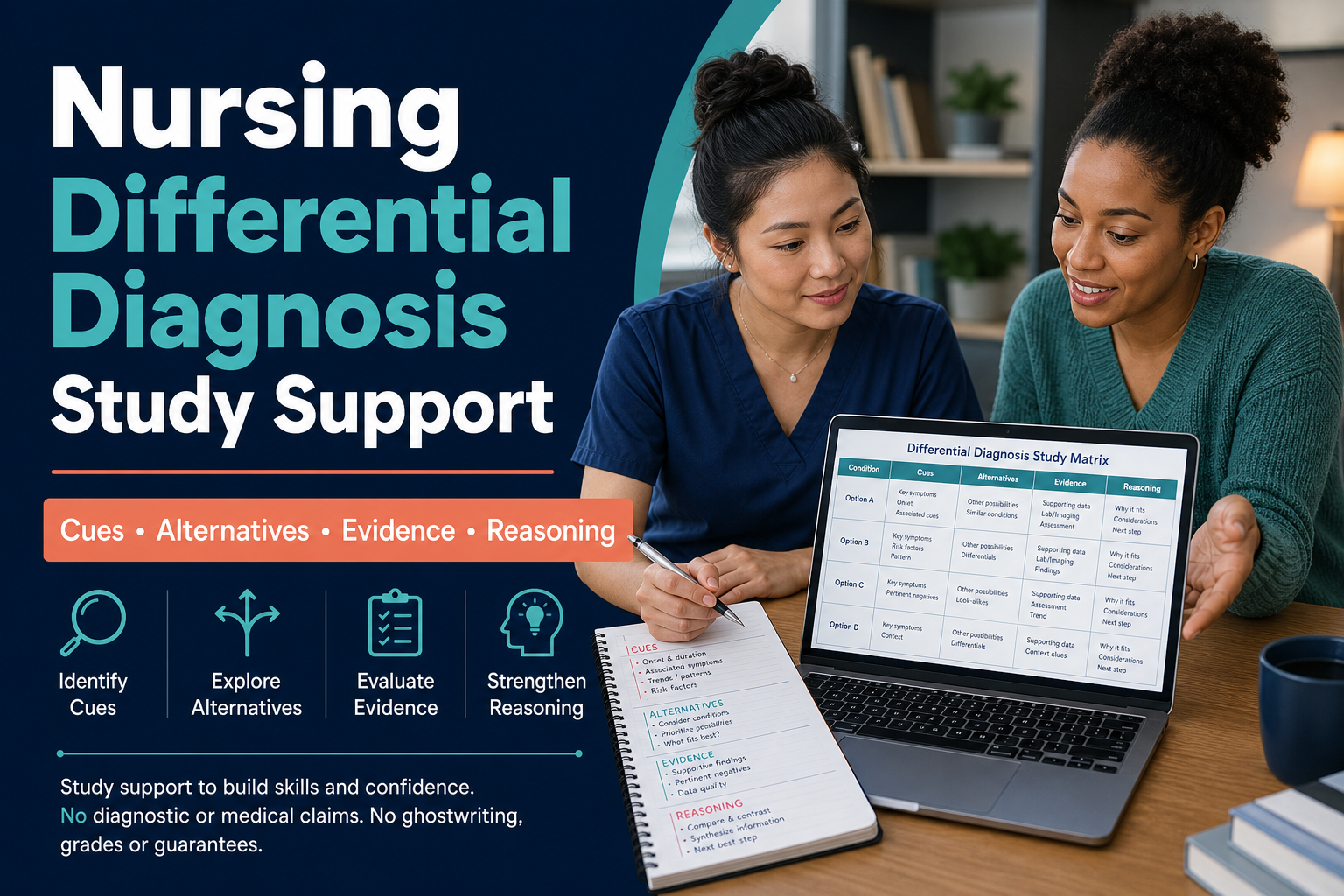
Nursing Differential Diagnosis Study Support

Nursing Differential Diagnosis Study Support: Compare Cues and Alternatives

Nursing Differential Diagnosis Study Support is designed for advanced nursing learners practising structured diagnostic reasoning for coursework or simulation. Effective tutoring does not replace a learner’s work. It creates a structured way to understand the task, practise the underlying skill, receive feedback and revise independently.

Nursing Differential Diagnosis Study Support
Illustrative educational visual for Nursing Differential Diagnosis Study Support; it is not presented as a claimed student result or clinical service.

prematurely settling on one explanation can lead students to ignore conflicting cues, alternative causes and the evidence needed to distinguish possibilities. The solution is not a shortcut or a pre-written submission. It is guided learning that makes the reasoning process visible and repeatable.

What this tutoring topic covers

  • organising subjective and objective cues: define what good execution looks like, which records are required, who is responsible and how exceptions will be handled.
  • building a reasoned problem list: define what good execution looks like, which records are required, who is responsible and how exceptions will be handled.
  • generating plausible alternatives: define what good execution looks like, which records are required, who is responsible and how exceptions will be handled.
  • identifying supporting and conflicting evidence: define what good execution looks like, which records are required, who is responsible and how exceptions will be handled.
  • planning educational next-step questions: define what good execution looks like, which records are required, who is responsible and how exceptions will be handled.
  • explaining uncertainty and reasoning clearly: define what good execution looks like, which records are required, who is responsible and how exceptions will be handled.

What a productive session should achieve

  • more organised case analysis
  • less premature closure
  • stronger comparison of alternatives
  • clearer reasoning explanations

Progress depends on preparation, active participation, practice and revision. No ethical tutor can guarantee a grade, examination result, registration decision or clinical outcome.

How the tutoring process works

  1. Share the learning goal: identify the module, prompt, rubric, deadline and skill that needs attention.
  2. Diagnose the difficulty: separate knowledge gaps from problems with analysis, organisation, evidence or academic communication.
  3. Model the process: the tutor explains a framework using examples or practice material rather than completing the assessed work.
  4. Practise actively: the learner applies the framework, explains decisions and asks questions.
  5. Receive feedback: feedback identifies strengths, gaps and specific revision actions.
  6. Revise independently: the learner remains the author and checks the final work against institutional rules.

Questions to ask before choosing support

  • Does the tutor understand the nursing level, task type and relevant academic expectations?
  • Will the session build transferable skills instead of supplying answers?
  • Are confidentiality and professional boundaries respected in any scenario discussed?
  • Can the learner request feedback on reasoning, structure, evidence and referencing?
  • Are limitations stated clearly, including that tutoring is not medical advice or clinical supervision?

Academic integrity and professional boundaries

NurseHomework offers educational tutoring, guided practice and feedback that help nursing learners build their own knowledge, reasoning and academic skills. Tutoring must not involve impersonation, fabricated evidence, falsified placement records, examination assistance or completion of an assessment on a student’s behalf. Any case material should be anonymised. Clinical decisions must follow authorised educators, supervisors, local policy and qualified practitioners.

How to prepare for a session

Bring the official task instructions, marking criteria, permitted resources, your own notes and a list of questions. If you have attempted an outline or practice response, share it so feedback can focus on your reasoning. Remove names and identifying details from patient or placement material.

How to turn feedback into lasting improvement

Finish each session with a short learning plan. Record the concept that became clearer, the mistake you want to avoid, the framework you will use and one task you will complete without assistance. Revisit the same skill with a different practice scenario so that you are learning a method rather than memorising one answer. A useful tutor should be able to explain why a change is needed and invite you to explain the reasoning back in your own words.

Measure progress through the quality of your process: Can you interpret a new prompt, identify relevant evidence, justify choices, organise an argument and revise using a checklist? Keep earlier drafts or practice notes and compare them with later work. This gives you concrete evidence of development even though no tutoring service can predict an assessor’s judgment.

Frequently asked questions

Will a tutor write my assessment?

No. Ethical support explains concepts, demonstrates methods, provides practice and comments on learner-created work. You retain authorship and responsibility for the final submission.

Can tutoring guarantee my grade?

No. Results depend on your work, course rules, assessment standards and evaluator judgment. Tutoring aims to improve understanding and independent performance.

Can I use real patient information?

Do not share identifying patient or service-user information. Use anonymised or fictional educational scenarios and follow your institution’s confidentiality rules.

Is this clinical advice?

No. The service is educational. Clinical questions and decisions should be handled through authorised supervisors, educators and qualified healthcare professionals.

Take the next step

Book a nursing study-support session. Share the learning objective and official instructions, and explain the skill you want to strengthen.

Needs help with Nursing Assignment?

We are available 24x7 to deliver the best services and assignment ready within 3-4 hours? Order a custom-written, plagiarism-free paper

Get Answer Over WhatsApp Order Paper Now
Nursing Prioritization and Delegation Tutoring Online

Nursing Prioritization and Delegation Tutoring Online: Make Safer Scenario Decisions

Nursing Prioritization and Delegation Tutoring Online is designed for nursing students practising prioritisation and delegation through educational scenarios. Effective tutoring does not replace a learner’s work. It creates a structured way to understand the task, practise the underlying skill, receive feedback and revise independently.

Nursing Prioritization and Delegation Tutoring Online
Illustrative educational visual for Nursing Prioritization and Delegation Tutoring Online; it is not presented as a claimed student result or clinical service.

memorised rules become unreliable when a scenario combines unstable patients, competing needs, limited staff and tasks with different supervision requirements. The solution is not a shortcut or a pre-written submission. It is guided learning that makes the reasoning process visible and repeatable.

What this tutoring topic covers

  • recognising urgent and unstable cues: define what good execution looks like, which records are required, who is responsible and how exceptions will be handled.
  • comparing time-sensitive needs: define what good execution looks like, which records are required, who is responsible and how exceptions will be handled.
  • matching tasks to role and scope: define what good execution looks like, which records are required, who is responsible and how exceptions will be handled.
  • considering predictability and risk: define what good execution looks like, which records are required, who is responsible and how exceptions will be handled.
  • giving clear direction and supervision: define what good execution looks like, which records are required, who is responsible and how exceptions will be handled.
  • reassessing outcomes and escalation: define what good execution looks like, which records are required, who is responsible and how exceptions will be handled.

What a productive session should achieve

  • a repeatable prioritisation method
  • clearer delegation rationale
  • better recognition of risk
  • confidence with complex scenarios

Progress depends on preparation, active participation, practice and revision. No ethical tutor can guarantee a grade, examination result, registration decision or clinical outcome.

How the tutoring process works

  1. Share the learning goal: identify the module, prompt, rubric, deadline and skill that needs attention.
  2. Diagnose the difficulty: separate knowledge gaps from problems with analysis, organisation, evidence or academic communication.
  3. Model the process: the tutor explains a framework using examples or practice material rather than completing the assessed work.
  4. Practise actively: the learner applies the framework, explains decisions and asks questions.
  5. Receive feedback: feedback identifies strengths, gaps and specific revision actions.
  6. Revise independently: the learner remains the author and checks the final work against institutional rules.

Questions to ask before choosing support

  • Does the tutor understand the nursing level, task type and relevant academic expectations?
  • Will the session build transferable skills instead of supplying answers?
  • Are confidentiality and professional boundaries respected in any scenario discussed?
  • Can the learner request feedback on reasoning, structure, evidence and referencing?
  • Are limitations stated clearly, including that tutoring is not medical advice or clinical supervision?

Academic integrity and professional boundaries

NurseHomework offers educational tutoring, guided practice and feedback that help nursing learners build their own knowledge, reasoning and academic skills. Tutoring must not involve impersonation, fabricated evidence, falsified placement records, examination assistance or completion of an assessment on a student’s behalf. Any case material should be anonymised. Clinical decisions must follow authorised educators, supervisors, local policy and qualified practitioners.

How to prepare for a session

Bring the official task instructions, marking criteria, permitted resources, your own notes and a list of questions. If you have attempted an outline or practice response, share it so feedback can focus on your reasoning. Remove names and identifying details from patient or placement material.

How to turn feedback into lasting improvement

Finish each session with a short learning plan. Record the concept that became clearer, the mistake you want to avoid, the framework you will use and one task you will complete without assistance. Revisit the same skill with a different practice scenario so that you are learning a method rather than memorising one answer. A useful tutor should be able to explain why a change is needed and invite you to explain the reasoning back in your own words.

Measure progress through the quality of your process: Can you interpret a new prompt, identify relevant evidence, justify choices, organise an argument and revise using a checklist? Keep earlier drafts or practice notes and compare them with later work. This gives you concrete evidence of development even though no tutoring service can predict an assessor’s judgment.

Frequently asked questions

Will a tutor write my assessment?

No. Ethical support explains concepts, demonstrates methods, provides practice and comments on learner-created work. You retain authorship and responsibility for the final submission.

Can tutoring guarantee my grade?

No. Results depend on your work, course rules, assessment standards and evaluator judgment. Tutoring aims to improve understanding and independent performance.

Can I use real patient information?

Do not share identifying patient or service-user information. Use anonymised or fictional educational scenarios and follow your institution’s confidentiality rules.

Is this clinical advice?

No. The service is educational. Clinical questions and decisions should be handled through authorised supervisors, educators and qualified healthcare professionals.

Take the next step

Book a nursing study-support session. Share the learning objective and official instructions, and explain the skill you want to strengthen.

Needs help with Nursing Assignment?

We are available 24x7 to deliver the best services and assignment ready within 3-4 hours? Order a custom-written, plagiarism-free paper

Get Answer Over WhatsApp Order Paper Now
Head-to-Toe Assessment Tutoring Online

Head-to-Toe Assessment Tutoring Online: Practise a Safe, Logical Sequence

Head-to-Toe Assessment Tutoring Online is designed for nursing students who want guided, simulation-based assessment practice. Effective tutoring does not replace a learner’s work. It creates a structured way to understand the task, practise the underlying skill, receive feedback and revise independently.

Head-to-Toe Assessment Tutoring Online
Illustrative educational visual for Head-to-Toe Assessment Tutoring Online; it is not presented as a claimed student result or clinical service.

learners can omit steps or lose sequence when inspection, examination techniques, safety, normal findings and documentation are memorised separately. The solution is not a shortcut or a pre-written submission. It is guided learning that makes the reasoning process visible and repeatable.

What this tutoring topic covers

  • preparation, identity and safety checks: define what good execution looks like, which records are required, who is responsible and how exceptions will be handled.
  • a consistent assessment sequence: define what good execution looks like, which records are required, who is responsible and how exceptions will be handled.
  • inspection and examination techniques: define what good execution looks like, which records are required, who is responsible and how exceptions will be handled.
  • recognising expected and unexpected cues: define what good execution looks like, which records are required, who is responsible and how exceptions will be handled.
  • concise documentation practice: define what good execution looks like, which records are required, who is responsible and how exceptions will be handled.
  • simulation feedback and targeted repetition: define what good execution looks like, which records are required, who is responsible and how exceptions will be handled.

What a productive session should achieve

  • a more reliable sequence
  • better explanation of technique
  • clearer documentation
  • more focused skills practice

Progress depends on preparation, active participation, practice and revision. No ethical tutor can guarantee a grade, examination result, registration decision or clinical outcome.

How the tutoring process works

  1. Share the learning goal: identify the module, prompt, rubric, deadline and skill that needs attention.
  2. Diagnose the difficulty: separate knowledge gaps from problems with analysis, organisation, evidence or academic communication.
  3. Model the process: the tutor explains a framework using examples or practice material rather than completing the assessed work.
  4. Practise actively: the learner applies the framework, explains decisions and asks questions.
  5. Receive feedback: feedback identifies strengths, gaps and specific revision actions.
  6. Revise independently: the learner remains the author and checks the final work against institutional rules.

Questions to ask before choosing support

  • Does the tutor understand the nursing level, task type and relevant academic expectations?
  • Will the session build transferable skills instead of supplying answers?
  • Are confidentiality and professional boundaries respected in any scenario discussed?
  • Can the learner request feedback on reasoning, structure, evidence and referencing?
  • Are limitations stated clearly, including that tutoring is not medical advice or clinical supervision?

Academic integrity and professional boundaries

NurseHomework offers educational tutoring, guided practice and feedback that help nursing learners build their own knowledge, reasoning and academic skills. Tutoring must not involve impersonation, fabricated evidence, falsified placement records, examination assistance or completion of an assessment on a student’s behalf. Any case material should be anonymised. Clinical decisions must follow authorised educators, supervisors, local policy and qualified practitioners.

How to prepare for a session

Bring the official task instructions, marking criteria, permitted resources, your own notes and a list of questions. If you have attempted an outline or practice response, share it so feedback can focus on your reasoning. Remove names and identifying details from patient or placement material.

How to turn feedback into lasting improvement

Finish each session with a short learning plan. Record the concept that became clearer, the mistake you want to avoid, the framework you will use and one task you will complete without assistance. Revisit the same skill with a different practice scenario so that you are learning a method rather than memorising one answer. A useful tutor should be able to explain why a change is needed and invite you to explain the reasoning back in your own words.

Measure progress through the quality of your process: Can you interpret a new prompt, identify relevant evidence, justify choices, organise an argument and revise using a checklist? Keep earlier drafts or practice notes and compare them with later work. This gives you concrete evidence of development even though no tutoring service can predict an assessor’s judgment.

Frequently asked questions

Will a tutor write my assessment?

No. Ethical support explains concepts, demonstrates methods, provides practice and comments on learner-created work. You retain authorship and responsibility for the final submission.

Can tutoring guarantee my grade?

No. Results depend on your work, course rules, assessment standards and evaluator judgment. Tutoring aims to improve understanding and independent performance.

Can I use real patient information?

Do not share identifying patient or service-user information. Use anonymised or fictional educational scenarios and follow your institution’s confidentiality rules.

Is this clinical advice?

No. The service is educational. Clinical questions and decisions should be handled through authorised supervisors, educators and qualified healthcare professionals.

Take the next step

Book a nursing study-support session. Share the learning objective and official instructions, and explain the skill you want to strengthen.

Needs help with Nursing Assignment?

We are available 24x7 to deliver the best services and assignment ready within 3-4 hours? Order a custom-written, plagiarism-free paper

Get Answer Over WhatsApp Order Paper Now