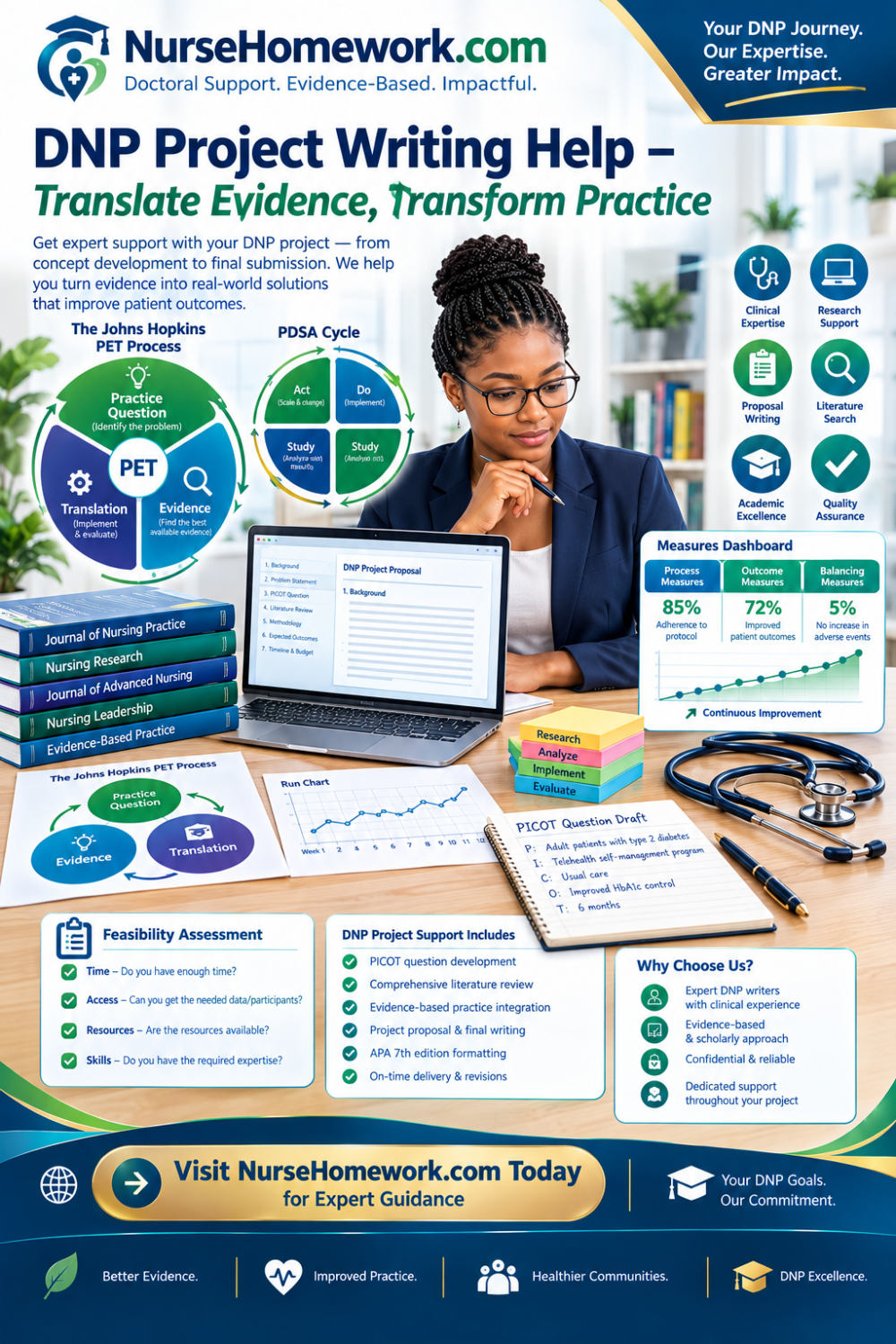
Evidence Based Practice Nursing Assignment Help for nursing students

Evidence Based Practice Nursing Assignment Help: 8 Steps for Strong EBP Papers

Evidence Based Practice Nursing Assignment Help: 8 Steps for Strong EBP Papers

Evidence Based Practice Nursing Assignment Help for nursing students
Evidence Based Practice Nursing Assignment Help for nursing students who need structured academic guidance, research support, editing, and clearer clinical reasoning.

Evidence Based Practice Nursing Assignment Help is one of the most common online searches from nursing students who are trying to balance demanding coursework, clinical rotations, exams, jobs, and personal responsibilities while still submitting clear academic work.

Nursing school is challenging because assignments are rarely about memorizing facts only. Students must connect theory, patient assessment, research evidence, clinical judgment, safety, ethics, and professional writing. That is why many learners look for guided support when they feel stuck, behind schedule, or unsure how to organize their ideas.

At NurseHomework, the goal is to support learning through topic guidance, research direction, editing feedback, structure planning, APA formatting help, and academic coaching. Students should always follow their school policies and use support responsibly as a study and writing aid.

For support, contact NurseHomework through the website or request help with your nursing topic.

Table of Contents

What is Evidence Based Practice Nursing Assignment Help?

Evidence Based Practice Nursing Assignment Help is academic support for nursing students who need help understanding instructions, planning assignments, organizing ideas, finding scholarly sources, improving drafts, and applying nursing concepts more clearly.

This support can include tutoring-style explanations, outline development, care plan guidance, case study review, APA formatting help, literature search direction, editing feedback, and examples that help students understand how to approach a nursing topic.

It is especially useful for BSN, MSN, DNP, and online nursing students working on evidence-based practice papers because nursing programs expect students to think like future clinicians while also writing like academic professionals. That combination can feel stressful when multiple deadlines arrive at the same time.

Common areas included in Evidence Based Practice Nursing Assignment Help:

  • PICOT questions
  • literature search
  • evidence appraisal
  • research summary
  • practice application
  • APA citations
  • paper structure
  • editing support

Why Nursing Students Look for Evidence Based Practice Nursing Assignment Help Online

The main reason students search for help is finding scholarly evidence, building PICOT questions, appraising research, and connecting evidence to nursing practice. These pressures can make even capable students feel overwhelmed, especially when assignments require both clinical accuracy and scholarly writing.

1. Nursing Assignments Require Clinical Reasoning

Nursing work is not just general academic writing. A strong paper must show patient safety, prioritization, assessment, intervention planning, evidence, and professional judgment. Students often understand parts of the topic but struggle to connect everything into one clear response.

Good academic support helps students break down the assignment. Instead of staring at a blank page, the learner can identify the patient problem, expected outcome, evidence, nursing actions, and final explanation.

2. Rubrics Can Be Detailed and Confusing

Nursing rubrics often include many requirements: introduction, clinical background, evidence, pathophysiology, interventions, patient education, citations, reflection, and conclusion. Missing one section can reduce the final grade.

Support can help students read the rubric carefully and turn it into an outline. This makes the work easier to manage and reduces the risk of leaving out key parts.

3. APA Formatting Takes Time

Many nursing programs require APA style. Students must format title pages, headings, citations, references, tables, and scholarly sources correctly. APA mistakes can distract from strong content.

Students who need professional writing support can also review broader academic writing help resources for structure, editing, and formatting ideas.

4. Clinical Rotations Reduce Study Time

Nursing students often attend clinicals, complete paperwork, prepare for exams, and manage personal responsibilities at the same time. This makes assignment planning difficult, especially for students who work or study online.

Academic support can help with time management, research direction, outlining, and revision so the student can use limited study time more effectively.

5. Research Sources Can Be Hard to Choose

Many assignments require peer-reviewed journal articles, clinical guidelines, textbooks, or evidence-based sources. Students may find many articles but struggle to choose the most relevant ones.

For larger research-heavy projects, students may also explore dissertation and research support to understand how scholarly projects are organized from topic selection to final review.

Common Assignments Students Struggle With

Nursing coursework includes many different assignment types. Each one requires a slightly different approach, so students benefit from learning how to structure the work before they begin writing.

Nursing Care Plans

Care plans are challenging because they require assessment data, nursing diagnoses, goals, interventions, rationales, and evaluation. A student must show why each nursing action is appropriate for the patient.

Students who need extra essay writing support can use writing guidance to improve clarity, paragraph flow, and explanation of clinical reasoning.

Nursing Case Studies

Case studies require students to analyze patient history, symptoms, medications, labs, risks, and priorities. A strong case study answer explains what matters most and why.

Pathophysiology Assignments

Pathophysiology assignments ask students to explain how disease affects the body. Students must connect causes, symptoms, complications, nursing concerns, and patient education.

Pharmacology Homework

Pharmacology can be difficult because students must understand drug classes, mechanisms of action, adverse effects, contraindications, interactions, and safety teaching. Medication-related assignments require careful attention to accuracy.

Evidence-Based Practice Papers

Evidence-based practice assignments require students to find research, summarize evidence, appraise quality, and explain how findings apply to nursing care. These papers can be difficult when students have not worked with scholarly databases before.

SOAP Notes

SOAP notes require concise documentation. Students must separate subjective data, objective findings, assessment, and plan. The challenge is writing enough detail without becoming disorganized.

Nursing Capstone Projects

Capstone projects require planning, research, implementation ideas, evaluation, and professional writing. They are often longer than ordinary assignments and need careful organization.

How Evidence Based Practice Nursing Assignment Help Can Help Students Improve

Academic support works best when it helps students understand the assignment rather than simply rushing to finish a task. The right support should make the student more confident about the topic and the writing process.

1. Understanding the Prompt

Many students lose time because they do not fully understand what the prompt is asking. Support can help identify the topic, required sections, formatting rules, source requirements, and grading priorities.

2. Creating an Outline

An outline gives the assignment direction. For example, a care plan outline may include assessment data, diagnosis, goals, interventions, rationales, and evaluation. An essay outline may include introduction, thesis, evidence, analysis, and conclusion.

3. Finding Better Evidence

Nursing papers should use credible sources. Support can help students understand what counts as scholarly evidence and how to connect research to nursing practice.

4. Improving Draft Quality

Draft feedback can improve clarity, flow, grammar, APA style, citations, headings, and professional tone. Students often learn more when they can see how their writing can be improved.

5. Strengthening Clinical Reasoning

Clinical reasoning is the heart of nursing assignments. Support can help students explain why a problem matters, why an intervention is appropriate, and how outcomes should be evaluated.

Students who need wider online academic support can also use digital learning resources to organize study tasks and deadlines.

How to Use Evidence Based Practice Nursing Assignment Help Responsibly

Students should use academic help as a learning support, not as a way to avoid learning. Nursing is a professional field where knowledge affects patient safety, so students must understand the concepts behind their assignments.

Use Help to Understand the Topic

Ask questions about what you do not understand. If the assignment is about heart failure, for example, make sure you can explain symptoms, pathophysiology, nursing priorities, medications, and patient education.

Follow Your School Policy

Every school has rules about academic integrity. Students should follow those policies and use tutoring, editing, examples, and research support appropriately.

Review the Final Work Carefully

Whether you receive feedback, an outline, or editing help, review everything carefully. Make sure the work matches your course instructions and that you understand the reasoning behind it.

Use Support Early

Waiting until the last minute creates stress. Early support gives students time to clarify instructions, gather evidence, write, revise, and ask follow-up questions.

What Makes Good

Good nursing academic support should be clear, ethical, student-centered, and focused on learning. It should help the student understand the assignment, not create confusion or unrealistic promises.

  • Clear explanation of nursing concepts
  • Support with assignment structure
  • Respect for academic integrity
  • Use of scholarly and credible sources
  • APA formatting guidance
  • Editing and revision feedback
  • Understanding of nursing rubrics
  • Timely communication

Why Choose NurseHomework?

NurseHomework focuses on practical academic support for nursing students. The site helps learners approach difficult coursework with more structure, better organization, and clearer understanding.

Students may need help with planning, writing, editing, research, or understanding nursing concepts. The best support depends on the assignment instructions and the student's current challenge.

If you are struggling with finding scholarly evidence, building PICOT questions, appraising research, and connecting evidence to nursing practice, NurseHomework can help you plan your next step and approach the work with more confidence.

Visit NurseHomework to request academic support for your nursing coursework.

Frequently Asked Questions

What is

Evidence Based Practice Nursing Assignment Help is guided academic support for nursing students who need help understanding coursework, organizing assignments, improving drafts, formatting references, and applying nursing concepts.

Can nursing students get help with care plans?

Yes. Students can get guidance on nursing diagnoses, SMART goals, interventions, rationales, assessment data, and evaluation. The goal should be to understand how the care plan works.

Can I get help with APA formatting?

Yes. APA support can include title pages, headings, in-text citations, references, formatting, and general editing for clarity.

Is online nursing homework help useful for busy students?

Yes. Busy students often need help understanding instructions, creating outlines, finding evidence, or revising drafts while balancing clinicals and exams.

How should students use this support?

Students should use support responsibly as tutoring, guidance, editing, research direction, and learning assistance while following their school's academic integrity policy.

More Study Tips for Evidence Based Practice Nursing Assignment Help

Start by reading the assignment instructions twice. Highlight the required sections, required sources, due date, formatting rules, and any special instructions from the professor. Many students lose marks because they skip a small requirement hidden in the prompt.

Build a simple outline before writing. A nursing paper becomes easier when each section has a clear purpose. The introduction should explain the topic, the body should analyze the main nursing issues, and the conclusion should connect the discussion back to patient care or professional practice.

Use credible evidence. Nursing assignments should rely on textbooks, peer-reviewed journals, clinical guidelines, and professional sources. Avoid weak internet sources unless the instructor allows them.

Revise for clarity. After drafting, read each paragraph and ask whether it explains one main idea. Strong nursing writing is direct, evidence-based, and organized around patient safety, clinical reasoning, and professional standards.

Keep learning from feedback. Instructor comments, editing notes, and tutor suggestions can help you improve future assignments. Nursing school becomes easier when students build repeatable writing and study habits.

More Study Tips for Evidence Based Practice Nursing Assignment Help

Start by reading the assignment instructions twice. Highlight the required sections, required sources, due date, formatting rules, and any special instructions from the professor. Many students lose marks because they skip a small requirement hidden in the prompt.

Build a simple outline before writing. A nursing paper becomes easier when each section has a clear purpose. The introduction should explain the topic, the body should analyze the main nursing issues, and the conclusion should connect the discussion back to patient care or professional practice.

Use credible evidence. Nursing assignments should rely on textbooks, peer-reviewed journals, clinical guidelines, and professional sources. Avoid weak internet sources unless the instructor allows them.

Revise for clarity. After drafting, read each paragraph and ask whether it explains one main idea. Strong nursing writing is direct, evidence-based, and organized around patient safety, clinical reasoning, and professional standards.

Keep learning from feedback. Instructor comments, editing notes, and tutor suggestions can help you improve future assignments. Nursing school becomes easier when students build repeatable writing and study habits.

More Study Tips for Evidence Based Practice Nursing Assignment Help

Start by reading the assignment instructions twice. Highlight the required sections, required sources, due date, formatting rules, and any special instructions from the professor. Many students lose marks because they skip a small requirement hidden in the prompt.

Build a simple outline before writing. A nursing paper becomes easier when each section has a clear purpose. The introduction should explain the topic, the body should analyze the main nursing issues, and the conclusion should connect the discussion back to patient care or professional practice.

Use credible evidence. Nursing assignments should rely on textbooks, peer-reviewed journals, clinical guidelines, and professional sources. Avoid weak internet sources unless the instructor allows them.

Revise for clarity. After drafting, read each paragraph and ask whether it explains one main idea. Strong nursing writing is direct, evidence-based, and organized around patient safety, clinical reasoning, and professional standards.

Keep learning from feedback. Instructor comments, editing notes, and tutor suggestions can help you improve future assignments. Nursing school becomes easier when students build repeatable writing and study habits.

More Study Tips for Evidence Based Practice Nursing Assignment Help

Start by reading the assignment instructions twice. Highlight the required sections, required sources, due date, formatting rules, and any special instructions from the professor. Many students lose marks because they skip a small requirement hidden in the prompt.

Build a simple outline before writing. A nursing paper becomes easier when each section has a clear purpose. The introduction should explain the topic, the body should analyze the main nursing issues, and the conclusion should connect the discussion back to patient care or professional practice.

Use credible evidence. Nursing assignments should rely on textbooks, peer-reviewed journals, clinical guidelines, and professional sources. Avoid weak internet sources unless the instructor allows them.

Revise for clarity. After drafting, read each paragraph and ask whether it explains one main idea. Strong nursing writing is direct, evidence-based, and organized around patient safety, clinical reasoning, and professional standards.

Keep learning from feedback. Instructor comments, editing notes, and tutor suggestions can help you improve future assignments. Nursing school becomes easier when students build repeatable writing and study habits.

More Study Tips for Evidence Based Practice Nursing Assignment Help

Start by reading the assignment instructions twice. Highlight the required sections, required sources, due date, formatting rules, and any special instructions from the professor. Many students lose marks because they skip a small requirement hidden in the prompt.

Build a simple outline before writing. A nursing paper becomes easier when each section has a clear purpose. The introduction should explain the topic, the body should analyze the main nursing issues, and the conclusion should connect the discussion back to patient care or professional practice.

Use credible evidence. Nursing assignments should rely on textbooks, peer-reviewed journals, clinical guidelines, and professional sources. Avoid weak internet sources unless the instructor allows them.

Revise for clarity. After drafting, read each paragraph and ask whether it explains one main idea. Strong nursing writing is direct, evidence-based, and organized around patient safety, clinical reasoning, and professional standards.

Keep learning from feedback. Instructor comments, editing notes, and tutor suggestions can help you improve future assignments. Nursing school becomes easier when students build repeatable writing and study habits.

More Study Tips for Evidence Based Practice Nursing Assignment Help

Start by reading the assignment instructions twice. Highlight the required sections, required sources, due date, formatting rules, and any special instructions from the professor. Many students lose marks because they skip a small requirement hidden in the prompt.

Build a simple outline before writing. A nursing paper becomes easier when each section has a clear purpose. The introduction should explain the topic, the body should analyze the main nursing issues, and the conclusion should connect the discussion back to patient care or professional practice.

Use credible evidence. Nursing assignments should rely on textbooks, peer-reviewed journals, clinical guidelines, and professional sources. Avoid weak internet sources unless the instructor allows them.

Revise for clarity. After drafting, read each paragraph and ask whether it explains one main idea. Strong nursing writing is direct, evidence-based, and organized around patient safety, clinical reasoning, and professional standards.

Keep learning from feedback. Instructor comments, editing notes, and tutor suggestions can help you improve future assignments. Nursing school becomes easier when students build repeatable writing and study habits.

More Study Tips for Evidence Based Practice Nursing Assignment Help

Start by reading the assignment instructions twice. Highlight the required sections, required sources, due date, formatting rules, and any special instructions from the professor. Many students lose marks because they skip a small requirement hidden in the prompt.

Build a simple outline before writing. A nursing paper becomes easier when each section has a clear purpose. The introduction should explain the topic, the body should analyze the main nursing issues, and the conclusion should connect the discussion back to patient care or professional practice.

Use credible evidence. Nursing assignments should rely on textbooks, peer-reviewed journals, clinical guidelines, and professional sources. Avoid weak internet sources unless the instructor allows them.

Revise for clarity. After drafting, read each paragraph and ask whether it explains one main idea. Strong nursing writing is direct, evidence-based, and organized around patient safety, clinical reasoning, and professional standards.

Keep learning from feedback. Instructor comments, editing notes, and tutor suggestions can help you improve future assignments. Nursing school becomes easier when students build repeatable writing and study habits.

More Study Tips for Evidence Based Practice Nursing Assignment Help

Start by reading the assignment instructions twice. Highlight the required sections, required sources, due date, formatting rules, and any special instructions from the professor. Many students lose marks because they skip a small requirement hidden in the prompt.

Build a simple outline before writing. A nursing paper becomes easier when each section has a clear purpose. The introduction should explain the topic, the body should analyze the main nursing issues, and the conclusion should connect the discussion back to patient care or professional practice.

Use credible evidence. Nursing assignments should rely on textbooks, peer-reviewed journals, clinical guidelines, and professional sources. Avoid weak internet sources unless the instructor allows them.

Revise for clarity. After drafting, read each paragraph and ask whether it explains one main idea. Strong nursing writing is direct, evidence-based, and organized around patient safety, clinical reasoning, and professional standards.

Keep learning from feedback. Instructor comments, editing notes, and tutor suggestions can help you improve future assignments. Nursing school becomes easier when students build repeatable writing and study habits.

More Study Tips for Evidence Based Practice Nursing Assignment Help

Start by reading the assignment instructions twice. Highlight the required sections, required sources, due date, formatting rules, and any special instructions from the professor. Many students lose marks because they skip a small requirement hidden in the prompt.

Build a simple outline before writing. A nursing paper becomes easier when each section has a clear purpose. The introduction should explain the topic, the body should analyze the main nursing issues, and the conclusion should connect the discussion back to patient care or professional practice.

Use credible evidence. Nursing assignments should rely on textbooks, peer-reviewed journals, clinical guidelines, and professional sources. Avoid weak internet sources unless the instructor allows them.

Revise for clarity. After drafting, read each paragraph and ask whether it explains one main idea. Strong nursing writing is direct, evidence-based, and organized around patient safety, clinical reasoning, and professional standards.

Keep learning from feedback. Instructor comments, editing notes, and tutor suggestions can help you improve future assignments. Nursing school becomes easier when students build repeatable writing and study habits.

More Study Tips for Evidence Based Practice Nursing Assignment Help

Start by reading the assignment instructions twice. Highlight the required sections, required sources, due date, formatting rules, and any special instructions from the professor. Many students lose marks because they skip a small requirement hidden in the prompt.

Build a simple outline before writing. A nursing paper becomes easier when each section has a clear purpose. The introduction should explain the topic, the body should analyze the main nursing issues, and the conclusion should connect the discussion back to patient care or professional practice.

Use credible evidence. Nursing assignments should rely on textbooks, peer-reviewed journals, clinical guidelines, and professional sources. Avoid weak internet sources unless the instructor allows them.

Revise for clarity. After drafting, read each paragraph and ask whether it explains one main idea. Strong nursing writing is direct, evidence-based, and organized around patient safety, clinical reasoning, and professional standards.

Keep learning from feedback. Instructor comments, editing notes, and tutor suggestions can help you improve future assignments. Nursing school becomes easier when students build repeatable writing and study habits.

More Study Tips for Evidence Based Practice Nursing Assignment Help

Start by reading the assignment instructions twice. Highlight the required sections, required sources, due date, formatting rules, and any special instructions from the professor. Many students lose marks because they skip a small requirement hidden in the prompt.

Build a simple outline before writing. A nursing paper becomes easier when each section has a clear purpose. The introduction should explain the topic, the body should analyze the main nursing issues, and the conclusion should connect the discussion back to patient care or professional practice.

Use credible evidence. Nursing assignments should rely on textbooks, peer-reviewed journals, clinical guidelines, and professional sources. Avoid weak internet sources unless the instructor allows them.

Revise for clarity. After drafting, read each paragraph and ask whether it explains one main idea. Strong nursing writing is direct, evidence-based, and organized around patient safety, clinical reasoning, and professional standards.

Keep learning from feedback. Instructor comments, editing notes, and tutor suggestions can help you improve future assignments. Nursing school becomes easier when students build repeatable writing and study habits.

Needs help with Nursing Assignment?

We are available 24x7 to deliver the best services and assignment ready within 3-4 hours? Order a custom-written, plagiarism-free paper

Get Answer Over WhatsApp Order Paper Now
Pharmacology Homework Help for nursing students

Pharmacology Homework Help: 9 Essential Areas Nursing Students Must Understand

Pharmacology Homework Help: 9 Essential Areas Nursing Students Must Understand

Pharmacology Homework Help for nursing students
Pharmacology Homework Help for nursing students who need structured academic guidance, research support, editing, and clearer clinical reasoning.

Pharmacology Homework Help is one of the most common online searches from nursing students who are trying to balance demanding coursework, clinical rotations, exams, jobs, and personal responsibilities while still submitting clear academic work.

Nursing school is challenging because assignments are rarely about memorizing facts only. Students must connect theory, patient assessment, research evidence, clinical judgment, safety, ethics, and professional writing. That is why many learners look for guided support when they feel stuck, behind schedule, or unsure how to organize their ideas.

At NurseHomework, the goal is to support learning through topic guidance, research direction, editing feedback, structure planning, APA formatting help, and academic coaching. Students should always follow their school policies and use support responsibly as a study and writing aid.

For support, contact NurseHomework through the website or request help with your nursing topic.

Table of Contents

What is Pharmacology Homework Help?

Pharmacology Homework Help is academic support for nursing students who need help understanding instructions, planning assignments, organizing ideas, finding scholarly sources, improving drafts, and applying nursing concepts more clearly.

This support can include tutoring-style explanations, outline development, care plan guidance, case study review, APA formatting help, literature search direction, editing feedback, and examples that help students understand how to approach a nursing topic.

It is especially useful for nursing students preparing pharmacology assignments, medication cards, exams, and clinical medication reviews because nursing programs expect students to think like future clinicians while also writing like academic professionals. That combination can feel stressful when multiple deadlines arrive at the same time.

Common areas included in Pharmacology Homework Help:

  • drug classes
  • mechanism of action
  • side effects
  • contraindications
  • patient teaching
  • dosage concepts
  • medication cards
  • safety review

Why Nursing Students Look for Pharmacology Homework Help Online

The main reason students search for help is drug classes, mechanisms of action, side effects, contraindications, dosage calculations, and patient teaching. These pressures can make even capable students feel overwhelmed, especially when assignments require both clinical accuracy and scholarly writing.

1. Nursing Assignments Require Clinical Reasoning

Nursing work is not just general academic writing. A strong paper must show patient safety, prioritization, assessment, intervention planning, evidence, and professional judgment. Students often understand parts of the topic but struggle to connect everything into one clear response.

Good academic support helps students break down the assignment. Instead of staring at a blank page, the learner can identify the patient problem, expected outcome, evidence, nursing actions, and final explanation.

2. Rubrics Can Be Detailed and Confusing

Nursing rubrics often include many requirements: introduction, clinical background, evidence, pathophysiology, interventions, patient education, citations, reflection, and conclusion. Missing one section can reduce the final grade.

Support can help students read the rubric carefully and turn it into an outline. This makes the work easier to manage and reduces the risk of leaving out key parts.

3. APA Formatting Takes Time

Many nursing programs require APA style. Students must format title pages, headings, citations, references, tables, and scholarly sources correctly. APA mistakes can distract from strong content.

Students who need professional writing support can also review broader academic writing help resources for structure, editing, and formatting ideas.

4. Clinical Rotations Reduce Study Time

Nursing students often attend clinicals, complete paperwork, prepare for exams, and manage personal responsibilities at the same time. This makes assignment planning difficult, especially for students who work or study online.

Academic support can help with time management, research direction, outlining, and revision so the student can use limited study time more effectively.

5. Research Sources Can Be Hard to Choose

Many assignments require peer-reviewed journal articles, clinical guidelines, textbooks, or evidence-based sources. Students may find many articles but struggle to choose the most relevant ones.

For larger research-heavy projects, students may also explore dissertation and research support to understand how scholarly projects are organized from topic selection to final review.

Common Assignments Students Struggle With

Nursing coursework includes many different assignment types. Each one requires a slightly different approach, so students benefit from learning how to structure the work before they begin writing.

Nursing Care Plans

Care plans are challenging because they require assessment data, nursing diagnoses, goals, interventions, rationales, and evaluation. A student must show why each nursing action is appropriate for the patient.

Students who need extra essay writing support can use writing guidance to improve clarity, paragraph flow, and explanation of clinical reasoning.

Nursing Case Studies

Case studies require students to analyze patient history, symptoms, medications, labs, risks, and priorities. A strong case study answer explains what matters most and why.

Pathophysiology Assignments

Pathophysiology assignments ask students to explain how disease affects the body. Students must connect causes, symptoms, complications, nursing concerns, and patient education.

Pharmacology Homework

Pharmacology can be difficult because students must understand drug classes, mechanisms of action, adverse effects, contraindications, interactions, and safety teaching. Medication-related assignments require careful attention to accuracy.

Evidence-Based Practice Papers

Evidence-based practice assignments require students to find research, summarize evidence, appraise quality, and explain how findings apply to nursing care. These papers can be difficult when students have not worked with scholarly databases before.

SOAP Notes

SOAP notes require concise documentation. Students must separate subjective data, objective findings, assessment, and plan. The challenge is writing enough detail without becoming disorganized.

Nursing Capstone Projects

Capstone projects require planning, research, implementation ideas, evaluation, and professional writing. They are often longer than ordinary assignments and need careful organization.

How Pharmacology Homework Help Can Help Students Improve

Academic support works best when it helps students understand the assignment rather than simply rushing to finish a task. The right support should make the student more confident about the topic and the writing process.

1. Understanding the Prompt

Many students lose time because they do not fully understand what the prompt is asking. Support can help identify the topic, required sections, formatting rules, source requirements, and grading priorities.

2. Creating an Outline

An outline gives the assignment direction. For example, a care plan outline may include assessment data, diagnosis, goals, interventions, rationales, and evaluation. An essay outline may include introduction, thesis, evidence, analysis, and conclusion.

3. Finding Better Evidence

Nursing papers should use credible sources. Support can help students understand what counts as scholarly evidence and how to connect research to nursing practice.

4. Improving Draft Quality

Draft feedback can improve clarity, flow, grammar, APA style, citations, headings, and professional tone. Students often learn more when they can see how their writing can be improved.

5. Strengthening Clinical Reasoning

Clinical reasoning is the heart of nursing assignments. Support can help students explain why a problem matters, why an intervention is appropriate, and how outcomes should be evaluated.

Students who need wider online academic support can also use digital learning resources to organize study tasks and deadlines.

How to Use Pharmacology Homework Help Responsibly

Students should use academic help as a learning support, not as a way to avoid learning. Nursing is a professional field where knowledge affects patient safety, so students must understand the concepts behind their assignments.

Use Help to Understand the Topic

Ask questions about what you do not understand. If the assignment is about heart failure, for example, make sure you can explain symptoms, pathophysiology, nursing priorities, medications, and patient education.

Follow Your School Policy

Every school has rules about academic integrity. Students should follow those policies and use tutoring, editing, examples, and research support appropriately.

Review the Final Work Carefully

Whether you receive feedback, an outline, or editing help, review everything carefully. Make sure the work matches your course instructions and that you understand the reasoning behind it.

Use Support Early

Waiting until the last minute creates stress. Early support gives students time to clarify instructions, gather evidence, write, revise, and ask follow-up questions.

What Makes Good

Good nursing academic support should be clear, ethical, student-centered, and focused on learning. It should help the student understand the assignment, not create confusion or unrealistic promises.

  • Clear explanation of nursing concepts
  • Support with assignment structure
  • Respect for academic integrity
  • Use of scholarly and credible sources
  • APA formatting guidance
  • Editing and revision feedback
  • Understanding of nursing rubrics
  • Timely communication

Why Choose NurseHomework?

NurseHomework focuses on practical academic support for nursing students. The site helps learners approach difficult coursework with more structure, better organization, and clearer understanding.

Students may need help with planning, writing, editing, research, or understanding nursing concepts. The best support depends on the assignment instructions and the student's current challenge.

If you are struggling with drug classes, mechanisms of action, side effects, contraindications, dosage calculations, and patient teaching, NurseHomework can help you plan your next step and approach the work with more confidence.

Visit NurseHomework to request academic support for your nursing coursework.

Frequently Asked Questions

What is

Pharmacology Homework Help is guided academic support for nursing students who need help understanding coursework, organizing assignments, improving drafts, formatting references, and applying nursing concepts.

Can nursing students get help with care plans?

Yes. Students can get guidance on nursing diagnoses, SMART goals, interventions, rationales, assessment data, and evaluation. The goal should be to understand how the care plan works.

Can I get help with APA formatting?

Yes. APA support can include title pages, headings, in-text citations, references, formatting, and general editing for clarity.

Is online nursing homework help useful for busy students?

Yes. Busy students often need help understanding instructions, creating outlines, finding evidence, or revising drafts while balancing clinicals and exams.

How should students use this support?

Students should use support responsibly as tutoring, guidance, editing, research direction, and learning assistance while following their school's academic integrity policy.

More Study Tips for Pharmacology Homework Help

Start by reading the assignment instructions twice. Highlight the required sections, required sources, due date, formatting rules, and any special instructions from the professor. Many students lose marks because they skip a small requirement hidden in the prompt.

Build a simple outline before writing. A nursing paper becomes easier when each section has a clear purpose. The introduction should explain the topic, the body should analyze the main nursing issues, and the conclusion should connect the discussion back to patient care or professional practice.

Use credible evidence. Nursing assignments should rely on textbooks, peer-reviewed journals, clinical guidelines, and professional sources. Avoid weak internet sources unless the instructor allows them.

Revise for clarity. After drafting, read each paragraph and ask whether it explains one main idea. Strong nursing writing is direct, evidence-based, and organized around patient safety, clinical reasoning, and professional standards.

Keep learning from feedback. Instructor comments, editing notes, and tutor suggestions can help you improve future assignments. Nursing school becomes easier when students build repeatable writing and study habits.

More Study Tips for Pharmacology Homework Help

Start by reading the assignment instructions twice. Highlight the required sections, required sources, due date, formatting rules, and any special instructions from the professor. Many students lose marks because they skip a small requirement hidden in the prompt.

Build a simple outline before writing. A nursing paper becomes easier when each section has a clear purpose. The introduction should explain the topic, the body should analyze the main nursing issues, and the conclusion should connect the discussion back to patient care or professional practice.

Use credible evidence. Nursing assignments should rely on textbooks, peer-reviewed journals, clinical guidelines, and professional sources. Avoid weak internet sources unless the instructor allows them.

Revise for clarity. After drafting, read each paragraph and ask whether it explains one main idea. Strong nursing writing is direct, evidence-based, and organized around patient safety, clinical reasoning, and professional standards.

Keep learning from feedback. Instructor comments, editing notes, and tutor suggestions can help you improve future assignments. Nursing school becomes easier when students build repeatable writing and study habits.

More Study Tips for Pharmacology Homework Help

Start by reading the assignment instructions twice. Highlight the required sections, required sources, due date, formatting rules, and any special instructions from the professor. Many students lose marks because they skip a small requirement hidden in the prompt.

Build a simple outline before writing. A nursing paper becomes easier when each section has a clear purpose. The introduction should explain the topic, the body should analyze the main nursing issues, and the conclusion should connect the discussion back to patient care or professional practice.

Use credible evidence. Nursing assignments should rely on textbooks, peer-reviewed journals, clinical guidelines, and professional sources. Avoid weak internet sources unless the instructor allows them.

Revise for clarity. After drafting, read each paragraph and ask whether it explains one main idea. Strong nursing writing is direct, evidence-based, and organized around patient safety, clinical reasoning, and professional standards.

Keep learning from feedback. Instructor comments, editing notes, and tutor suggestions can help you improve future assignments. Nursing school becomes easier when students build repeatable writing and study habits.

More Study Tips for Pharmacology Homework Help

Start by reading the assignment instructions twice. Highlight the required sections, required sources, due date, formatting rules, and any special instructions from the professor. Many students lose marks because they skip a small requirement hidden in the prompt.

Build a simple outline before writing. A nursing paper becomes easier when each section has a clear purpose. The introduction should explain the topic, the body should analyze the main nursing issues, and the conclusion should connect the discussion back to patient care or professional practice.

Use credible evidence. Nursing assignments should rely on textbooks, peer-reviewed journals, clinical guidelines, and professional sources. Avoid weak internet sources unless the instructor allows them.

Revise for clarity. After drafting, read each paragraph and ask whether it explains one main idea. Strong nursing writing is direct, evidence-based, and organized around patient safety, clinical reasoning, and professional standards.

Keep learning from feedback. Instructor comments, editing notes, and tutor suggestions can help you improve future assignments. Nursing school becomes easier when students build repeatable writing and study habits.

More Study Tips for Pharmacology Homework Help

Start by reading the assignment instructions twice. Highlight the required sections, required sources, due date, formatting rules, and any special instructions from the professor. Many students lose marks because they skip a small requirement hidden in the prompt.

Build a simple outline before writing. A nursing paper becomes easier when each section has a clear purpose. The introduction should explain the topic, the body should analyze the main nursing issues, and the conclusion should connect the discussion back to patient care or professional practice.

Use credible evidence. Nursing assignments should rely on textbooks, peer-reviewed journals, clinical guidelines, and professional sources. Avoid weak internet sources unless the instructor allows them.

Revise for clarity. After drafting, read each paragraph and ask whether it explains one main idea. Strong nursing writing is direct, evidence-based, and organized around patient safety, clinical reasoning, and professional standards.

Keep learning from feedback. Instructor comments, editing notes, and tutor suggestions can help you improve future assignments. Nursing school becomes easier when students build repeatable writing and study habits.

More Study Tips for Pharmacology Homework Help

Start by reading the assignment instructions twice. Highlight the required sections, required sources, due date, formatting rules, and any special instructions from the professor. Many students lose marks because they skip a small requirement hidden in the prompt.

Build a simple outline before writing. A nursing paper becomes easier when each section has a clear purpose. The introduction should explain the topic, the body should analyze the main nursing issues, and the conclusion should connect the discussion back to patient care or professional practice.

Use credible evidence. Nursing assignments should rely on textbooks, peer-reviewed journals, clinical guidelines, and professional sources. Avoid weak internet sources unless the instructor allows them.

Revise for clarity. After drafting, read each paragraph and ask whether it explains one main idea. Strong nursing writing is direct, evidence-based, and organized around patient safety, clinical reasoning, and professional standards.

Keep learning from feedback. Instructor comments, editing notes, and tutor suggestions can help you improve future assignments. Nursing school becomes easier when students build repeatable writing and study habits.

More Study Tips for Pharmacology Homework Help

Start by reading the assignment instructions twice. Highlight the required sections, required sources, due date, formatting rules, and any special instructions from the professor. Many students lose marks because they skip a small requirement hidden in the prompt.

Build a simple outline before writing. A nursing paper becomes easier when each section has a clear purpose. The introduction should explain the topic, the body should analyze the main nursing issues, and the conclusion should connect the discussion back to patient care or professional practice.

Use credible evidence. Nursing assignments should rely on textbooks, peer-reviewed journals, clinical guidelines, and professional sources. Avoid weak internet sources unless the instructor allows them.

Revise for clarity. After drafting, read each paragraph and ask whether it explains one main idea. Strong nursing writing is direct, evidence-based, and organized around patient safety, clinical reasoning, and professional standards.

Keep learning from feedback. Instructor comments, editing notes, and tutor suggestions can help you improve future assignments. Nursing school becomes easier when students build repeatable writing and study habits.

More Study Tips for Pharmacology Homework Help

Start by reading the assignment instructions twice. Highlight the required sections, required sources, due date, formatting rules, and any special instructions from the professor. Many students lose marks because they skip a small requirement hidden in the prompt.

Build a simple outline before writing. A nursing paper becomes easier when each section has a clear purpose. The introduction should explain the topic, the body should analyze the main nursing issues, and the conclusion should connect the discussion back to patient care or professional practice.

Use credible evidence. Nursing assignments should rely on textbooks, peer-reviewed journals, clinical guidelines, and professional sources. Avoid weak internet sources unless the instructor allows them.

Revise for clarity. After drafting, read each paragraph and ask whether it explains one main idea. Strong nursing writing is direct, evidence-based, and organized around patient safety, clinical reasoning, and professional standards.

Keep learning from feedback. Instructor comments, editing notes, and tutor suggestions can help you improve future assignments. Nursing school becomes easier when students build repeatable writing and study habits.

More Study Tips for Pharmacology Homework Help

Start by reading the assignment instructions twice. Highlight the required sections, required sources, due date, formatting rules, and any special instructions from the professor. Many students lose marks because they skip a small requirement hidden in the prompt.

Build a simple outline before writing. A nursing paper becomes easier when each section has a clear purpose. The introduction should explain the topic, the body should analyze the main nursing issues, and the conclusion should connect the discussion back to patient care or professional practice.

Use credible evidence. Nursing assignments should rely on textbooks, peer-reviewed journals, clinical guidelines, and professional sources. Avoid weak internet sources unless the instructor allows them.

Revise for clarity. After drafting, read each paragraph and ask whether it explains one main idea. Strong nursing writing is direct, evidence-based, and organized around patient safety, clinical reasoning, and professional standards.

Keep learning from feedback. Instructor comments, editing notes, and tutor suggestions can help you improve future assignments. Nursing school becomes easier when students build repeatable writing and study habits.

More Study Tips for Pharmacology Homework Help

Start by reading the assignment instructions twice. Highlight the required sections, required sources, due date, formatting rules, and any special instructions from the professor. Many students lose marks because they skip a small requirement hidden in the prompt.

Build a simple outline before writing. A nursing paper becomes easier when each section has a clear purpose. The introduction should explain the topic, the body should analyze the main nursing issues, and the conclusion should connect the discussion back to patient care or professional practice.

Use credible evidence. Nursing assignments should rely on textbooks, peer-reviewed journals, clinical guidelines, and professional sources. Avoid weak internet sources unless the instructor allows them.

Revise for clarity. After drafting, read each paragraph and ask whether it explains one main idea. Strong nursing writing is direct, evidence-based, and organized around patient safety, clinical reasoning, and professional standards.

Keep learning from feedback. Instructor comments, editing notes, and tutor suggestions can help you improve future assignments. Nursing school becomes easier when students build repeatable writing and study habits.

More Study Tips for Pharmacology Homework Help

Start by reading the assignment instructions twice. Highlight the required sections, required sources, due date, formatting rules, and any special instructions from the professor. Many students lose marks because they skip a small requirement hidden in the prompt.

Build a simple outline before writing. A nursing paper becomes easier when each section has a clear purpose. The introduction should explain the topic, the body should analyze the main nursing issues, and the conclusion should connect the discussion back to patient care or professional practice.

Use credible evidence. Nursing assignments should rely on textbooks, peer-reviewed journals, clinical guidelines, and professional sources. Avoid weak internet sources unless the instructor allows them.

Revise for clarity. After drafting, read each paragraph and ask whether it explains one main idea. Strong nursing writing is direct, evidence-based, and organized around patient safety, clinical reasoning, and professional standards.

Keep learning from feedback. Instructor comments, editing notes, and tutor suggestions can help you improve future assignments. Nursing school becomes easier when students build repeatable writing and study habits.

Needs help with Nursing Assignment?

We are available 24x7 to deliver the best services and assignment ready within 3-4 hours? Order a custom-written, plagiarism-free paper

Get Answer Over WhatsApp Order Paper Now
Pathophysiology Assignment Help for nursing students

Pathophysiology Assignment Help: 8 Useful Ways to Explain Disease Processes

Pathophysiology Assignment Help: 8 Useful Ways to Explain Disease Processes

Pathophysiology Assignment Help for nursing students
Pathophysiology Assignment Help for nursing students who need structured academic guidance, research support, editing, and clearer clinical reasoning.

Pathophysiology Assignment Help is one of the most common online searches from nursing students who are trying to balance demanding coursework, clinical rotations, exams, jobs, and personal responsibilities while still submitting clear academic work.

Nursing school is challenging because assignments are rarely about memorizing facts only. Students must connect theory, patient assessment, research evidence, clinical judgment, safety, ethics, and professional writing. That is why many learners look for guided support when they feel stuck, behind schedule, or unsure how to organize their ideas.

At NurseHomework, the goal is to support learning through topic guidance, research direction, editing feedback, structure planning, APA formatting help, and academic coaching. Students should always follow their school policies and use support responsibly as a study and writing aid.

For support, contact NurseHomework through the website or request help with your nursing topic.

Table of Contents

What is Pathophysiology Assignment Help?

Pathophysiology Assignment Help is academic support for nursing students who need help understanding instructions, planning assignments, organizing ideas, finding scholarly sources, improving drafts, and applying nursing concepts more clearly.

This support can include tutoring-style explanations, outline development, care plan guidance, case study review, APA formatting help, literature search direction, editing feedback, and examples that help students understand how to approach a nursing topic.

It is especially useful for students studying adult health, pharmacology, med-surg, advanced pathophysiology, and clinical reasoning courses because nursing programs expect students to think like future clinicians while also writing like academic professionals. That combination can feel stressful when multiple deadlines arrive at the same time.

Common areas included in Pathophysiology Assignment Help:

  • disease process explanation
  • symptom links
  • risk factors
  • complications
  • nursing implications
  • concept maps
  • study support
  • paper review

Why Nursing Students Look for Pathophysiology Assignment Help Online

The main reason students search for help is understanding disease mechanisms, linking symptoms to body systems, explaining complications, and applying concepts to nursing care. These pressures can make even capable students feel overwhelmed, especially when assignments require both clinical accuracy and scholarly writing.

1. Nursing Assignments Require Clinical Reasoning

Nursing work is not just general academic writing. A strong paper must show patient safety, prioritization, assessment, intervention planning, evidence, and professional judgment. Students often understand parts of the topic but struggle to connect everything into one clear response.

Good academic support helps students break down the assignment. Instead of staring at a blank page, the learner can identify the patient problem, expected outcome, evidence, nursing actions, and final explanation.

2. Rubrics Can Be Detailed and Confusing

Nursing rubrics often include many requirements: introduction, clinical background, evidence, pathophysiology, interventions, patient education, citations, reflection, and conclusion. Missing one section can reduce the final grade.

Support can help students read the rubric carefully and turn it into an outline. This makes the work easier to manage and reduces the risk of leaving out key parts.

3. APA Formatting Takes Time

Many nursing programs require APA style. Students must format title pages, headings, citations, references, tables, and scholarly sources correctly. APA mistakes can distract from strong content.

Students who need professional writing support can also review broader academic writing help resources for structure, editing, and formatting ideas.

4. Clinical Rotations Reduce Study Time

Nursing students often attend clinicals, complete paperwork, prepare for exams, and manage personal responsibilities at the same time. This makes assignment planning difficult, especially for students who work or study online.

Academic support can help with time management, research direction, outlining, and revision so the student can use limited study time more effectively.

5. Research Sources Can Be Hard to Choose

Many assignments require peer-reviewed journal articles, clinical guidelines, textbooks, or evidence-based sources. Students may find many articles but struggle to choose the most relevant ones.

For larger research-heavy projects, students may also explore dissertation and research support to understand how scholarly projects are organized from topic selection to final review.

Common Assignments Students Struggle With

Nursing coursework includes many different assignment types. Each one requires a slightly different approach, so students benefit from learning how to structure the work before they begin writing.

Nursing Care Plans

Care plans are challenging because they require assessment data, nursing diagnoses, goals, interventions, rationales, and evaluation. A student must show why each nursing action is appropriate for the patient.

Students who need extra essay writing support can use writing guidance to improve clarity, paragraph flow, and explanation of clinical reasoning.

Nursing Case Studies

Case studies require students to analyze patient history, symptoms, medications, labs, risks, and priorities. A strong case study answer explains what matters most and why.

Pathophysiology Assignments

Pathophysiology assignments ask students to explain how disease affects the body. Students must connect causes, symptoms, complications, nursing concerns, and patient education.

Pharmacology Homework

Pharmacology can be difficult because students must understand drug classes, mechanisms of action, adverse effects, contraindications, interactions, and safety teaching. Medication-related assignments require careful attention to accuracy.

Evidence-Based Practice Papers

Evidence-based practice assignments require students to find research, summarize evidence, appraise quality, and explain how findings apply to nursing care. These papers can be difficult when students have not worked with scholarly databases before.

SOAP Notes

SOAP notes require concise documentation. Students must separate subjective data, objective findings, assessment, and plan. The challenge is writing enough detail without becoming disorganized.

Nursing Capstone Projects

Capstone projects require planning, research, implementation ideas, evaluation, and professional writing. They are often longer than ordinary assignments and need careful organization.

How Pathophysiology Assignment Help Can Help Students Improve

Academic support works best when it helps students understand the assignment rather than simply rushing to finish a task. The right support should make the student more confident about the topic and the writing process.

1. Understanding the Prompt

Many students lose time because they do not fully understand what the prompt is asking. Support can help identify the topic, required sections, formatting rules, source requirements, and grading priorities.

2. Creating an Outline

An outline gives the assignment direction. For example, a care plan outline may include assessment data, diagnosis, goals, interventions, rationales, and evaluation. An essay outline may include introduction, thesis, evidence, analysis, and conclusion.

3. Finding Better Evidence

Nursing papers should use credible sources. Support can help students understand what counts as scholarly evidence and how to connect research to nursing practice.

4. Improving Draft Quality

Draft feedback can improve clarity, flow, grammar, APA style, citations, headings, and professional tone. Students often learn more when they can see how their writing can be improved.

5. Strengthening Clinical Reasoning

Clinical reasoning is the heart of nursing assignments. Support can help students explain why a problem matters, why an intervention is appropriate, and how outcomes should be evaluated.

Students who need wider online academic support can also use digital learning resources to organize study tasks and deadlines.

How to Use Pathophysiology Assignment Help Responsibly

Students should use academic help as a learning support, not as a way to avoid learning. Nursing is a professional field where knowledge affects patient safety, so students must understand the concepts behind their assignments.

Use Help to Understand the Topic

Ask questions about what you do not understand. If the assignment is about heart failure, for example, make sure you can explain symptoms, pathophysiology, nursing priorities, medications, and patient education.

Follow Your School Policy

Every school has rules about academic integrity. Students should follow those policies and use tutoring, editing, examples, and research support appropriately.

Review the Final Work Carefully

Whether you receive feedback, an outline, or editing help, review everything carefully. Make sure the work matches your course instructions and that you understand the reasoning behind it.

Use Support Early

Waiting until the last minute creates stress. Early support gives students time to clarify instructions, gather evidence, write, revise, and ask follow-up questions.

What Makes Good

Good nursing academic support should be clear, ethical, student-centered, and focused on learning. It should help the student understand the assignment, not create confusion or unrealistic promises.

  • Clear explanation of nursing concepts
  • Support with assignment structure
  • Respect for academic integrity
  • Use of scholarly and credible sources
  • APA formatting guidance
  • Editing and revision feedback
  • Understanding of nursing rubrics
  • Timely communication

Why Choose NurseHomework?

NurseHomework focuses on practical academic support for nursing students. The site helps learners approach difficult coursework with more structure, better organization, and clearer understanding.

Students may need help with planning, writing, editing, research, or understanding nursing concepts. The best support depends on the assignment instructions and the student's current challenge.

If you are struggling with understanding disease mechanisms, linking symptoms to body systems, explaining complications, and applying concepts to nursing care, NurseHomework can help you plan your next step and approach the work with more confidence.

Visit NurseHomework to request academic support for your nursing coursework.

Frequently Asked Questions

What is

Pathophysiology Assignment Help is guided academic support for nursing students who need help understanding coursework, organizing assignments, improving drafts, formatting references, and applying nursing concepts.

Can nursing students get help with care plans?

Yes. Students can get guidance on nursing diagnoses, SMART goals, interventions, rationales, assessment data, and evaluation. The goal should be to understand how the care plan works.

Can I get help with APA formatting?

Yes. APA support can include title pages, headings, in-text citations, references, formatting, and general editing for clarity.

Is online nursing homework help useful for busy students?

Yes. Busy students often need help understanding instructions, creating outlines, finding evidence, or revising drafts while balancing clinicals and exams.

How should students use this support?

Students should use support responsibly as tutoring, guidance, editing, research direction, and learning assistance while following their school's academic integrity policy.

More Study Tips for Pathophysiology Assignment Help

Start by reading the assignment instructions twice. Highlight the required sections, required sources, due date, formatting rules, and any special instructions from the professor. Many students lose marks because they skip a small requirement hidden in the prompt.

Build a simple outline before writing. A nursing paper becomes easier when each section has a clear purpose. The introduction should explain the topic, the body should analyze the main nursing issues, and the conclusion should connect the discussion back to patient care or professional practice.

Use credible evidence. Nursing assignments should rely on textbooks, peer-reviewed journals, clinical guidelines, and professional sources. Avoid weak internet sources unless the instructor allows them.

Revise for clarity. After drafting, read each paragraph and ask whether it explains one main idea. Strong nursing writing is direct, evidence-based, and organized around patient safety, clinical reasoning, and professional standards.

Keep learning from feedback. Instructor comments, editing notes, and tutor suggestions can help you improve future assignments. Nursing school becomes easier when students build repeatable writing and study habits.

More Study Tips for Pathophysiology Assignment Help

Start by reading the assignment instructions twice. Highlight the required sections, required sources, due date, formatting rules, and any special instructions from the professor. Many students lose marks because they skip a small requirement hidden in the prompt.

Build a simple outline before writing. A nursing paper becomes easier when each section has a clear purpose. The introduction should explain the topic, the body should analyze the main nursing issues, and the conclusion should connect the discussion back to patient care or professional practice.

Use credible evidence. Nursing assignments should rely on textbooks, peer-reviewed journals, clinical guidelines, and professional sources. Avoid weak internet sources unless the instructor allows them.

Revise for clarity. After drafting, read each paragraph and ask whether it explains one main idea. Strong nursing writing is direct, evidence-based, and organized around patient safety, clinical reasoning, and professional standards.

Keep learning from feedback. Instructor comments, editing notes, and tutor suggestions can help you improve future assignments. Nursing school becomes easier when students build repeatable writing and study habits.

More Study Tips for Pathophysiology Assignment Help

Start by reading the assignment instructions twice. Highlight the required sections, required sources, due date, formatting rules, and any special instructions from the professor. Many students lose marks because they skip a small requirement hidden in the prompt.

Build a simple outline before writing. A nursing paper becomes easier when each section has a clear purpose. The introduction should explain the topic, the body should analyze the main nursing issues, and the conclusion should connect the discussion back to patient care or professional practice.

Use credible evidence. Nursing assignments should rely on textbooks, peer-reviewed journals, clinical guidelines, and professional sources. Avoid weak internet sources unless the instructor allows them.

Revise for clarity. After drafting, read each paragraph and ask whether it explains one main idea. Strong nursing writing is direct, evidence-based, and organized around patient safety, clinical reasoning, and professional standards.

Keep learning from feedback. Instructor comments, editing notes, and tutor suggestions can help you improve future assignments. Nursing school becomes easier when students build repeatable writing and study habits.

More Study Tips for Pathophysiology Assignment Help

Start by reading the assignment instructions twice. Highlight the required sections, required sources, due date, formatting rules, and any special instructions from the professor. Many students lose marks because they skip a small requirement hidden in the prompt.

Build a simple outline before writing. A nursing paper becomes easier when each section has a clear purpose. The introduction should explain the topic, the body should analyze the main nursing issues, and the conclusion should connect the discussion back to patient care or professional practice.

Use credible evidence. Nursing assignments should rely on textbooks, peer-reviewed journals, clinical guidelines, and professional sources. Avoid weak internet sources unless the instructor allows them.

Revise for clarity. After drafting, read each paragraph and ask whether it explains one main idea. Strong nursing writing is direct, evidence-based, and organized around patient safety, clinical reasoning, and professional standards.

Keep learning from feedback. Instructor comments, editing notes, and tutor suggestions can help you improve future assignments. Nursing school becomes easier when students build repeatable writing and study habits.

More Study Tips for Pathophysiology Assignment Help

Start by reading the assignment instructions twice. Highlight the required sections, required sources, due date, formatting rules, and any special instructions from the professor. Many students lose marks because they skip a small requirement hidden in the prompt.

Build a simple outline before writing. A nursing paper becomes easier when each section has a clear purpose. The introduction should explain the topic, the body should analyze the main nursing issues, and the conclusion should connect the discussion back to patient care or professional practice.

Use credible evidence. Nursing assignments should rely on textbooks, peer-reviewed journals, clinical guidelines, and professional sources. Avoid weak internet sources unless the instructor allows them.

Revise for clarity. After drafting, read each paragraph and ask whether it explains one main idea. Strong nursing writing is direct, evidence-based, and organized around patient safety, clinical reasoning, and professional standards.

Keep learning from feedback. Instructor comments, editing notes, and tutor suggestions can help you improve future assignments. Nursing school becomes easier when students build repeatable writing and study habits.

More Study Tips for Pathophysiology Assignment Help

Start by reading the assignment instructions twice. Highlight the required sections, required sources, due date, formatting rules, and any special instructions from the professor. Many students lose marks because they skip a small requirement hidden in the prompt.

Build a simple outline before writing. A nursing paper becomes easier when each section has a clear purpose. The introduction should explain the topic, the body should analyze the main nursing issues, and the conclusion should connect the discussion back to patient care or professional practice.

Use credible evidence. Nursing assignments should rely on textbooks, peer-reviewed journals, clinical guidelines, and professional sources. Avoid weak internet sources unless the instructor allows them.

Revise for clarity. After drafting, read each paragraph and ask whether it explains one main idea. Strong nursing writing is direct, evidence-based, and organized around patient safety, clinical reasoning, and professional standards.

Keep learning from feedback. Instructor comments, editing notes, and tutor suggestions can help you improve future assignments. Nursing school becomes easier when students build repeatable writing and study habits.

More Study Tips for Pathophysiology Assignment Help

Start by reading the assignment instructions twice. Highlight the required sections, required sources, due date, formatting rules, and any special instructions from the professor. Many students lose marks because they skip a small requirement hidden in the prompt.

Build a simple outline before writing. A nursing paper becomes easier when each section has a clear purpose. The introduction should explain the topic, the body should analyze the main nursing issues, and the conclusion should connect the discussion back to patient care or professional practice.

Use credible evidence. Nursing assignments should rely on textbooks, peer-reviewed journals, clinical guidelines, and professional sources. Avoid weak internet sources unless the instructor allows them.

Revise for clarity. After drafting, read each paragraph and ask whether it explains one main idea. Strong nursing writing is direct, evidence-based, and organized around patient safety, clinical reasoning, and professional standards.

Keep learning from feedback. Instructor comments, editing notes, and tutor suggestions can help you improve future assignments. Nursing school becomes easier when students build repeatable writing and study habits.

More Study Tips for Pathophysiology Assignment Help

Start by reading the assignment instructions twice. Highlight the required sections, required sources, due date, formatting rules, and any special instructions from the professor. Many students lose marks because they skip a small requirement hidden in the prompt.

Build a simple outline before writing. A nursing paper becomes easier when each section has a clear purpose. The introduction should explain the topic, the body should analyze the main nursing issues, and the conclusion should connect the discussion back to patient care or professional practice.

Use credible evidence. Nursing assignments should rely on textbooks, peer-reviewed journals, clinical guidelines, and professional sources. Avoid weak internet sources unless the instructor allows them.

Revise for clarity. After drafting, read each paragraph and ask whether it explains one main idea. Strong nursing writing is direct, evidence-based, and organized around patient safety, clinical reasoning, and professional standards.

Keep learning from feedback. Instructor comments, editing notes, and tutor suggestions can help you improve future assignments. Nursing school becomes easier when students build repeatable writing and study habits.

More Study Tips for Pathophysiology Assignment Help

Start by reading the assignment instructions twice. Highlight the required sections, required sources, due date, formatting rules, and any special instructions from the professor. Many students lose marks because they skip a small requirement hidden in the prompt.

Build a simple outline before writing. A nursing paper becomes easier when each section has a clear purpose. The introduction should explain the topic, the body should analyze the main nursing issues, and the conclusion should connect the discussion back to patient care or professional practice.

Use credible evidence. Nursing assignments should rely on textbooks, peer-reviewed journals, clinical guidelines, and professional sources. Avoid weak internet sources unless the instructor allows them.

Revise for clarity. After drafting, read each paragraph and ask whether it explains one main idea. Strong nursing writing is direct, evidence-based, and organized around patient safety, clinical reasoning, and professional standards.

Keep learning from feedback. Instructor comments, editing notes, and tutor suggestions can help you improve future assignments. Nursing school becomes easier when students build repeatable writing and study habits.

More Study Tips for Pathophysiology Assignment Help

Start by reading the assignment instructions twice. Highlight the required sections, required sources, due date, formatting rules, and any special instructions from the professor. Many students lose marks because they skip a small requirement hidden in the prompt.

Build a simple outline before writing. A nursing paper becomes easier when each section has a clear purpose. The introduction should explain the topic, the body should analyze the main nursing issues, and the conclusion should connect the discussion back to patient care or professional practice.

Use credible evidence. Nursing assignments should rely on textbooks, peer-reviewed journals, clinical guidelines, and professional sources. Avoid weak internet sources unless the instructor allows them.

Revise for clarity. After drafting, read each paragraph and ask whether it explains one main idea. Strong nursing writing is direct, evidence-based, and organized around patient safety, clinical reasoning, and professional standards.

Keep learning from feedback. Instructor comments, editing notes, and tutor suggestions can help you improve future assignments. Nursing school becomes easier when students build repeatable writing and study habits.

More Study Tips for Pathophysiology Assignment Help

Start by reading the assignment instructions twice. Highlight the required sections, required sources, due date, formatting rules, and any special instructions from the professor. Many students lose marks because they skip a small requirement hidden in the prompt.

Build a simple outline before writing. A nursing paper becomes easier when each section has a clear purpose. The introduction should explain the topic, the body should analyze the main nursing issues, and the conclusion should connect the discussion back to patient care or professional practice.

Use credible evidence. Nursing assignments should rely on textbooks, peer-reviewed journals, clinical guidelines, and professional sources. Avoid weak internet sources unless the instructor allows them.

Revise for clarity. After drafting, read each paragraph and ask whether it explains one main idea. Strong nursing writing is direct, evidence-based, and organized around patient safety, clinical reasoning, and professional standards.

Keep learning from feedback. Instructor comments, editing notes, and tutor suggestions can help you improve future assignments. Nursing school becomes easier when students build repeatable writing and study habits.

Needs help with Nursing Assignment?

We are available 24x7 to deliver the best services and assignment ready within 3-4 hours? Order a custom-written, plagiarism-free paper

Get Answer Over WhatsApp Order Paper Now
Nursing Care Plan Help by NurseHomework

Nursing Care Plan Help: 9 Ways to Build Stronger Patient Care Plans

Nursing Care Plan Help: 9 Ways to Build Stronger Patient Care Plans

Nursing Care Plan Help is useful for clinical nursing students, BSN learners, ADN students, online learners, and students writing patient care plans who need structured academic guidance, editing support, research direction, APA help, and clearer clinical reasoning. Improve nursing diagnoses, SMART goals, interventions, rationales, evaluation criteria, and care planning. NurseHomework supports responsible academic learning through planning, feedback, source guidance, and revision help. Related Nursing Care Plan Help resources: Nursing Care Plan Help – Zama.c.ke | Nursing Care Plan Help – Prim.co.ke | Nursing Care Plan Help – RentalDesk.co.ke | Nursing Care Plan Help – Saseni.co.ke | Nursing Care Plan Help – Spacekits.co.ke | Nursing Care Plan Help – Dereva.co.ke | Nursing Care Plan Help – PMS.co.ke.

Nursing Care Plan Help by NurseHomework
Nursing Care Plan Help by NurseHomework for nursing students who need ethical academic guidance, editing, and better assignment planning.

Table of Contents

What Is

Nursing Care Plan Help is academic support that helps nursing students understand instructions, organize ideas, review credible sources, improve drafts, and present nursing concepts clearly. It can be used for planning, editing, topic explanation, APA review, source guidance, and feedback.

Nursing assignments are different from general essays because they require evidence, patient-centered thinking, clinical judgment, safety awareness, and professional communication. Good support helps students strengthen those skills instead of replacing learning.

Important Support Areas for Nursing Care Plan Help

  • assessment review
  • nursing diagnoses
  • SMART goals
  • interventions
  • rationales
  • evaluation criteria
  • patient education
  • care plan structure

1. Understanding the assignment prompt: Nursing Care Plan Help

Nursing Care Plan Help helps clinical nursing students, BSN learners, ADN students, online learners, and students writing patient care plans handle academic tasks with better structure, clearer evidence, and more responsible revision. Nursing coursework is demanding because it combines patient safety, clinical judgment, scholarly evidence, ethical decision-making, and professional writing. A student may understand the topic but still struggle to turn ideas into a clear response that follows the rubric.

Useful support should focus on learning, planning, editing, and responsible guidance. It should help the student read instructions, clarify expectations, build an outline, review sources, improve logic, and revise drafts without ignoring school policies.

Important support areas include assessment review, nursing diagnoses, SMART goals, interventions, rationales, evaluation criteria, patient education, care plan structure. These areas can help students improve care plans, case studies, essays, research papers, discussion posts, reflection papers, capstone projects, and evidence-based practice tasks.

Before requesting help, students should prepare the prompt, rubric, deadline, required readings, source requirements, formatting instructions, and any professor feedback. Clear instructions make guidance more accurate and help the final draft align with course expectations.

2. Using the rubric correctly: Nursing Care Plan Help

Nursing Care Plan Help helps clinical nursing students, BSN learners, ADN students, online learners, and students writing patient care plans handle academic tasks with better structure, clearer evidence, and more responsible revision. Nursing coursework is demanding because it combines patient safety, clinical judgment, scholarly evidence, ethical decision-making, and professional writing. A student may understand the topic but still struggle to turn ideas into a clear response that follows the rubric.

Useful support should focus on learning, planning, editing, and responsible guidance. It should help the student read instructions, clarify expectations, build an outline, review sources, improve logic, and revise drafts without ignoring school policies.

Important support areas include assessment review, nursing diagnoses, SMART goals, interventions, rationales, evaluation criteria, patient education, care plan structure. These areas can help students improve care plans, case studies, essays, research papers, discussion posts, reflection papers, capstone projects, and evidence-based practice tasks.

Before requesting help, students should prepare the prompt, rubric, deadline, required readings, source requirements, formatting instructions, and any professor feedback. Clear instructions make guidance more accurate and help the final draft align with course expectations.

3. Finding credible nursing evidence: Nursing Care Plan Help

Nursing Care Plan Help helps clinical nursing students, BSN learners, ADN students, online learners, and students writing patient care plans handle academic tasks with better structure, clearer evidence, and more responsible revision. Nursing coursework is demanding because it combines patient safety, clinical judgment, scholarly evidence, ethical decision-making, and professional writing. A student may understand the topic but still struggle to turn ideas into a clear response that follows the rubric.

Useful support should focus on learning, planning, editing, and responsible guidance. It should help the student read instructions, clarify expectations, build an outline, review sources, improve logic, and revise drafts without ignoring school policies.

Important support areas include assessment review, nursing diagnoses, SMART goals, interventions, rationales, evaluation criteria, patient education, care plan structure. These areas can help students improve care plans, case studies, essays, research papers, discussion posts, reflection papers, capstone projects, and evidence-based practice tasks.

Before requesting help, students should prepare the prompt, rubric, deadline, required readings, source requirements, formatting instructions, and any professor feedback. Clear instructions make guidance more accurate and help the final draft align with course expectations.

4. Building a clear outline: Nursing Care Plan Help

Nursing Care Plan Help helps clinical nursing students, BSN learners, ADN students, online learners, and students writing patient care plans handle academic tasks with better structure, clearer evidence, and more responsible revision. Nursing coursework is demanding because it combines patient safety, clinical judgment, scholarly evidence, ethical decision-making, and professional writing. A student may understand the topic but still struggle to turn ideas into a clear response that follows the rubric.

Useful support should focus on learning, planning, editing, and responsible guidance. It should help the student read instructions, clarify expectations, build an outline, review sources, improve logic, and revise drafts without ignoring school policies.

Important support areas include assessment review, nursing diagnoses, SMART goals, interventions, rationales, evaluation criteria, patient education, care plan structure. These areas can help students improve care plans, case studies, essays, research papers, discussion posts, reflection papers, capstone projects, and evidence-based practice tasks.

Before requesting help, students should prepare the prompt, rubric, deadline, required readings, source requirements, formatting instructions, and any professor feedback. Clear instructions make guidance more accurate and help the final draft align with course expectations.

5. Improving clinical reasoning: Nursing Care Plan Help

Nursing Care Plan Help helps clinical nursing students, BSN learners, ADN students, online learners, and students writing patient care plans handle academic tasks with better structure, clearer evidence, and more responsible revision. Nursing coursework is demanding because it combines patient safety, clinical judgment, scholarly evidence, ethical decision-making, and professional writing. A student may understand the topic but still struggle to turn ideas into a clear response that follows the rubric.

Useful support should focus on learning, planning, editing, and responsible guidance. It should help the student read instructions, clarify expectations, build an outline, review sources, improve logic, and revise drafts without ignoring school policies.

Important support areas include assessment review, nursing diagnoses, SMART goals, interventions, rationales, evaluation criteria, patient education, care plan structure. These areas can help students improve care plans, case studies, essays, research papers, discussion posts, reflection papers, capstone projects, and evidence-based practice tasks.

Before requesting help, students should prepare the prompt, rubric, deadline, required readings, source requirements, formatting instructions, and any professor feedback. Clear instructions make guidance more accurate and help the final draft align with course expectations.

6. APA formatting and citations: Nursing Care Plan Help

Nursing Care Plan Help helps clinical nursing students, BSN learners, ADN students, online learners, and students writing patient care plans handle academic tasks with better structure, clearer evidence, and more responsible revision. Nursing coursework is demanding because it combines patient safety, clinical judgment, scholarly evidence, ethical decision-making, and professional writing. A student may understand the topic but still struggle to turn ideas into a clear response that follows the rubric.

Useful support should focus on learning, planning, editing, and responsible guidance. It should help the student read instructions, clarify expectations, build an outline, review sources, improve logic, and revise drafts without ignoring school policies.

Important support areas include assessment review, nursing diagnoses, SMART goals, interventions, rationales, evaluation criteria, patient education, care plan structure. These areas can help students improve care plans, case studies, essays, research papers, discussion posts, reflection papers, capstone projects, and evidence-based practice tasks.

Before requesting help, students should prepare the prompt, rubric, deadline, required readings, source requirements, formatting instructions, and any professor feedback. Clear instructions make guidance more accurate and help the final draft align with course expectations.

7. Editing and revision support: Nursing Care Plan Help

Nursing Care Plan Help helps clinical nursing students, BSN learners, ADN students, online learners, and students writing patient care plans handle academic tasks with better structure, clearer evidence, and more responsible revision. Nursing coursework is demanding because it combines patient safety, clinical judgment, scholarly evidence, ethical decision-making, and professional writing. A student may understand the topic but still struggle to turn ideas into a clear response that follows the rubric.

Useful support should focus on learning, planning, editing, and responsible guidance. It should help the student read instructions, clarify expectations, build an outline, review sources, improve logic, and revise drafts without ignoring school policies.

Important support areas include assessment review, nursing diagnoses, SMART goals, interventions, rationales, evaluation criteria, patient education, care plan structure. These areas can help students improve care plans, case studies, essays, research papers, discussion posts, reflection papers, capstone projects, and evidence-based practice tasks.

Before requesting help, students should prepare the prompt, rubric, deadline, required readings, source requirements, formatting instructions, and any professor feedback. Clear instructions make guidance more accurate and help the final draft align with course expectations.

8. Care plans and case studies: Nursing Care Plan Help

Nursing Care Plan Help helps clinical nursing students, BSN learners, ADN students, online learners, and students writing patient care plans handle academic tasks with better structure, clearer evidence, and more responsible revision. Nursing coursework is demanding because it combines patient safety, clinical judgment, scholarly evidence, ethical decision-making, and professional writing. A student may understand the topic but still struggle to turn ideas into a clear response that follows the rubric.

Useful support should focus on learning, planning, editing, and responsible guidance. It should help the student read instructions, clarify expectations, build an outline, review sources, improve logic, and revise drafts without ignoring school policies.

Important support areas include assessment review, nursing diagnoses, SMART goals, interventions, rationales, evaluation criteria, patient education, care plan structure. These areas can help students improve care plans, case studies, essays, research papers, discussion posts, reflection papers, capstone projects, and evidence-based practice tasks.

Before requesting help, students should prepare the prompt, rubric, deadline, required readings, source requirements, formatting instructions, and any professor feedback. Clear instructions make guidance more accurate and help the final draft align with course expectations.

9. Discussion posts and weekly deadlines: Nursing Care Plan Help

Nursing Care Plan Help helps clinical nursing students, BSN learners, ADN students, online learners, and students writing patient care plans handle academic tasks with better structure, clearer evidence, and more responsible revision. Nursing coursework is demanding because it combines patient safety, clinical judgment, scholarly evidence, ethical decision-making, and professional writing. A student may understand the topic but still struggle to turn ideas into a clear response that follows the rubric.

Useful support should focus on learning, planning, editing, and responsible guidance. It should help the student read instructions, clarify expectations, build an outline, review sources, improve logic, and revise drafts without ignoring school policies.

Important support areas include assessment review, nursing diagnoses, SMART goals, interventions, rationales, evaluation criteria, patient education, care plan structure. These areas can help students improve care plans, case studies, essays, research papers, discussion posts, reflection papers, capstone projects, and evidence-based practice tasks.

Before requesting help, students should prepare the prompt, rubric, deadline, required readings, source requirements, formatting instructions, and any professor feedback. Clear instructions make guidance more accurate and help the final draft align with course expectations.

10. Capstone and research planning: Nursing Care Plan Help

Nursing Care Plan Help helps clinical nursing students, BSN learners, ADN students, online learners, and students writing patient care plans handle academic tasks with better structure, clearer evidence, and more responsible revision. Nursing coursework is demanding because it combines patient safety, clinical judgment, scholarly evidence, ethical decision-making, and professional writing. A student may understand the topic but still struggle to turn ideas into a clear response that follows the rubric.

Useful support should focus on learning, planning, editing, and responsible guidance. It should help the student read instructions, clarify expectations, build an outline, review sources, improve logic, and revise drafts without ignoring school policies.

Important support areas include assessment review, nursing diagnoses, SMART goals, interventions, rationales, evaluation criteria, patient education, care plan structure. These areas can help students improve care plans, case studies, essays, research papers, discussion posts, reflection papers, capstone projects, and evidence-based practice tasks.

Before requesting help, students should prepare the prompt, rubric, deadline, required readings, source requirements, formatting instructions, and any professor feedback. Clear instructions make guidance more accurate and help the final draft align with course expectations.

11. Ethical use of academic support: Nursing Care Plan Help

Nursing Care Plan Help helps clinical nursing students, BSN learners, ADN students, online learners, and students writing patient care plans handle academic tasks with better structure, clearer evidence, and more responsible revision. Nursing coursework is demanding because it combines patient safety, clinical judgment, scholarly evidence, ethical decision-making, and professional writing. A student may understand the topic but still struggle to turn ideas into a clear response that follows the rubric.

Useful support should focus on learning, planning, editing, and responsible guidance. It should help the student read instructions, clarify expectations, build an outline, review sources, improve logic, and revise drafts without ignoring school policies.

Important support areas include assessment review, nursing diagnoses, SMART goals, interventions, rationales, evaluation criteria, patient education, care plan structure. These areas can help students improve care plans, case studies, essays, research papers, discussion posts, reflection papers, capstone projects, and evidence-based practice tasks.

Before requesting help, students should prepare the prompt, rubric, deadline, required readings, source requirements, formatting instructions, and any professor feedback. Clear instructions make guidance more accurate and help the final draft align with course expectations.

12. How NurseHomework can help

This support area helps clinical nursing students, BSN learners, ADN students, online learners, and students writing patient care plans turn complex nursing requirements into a manageable academic process. Nursing coursework is demanding because it combines patient safety, clinical judgment, scholarly evidence, ethical decision-making, and professional writing. A student may understand the topic but still struggle to turn ideas into a clear response that follows the rubric.

Useful support should focus on learning, planning, editing, and responsible guidance. It should help the student read instructions, clarify expectations, build an outline, review sources, improve logic, and revise drafts without ignoring school policies.

Important support areas include assessment review, nursing diagnoses, SMART goals, interventions, rationales, evaluation criteria, patient education, care plan structure. These areas can help students improve care plans, case studies, essays, research papers, discussion posts, reflection papers, capstone projects, and evidence-based practice tasks.

Before requesting help, students should prepare the prompt, rubric, deadline, required readings, source requirements, formatting instructions, and any professor feedback. Clear instructions make guidance more accurate and help the final draft align with course expectations.

13. Practical checklist before ordering

This support area helps clinical nursing students, BSN learners, ADN students, online learners, and students writing patient care plans turn complex nursing requirements into a manageable academic process. Nursing coursework is demanding because it combines patient safety, clinical judgment, scholarly evidence, ethical decision-making, and professional writing. A student may understand the topic but still struggle to turn ideas into a clear response that follows the rubric.

Useful support should focus on learning, planning, editing, and responsible guidance. It should help the student read instructions, clarify expectations, build an outline, review sources, improve logic, and revise drafts without ignoring school policies.

Important support areas include assessment review, nursing diagnoses, SMART goals, interventions, rationales, evaluation criteria, patient education, care plan structure. These areas can help students improve care plans, case studies, essays, research papers, discussion posts, reflection papers, capstone projects, and evidence-based practice tasks.

Before requesting help, students should prepare the prompt, rubric, deadline, required readings, source requirements, formatting instructions, and any professor feedback. Clear instructions make guidance more accurate and help the final draft align with course expectations.

14. Final recommendation

This support area helps clinical nursing students, BSN learners, ADN students, online learners, and students writing patient care plans turn complex nursing requirements into a manageable academic process. Nursing coursework is demanding because it combines patient safety, clinical judgment, scholarly evidence, ethical decision-making, and professional writing. A student may understand the topic but still struggle to turn ideas into a clear response that follows the rubric.

Useful support should focus on learning, planning, editing, and responsible guidance. It should help the student read instructions, clarify expectations, build an outline, review sources, improve logic, and revise drafts without ignoring school policies.

Important support areas include assessment review, nursing diagnoses, SMART goals, interventions, rationales, evaluation criteria, patient education, care plan structure. These areas can help students improve care plans, case studies, essays, research papers, discussion posts, reflection papers, capstone projects, and evidence-based practice tasks.

Before requesting help, students should prepare the prompt, rubric, deadline, required readings, source requirements, formatting instructions, and any professor feedback. Clear instructions make guidance more accurate and help the final draft align with course expectations.

How to Use Nursing Care Plan Help Ethically

Students should use academic support to understand instructions, improve writing, review formatting, and learn how to connect evidence to nursing reasoning. They should follow school policies and avoid submitting work they do not understand.

Responsible help can include tutoring, editing, draft feedback, outline planning, citation review, and examples for learning. This approach protects academic integrity while still helping students manage complex coursework.

Internal NurseHomework resources include NurseHomework academic support, Nursing Care Plan Help, Nursing Case Study Help, and Nursing Capstone Project Help.

External references include APA Style, American Nurses Association, and NCBI.

Frequently Asked Questions

Who needs

It is useful for nursing students who need help with assignment planning, research direction, clinical reasoning, care plans, essays, APA formatting, editing, and revision.

Can this help with APA formatting?

Yes. Support can include APA headings, in-text citations, reference lists, title pages, grammar, flow, and formatting review.

Can this help with nursing care plans?

Yes. Students can get guidance on assessment data, nursing diagnoses, SMART goals, interventions, rationales, and evaluation criteria.

How do I get started?

Visit NurseHomework and prepare your prompt, rubric, deadline, source requirements, and draft if available.

Needs help with Nursing Assignment?

We are available 24x7 to deliver the best services and assignment ready within 3-4 hours? Order a custom-written, plagiarism-free paper

Get Answer Over WhatsApp Order Paper Now
Nursing Essay Help by NurseHomework

Nursing Essay Help: 8 Smart Ways to Write Strong Nursing Papers

Nursing Essay Help: 8 Smart Ways to Write Strong Nursing Papers

Nursing Essay Help is useful for students writing reflection essays, leadership papers, ethics essays, theory papers, and EBP essays who need structured academic guidance, editing support, research direction, APA help, and clearer clinical reasoning. Improve nursing essay outlines, thesis statements, scholarly evidence, APA style, editing, and revision. NurseHomework supports responsible academic learning through planning, feedback, source guidance, and revision help. Related Nursing Essay Help resources: Nursing Essay Help – Zama.c.ke | Nursing Essay Help – Prim.co.ke | Nursing Essay Help – RentalDesk.co.ke | Nursing Essay Help – Saseni.co.ke | Nursing Essay Help – Spacekits.co.ke | Nursing Essay Help – Dereva.co.ke | Nursing Essay Help – PMS.co.ke.

Nursing Essay Help by NurseHomework
Nursing Essay Help by NurseHomework for nursing students who need ethical academic guidance, editing, and better assignment planning.

Table of Contents

What Is

Nursing Essay Help is academic support that helps nursing students understand instructions, organize ideas, review credible sources, improve drafts, and present nursing concepts clearly. It can be used for planning, editing, topic explanation, APA review, source guidance, and feedback.

Nursing assignments are different from general essays because they require evidence, patient-centered thinking, clinical judgment, safety awareness, and professional communication. Good support helps students strengthen those skills instead of replacing learning.

Important Support Areas for Nursing Essay Help

  • essay outlines
  • thesis support
  • scholarly sources
  • APA citations
  • editing feedback
  • clinical analysis
  • paragraph flow
  • revision support

1. Understanding the assignment prompt: Nursing Essay Help

Nursing Essay Help helps students writing reflection essays, leadership papers, ethics essays, theory papers, and EBP essays handle academic tasks with better structure, clearer evidence, and more responsible revision. Nursing coursework is demanding because it combines patient safety, clinical judgment, scholarly evidence, ethical decision-making, and professional writing. A student may understand the topic but still struggle to turn ideas into a clear response that follows the rubric.

Useful support should focus on learning, planning, editing, and responsible guidance. It should help the student read instructions, clarify expectations, build an outline, review sources, improve logic, and revise drafts without ignoring school policies.

Important support areas include essay outlines, thesis support, scholarly sources, APA citations, editing feedback, clinical analysis, paragraph flow, revision support. These areas can help students improve care plans, case studies, essays, research papers, discussion posts, reflection papers, capstone projects, and evidence-based practice tasks.

Before requesting help, students should prepare the prompt, rubric, deadline, required readings, source requirements, formatting instructions, and any professor feedback. Clear instructions make guidance more accurate and help the final draft align with course expectations.

2. Using the rubric correctly: Nursing Essay Help

Nursing Essay Help helps students writing reflection essays, leadership papers, ethics essays, theory papers, and EBP essays handle academic tasks with better structure, clearer evidence, and more responsible revision. Nursing coursework is demanding because it combines patient safety, clinical judgment, scholarly evidence, ethical decision-making, and professional writing. A student may understand the topic but still struggle to turn ideas into a clear response that follows the rubric.

Useful support should focus on learning, planning, editing, and responsible guidance. It should help the student read instructions, clarify expectations, build an outline, review sources, improve logic, and revise drafts without ignoring school policies.

Important support areas include essay outlines, thesis support, scholarly sources, APA citations, editing feedback, clinical analysis, paragraph flow, revision support. These areas can help students improve care plans, case studies, essays, research papers, discussion posts, reflection papers, capstone projects, and evidence-based practice tasks.

Before requesting help, students should prepare the prompt, rubric, deadline, required readings, source requirements, formatting instructions, and any professor feedback. Clear instructions make guidance more accurate and help the final draft align with course expectations.

3. Finding credible nursing evidence: Nursing Essay Help

Nursing Essay Help helps students writing reflection essays, leadership papers, ethics essays, theory papers, and EBP essays handle academic tasks with better structure, clearer evidence, and more responsible revision. Nursing coursework is demanding because it combines patient safety, clinical judgment, scholarly evidence, ethical decision-making, and professional writing. A student may understand the topic but still struggle to turn ideas into a clear response that follows the rubric.

Useful support should focus on learning, planning, editing, and responsible guidance. It should help the student read instructions, clarify expectations, build an outline, review sources, improve logic, and revise drafts without ignoring school policies.

Important support areas include essay outlines, thesis support, scholarly sources, APA citations, editing feedback, clinical analysis, paragraph flow, revision support. These areas can help students improve care plans, case studies, essays, research papers, discussion posts, reflection papers, capstone projects, and evidence-based practice tasks.

Before requesting help, students should prepare the prompt, rubric, deadline, required readings, source requirements, formatting instructions, and any professor feedback. Clear instructions make guidance more accurate and help the final draft align with course expectations.

4. Building a clear outline: Nursing Essay Help

Nursing Essay Help helps students writing reflection essays, leadership papers, ethics essays, theory papers, and EBP essays handle academic tasks with better structure, clearer evidence, and more responsible revision. Nursing coursework is demanding because it combines patient safety, clinical judgment, scholarly evidence, ethical decision-making, and professional writing. A student may understand the topic but still struggle to turn ideas into a clear response that follows the rubric.

Useful support should focus on learning, planning, editing, and responsible guidance. It should help the student read instructions, clarify expectations, build an outline, review sources, improve logic, and revise drafts without ignoring school policies.

Important support areas include essay outlines, thesis support, scholarly sources, APA citations, editing feedback, clinical analysis, paragraph flow, revision support. These areas can help students improve care plans, case studies, essays, research papers, discussion posts, reflection papers, capstone projects, and evidence-based practice tasks.

Before requesting help, students should prepare the prompt, rubric, deadline, required readings, source requirements, formatting instructions, and any professor feedback. Clear instructions make guidance more accurate and help the final draft align with course expectations.

5. Improving clinical reasoning: Nursing Essay Help

Nursing Essay Help helps students writing reflection essays, leadership papers, ethics essays, theory papers, and EBP essays handle academic tasks with better structure, clearer evidence, and more responsible revision. Nursing coursework is demanding because it combines patient safety, clinical judgment, scholarly evidence, ethical decision-making, and professional writing. A student may understand the topic but still struggle to turn ideas into a clear response that follows the rubric.

Useful support should focus on learning, planning, editing, and responsible guidance. It should help the student read instructions, clarify expectations, build an outline, review sources, improve logic, and revise drafts without ignoring school policies.

Important support areas include essay outlines, thesis support, scholarly sources, APA citations, editing feedback, clinical analysis, paragraph flow, revision support. These areas can help students improve care plans, case studies, essays, research papers, discussion posts, reflection papers, capstone projects, and evidence-based practice tasks.

Before requesting help, students should prepare the prompt, rubric, deadline, required readings, source requirements, formatting instructions, and any professor feedback. Clear instructions make guidance more accurate and help the final draft align with course expectations.

6. APA formatting and citations: Nursing Essay Help

Nursing Essay Help helps students writing reflection essays, leadership papers, ethics essays, theory papers, and EBP essays handle academic tasks with better structure, clearer evidence, and more responsible revision. Nursing coursework is demanding because it combines patient safety, clinical judgment, scholarly evidence, ethical decision-making, and professional writing. A student may understand the topic but still struggle to turn ideas into a clear response that follows the rubric.

Useful support should focus on learning, planning, editing, and responsible guidance. It should help the student read instructions, clarify expectations, build an outline, review sources, improve logic, and revise drafts without ignoring school policies.

Important support areas include essay outlines, thesis support, scholarly sources, APA citations, editing feedback, clinical analysis, paragraph flow, revision support. These areas can help students improve care plans, case studies, essays, research papers, discussion posts, reflection papers, capstone projects, and evidence-based practice tasks.

Before requesting help, students should prepare the prompt, rubric, deadline, required readings, source requirements, formatting instructions, and any professor feedback. Clear instructions make guidance more accurate and help the final draft align with course expectations.

7. Editing and revision support: Nursing Essay Help

Nursing Essay Help helps students writing reflection essays, leadership papers, ethics essays, theory papers, and EBP essays handle academic tasks with better structure, clearer evidence, and more responsible revision. Nursing coursework is demanding because it combines patient safety, clinical judgment, scholarly evidence, ethical decision-making, and professional writing. A student may understand the topic but still struggle to turn ideas into a clear response that follows the rubric.

Useful support should focus on learning, planning, editing, and responsible guidance. It should help the student read instructions, clarify expectations, build an outline, review sources, improve logic, and revise drafts without ignoring school policies.

Important support areas include essay outlines, thesis support, scholarly sources, APA citations, editing feedback, clinical analysis, paragraph flow, revision support. These areas can help students improve care plans, case studies, essays, research papers, discussion posts, reflection papers, capstone projects, and evidence-based practice tasks.

Before requesting help, students should prepare the prompt, rubric, deadline, required readings, source requirements, formatting instructions, and any professor feedback. Clear instructions make guidance more accurate and help the final draft align with course expectations.

8. Care plans and case studies: Nursing Essay Help

Nursing Essay Help helps students writing reflection essays, leadership papers, ethics essays, theory papers, and EBP essays handle academic tasks with better structure, clearer evidence, and more responsible revision. Nursing coursework is demanding because it combines patient safety, clinical judgment, scholarly evidence, ethical decision-making, and professional writing. A student may understand the topic but still struggle to turn ideas into a clear response that follows the rubric.

Useful support should focus on learning, planning, editing, and responsible guidance. It should help the student read instructions, clarify expectations, build an outline, review sources, improve logic, and revise drafts without ignoring school policies.

Important support areas include essay outlines, thesis support, scholarly sources, APA citations, editing feedback, clinical analysis, paragraph flow, revision support. These areas can help students improve care plans, case studies, essays, research papers, discussion posts, reflection papers, capstone projects, and evidence-based practice tasks.

Before requesting help, students should prepare the prompt, rubric, deadline, required readings, source requirements, formatting instructions, and any professor feedback. Clear instructions make guidance more accurate and help the final draft align with course expectations.

9. Discussion posts and weekly deadlines: Nursing Essay Help

Nursing Essay Help helps students writing reflection essays, leadership papers, ethics essays, theory papers, and EBP essays handle academic tasks with better structure, clearer evidence, and more responsible revision. Nursing coursework is demanding because it combines patient safety, clinical judgment, scholarly evidence, ethical decision-making, and professional writing. A student may understand the topic but still struggle to turn ideas into a clear response that follows the rubric.

Useful support should focus on learning, planning, editing, and responsible guidance. It should help the student read instructions, clarify expectations, build an outline, review sources, improve logic, and revise drafts without ignoring school policies.

Important support areas include essay outlines, thesis support, scholarly sources, APA citations, editing feedback, clinical analysis, paragraph flow, revision support. These areas can help students improve care plans, case studies, essays, research papers, discussion posts, reflection papers, capstone projects, and evidence-based practice tasks.

Before requesting help, students should prepare the prompt, rubric, deadline, required readings, source requirements, formatting instructions, and any professor feedback. Clear instructions make guidance more accurate and help the final draft align with course expectations.

10. Capstone and research planning: Nursing Essay Help

Nursing Essay Help helps students writing reflection essays, leadership papers, ethics essays, theory papers, and EBP essays handle academic tasks with better structure, clearer evidence, and more responsible revision. Nursing coursework is demanding because it combines patient safety, clinical judgment, scholarly evidence, ethical decision-making, and professional writing. A student may understand the topic but still struggle to turn ideas into a clear response that follows the rubric.

Useful support should focus on learning, planning, editing, and responsible guidance. It should help the student read instructions, clarify expectations, build an outline, review sources, improve logic, and revise drafts without ignoring school policies.

Important support areas include essay outlines, thesis support, scholarly sources, APA citations, editing feedback, clinical analysis, paragraph flow, revision support. These areas can help students improve care plans, case studies, essays, research papers, discussion posts, reflection papers, capstone projects, and evidence-based practice tasks.

Before requesting help, students should prepare the prompt, rubric, deadline, required readings, source requirements, formatting instructions, and any professor feedback. Clear instructions make guidance more accurate and help the final draft align with course expectations.

11. Ethical use of academic support: Nursing Essay Help

Nursing Essay Help helps students writing reflection essays, leadership papers, ethics essays, theory papers, and EBP essays handle academic tasks with better structure, clearer evidence, and more responsible revision. Nursing coursework is demanding because it combines patient safety, clinical judgment, scholarly evidence, ethical decision-making, and professional writing. A student may understand the topic but still struggle to turn ideas into a clear response that follows the rubric.

Useful support should focus on learning, planning, editing, and responsible guidance. It should help the student read instructions, clarify expectations, build an outline, review sources, improve logic, and revise drafts without ignoring school policies.

Important support areas include essay outlines, thesis support, scholarly sources, APA citations, editing feedback, clinical analysis, paragraph flow, revision support. These areas can help students improve care plans, case studies, essays, research papers, discussion posts, reflection papers, capstone projects, and evidence-based practice tasks.

Before requesting help, students should prepare the prompt, rubric, deadline, required readings, source requirements, formatting instructions, and any professor feedback. Clear instructions make guidance more accurate and help the final draft align with course expectations.

12. How NurseHomework can help

This support area helps students writing reflection essays, leadership papers, ethics essays, theory papers, and EBP essays turn complex nursing requirements into a manageable academic process. Nursing coursework is demanding because it combines patient safety, clinical judgment, scholarly evidence, ethical decision-making, and professional writing. A student may understand the topic but still struggle to turn ideas into a clear response that follows the rubric.

Useful support should focus on learning, planning, editing, and responsible guidance. It should help the student read instructions, clarify expectations, build an outline, review sources, improve logic, and revise drafts without ignoring school policies.

Important support areas include essay outlines, thesis support, scholarly sources, APA citations, editing feedback, clinical analysis, paragraph flow, revision support. These areas can help students improve care plans, case studies, essays, research papers, discussion posts, reflection papers, capstone projects, and evidence-based practice tasks.

Before requesting help, students should prepare the prompt, rubric, deadline, required readings, source requirements, formatting instructions, and any professor feedback. Clear instructions make guidance more accurate and help the final draft align with course expectations.

13. Practical checklist before ordering

This support area helps students writing reflection essays, leadership papers, ethics essays, theory papers, and EBP essays turn complex nursing requirements into a manageable academic process. Nursing coursework is demanding because it combines patient safety, clinical judgment, scholarly evidence, ethical decision-making, and professional writing. A student may understand the topic but still struggle to turn ideas into a clear response that follows the rubric.

Useful support should focus on learning, planning, editing, and responsible guidance. It should help the student read instructions, clarify expectations, build an outline, review sources, improve logic, and revise drafts without ignoring school policies.

Important support areas include essay outlines, thesis support, scholarly sources, APA citations, editing feedback, clinical analysis, paragraph flow, revision support. These areas can help students improve care plans, case studies, essays, research papers, discussion posts, reflection papers, capstone projects, and evidence-based practice tasks.

Before requesting help, students should prepare the prompt, rubric, deadline, required readings, source requirements, formatting instructions, and any professor feedback. Clear instructions make guidance more accurate and help the final draft align with course expectations.

14. Final recommendation

This support area helps students writing reflection essays, leadership papers, ethics essays, theory papers, and EBP essays turn complex nursing requirements into a manageable academic process. Nursing coursework is demanding because it combines patient safety, clinical judgment, scholarly evidence, ethical decision-making, and professional writing. A student may understand the topic but still struggle to turn ideas into a clear response that follows the rubric.

Useful support should focus on learning, planning, editing, and responsible guidance. It should help the student read instructions, clarify expectations, build an outline, review sources, improve logic, and revise drafts without ignoring school policies.

Important support areas include essay outlines, thesis support, scholarly sources, APA citations, editing feedback, clinical analysis, paragraph flow, revision support. These areas can help students improve care plans, case studies, essays, research papers, discussion posts, reflection papers, capstone projects, and evidence-based practice tasks.

Before requesting help, students should prepare the prompt, rubric, deadline, required readings, source requirements, formatting instructions, and any professor feedback. Clear instructions make guidance more accurate and help the final draft align with course expectations.

How to Use Nursing Essay Help Ethically

Students should use academic support to understand instructions, improve writing, review formatting, and learn how to connect evidence to nursing reasoning. They should follow school policies and avoid submitting work they do not understand.

Responsible help can include tutoring, editing, draft feedback, outline planning, citation review, and examples for learning. This approach protects academic integrity while still helping students manage complex coursework.

Internal NurseHomework resources include NurseHomework academic support, Nursing Care Plan Help, Nursing Case Study Help, and Nursing Capstone Project Help.

External references include APA Style, American Nurses Association, and NCBI.

Frequently Asked Questions

Who needs

It is useful for nursing students who need help with assignment planning, research direction, clinical reasoning, care plans, essays, APA formatting, editing, and revision.

Can this help with APA formatting?

Yes. Support can include APA headings, in-text citations, reference lists, title pages, grammar, flow, and formatting review.

Can this help with nursing care plans?

Yes. Students can get guidance on assessment data, nursing diagnoses, SMART goals, interventions, rationales, and evaluation criteria.

How do I get started?

Visit NurseHomework and prepare your prompt, rubric, deadline, source requirements, and draft if available.

Needs help with Nursing Assignment?

We are available 24x7 to deliver the best services and assignment ready within 3-4 hours? Order a custom-written, plagiarism-free paper

Get Answer Over WhatsApp Order Paper Now
Nursing Capstone Project Help by NurseHomework

Nursing Capstone Project Help: 10 Steps to Plan a Strong Final Project

Nursing Capstone Project Help: 10 Steps to Plan a Strong Final Project

Nursing Capstone Project Help is useful for BSN, RN-to-BSN, MSN, DNP, and practicum students preparing final nursing projects who need structured academic guidance, editing support, research direction, APA help, and clearer clinical reasoning. Plan capstone topics, problem statements, literature reviews, implementation ideas, evaluation, and final editing. NurseHomework supports responsible academic learning through planning, feedback, source guidance, and revision help. Related Nursing Capstone Project Help resources: Nursing Capstone Project Help – Zama.c.ke | Nursing Capstone Project Help – Prim.co.ke | Nursing Capstone Project Help – RentalDesk.co.ke | Nursing Capstone Project Help – Saseni.co.ke | Nursing Capstone Project Help – Spacekits.co.ke | Nursing Capstone Project Help – Dereva.co.ke | Nursing Capstone Project Help – PMS.co.ke.

Nursing Capstone Project Help by NurseHomework
Nursing Capstone Project Help by NurseHomework for nursing students who need ethical academic guidance, editing, and better assignment planning.

Table of Contents

What Is

Nursing Capstone Project Help is academic support that helps nursing students understand instructions, organize ideas, review credible sources, improve drafts, and present nursing concepts clearly. It can be used for planning, editing, topic explanation, APA review, source guidance, and feedback.

Nursing assignments are different from general essays because they require evidence, patient-centered thinking, clinical judgment, safety awareness, and professional communication. Good support helps students strengthen those skills instead of replacing learning.

Important Support Areas for Nursing Capstone Project Help

  • topic selection
  • problem statement
  • literature review
  • project outline
  • implementation plan
  • evaluation plan
  • APA style
  • editing support

1. Understanding the assignment prompt: Nursing Capstone Project Help

Nursing Capstone Project Help helps BSN, RN-to-BSN, MSN, DNP, and practicum students preparing final nursing projects handle academic tasks with better structure, clearer evidence, and more responsible revision. Nursing coursework is demanding because it combines patient safety, clinical judgment, scholarly evidence, ethical decision-making, and professional writing. A student may understand the topic but still struggle to turn ideas into a clear response that follows the rubric.

Useful support should focus on learning, planning, editing, and responsible guidance. It should help the student read instructions, clarify expectations, build an outline, review sources, improve logic, and revise drafts without ignoring school policies.

Important support areas include topic selection, problem statement, literature review, project outline, implementation plan, evaluation plan, APA style, editing support. These areas can help students improve care plans, case studies, essays, research papers, discussion posts, reflection papers, capstone projects, and evidence-based practice tasks.

Before requesting help, students should prepare the prompt, rubric, deadline, required readings, source requirements, formatting instructions, and any professor feedback. Clear instructions make guidance more accurate and help the final draft align with course expectations.

2. Using the rubric correctly: Nursing Capstone Project Help

Nursing Capstone Project Help helps BSN, RN-to-BSN, MSN, DNP, and practicum students preparing final nursing projects handle academic tasks with better structure, clearer evidence, and more responsible revision. Nursing coursework is demanding because it combines patient safety, clinical judgment, scholarly evidence, ethical decision-making, and professional writing. A student may understand the topic but still struggle to turn ideas into a clear response that follows the rubric.

Useful support should focus on learning, planning, editing, and responsible guidance. It should help the student read instructions, clarify expectations, build an outline, review sources, improve logic, and revise drafts without ignoring school policies.

Important support areas include topic selection, problem statement, literature review, project outline, implementation plan, evaluation plan, APA style, editing support. These areas can help students improve care plans, case studies, essays, research papers, discussion posts, reflection papers, capstone projects, and evidence-based practice tasks.

Before requesting help, students should prepare the prompt, rubric, deadline, required readings, source requirements, formatting instructions, and any professor feedback. Clear instructions make guidance more accurate and help the final draft align with course expectations.

3. Finding credible nursing evidence: Nursing Capstone Project Help

Nursing Capstone Project Help helps BSN, RN-to-BSN, MSN, DNP, and practicum students preparing final nursing projects handle academic tasks with better structure, clearer evidence, and more responsible revision. Nursing coursework is demanding because it combines patient safety, clinical judgment, scholarly evidence, ethical decision-making, and professional writing. A student may understand the topic but still struggle to turn ideas into a clear response that follows the rubric.

Useful support should focus on learning, planning, editing, and responsible guidance. It should help the student read instructions, clarify expectations, build an outline, review sources, improve logic, and revise drafts without ignoring school policies.

Important support areas include topic selection, problem statement, literature review, project outline, implementation plan, evaluation plan, APA style, editing support. These areas can help students improve care plans, case studies, essays, research papers, discussion posts, reflection papers, capstone projects, and evidence-based practice tasks.

Before requesting help, students should prepare the prompt, rubric, deadline, required readings, source requirements, formatting instructions, and any professor feedback. Clear instructions make guidance more accurate and help the final draft align with course expectations.

4. Building a clear outline: Nursing Capstone Project Help

Nursing Capstone Project Help helps BSN, RN-to-BSN, MSN, DNP, and practicum students preparing final nursing projects handle academic tasks with better structure, clearer evidence, and more responsible revision. Nursing coursework is demanding because it combines patient safety, clinical judgment, scholarly evidence, ethical decision-making, and professional writing. A student may understand the topic but still struggle to turn ideas into a clear response that follows the rubric.

Useful support should focus on learning, planning, editing, and responsible guidance. It should help the student read instructions, clarify expectations, build an outline, review sources, improve logic, and revise drafts without ignoring school policies.

Important support areas include topic selection, problem statement, literature review, project outline, implementation plan, evaluation plan, APA style, editing support. These areas can help students improve care plans, case studies, essays, research papers, discussion posts, reflection papers, capstone projects, and evidence-based practice tasks.

Before requesting help, students should prepare the prompt, rubric, deadline, required readings, source requirements, formatting instructions, and any professor feedback. Clear instructions make guidance more accurate and help the final draft align with course expectations.

5. Improving clinical reasoning: Nursing Capstone Project Help

Nursing Capstone Project Help helps BSN, RN-to-BSN, MSN, DNP, and practicum students preparing final nursing projects handle academic tasks with better structure, clearer evidence, and more responsible revision. Nursing coursework is demanding because it combines patient safety, clinical judgment, scholarly evidence, ethical decision-making, and professional writing. A student may understand the topic but still struggle to turn ideas into a clear response that follows the rubric.

Useful support should focus on learning, planning, editing, and responsible guidance. It should help the student read instructions, clarify expectations, build an outline, review sources, improve logic, and revise drafts without ignoring school policies.

Important support areas include topic selection, problem statement, literature review, project outline, implementation plan, evaluation plan, APA style, editing support. These areas can help students improve care plans, case studies, essays, research papers, discussion posts, reflection papers, capstone projects, and evidence-based practice tasks.

Before requesting help, students should prepare the prompt, rubric, deadline, required readings, source requirements, formatting instructions, and any professor feedback. Clear instructions make guidance more accurate and help the final draft align with course expectations.

6. APA formatting and citations: Nursing Capstone Project Help

Nursing Capstone Project Help helps BSN, RN-to-BSN, MSN, DNP, and practicum students preparing final nursing projects handle academic tasks with better structure, clearer evidence, and more responsible revision. Nursing coursework is demanding because it combines patient safety, clinical judgment, scholarly evidence, ethical decision-making, and professional writing. A student may understand the topic but still struggle to turn ideas into a clear response that follows the rubric.

Useful support should focus on learning, planning, editing, and responsible guidance. It should help the student read instructions, clarify expectations, build an outline, review sources, improve logic, and revise drafts without ignoring school policies.

Important support areas include topic selection, problem statement, literature review, project outline, implementation plan, evaluation plan, APA style, editing support. These areas can help students improve care plans, case studies, essays, research papers, discussion posts, reflection papers, capstone projects, and evidence-based practice tasks.

Before requesting help, students should prepare the prompt, rubric, deadline, required readings, source requirements, formatting instructions, and any professor feedback. Clear instructions make guidance more accurate and help the final draft align with course expectations.

7. Editing and revision support: Nursing Capstone Project Help

Nursing Capstone Project Help helps BSN, RN-to-BSN, MSN, DNP, and practicum students preparing final nursing projects handle academic tasks with better structure, clearer evidence, and more responsible revision. Nursing coursework is demanding because it combines patient safety, clinical judgment, scholarly evidence, ethical decision-making, and professional writing. A student may understand the topic but still struggle to turn ideas into a clear response that follows the rubric.

Useful support should focus on learning, planning, editing, and responsible guidance. It should help the student read instructions, clarify expectations, build an outline, review sources, improve logic, and revise drafts without ignoring school policies.

Important support areas include topic selection, problem statement, literature review, project outline, implementation plan, evaluation plan, APA style, editing support. These areas can help students improve care plans, case studies, essays, research papers, discussion posts, reflection papers, capstone projects, and evidence-based practice tasks.

Before requesting help, students should prepare the prompt, rubric, deadline, required readings, source requirements, formatting instructions, and any professor feedback. Clear instructions make guidance more accurate and help the final draft align with course expectations.

8. Care plans and case studies: Nursing Capstone Project Help

Nursing Capstone Project Help helps BSN, RN-to-BSN, MSN, DNP, and practicum students preparing final nursing projects handle academic tasks with better structure, clearer evidence, and more responsible revision. Nursing coursework is demanding because it combines patient safety, clinical judgment, scholarly evidence, ethical decision-making, and professional writing. A student may understand the topic but still struggle to turn ideas into a clear response that follows the rubric.

Useful support should focus on learning, planning, editing, and responsible guidance. It should help the student read instructions, clarify expectations, build an outline, review sources, improve logic, and revise drafts without ignoring school policies.

Important support areas include topic selection, problem statement, literature review, project outline, implementation plan, evaluation plan, APA style, editing support. These areas can help students improve care plans, case studies, essays, research papers, discussion posts, reflection papers, capstone projects, and evidence-based practice tasks.

Before requesting help, students should prepare the prompt, rubric, deadline, required readings, source requirements, formatting instructions, and any professor feedback. Clear instructions make guidance more accurate and help the final draft align with course expectations.

9. Discussion posts and weekly deadlines: Nursing Capstone Project Help

Nursing Capstone Project Help helps BSN, RN-to-BSN, MSN, DNP, and practicum students preparing final nursing projects handle academic tasks with better structure, clearer evidence, and more responsible revision. Nursing coursework is demanding because it combines patient safety, clinical judgment, scholarly evidence, ethical decision-making, and professional writing. A student may understand the topic but still struggle to turn ideas into a clear response that follows the rubric.

Useful support should focus on learning, planning, editing, and responsible guidance. It should help the student read instructions, clarify expectations, build an outline, review sources, improve logic, and revise drafts without ignoring school policies.

Important support areas include topic selection, problem statement, literature review, project outline, implementation plan, evaluation plan, APA style, editing support. These areas can help students improve care plans, case studies, essays, research papers, discussion posts, reflection papers, capstone projects, and evidence-based practice tasks.

Before requesting help, students should prepare the prompt, rubric, deadline, required readings, source requirements, formatting instructions, and any professor feedback. Clear instructions make guidance more accurate and help the final draft align with course expectations.

10. Capstone and research planning: Nursing Capstone Project Help

Nursing Capstone Project Help helps BSN, RN-to-BSN, MSN, DNP, and practicum students preparing final nursing projects handle academic tasks with better structure, clearer evidence, and more responsible revision. Nursing coursework is demanding because it combines patient safety, clinical judgment, scholarly evidence, ethical decision-making, and professional writing. A student may understand the topic but still struggle to turn ideas into a clear response that follows the rubric.

Useful support should focus on learning, planning, editing, and responsible guidance. It should help the student read instructions, clarify expectations, build an outline, review sources, improve logic, and revise drafts without ignoring school policies.

Important support areas include topic selection, problem statement, literature review, project outline, implementation plan, evaluation plan, APA style, editing support. These areas can help students improve care plans, case studies, essays, research papers, discussion posts, reflection papers, capstone projects, and evidence-based practice tasks.

Before requesting help, students should prepare the prompt, rubric, deadline, required readings, source requirements, formatting instructions, and any professor feedback. Clear instructions make guidance more accurate and help the final draft align with course expectations.

11. Ethical use of academic support: Nursing Capstone Project Help

Nursing Capstone Project Help helps BSN, RN-to-BSN, MSN, DNP, and practicum students preparing final nursing projects handle academic tasks with better structure, clearer evidence, and more responsible revision. Nursing coursework is demanding because it combines patient safety, clinical judgment, scholarly evidence, ethical decision-making, and professional writing. A student may understand the topic but still struggle to turn ideas into a clear response that follows the rubric.

Useful support should focus on learning, planning, editing, and responsible guidance. It should help the student read instructions, clarify expectations, build an outline, review sources, improve logic, and revise drafts without ignoring school policies.

Important support areas include topic selection, problem statement, literature review, project outline, implementation plan, evaluation plan, APA style, editing support. These areas can help students improve care plans, case studies, essays, research papers, discussion posts, reflection papers, capstone projects, and evidence-based practice tasks.

Before requesting help, students should prepare the prompt, rubric, deadline, required readings, source requirements, formatting instructions, and any professor feedback. Clear instructions make guidance more accurate and help the final draft align with course expectations.

12. How NurseHomework can help

This support area helps BSN, RN-to-BSN, MSN, DNP, and practicum students preparing final nursing projects turn complex nursing requirements into a manageable academic process. Nursing coursework is demanding because it combines patient safety, clinical judgment, scholarly evidence, ethical decision-making, and professional writing. A student may understand the topic but still struggle to turn ideas into a clear response that follows the rubric.

Useful support should focus on learning, planning, editing, and responsible guidance. It should help the student read instructions, clarify expectations, build an outline, review sources, improve logic, and revise drafts without ignoring school policies.

Important support areas include topic selection, problem statement, literature review, project outline, implementation plan, evaluation plan, APA style, editing support. These areas can help students improve care plans, case studies, essays, research papers, discussion posts, reflection papers, capstone projects, and evidence-based practice tasks.

Before requesting help, students should prepare the prompt, rubric, deadline, required readings, source requirements, formatting instructions, and any professor feedback. Clear instructions make guidance more accurate and help the final draft align with course expectations.

13. Practical checklist before ordering

This support area helps BSN, RN-to-BSN, MSN, DNP, and practicum students preparing final nursing projects turn complex nursing requirements into a manageable academic process. Nursing coursework is demanding because it combines patient safety, clinical judgment, scholarly evidence, ethical decision-making, and professional writing. A student may understand the topic but still struggle to turn ideas into a clear response that follows the rubric.

Useful support should focus on learning, planning, editing, and responsible guidance. It should help the student read instructions, clarify expectations, build an outline, review sources, improve logic, and revise drafts without ignoring school policies.

Important support areas include topic selection, problem statement, literature review, project outline, implementation plan, evaluation plan, APA style, editing support. These areas can help students improve care plans, case studies, essays, research papers, discussion posts, reflection papers, capstone projects, and evidence-based practice tasks.

Before requesting help, students should prepare the prompt, rubric, deadline, required readings, source requirements, formatting instructions, and any professor feedback. Clear instructions make guidance more accurate and help the final draft align with course expectations.

14. Final recommendation

This support area helps BSN, RN-to-BSN, MSN, DNP, and practicum students preparing final nursing projects turn complex nursing requirements into a manageable academic process. Nursing coursework is demanding because it combines patient safety, clinical judgment, scholarly evidence, ethical decision-making, and professional writing. A student may understand the topic but still struggle to turn ideas into a clear response that follows the rubric.

Useful support should focus on learning, planning, editing, and responsible guidance. It should help the student read instructions, clarify expectations, build an outline, review sources, improve logic, and revise drafts without ignoring school policies.

Important support areas include topic selection, problem statement, literature review, project outline, implementation plan, evaluation plan, APA style, editing support. These areas can help students improve care plans, case studies, essays, research papers, discussion posts, reflection papers, capstone projects, and evidence-based practice tasks.

Before requesting help, students should prepare the prompt, rubric, deadline, required readings, source requirements, formatting instructions, and any professor feedback. Clear instructions make guidance more accurate and help the final draft align with course expectations.

How to Use Nursing Capstone Project Help Ethically

Students should use academic support to understand instructions, improve writing, review formatting, and learn how to connect evidence to nursing reasoning. They should follow school policies and avoid submitting work they do not understand.

Responsible help can include tutoring, editing, draft feedback, outline planning, citation review, and examples for learning. This approach protects academic integrity while still helping students manage complex coursework.

Internal NurseHomework resources include NurseHomework academic support, Nursing Care Plan Help, Nursing Case Study Help, and Nursing Capstone Project Help.

External references include APA Style, American Nurses Association, and NCBI.

Frequently Asked Questions

Who needs

It is useful for nursing students who need help with assignment planning, research direction, clinical reasoning, care plans, essays, APA formatting, editing, and revision.

Can this help with APA formatting?

Yes. Support can include APA headings, in-text citations, reference lists, title pages, grammar, flow, and formatting review.

Can this help with nursing care plans?

Yes. Students can get guidance on assessment data, nursing diagnoses, SMART goals, interventions, rationales, and evaluation criteria.

How do I get started?

Visit NurseHomework and prepare your prompt, rubric, deadline, source requirements, and draft if available.

Needs help with Nursing Assignment?

We are available 24x7 to deliver the best services and assignment ready within 3-4 hours? Order a custom-written, plagiarism-free paper

Get Answer Over WhatsApp Order Paper Now
Nursing Case Study Help by NurseHomework

Nursing Case Study Help: 8 Ways to Analyze Patient Scenarios

Nursing Case Study Help: 8 Ways to Analyze Patient Scenarios

Nursing Case Study Help is useful for students in med-surg, pediatrics, maternity, mental health, community health, and advanced nursing courses who need structured academic guidance, editing support, research direction, APA help, and clearer clinical reasoning. Analyze patient scenarios, symptoms, labs, medications, priorities, nursing interventions, and outcomes. NurseHomework supports responsible academic learning through planning, feedback, source guidance, and revision help. Related Nursing Case Study Help resources: Nursing Case Study Help – Zama.c.ke | Nursing Case Study Help – Prim.co.ke | Nursing Case Study Help – RentalDesk.co.ke | Nursing Case Study Help – Saseni.co.ke | Nursing Case Study Help – Spacekits.co.ke | Nursing Case Study Help – Dereva.co.ke | Nursing Case Study Help – PMS.co.ke.

Nursing Case Study Help by NurseHomework
Nursing Case Study Help by NurseHomework for nursing students who need ethical academic guidance, editing, and better assignment planning.

Table of Contents

What Is

Nursing Case Study Help is academic support that helps nursing students understand instructions, organize ideas, review credible sources, improve drafts, and present nursing concepts clearly. It can be used for planning, editing, topic explanation, APA review, source guidance, and feedback.

Nursing assignments are different from general essays because they require evidence, patient-centered thinking, clinical judgment, safety awareness, and professional communication. Good support helps students strengthen those skills instead of replacing learning.

Important Support Areas for Nursing Case Study Help

  • case analysis
  • patient assessment
  • priority setting
  • clinical reasoning
  • lab interpretation
  • interventions
  • evidence support
  • conclusion review

1. Understanding the assignment prompt: Nursing Case Study Help

Nursing Case Study Help helps students in med-surg, pediatrics, maternity, mental health, community health, and advanced nursing courses handle academic tasks with better structure, clearer evidence, and more responsible revision. Nursing coursework is demanding because it combines patient safety, clinical judgment, scholarly evidence, ethical decision-making, and professional writing. A student may understand the topic but still struggle to turn ideas into a clear response that follows the rubric.

Useful support should focus on learning, planning, editing, and responsible guidance. It should help the student read instructions, clarify expectations, build an outline, review sources, improve logic, and revise drafts without ignoring school policies.

Important support areas include case analysis, patient assessment, priority setting, clinical reasoning, lab interpretation, interventions, evidence support, conclusion review. These areas can help students improve care plans, case studies, essays, research papers, discussion posts, reflection papers, capstone projects, and evidence-based practice tasks.

Before requesting help, students should prepare the prompt, rubric, deadline, required readings, source requirements, formatting instructions, and any professor feedback. Clear instructions make guidance more accurate and help the final draft align with course expectations.

2. Using the rubric correctly: Nursing Case Study Help

Nursing Case Study Help helps students in med-surg, pediatrics, maternity, mental health, community health, and advanced nursing courses handle academic tasks with better structure, clearer evidence, and more responsible revision. Nursing coursework is demanding because it combines patient safety, clinical judgment, scholarly evidence, ethical decision-making, and professional writing. A student may understand the topic but still struggle to turn ideas into a clear response that follows the rubric.

Useful support should focus on learning, planning, editing, and responsible guidance. It should help the student read instructions, clarify expectations, build an outline, review sources, improve logic, and revise drafts without ignoring school policies.

Important support areas include case analysis, patient assessment, priority setting, clinical reasoning, lab interpretation, interventions, evidence support, conclusion review. These areas can help students improve care plans, case studies, essays, research papers, discussion posts, reflection papers, capstone projects, and evidence-based practice tasks.

Before requesting help, students should prepare the prompt, rubric, deadline, required readings, source requirements, formatting instructions, and any professor feedback. Clear instructions make guidance more accurate and help the final draft align with course expectations.

3. Finding credible nursing evidence: Nursing Case Study Help

Nursing Case Study Help helps students in med-surg, pediatrics, maternity, mental health, community health, and advanced nursing courses handle academic tasks with better structure, clearer evidence, and more responsible revision. Nursing coursework is demanding because it combines patient safety, clinical judgment, scholarly evidence, ethical decision-making, and professional writing. A student may understand the topic but still struggle to turn ideas into a clear response that follows the rubric.

Useful support should focus on learning, planning, editing, and responsible guidance. It should help the student read instructions, clarify expectations, build an outline, review sources, improve logic, and revise drafts without ignoring school policies.

Important support areas include case analysis, patient assessment, priority setting, clinical reasoning, lab interpretation, interventions, evidence support, conclusion review. These areas can help students improve care plans, case studies, essays, research papers, discussion posts, reflection papers, capstone projects, and evidence-based practice tasks.

Before requesting help, students should prepare the prompt, rubric, deadline, required readings, source requirements, formatting instructions, and any professor feedback. Clear instructions make guidance more accurate and help the final draft align with course expectations.

4. Building a clear outline: Nursing Case Study Help

Nursing Case Study Help helps students in med-surg, pediatrics, maternity, mental health, community health, and advanced nursing courses handle academic tasks with better structure, clearer evidence, and more responsible revision. Nursing coursework is demanding because it combines patient safety, clinical judgment, scholarly evidence, ethical decision-making, and professional writing. A student may understand the topic but still struggle to turn ideas into a clear response that follows the rubric.

Useful support should focus on learning, planning, editing, and responsible guidance. It should help the student read instructions, clarify expectations, build an outline, review sources, improve logic, and revise drafts without ignoring school policies.

Important support areas include case analysis, patient assessment, priority setting, clinical reasoning, lab interpretation, interventions, evidence support, conclusion review. These areas can help students improve care plans, case studies, essays, research papers, discussion posts, reflection papers, capstone projects, and evidence-based practice tasks.

Before requesting help, students should prepare the prompt, rubric, deadline, required readings, source requirements, formatting instructions, and any professor feedback. Clear instructions make guidance more accurate and help the final draft align with course expectations.

5. Improving clinical reasoning: Nursing Case Study Help

Nursing Case Study Help helps students in med-surg, pediatrics, maternity, mental health, community health, and advanced nursing courses handle academic tasks with better structure, clearer evidence, and more responsible revision. Nursing coursework is demanding because it combines patient safety, clinical judgment, scholarly evidence, ethical decision-making, and professional writing. A student may understand the topic but still struggle to turn ideas into a clear response that follows the rubric.

Useful support should focus on learning, planning, editing, and responsible guidance. It should help the student read instructions, clarify expectations, build an outline, review sources, improve logic, and revise drafts without ignoring school policies.

Important support areas include case analysis, patient assessment, priority setting, clinical reasoning, lab interpretation, interventions, evidence support, conclusion review. These areas can help students improve care plans, case studies, essays, research papers, discussion posts, reflection papers, capstone projects, and evidence-based practice tasks.

Before requesting help, students should prepare the prompt, rubric, deadline, required readings, source requirements, formatting instructions, and any professor feedback. Clear instructions make guidance more accurate and help the final draft align with course expectations.

6. APA formatting and citations: Nursing Case Study Help

Nursing Case Study Help helps students in med-surg, pediatrics, maternity, mental health, community health, and advanced nursing courses handle academic tasks with better structure, clearer evidence, and more responsible revision. Nursing coursework is demanding because it combines patient safety, clinical judgment, scholarly evidence, ethical decision-making, and professional writing. A student may understand the topic but still struggle to turn ideas into a clear response that follows the rubric.

Useful support should focus on learning, planning, editing, and responsible guidance. It should help the student read instructions, clarify expectations, build an outline, review sources, improve logic, and revise drafts without ignoring school policies.

Important support areas include case analysis, patient assessment, priority setting, clinical reasoning, lab interpretation, interventions, evidence support, conclusion review. These areas can help students improve care plans, case studies, essays, research papers, discussion posts, reflection papers, capstone projects, and evidence-based practice tasks.

Before requesting help, students should prepare the prompt, rubric, deadline, required readings, source requirements, formatting instructions, and any professor feedback. Clear instructions make guidance more accurate and help the final draft align with course expectations.

7. Editing and revision support: Nursing Case Study Help

Nursing Case Study Help helps students in med-surg, pediatrics, maternity, mental health, community health, and advanced nursing courses handle academic tasks with better structure, clearer evidence, and more responsible revision. Nursing coursework is demanding because it combines patient safety, clinical judgment, scholarly evidence, ethical decision-making, and professional writing. A student may understand the topic but still struggle to turn ideas into a clear response that follows the rubric.

Useful support should focus on learning, planning, editing, and responsible guidance. It should help the student read instructions, clarify expectations, build an outline, review sources, improve logic, and revise drafts without ignoring school policies.

Important support areas include case analysis, patient assessment, priority setting, clinical reasoning, lab interpretation, interventions, evidence support, conclusion review. These areas can help students improve care plans, case studies, essays, research papers, discussion posts, reflection papers, capstone projects, and evidence-based practice tasks.

Before requesting help, students should prepare the prompt, rubric, deadline, required readings, source requirements, formatting instructions, and any professor feedback. Clear instructions make guidance more accurate and help the final draft align with course expectations.

8. Care plans and case studies: Nursing Case Study Help

Nursing Case Study Help helps students in med-surg, pediatrics, maternity, mental health, community health, and advanced nursing courses handle academic tasks with better structure, clearer evidence, and more responsible revision. Nursing coursework is demanding because it combines patient safety, clinical judgment, scholarly evidence, ethical decision-making, and professional writing. A student may understand the topic but still struggle to turn ideas into a clear response that follows the rubric.

Useful support should focus on learning, planning, editing, and responsible guidance. It should help the student read instructions, clarify expectations, build an outline, review sources, improve logic, and revise drafts without ignoring school policies.

Important support areas include case analysis, patient assessment, priority setting, clinical reasoning, lab interpretation, interventions, evidence support, conclusion review. These areas can help students improve care plans, case studies, essays, research papers, discussion posts, reflection papers, capstone projects, and evidence-based practice tasks.

Before requesting help, students should prepare the prompt, rubric, deadline, required readings, source requirements, formatting instructions, and any professor feedback. Clear instructions make guidance more accurate and help the final draft align with course expectations.

9. Discussion posts and weekly deadlines: Nursing Case Study Help

Nursing Case Study Help helps students in med-surg, pediatrics, maternity, mental health, community health, and advanced nursing courses handle academic tasks with better structure, clearer evidence, and more responsible revision. Nursing coursework is demanding because it combines patient safety, clinical judgment, scholarly evidence, ethical decision-making, and professional writing. A student may understand the topic but still struggle to turn ideas into a clear response that follows the rubric.

Useful support should focus on learning, planning, editing, and responsible guidance. It should help the student read instructions, clarify expectations, build an outline, review sources, improve logic, and revise drafts without ignoring school policies.

Important support areas include case analysis, patient assessment, priority setting, clinical reasoning, lab interpretation, interventions, evidence support, conclusion review. These areas can help students improve care plans, case studies, essays, research papers, discussion posts, reflection papers, capstone projects, and evidence-based practice tasks.

Before requesting help, students should prepare the prompt, rubric, deadline, required readings, source requirements, formatting instructions, and any professor feedback. Clear instructions make guidance more accurate and help the final draft align with course expectations.

10. Capstone and research planning: Nursing Case Study Help

Nursing Case Study Help helps students in med-surg, pediatrics, maternity, mental health, community health, and advanced nursing courses handle academic tasks with better structure, clearer evidence, and more responsible revision. Nursing coursework is demanding because it combines patient safety, clinical judgment, scholarly evidence, ethical decision-making, and professional writing. A student may understand the topic but still struggle to turn ideas into a clear response that follows the rubric.

Useful support should focus on learning, planning, editing, and responsible guidance. It should help the student read instructions, clarify expectations, build an outline, review sources, improve logic, and revise drafts without ignoring school policies.

Important support areas include case analysis, patient assessment, priority setting, clinical reasoning, lab interpretation, interventions, evidence support, conclusion review. These areas can help students improve care plans, case studies, essays, research papers, discussion posts, reflection papers, capstone projects, and evidence-based practice tasks.

Before requesting help, students should prepare the prompt, rubric, deadline, required readings, source requirements, formatting instructions, and any professor feedback. Clear instructions make guidance more accurate and help the final draft align with course expectations.

11. Ethical use of academic support: Nursing Case Study Help

Nursing Case Study Help helps students in med-surg, pediatrics, maternity, mental health, community health, and advanced nursing courses handle academic tasks with better structure, clearer evidence, and more responsible revision. Nursing coursework is demanding because it combines patient safety, clinical judgment, scholarly evidence, ethical decision-making, and professional writing. A student may understand the topic but still struggle to turn ideas into a clear response that follows the rubric.

Useful support should focus on learning, planning, editing, and responsible guidance. It should help the student read instructions, clarify expectations, build an outline, review sources, improve logic, and revise drafts without ignoring school policies.

Important support areas include case analysis, patient assessment, priority setting, clinical reasoning, lab interpretation, interventions, evidence support, conclusion review. These areas can help students improve care plans, case studies, essays, research papers, discussion posts, reflection papers, capstone projects, and evidence-based practice tasks.

Before requesting help, students should prepare the prompt, rubric, deadline, required readings, source requirements, formatting instructions, and any professor feedback. Clear instructions make guidance more accurate and help the final draft align with course expectations.

12. How NurseHomework can help

This support area helps students in med-surg, pediatrics, maternity, mental health, community health, and advanced nursing courses turn complex nursing requirements into a manageable academic process. Nursing coursework is demanding because it combines patient safety, clinical judgment, scholarly evidence, ethical decision-making, and professional writing. A student may understand the topic but still struggle to turn ideas into a clear response that follows the rubric.

Useful support should focus on learning, planning, editing, and responsible guidance. It should help the student read instructions, clarify expectations, build an outline, review sources, improve logic, and revise drafts without ignoring school policies.

Important support areas include case analysis, patient assessment, priority setting, clinical reasoning, lab interpretation, interventions, evidence support, conclusion review. These areas can help students improve care plans, case studies, essays, research papers, discussion posts, reflection papers, capstone projects, and evidence-based practice tasks.

Before requesting help, students should prepare the prompt, rubric, deadline, required readings, source requirements, formatting instructions, and any professor feedback. Clear instructions make guidance more accurate and help the final draft align with course expectations.

13. Practical checklist before ordering

This support area helps students in med-surg, pediatrics, maternity, mental health, community health, and advanced nursing courses turn complex nursing requirements into a manageable academic process. Nursing coursework is demanding because it combines patient safety, clinical judgment, scholarly evidence, ethical decision-making, and professional writing. A student may understand the topic but still struggle to turn ideas into a clear response that follows the rubric.

Useful support should focus on learning, planning, editing, and responsible guidance. It should help the student read instructions, clarify expectations, build an outline, review sources, improve logic, and revise drafts without ignoring school policies.

Important support areas include case analysis, patient assessment, priority setting, clinical reasoning, lab interpretation, interventions, evidence support, conclusion review. These areas can help students improve care plans, case studies, essays, research papers, discussion posts, reflection papers, capstone projects, and evidence-based practice tasks.

Before requesting help, students should prepare the prompt, rubric, deadline, required readings, source requirements, formatting instructions, and any professor feedback. Clear instructions make guidance more accurate and help the final draft align with course expectations.

14. Final recommendation

This support area helps students in med-surg, pediatrics, maternity, mental health, community health, and advanced nursing courses turn complex nursing requirements into a manageable academic process. Nursing coursework is demanding because it combines patient safety, clinical judgment, scholarly evidence, ethical decision-making, and professional writing. A student may understand the topic but still struggle to turn ideas into a clear response that follows the rubric.

Useful support should focus on learning, planning, editing, and responsible guidance. It should help the student read instructions, clarify expectations, build an outline, review sources, improve logic, and revise drafts without ignoring school policies.

Important support areas include case analysis, patient assessment, priority setting, clinical reasoning, lab interpretation, interventions, evidence support, conclusion review. These areas can help students improve care plans, case studies, essays, research papers, discussion posts, reflection papers, capstone projects, and evidence-based practice tasks.

Before requesting help, students should prepare the prompt, rubric, deadline, required readings, source requirements, formatting instructions, and any professor feedback. Clear instructions make guidance more accurate and help the final draft align with course expectations.

How to Use Nursing Case Study Help Ethically

Students should use academic support to understand instructions, improve writing, review formatting, and learn how to connect evidence to nursing reasoning. They should follow school policies and avoid submitting work they do not understand.

Responsible help can include tutoring, editing, draft feedback, outline planning, citation review, and examples for learning. This approach protects academic integrity while still helping students manage complex coursework.

Internal NurseHomework resources include NurseHomework academic support, Nursing Care Plan Help, Nursing Case Study Help, and Nursing Capstone Project Help.

External references include APA Style, American Nurses Association, and NCBI.

Frequently Asked Questions

Who needs

It is useful for nursing students who need help with assignment planning, research direction, clinical reasoning, care plans, essays, APA formatting, editing, and revision.

Can this help with APA formatting?

Yes. Support can include APA headings, in-text citations, reference lists, title pages, grammar, flow, and formatting review.

Can this help with nursing care plans?

Yes. Students can get guidance on assessment data, nursing diagnoses, SMART goals, interventions, rationales, and evaluation criteria.

How do I get started?

Visit NurseHomework and prepare your prompt, rubric, deadline, source requirements, and draft if available.

Needs help with Nursing Assignment?

We are available 24x7 to deliver the best services and assignment ready within 3-4 hours? Order a custom-written, plagiarism-free paper

Get Answer Over WhatsApp Order Paper Now
Nursing Essay Writing Help for nursing students

Nursing Essay Writing Help: 7 Clear Steps for Strong Academic Nursing Papers

Nursing Essay Writing Help: 7 Clear Steps for Strong Academic Nursing Papers

Nursing Essay Writing Help for nursing students
Nursing Essay Writing Help for nursing students who need structured academic guidance, research support, editing, and clearer clinical reasoning.

Nursing Essay Writing Help is one of the most common online searches from nursing students who are trying to balance demanding coursework, clinical rotations, exams, jobs, and personal responsibilities while still submitting clear academic work.

Nursing school is challenging because assignments are rarely about memorizing facts only. Students must connect theory, patient assessment, research evidence, clinical judgment, safety, ethics, and professional writing. That is why many learners look for guided support when they feel stuck, behind schedule, or unsure how to organize their ideas.

At NurseHomework, the goal is to support learning through topic guidance, research direction, editing feedback, structure planning, APA formatting help, and academic coaching. Students should always follow their school policies and use support responsibly as a study and writing aid.

For support, contact NurseHomework through the website or request help with your nursing topic.

Table of Contents

What is Nursing Essay Writing Help?

Nursing Essay Writing Help is academic support for nursing students who need help understanding instructions, planning assignments, organizing ideas, finding scholarly sources, improving drafts, and applying nursing concepts more clearly.

This support can include tutoring-style explanations, outline development, care plan guidance, case study review, APA formatting help, literature search direction, editing feedback, and examples that help students understand how to approach a nursing topic.

It is especially useful for nursing students writing reflective essays, ethics papers, leadership papers, theory papers, and discussion responses because nursing programs expect students to think like future clinicians while also writing like academic professionals. That combination can feel stressful when multiple deadlines arrive at the same time.

Common areas included in Nursing Essay Writing Help:

  • topic development
  • thesis support
  • outline planning
  • scholarly sources
  • APA formatting
  • editing
  • reflection structure
  • argument flow

Why Nursing Students Look for Nursing Essay Writing Help Online

The main reason students search for help is weak thesis statements, poor paragraph flow, limited scholarly sources, unclear analysis, and APA formatting mistakes. These pressures can make even capable students feel overwhelmed, especially when assignments require both clinical accuracy and scholarly writing.

1. Nursing Assignments Require Clinical Reasoning

Nursing work is not just general academic writing. A strong paper must show patient safety, prioritization, assessment, intervention planning, evidence, and professional judgment. Students often understand parts of the topic but struggle to connect everything into one clear response.

Good academic support helps students break down the assignment. Instead of staring at a blank page, the learner can identify the patient problem, expected outcome, evidence, nursing actions, and final explanation.

2. Rubrics Can Be Detailed and Confusing

Nursing rubrics often include many requirements: introduction, clinical background, evidence, pathophysiology, interventions, patient education, citations, reflection, and conclusion. Missing one section can reduce the final grade.

Support can help students read the rubric carefully and turn it into an outline. This makes the work easier to manage and reduces the risk of leaving out key parts.

3. APA Formatting Takes Time

Many nursing programs require APA style. Students must format title pages, headings, citations, references, tables, and scholarly sources correctly. APA mistakes can distract from strong content.

Students who need professional writing support can also review broader academic writing help resources for structure, editing, and formatting ideas.

4. Clinical Rotations Reduce Study Time

Nursing students often attend clinicals, complete paperwork, prepare for exams, and manage personal responsibilities at the same time. This makes assignment planning difficult, especially for students who work or study online.

Academic support can help with time management, research direction, outlining, and revision so the student can use limited study time more effectively.

5. Research Sources Can Be Hard to Choose

Many assignments require peer-reviewed journal articles, clinical guidelines, textbooks, or evidence-based sources. Students may find many articles but struggle to choose the most relevant ones.

For larger research-heavy projects, students may also explore dissertation and research support to understand how scholarly projects are organized from topic selection to final review.

Common Assignments Students Struggle With

Nursing coursework includes many different assignment types. Each one requires a slightly different approach, so students benefit from learning how to structure the work before they begin writing.

Nursing Care Plans

Care plans are challenging because they require assessment data, nursing diagnoses, goals, interventions, rationales, and evaluation. A student must show why each nursing action is appropriate for the patient.

Students who need extra essay writing support can use writing guidance to improve clarity, paragraph flow, and explanation of clinical reasoning.

Nursing Case Studies

Case studies require students to analyze patient history, symptoms, medications, labs, risks, and priorities. A strong case study answer explains what matters most and why.

Pathophysiology Assignments

Pathophysiology assignments ask students to explain how disease affects the body. Students must connect causes, symptoms, complications, nursing concerns, and patient education.

Pharmacology Homework

Pharmacology can be difficult because students must understand drug classes, mechanisms of action, adverse effects, contraindications, interactions, and safety teaching. Medication-related assignments require careful attention to accuracy.

Evidence-Based Practice Papers

Evidence-based practice assignments require students to find research, summarize evidence, appraise quality, and explain how findings apply to nursing care. These papers can be difficult when students have not worked with scholarly databases before.

SOAP Notes

SOAP notes require concise documentation. Students must separate subjective data, objective findings, assessment, and plan. The challenge is writing enough detail without becoming disorganized.

Nursing Capstone Projects

Capstone projects require planning, research, implementation ideas, evaluation, and professional writing. They are often longer than ordinary assignments and need careful organization.

How Nursing Essay Writing Help Can Help Students Improve

Academic support works best when it helps students understand the assignment rather than simply rushing to finish a task. The right support should make the student more confident about the topic and the writing process.

1. Understanding the Prompt

Many students lose time because they do not fully understand what the prompt is asking. Support can help identify the topic, required sections, formatting rules, source requirements, and grading priorities.

2. Creating an Outline

An outline gives the assignment direction. For example, a care plan outline may include assessment data, diagnosis, goals, interventions, rationales, and evaluation. An essay outline may include introduction, thesis, evidence, analysis, and conclusion.

3. Finding Better Evidence

Nursing papers should use credible sources. Support can help students understand what counts as scholarly evidence and how to connect research to nursing practice.

4. Improving Draft Quality

Draft feedback can improve clarity, flow, grammar, APA style, citations, headings, and professional tone. Students often learn more when they can see how their writing can be improved.

5. Strengthening Clinical Reasoning

Clinical reasoning is the heart of nursing assignments. Support can help students explain why a problem matters, why an intervention is appropriate, and how outcomes should be evaluated.

Students who need wider online academic support can also use digital learning resources to organize study tasks and deadlines.

How to Use Nursing Essay Writing Help Responsibly

Students should use academic help as a learning support, not as a way to avoid learning. Nursing is a professional field where knowledge affects patient safety, so students must understand the concepts behind their assignments.

Use Help to Understand the Topic

Ask questions about what you do not understand. If the assignment is about heart failure, for example, make sure you can explain symptoms, pathophysiology, nursing priorities, medications, and patient education.

Follow Your School Policy

Every school has rules about academic integrity. Students should follow those policies and use tutoring, editing, examples, and research support appropriately.

Review the Final Work Carefully

Whether you receive feedback, an outline, or editing help, review everything carefully. Make sure the work matches your course instructions and that you understand the reasoning behind it.

Use Support Early

Waiting until the last minute creates stress. Early support gives students time to clarify instructions, gather evidence, write, revise, and ask follow-up questions.

What Makes Good

Good nursing academic support should be clear, ethical, student-centered, and focused on learning. It should help the student understand the assignment, not create confusion or unrealistic promises.

  • Clear explanation of nursing concepts
  • Support with assignment structure
  • Respect for academic integrity
  • Use of scholarly and credible sources
  • APA formatting guidance
  • Editing and revision feedback
  • Understanding of nursing rubrics
  • Timely communication

Why Choose NurseHomework?

NurseHomework focuses on practical academic support for nursing students. The site helps learners approach difficult coursework with more structure, better organization, and clearer understanding.

Students may need help with planning, writing, editing, research, or understanding nursing concepts. The best support depends on the assignment instructions and the student's current challenge.

If you are struggling with weak thesis statements, poor paragraph flow, limited scholarly sources, unclear analysis, and APA formatting mistakes, NurseHomework can help you plan your next step and approach the work with more confidence.

Visit NurseHomework to request academic support for your nursing coursework.

Frequently Asked Questions

What is

Nursing Essay Writing Help is guided academic support for nursing students who need help understanding coursework, organizing assignments, improving drafts, formatting references, and applying nursing concepts.

Can nursing students get help with care plans?

Yes. Students can get guidance on nursing diagnoses, SMART goals, interventions, rationales, assessment data, and evaluation. The goal should be to understand how the care plan works.

Can I get help with APA formatting?

Yes. APA support can include title pages, headings, in-text citations, references, formatting, and general editing for clarity.

Is online nursing homework help useful for busy students?

Yes. Busy students often need help understanding instructions, creating outlines, finding evidence, or revising drafts while balancing clinicals and exams.

How should students use this support?

Students should use support responsibly as tutoring, guidance, editing, research direction, and learning assistance while following their school's academic integrity policy.

More Study Tips for Nursing Essay Writing Help

Start by reading the assignment instructions twice. Highlight the required sections, required sources, due date, formatting rules, and any special instructions from the professor. Many students lose marks because they skip a small requirement hidden in the prompt.

Build a simple outline before writing. A nursing paper becomes easier when each section has a clear purpose. The introduction should explain the topic, the body should analyze the main nursing issues, and the conclusion should connect the discussion back to patient care or professional practice.

Use credible evidence. Nursing assignments should rely on textbooks, peer-reviewed journals, clinical guidelines, and professional sources. Avoid weak internet sources unless the instructor allows them.

Revise for clarity. After drafting, read each paragraph and ask whether it explains one main idea. Strong nursing writing is direct, evidence-based, and organized around patient safety, clinical reasoning, and professional standards.

Keep learning from feedback. Instructor comments, editing notes, and tutor suggestions can help you improve future assignments. Nursing school becomes easier when students build repeatable writing and study habits.

More Study Tips for Nursing Essay Writing Help

Start by reading the assignment instructions twice. Highlight the required sections, required sources, due date, formatting rules, and any special instructions from the professor. Many students lose marks because they skip a small requirement hidden in the prompt.

Build a simple outline before writing. A nursing paper becomes easier when each section has a clear purpose. The introduction should explain the topic, the body should analyze the main nursing issues, and the conclusion should connect the discussion back to patient care or professional practice.

Use credible evidence. Nursing assignments should rely on textbooks, peer-reviewed journals, clinical guidelines, and professional sources. Avoid weak internet sources unless the instructor allows them.

Revise for clarity. After drafting, read each paragraph and ask whether it explains one main idea. Strong nursing writing is direct, evidence-based, and organized around patient safety, clinical reasoning, and professional standards.

Keep learning from feedback. Instructor comments, editing notes, and tutor suggestions can help you improve future assignments. Nursing school becomes easier when students build repeatable writing and study habits.

More Study Tips for Nursing Essay Writing Help

Start by reading the assignment instructions twice. Highlight the required sections, required sources, due date, formatting rules, and any special instructions from the professor. Many students lose marks because they skip a small requirement hidden in the prompt.

Build a simple outline before writing. A nursing paper becomes easier when each section has a clear purpose. The introduction should explain the topic, the body should analyze the main nursing issues, and the conclusion should connect the discussion back to patient care or professional practice.

Use credible evidence. Nursing assignments should rely on textbooks, peer-reviewed journals, clinical guidelines, and professional sources. Avoid weak internet sources unless the instructor allows them.

Revise for clarity. After drafting, read each paragraph and ask whether it explains one main idea. Strong nursing writing is direct, evidence-based, and organized around patient safety, clinical reasoning, and professional standards.

Keep learning from feedback. Instructor comments, editing notes, and tutor suggestions can help you improve future assignments. Nursing school becomes easier when students build repeatable writing and study habits.

More Study Tips for Nursing Essay Writing Help

Start by reading the assignment instructions twice. Highlight the required sections, required sources, due date, formatting rules, and any special instructions from the professor. Many students lose marks because they skip a small requirement hidden in the prompt.

Build a simple outline before writing. A nursing paper becomes easier when each section has a clear purpose. The introduction should explain the topic, the body should analyze the main nursing issues, and the conclusion should connect the discussion back to patient care or professional practice.

Use credible evidence. Nursing assignments should rely on textbooks, peer-reviewed journals, clinical guidelines, and professional sources. Avoid weak internet sources unless the instructor allows them.

Revise for clarity. After drafting, read each paragraph and ask whether it explains one main idea. Strong nursing writing is direct, evidence-based, and organized around patient safety, clinical reasoning, and professional standards.

Keep learning from feedback. Instructor comments, editing notes, and tutor suggestions can help you improve future assignments. Nursing school becomes easier when students build repeatable writing and study habits.

More Study Tips for Nursing Essay Writing Help

Start by reading the assignment instructions twice. Highlight the required sections, required sources, due date, formatting rules, and any special instructions from the professor. Many students lose marks because they skip a small requirement hidden in the prompt.

Build a simple outline before writing. A nursing paper becomes easier when each section has a clear purpose. The introduction should explain the topic, the body should analyze the main nursing issues, and the conclusion should connect the discussion back to patient care or professional practice.

Use credible evidence. Nursing assignments should rely on textbooks, peer-reviewed journals, clinical guidelines, and professional sources. Avoid weak internet sources unless the instructor allows them.

Revise for clarity. After drafting, read each paragraph and ask whether it explains one main idea. Strong nursing writing is direct, evidence-based, and organized around patient safety, clinical reasoning, and professional standards.

Keep learning from feedback. Instructor comments, editing notes, and tutor suggestions can help you improve future assignments. Nursing school becomes easier when students build repeatable writing and study habits.

More Study Tips for Nursing Essay Writing Help

Start by reading the assignment instructions twice. Highlight the required sections, required sources, due date, formatting rules, and any special instructions from the professor. Many students lose marks because they skip a small requirement hidden in the prompt.

Build a simple outline before writing. A nursing paper becomes easier when each section has a clear purpose. The introduction should explain the topic, the body should analyze the main nursing issues, and the conclusion should connect the discussion back to patient care or professional practice.

Use credible evidence. Nursing assignments should rely on textbooks, peer-reviewed journals, clinical guidelines, and professional sources. Avoid weak internet sources unless the instructor allows them.

Revise for clarity. After drafting, read each paragraph and ask whether it explains one main idea. Strong nursing writing is direct, evidence-based, and organized around patient safety, clinical reasoning, and professional standards.

Keep learning from feedback. Instructor comments, editing notes, and tutor suggestions can help you improve future assignments. Nursing school becomes easier when students build repeatable writing and study habits.

More Study Tips for Nursing Essay Writing Help

Start by reading the assignment instructions twice. Highlight the required sections, required sources, due date, formatting rules, and any special instructions from the professor. Many students lose marks because they skip a small requirement hidden in the prompt.

Build a simple outline before writing. A nursing paper becomes easier when each section has a clear purpose. The introduction should explain the topic, the body should analyze the main nursing issues, and the conclusion should connect the discussion back to patient care or professional practice.

Use credible evidence. Nursing assignments should rely on textbooks, peer-reviewed journals, clinical guidelines, and professional sources. Avoid weak internet sources unless the instructor allows them.

Revise for clarity. After drafting, read each paragraph and ask whether it explains one main idea. Strong nursing writing is direct, evidence-based, and organized around patient safety, clinical reasoning, and professional standards.

Keep learning from feedback. Instructor comments, editing notes, and tutor suggestions can help you improve future assignments. Nursing school becomes easier when students build repeatable writing and study habits.

More Study Tips for Nursing Essay Writing Help

Start by reading the assignment instructions twice. Highlight the required sections, required sources, due date, formatting rules, and any special instructions from the professor. Many students lose marks because they skip a small requirement hidden in the prompt.

Build a simple outline before writing. A nursing paper becomes easier when each section has a clear purpose. The introduction should explain the topic, the body should analyze the main nursing issues, and the conclusion should connect the discussion back to patient care or professional practice.

Use credible evidence. Nursing assignments should rely on textbooks, peer-reviewed journals, clinical guidelines, and professional sources. Avoid weak internet sources unless the instructor allows them.

Revise for clarity. After drafting, read each paragraph and ask whether it explains one main idea. Strong nursing writing is direct, evidence-based, and organized around patient safety, clinical reasoning, and professional standards.

Keep learning from feedback. Instructor comments, editing notes, and tutor suggestions can help you improve future assignments. Nursing school becomes easier when students build repeatable writing and study habits.

More Study Tips for Nursing Essay Writing Help

Start by reading the assignment instructions twice. Highlight the required sections, required sources, due date, formatting rules, and any special instructions from the professor. Many students lose marks because they skip a small requirement hidden in the prompt.

Build a simple outline before writing. A nursing paper becomes easier when each section has a clear purpose. The introduction should explain the topic, the body should analyze the main nursing issues, and the conclusion should connect the discussion back to patient care or professional practice.

Use credible evidence. Nursing assignments should rely on textbooks, peer-reviewed journals, clinical guidelines, and professional sources. Avoid weak internet sources unless the instructor allows them.

Revise for clarity. After drafting, read each paragraph and ask whether it explains one main idea. Strong nursing writing is direct, evidence-based, and organized around patient safety, clinical reasoning, and professional standards.

Keep learning from feedback. Instructor comments, editing notes, and tutor suggestions can help you improve future assignments. Nursing school becomes easier when students build repeatable writing and study habits.

More Study Tips for Nursing Essay Writing Help

Start by reading the assignment instructions twice. Highlight the required sections, required sources, due date, formatting rules, and any special instructions from the professor. Many students lose marks because they skip a small requirement hidden in the prompt.

Build a simple outline before writing. A nursing paper becomes easier when each section has a clear purpose. The introduction should explain the topic, the body should analyze the main nursing issues, and the conclusion should connect the discussion back to patient care or professional practice.

Use credible evidence. Nursing assignments should rely on textbooks, peer-reviewed journals, clinical guidelines, and professional sources. Avoid weak internet sources unless the instructor allows them.

Revise for clarity. After drafting, read each paragraph and ask whether it explains one main idea. Strong nursing writing is direct, evidence-based, and organized around patient safety, clinical reasoning, and professional standards.

Keep learning from feedback. Instructor comments, editing notes, and tutor suggestions can help you improve future assignments. Nursing school becomes easier when students build repeatable writing and study habits.

More Study Tips for Nursing Essay Writing Help

Start by reading the assignment instructions twice. Highlight the required sections, required sources, due date, formatting rules, and any special instructions from the professor. Many students lose marks because they skip a small requirement hidden in the prompt.

Build a simple outline before writing. A nursing paper becomes easier when each section has a clear purpose. The introduction should explain the topic, the body should analyze the main nursing issues, and the conclusion should connect the discussion back to patient care or professional practice.

Use credible evidence. Nursing assignments should rely on textbooks, peer-reviewed journals, clinical guidelines, and professional sources. Avoid weak internet sources unless the instructor allows them.

Revise for clarity. After drafting, read each paragraph and ask whether it explains one main idea. Strong nursing writing is direct, evidence-based, and organized around patient safety, clinical reasoning, and professional standards.

Keep learning from feedback. Instructor comments, editing notes, and tutor suggestions can help you improve future assignments. Nursing school becomes easier when students build repeatable writing and study habits.

Needs help with Nursing Assignment?

We are available 24x7 to deliver the best services and assignment ready within 3-4 hours? Order a custom-written, plagiarism-free paper

Get Answer Over WhatsApp Order Paper Now
Best Nursing Assignment Help

Nursing Assignment Help Online: Why NurseHomework.com is the Best Choice

Nursing Assignment Help Online

The journey of becoming a nurse is one of the most rewarding paths in healthcare, but it is also one of the most demanding. Between clinical rotations, heavy coursework, and personal responsibilities, many students struggle to balance everything. This is where nursing assignment help online becomes a lifeline. One of the most reliable platforms providing this type of support is NurseHomework.com.

With its specialized team of nursing professionals, affordable pricing, and commitment to academic integrity, NurseHomework.com ensures students receive the guidance they need to excel. In this detailed article, we’ll explore why the site stands out, the types of services it offers, and how it continues to be a trusted partner for nursing students across the globe.

Why Students Need Nursing Assignment Help

Nursing programs are intensive, often requiring students to juggle multiple assignments while also learning complex clinical skills. Common challenges include:

  • Time management issues – juggling classes, shifts, and personal responsibilities.

  • Difficult coursework – nursing involves evidence-based practice, detailed research, and case studies.

  • Language barriers – international students often need writing support.

  • High academic expectations – nursing schools demand well-structured, original assignments.

For these reasons, students increasingly seek nursing assignment help online from platforms like NurseHomework.com.

NurseHomework.com: A Reliable Partner for Students

Unlike generic essay sites, NurseHomework.com specializes only in nursing and healthcare education. This means the experts understand medical terminology, clinical guidelines, and professional formatting requirements. The site is designed to support nursing students at all levels—whether pursuing a BSN, MSN, or doctoral program.

Some standout features include:

  • 24/7 availability – always there when deadlines are tight.

  • Affordable services – designed with student budgets in mind.

  • Professional writers – experienced nursing professionals and educators.

  • Wide range of services – from essays to online exam preparation.

  • Confidentiality – ensuring student information remains private.

Services Offered by NurseHomework.com

1. Nursing Essays and Research Papers

Students often face difficulties when tasked with writing essays that require in-depth research and analysis. NurseHomework.com provides custom-written essays that are plagiarism-free and aligned with nursing standards.

2. Case Studies and Care Plans

Nursing case studies and care plans can be challenging since they require application of clinical reasoning. With nursing assignment help online, students can get structured case studies that highlight problem-solving skills.

3. Clinical Reflection Papers

Reflection is a crucial part of nursing education. NurseHomework.com assists students in writing reflective papers that demonstrate growth and critical thinking.

4. Dissertations and Capstone Projects

For advanced nursing degrees, students must often complete a dissertation or capstone project. The platform offers full-cycle support, from topic selection to editing the final draft.

5. Online Exam and Quiz Assistance

Exams can be stressful, but students can access practice materials and preparation help through NurseHomework.com’s team of experts.

6. Proofreading and Editing

Even well-written assignments benefit from professional editing. NurseHomework.com ensures proper grammar, APA formatting, and logical flow.

How NurseHomework.com Works

Getting started with the platform is simple and student-friendly:

  1. Place an order – Provide assignment details, deadlines, and requirements.

  2. Match with an expert – A nursing specialist reviews the task.

  3. Track progress – Students can monitor the status of their assignments.

  4. Receive completed work – Delivered on time and tailored to requirements.

This seamless process makes nursing assignment help online accessible and stress-free.

Benefits of Using NurseHomework.com

  • Time-saving: Students can focus on practical training while experts handle complex writing.

  • Improved grades: Professionally written assignments increase academic success.

  • Confidence boost: With expert guidance, students feel more prepared for exams and practice.

  • Learning opportunity: Model assignments serve as study guides for future work.

Why Choose NurseHomework.com Over Competitors?

Many sites claim to offer nursing assignment help online, but not all are trustworthy. NurseHomework.com stands out because it focuses exclusively on nursing, employs real nursing professionals, and maintains affordable pricing.

Competitors often use general writers without healthcare knowledge, leading to inaccurate work. NurseHomework.com, on the other hand, guarantees:

  • Accurate medical terminology

  • Adherence to nursing guidelines

  • Confidential support

  • Timely delivery

SEO Focus: Nursing Assignment Help Online

The keyword nursing assignment help online is highly relevant for students searching for academic support. NurseHomework.com positions itself as a leader in this niche by providing quality, accessible, and reliable services. Whether it’s essays, case studies, or dissertations, the platform ensures excellence.

Student Testimonials

“I was struggling with my nursing care plan assignment and didn’t know where to start. NurseHomework.com provided expert guidance, and I not only submitted on time but also scored higher than expected.” – Sarah K., BSN Student

“Balancing clinical rotations and assignments felt impossible until I found NurseHomework.com. Their nursing experts are lifesavers!” – James M., MSN Student

“Affordable, professional, and available 24/7. I highly recommend their nursing assignment help online services.” – Linda A., Nursing Graduate Student

FAQs

1. Is it legal to use nursing assignment help services?
Yes. Getting help is like hiring a tutor—it’s meant to guide and support your learning.

2. How do I know my assignment will be original?
NurseHomework.com provides plagiarism-free work and ensures originality in every order.

3. What if I need revisions?
The platform offers free revisions to guarantee satisfaction.

4. Can I get help with urgent assignments?
Yes. The service has experts available for tight deadlines.

5. Is my information confidential?
Absolutely. NurseHomework.com ensures 100% confidentiality and secure transactions.

In the demanding world of nursing education, support is essential. NurseHomework.com provides trusted, professional, and affordable nursing assignment help online that empowers students to succeed. With services ranging from essays and care plans to dissertations and online exam preparation, it’s a one-stop solution for nursing students worldwide.

By combining expertise, confidentiality, and 24/7 support, NurseHomework.com proves to be more than just an academic service—it’s a partner in building successful nursing careers.

If you’re looking for reliable assistance, NurseHomework.com is your go-to destination.

Needs help with Nursing Assignment?

We are available 24x7 to deliver the best services and assignment ready within 3-4 hours? Order a custom-written, plagiarism-free paper

Get Answer Over WhatsApp Order Paper Now
Nursing Assignment Help Online

Conquering the Clock: Top 7 Time Management Tips for Nursing Students Balancing Clinicals, Classes, and Homework

The journey to becoming a nurse is a deeply rewarding one, filled with the promise of making a real difference in people’s lives. However, it’s also undeniably demanding. Nursing students navigate a complex landscape of rigorous coursework, intensive clinical rotations, and a seemingly endless stream of assignments.

Top 7 Time Management Tips for Nursing Students Balancing Clinicals, Classes, and Homework

Top 7 Time Management Tips for Nursing Students Balancing Clinicals, Classes, and Homework

The sheer volume of information to absorb, skills to master, and practical experience to gain can often feel overwhelming, leaving you wondering how to possibly fit everything into the finite hours of the day.

At NurseHomework.com, we understand the unique pressures you face. We know that excelling in your nursing program requires not only dedication and intelligence but also exceptional time management skills. You’re not just learning about patient care; you’re learning to care for yourself amidst a demanding schedule. That’s why we’ve put together this comprehensive guide, packed with actionable time management tips specifically tailored to the challenges of nursing school.

Consider this your essential toolkit for navigating the whirlwind of clinicals, classes, and homework, empowering you to not just survive but thrive on your path to becoming a compassionate and competent healthcare professional. We’re here to support you not only with your assignments but also in developing the crucial skills that will contribute to your overall success and well-being.

Introduction: The Tightrope Walk of Nursing School

Imagine juggling multiple fragile objects while walking a tightrope – that’s often what life feels like for a nursing student. You’re balancing the theoretical knowledge gained in lectures with the practical application learned in clinical settings. You’re striving to master complex medical concepts while simultaneously completing research papers, care plans, and countless other assignments. The pressure to perform well in all these areas can be immense, and without effective time management strategies, it’s easy to feel like you’re constantly on the verge of dropping something.

Unlike students in some other disciplines, your schedule isn’t solely dictated by classroom hours. Clinical rotations often involve long and unpredictable shifts, demanding both physical and emotional energy. This variability can make it challenging to establish a consistent study routine. Furthermore, the nature of nursing education requires deep engagement with the material. Rote memorization often falls short; you need to understand the underlying principles and be able to apply them in real-world scenarios. This necessitates dedicated study time that goes beyond simply reviewing notes before an exam.

Recognizing these unique challenges is the first step towards mastering your time. You’re not alone in feeling overwhelmed. Many nursing students struggle to find a healthy balance. However, by implementing effective time management techniques, you can gain control of your schedule, reduce stress, improve your academic performance, and even carve out time for essential self-care.

1. Prioritize Tasks: Navigating the Urgency-Importance Matrix

In the whirlwind of nursing school, it’s easy to feel like everything is urgent. However, effective time management requires discerning between what truly needs immediate attention and what is important for your long-term success. The Eisenhower Matrix, also known as the urgency-importance matrix, is a powerful tool for achieving this clarity. This matrix categorizes tasks into four quadrants:

  • Quadrant 1: Urgent and Important: These are the tasks that demand immediate attention and contribute significantly to your goals. Examples include an upcoming exam, a clinical assignment due tomorrow, or preparing for a crucial clinical day. These tasks should be tackled first.
  • Quadrant 2: Not Urgent but Important: These tasks are crucial for your long-term success but don’t have immediate deadlines. Examples include reviewing lecture notes regularly, working on a long-term research paper in small increments, practicing clinical skills, or engaging in self-care activities. Scheduling time for these tasks proactively is key to preventing them from becoming urgent.
  • Quadrant 3: Urgent but Not Important: These tasks often feel pressing but don’t contribute significantly to your core goals. They might include responding to non-essential emails immediately, attending meetings that aren’t directly relevant, or getting sidetracked by less important requests. Learning to delegate or minimize these tasks can free up valuable time for more important activities.
  • Quadrant 4: Not Urgent and Not Important: These are time-wasting activities that provide little value. Examples include excessive social media scrolling, unproductive procrastination, or engaging in activities that don’t contribute to your well-being or academic progress. Minimizing or eliminating these activities is crucial for reclaiming lost time.
Top 7 Time Management Tips for Nursing Students Balancing Clinicals, Classes, and Homework

Top 7 Time Management Tips for Nursing Students Balancing Clinicals, Classes, and Homework

Actionable Steps:

  • Create a Master List: At the beginning of each week (or even each day), create a comprehensive list of all your tasks, including classes, clinical duties, assignments, readings, and personal appointments.
  • Categorize Using the Matrix: Go through your list and assign each task to one of the four quadrants of the Eisenhower Matrix.
  • Prioritize Your Schedule: Focus your energy on Quadrant 1 tasks first. Then, proactively schedule time for Quadrant 2 tasks to prevent them from becoming urgent. Learn to minimize or delegate Quadrant 3 tasks and consciously reduce time spent on Quadrant 4 activities.
  • Regular Review: Regularly review your task list and adjust your priorities as new assignments or deadlines arise.

2. Create a Study Schedule: Your Roadmap to Success

A consistent study schedule provides structure and helps you allocate sufficient time for all your academic responsibilities. Without a schedule, it’s easy to let certain tasks slide or to feel constantly reactive rather than proactive.

Key Elements of an Effective Study Schedule:

  • Block Scheduling: Divide your week into blocks of time dedicated to specific activities, such as attending lectures, reviewing specific subjects, working on assignments, or preparing for clinicals.
  • Realism and Flexibility: Be realistic about how much time you can realistically dedicate to studying each day. Build in some flexibility for unexpected events or changes in your clinical schedule. It’s better to create a schedule you can stick to consistently than an overly ambitious one that sets you up for failure.
  • Prioritize Based on Deadlines and Difficulty: Allocate more time to subjects you find challenging or assignments with upcoming deadlines.
  • Integrate Clinical Preparation and Review: Don’t forget to schedule time to prepare for your clinical days, review concepts relevant to your upcoming rotations, and reflect on your experiences afterward.
  • Include Breaks: Regular short breaks during study sessions are crucial for maintaining focus and preventing burnout. Schedule short 5-10 minute breaks every hour to stretch, walk around, or clear your head.
  • Schedule Self-Care: Just as you schedule study time, intentionally block out time for activities that promote your well-being, such as exercise, hobbies, spending time with loved ones, or simply relaxing. This is not a luxury; it’s a necessity for long-term success and preventing burnout.

Actionable Steps:

  • Use a Planner or Digital Calendar: Choose a method that works best for you – a traditional paper planner, a digital calendar app, or a dedicated study schedule app.
  • Input All Fixed Commitments: Start by blocking out time for your classes, clinical rotations, work (if applicable), and any other fixed appointments.
  • Schedule Study Blocks: Based on your priorities and deadlines, allocate specific time slots for studying each subject and working on assignments. Be specific about what you plan to accomplish during each study block.
  • Be Consistent: Try to stick to your schedule as much as possible. Consistency helps build good habits and makes it easier to stay on track.
  • Review and Adjust Weekly: At the end of each week, review your schedule and make adjustments for the upcoming week based on new assignments, deadlines, or changes in your clinical schedule.

    Top 7 Time Management Tips for Nursing Students Balancing Clinicals, Classes, and Homework

    Top 7 Time Management Tips for Nursing Students Balancing Clinicals, Classes, and Homework

3. Use Technology Wisely: Your Digital Allies

In today’s digital age, numerous apps and tools can be powerful allies in your time management efforts. However, it’s crucial to use technology wisely and avoid getting bogged down by endless notifications or distractions.

Helpful Technological Tools:

  • Calendar and Reminder Apps: Utilize calendar apps (like Google Calendar, Outlook Calendar, or Apple Calendar) to schedule classes, clinicals, study blocks, and deadlines. Set reminders to ensure you don’t miss important dates.
  • Note-Taking Apps: Apps like Evernote, OneNote, or Notion allow you to organize your lecture notes, clinical reflections, and research materials in a structured and easily searchable way. Many of these apps also offer features for creating to-do lists and setting reminders.
  • Task Management Apps: Apps like Todoist, Trello, or Asana can help you create and manage your task lists, set deadlines, and track your progress on assignments.
  • Flashcard and Quiz Apps: Apps like Anki or Quizlet can be invaluable for memorizing key nursing concepts, medications, and medical terminology.
  • Focus and Website Blocker Apps: If you find yourself easily distracted by social media or other websites, consider using focus apps (like Forest or Freedom) that can block distracting websites and notifications during your study sessions.

Tips for Wise Technology Use:

  • Be Intentional: Don’t just download every productivity app you find. Choose a few that genuinely meet your needs and learn how to use them effectively.
  • Minimize Notifications: Turn off non-essential notifications on your phone and computer to avoid constant interruptions during study time.
  • Schedule Technology Breaks: Just as you schedule study breaks, allocate specific times for checking social media or engaging in other online activities. Avoid letting these activities bleed into your dedicated study time.
  • Use Technology for Learning, Not Just Entertainment: Actively use online resources for research, accessing study materials, and engaging with online learning platforms.

4. Avoid Multitasking: The Myth of Doing It All at Once

While it might seem efficient to try and tackle multiple tasks simultaneously, research consistently shows that multitasking actually reduces productivity, increases errors, and hinders learning. When you switch between tasks rapidly, your brain has to constantly refocus, leading to cognitive overload and decreased efficiency.

Why Monotasking is More Effective:

  • Improved Focus: Concentrating on one task at a time allows you to fully engage with the material and minimize distractions.
  • Better Retention: When you focus your attention, you’re more likely to understand and remember the information.
  • Higher Quality Work: By dedicating your full attention to a single task, you’re more likely to produce higher-quality work with fewer errors.
  • Reduced Stress: Constantly switching between tasks can be mentally exhausting. Monotasking can lead to a greater sense of calm and accomplishment.

Actionable Steps:

  • Single-Task Your Study Sessions: When you’ve scheduled a block of time for studying a specific subject or working on an assignment, resist the urge to check emails, browse social media, or do other unrelated tasks at the same time.
  • Complete One Task Before Moving to the Next: Resist the temptation to jump between different assignments or readings. Focus on completing one task to a reasonable point before moving on to another.
  • Minimize Distractions: Create a dedicated study environment that is free from interruptions. Turn off notifications, let family or roommates know you need uninterrupted time, and put away anything that might tempt you to multitask.
  • Practice Mindful Focus: Be present in the task at hand. If your mind starts to wander, gently redirect your attention back to what you’re working on.

5. Take Breaks and Practice Self-Care: Fueling Your Success

Nursing school is a marathon, not a sprint. Neglecting your physical and mental well-being will inevitably lead to burnout, decreased motivation, and impaired academic performance. Taking regular breaks and prioritizing self-care are not signs of weakness; they are essential strategies for sustaining your energy and focus over the long haul.

The Importance of Breaks:

  • Improved Focus and Concentration: Short breaks during study sessions allow your brain to rest and recharge, leading to improved focus and concentration when you return to your work.
  • Reduced Mental Fatigue: Continuous studying without breaks can lead to mental exhaustion and decreased cognitive function.
  • Enhanced Retention: Taking breaks can actually improve memory consolidation and help you retain information more effectively.

Essential Self-Care Practices:

  • Prioritize Sleep: Aim for 7-9 hours of quality sleep each night. Adequate sleep is crucial for cognitive function, memory, and overall well-being.
  • Eat Nutritious Meals: Fuel your body and brain with healthy, balanced meals. Avoid relying on caffeine and sugary snacks for sustained energy.
  • Engage in Physical Activity: Regular exercise has numerous benefits for both physical and mental health, including reducing stress, improving mood, and boosting energy levels.1
  • Practice Relaxation Techniques: Incorporate stress-reducing activities into your routine, such as deep breathing exercises, meditation,2 yoga, or spending time in nature.3
  • Connect with Others: Make time for social interaction with friends, family, or classmates. Building a strong support network is crucial for navigating the challenges of nursing school.
  • Pursue Hobbies and Interests: Don’t let nursing school completely consume your life. Make time for activities you enjoy outside of your studies to help you relax and recharge.

    Top 7 Time Management Tips for Nursing Students Balancing Clinicals, Classes, and Homework

    Top 7 Time Management Tips for Nursing Students Balancing Clinicals, Classes, and Homework

Actionable Steps:

  • Schedule Short Study Breaks: Set a timer to take a 5-10 minute break every hour of studying. Use this time to stretch, walk around, grab a healthy snack, or do something you enjoy.
  • Block Out Time for Self-Care: Just like you schedule study time, intentionally schedule time for activities that promote your well-being. Treat these appointments with yourself as non-negotiable.
  • Listen to Your Body: Pay attention to signs of fatigue or stress and take breaks when you need them. Don’t push yourself to the point of burnout.

6. Seek Help Early: Your Safety Net is Here

Feeling overwhelmed or struggling with your coursework is a normal part of the nursing school experience. The key is to recognize when you need help and to seek it out early before deadlines pile up and stress levels become unmanageable.

Resources Available to You:

  • Professors and Teaching Assistants: Don’t hesitate to reach out to your professors or TAs during office hours if you’re struggling with specific concepts or assignments. They are valuable resources and want to see you succeed.
  • Academic Advisors: Your academic advisor can provide guidance on course selection, study strategies, and accessing other support services.
  • Tutoring Services: Many universities offer free tutoring services for nursing students. Take advantage of these resources if you’re struggling in a particular subject.
  • Study Groups: Collaborating with classmates in study groups can help you understand concepts from different perspectives, review material together, and stay motivated.
  • NurseHomework.com: We are here to provide you with expert assistance on your nursing assignments, helping you understand complex topics and improve your grades. Don’t wait until the last minute when you’re feeling overwhelmed – reach out to us for timely and reliable support.
  • Counseling Services: If you’re feeling overwhelmed by stress or anxiety, don’t hesitate to seek support from your university’s counseling services. They can provide you with coping strategies and support your mental well-being.

Actionable Steps:

  • Recognize When You’re Struggling: Pay attention to signs of academic difficulty, such as consistently falling behind on readings, struggling to understand concepts, or feeling overwhelmed by assignments.
  • Don’t Wait Until the Last Minute: Seek help as soon as you realize you’re struggling. Addressing issues early can prevent them from escalating.
  • Be Specific When Asking for Help: Clearly articulate what you’re struggling with so that the person you’re seeking help from can provide targeted assistance.
  • Utilize Available Resources: Don’t be afraid to take advantage of the various support services available to you.

    Top 7 Time Management Tips for Nursing Students Balancing Clinicals, Classes, and Homework

    Top 7 Time Management Tips for Nursing Students Balancing Clinicals, Classes, and Homework

Conclusion: Mastering Time, Mastering Your Future

The journey through nursing school is undoubtedly challenging, but it is also incredibly rewarding. By implementing effective time management strategies, you can navigate the demands of clinicals, classes, and homework with greater ease and confidence. Remember that mastering your time is not just about getting everything done; it’s about creating a sustainable and balanced approach to your education that supports your well-being and sets you up for success in your future nursing career.

At NurseHomework.com, we are committed to being your partner in this journey. We understand the pressures you face, and we are here to provide you with the academic support you need, when you need it. By combining effective time management skills with the resources available to you, including our expert homework assistance, you can conquer the clock, excel in your studies, and ultimately achieve your goals of becoming a skilled and compassionate nurse. Believe in yourself, prioritize your well-being, and remember that you have the strength and resilience to succeed.

Needs help with Nursing Assignment?

We are available 24x7 to deliver the best services and assignment ready within 3-4 hours? Order a custom-written, plagiarism-free paper

Get Answer Over WhatsApp Order Paper Now