NCLEX-RN Study Plan Guide: Your Complete Roadmap to Licensure Success
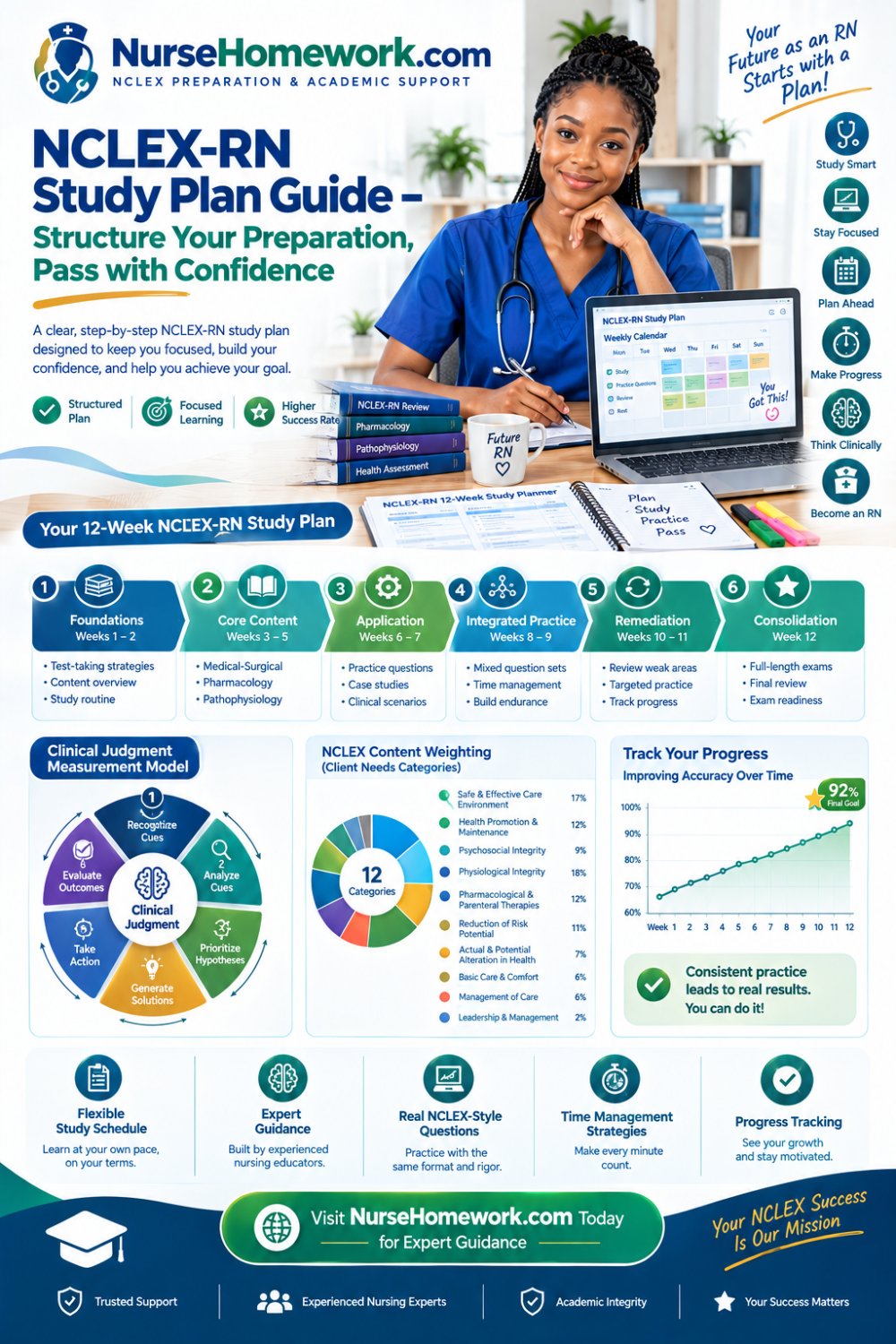
NCLEX-RN study plan guide is the single most valuable resource a nursing graduate can build before sitting for licensure, because passing the NCLEX-RN depends far less on how much you study than on how well your studying is organized. At NurseHomework.com, we understand that unstructured review produces anxiety and diminishing returns, while a disciplined NCLEX-RN study plan guide converts limited weeks into measurable readiness. This comprehensive guide walks through baseline assessment, timeline construction, content weighting, clinical judgment development, question practice, and final-week consolidation.
What an NCLEX-RN Study Plan Guide Actually Is
Before going further into NCLEX-RN study plan guide construction, it is essential to define what the document should contain. A study plan is not a list of chapters to read. It is a structured schedule that allocates finite hours across content categories according to test plan weighting, integrates active recall and question practice, builds clinical judgment deliberately, and includes periodic reassessment.
A well-constructed NCLEX-RN study plan guide answers four questions. What do I need to learn? How much time do I have? In what order should I study? And how will I know whether I am ready?
Most graduates fail to pass not because they lacked effort but because their effort was misallocated. They reviewed familiar content repeatedly and avoided weak areas, practiced untimed questions, and treated question banks as the entire preparation rather than one component of it. A structured NCLEX-RN study plan guide corrects these errors systematically.
Understanding What the NCLEX-RN Tests
Computerized Adaptive Testing
The NCLEX-RN uses computerized adaptive testing, selecting each question based on your performance on prior items. The algorithm continues until it determines with statistical confidence whether your ability exceeds the passing standard.
Practical implications for planning:
The examination has no fixed question count, ranging from 85 to 150 questions
Ending at 85 or 150 can mean either a pass or a fail
Difficulty increases as you answer correctly, which is expected rather than alarming
Questions cannot be skipped or revisited
Up to five hours of testing time is available
Understanding these mechanics prevents the panic that accompanies a steeply rising difficulty curve, and it is a foundational component of any NCLEX-RN study plan guide.
The Clinical Judgment Measurement Model
The Next-Generation NCLEX is built on the Clinical Judgment Measurement Model, which structures reasoning into six cognitive steps:
Recognize Cues
Analyze Cues
Prioritize Hypotheses
Generate Solutions
Take Action
Evaluate Outcomes
Every case study item maps to one or more of these steps. A credible NCLEX-RN study plan guide schedules explicit practice with each step rather than treating clinical judgment as an incidental byproduct of content review.
Client Needs Categories and Weighting
The test plan organizes content into four major categories with subcategories:
Safe and Effective Care Environment
Management of Care
Safety and Infection Control
Health Promotion and Maintenance
Psychosocial Integrity
Physiological Integrity
Basic Care and Comfort
Pharmacological and Parenteral Therapies
Reduction of Risk Potential
Physiological Adaptation
Study time should be allocated according to these weightings rather than personal preference. A reliable NCLEX-RN study plan guide uses the test plan as its organizing structure.
Step One: Establish Your Baseline
No plan can be built without a starting point.
Take a Full-Length Diagnostic Examination
Complete a full-length practice examination under timed conditions before beginning content review. This establishes baseline accuracy and identifies weak content categories.
Record Performance by Category
Do not simply note the overall percentage. Record accuracy by client needs category and subcategory, and by question format. This data determines where study hours should be concentrated.
Identify Whether the Issue Is Content or Strategy
Candidates who answer content questions correctly in isolation but perform poorly on application items usually have a reasoning or strategy deficit rather than a knowledge deficit. Misdiagnosing this wastes weeks of preparation.
Assess Anxiety and Logistics
Note how anxiety affected the diagnostic performance and whether time management was an issue. Both factors influence how the study plan should be structured.
Step Two: Choose a Realistic Timeline
Six to Twelve Weeks
This is the most common and most effective window. Six weeks suits candidates with strong academic foundations, while twelve weeks allows thorough remediation of weak areas.
Under Four Weeks
Compressed timelines require proportionally more daily hours and produce weaker retention. Candidates in this window should prioritize high-yield content and question practice over comprehensive review.
Over Twelve Weeks
Extended timelines risk fatigue and content decay. If more time is available, schedule lighter early weeks and increase intensity in the final six weeks.
Daily Study Volume
Two to four focused hours daily generally outperforms marathon sessions. Retrieval quality declines sharply after roughly ninety minutes of continuous study without a break.
Step Three: Distribute Content by Weighting
Management of Care
This subcategory carries substantial weighting and is frequently underestimated. Prioritization, delegation, assignment making, scope of practice, advocacy, and ethical reasoning all fall here.
Pharmacological and Parenteral Therapies
Focus on drug classifications, mechanisms of action, major adverse effects, nursing considerations, and dosage calculation accuracy. Classification-level understanding allows reasoning about unfamiliar drugs.
Reduction of Risk Potential
Focus on laboratory value interpretation, diagnostic testing, potential complications, and early recognition of deterioration.
Physiological Adaptation
Focus on fluid and electrolytes, acid-base balance, perioperative care, and management of acute and chronic conditions.
Safety and Infection Control
Focus on isolation precautions, standard precautions, fall prevention, and safe medication administration.
Health Promotion and Maintenance
Focus on screening, developmental stages, and anticipatory guidance.
Psychosocial Integrity
Focus on therapeutic communication, coping, grief, and mental health conditions.
Basic Care and Comfort
Focus on mobility, nutrition, elimination, and comfort measures.
Step Four: Build the Week-by-Week Structure
Weeks One and Two: Foundations and Weakest Categories
Begin with your weakest content categories while energy and motivation are highest. Combine content review with immediate question practice on the same topic, because retention improves dramatically when review is followed by application.
Weeks Three and Four: Core Content and Question Integration
Move through the heavily weighted categories while maintaining daily question practice on previously covered material to prevent decay.
Weeks Five and Six: Application and Clinical Judgment Focus
Shift from content acquisition to application. Increase the proportion of case study and NGN-format practice, and practice reasoning through the Clinical Judgment Measurement Model explicitly.
Weeks Seven and Eight: Integrated Practice
Complete full-length practice examinations under timed conditions and review every rationale thoroughly, including rationales for questions answered correctly.
Weeks Nine and Ten: Remediation of Persistent Weaknesses
Reassess performance data and direct additional time toward categories that have not improved despite review.
Weeks Eleven and Twelve: Consolidation and Taper
Reduce new content acquisition, consolidate high-yield material, complete one final full-length examination early in the period, and prioritize sleep in the final forty-eight hours.
This phased structure is the backbone of any effective NCLEX-RN study plan guide.
Step Five: Prioritize Active Recall Over Passive Review
Why Passive Review Fails
Reading notes and highlighting produce a subjective sense of familiarity that does not translate into retrieval ability. The NCLEX requires retrieval under pressure.
Retrieval Practice
Answer questions before reviewing content, test yourself with flashcards, and explain concepts aloud without notes. Retrieval attempts, even unsuccessful ones, strengthen memory more than rereading.
Spaced Repetition
Review material at expanding intervals. A topic covered on day one should be revisited on day three, day seven, and day twenty-one.
Elaborative Interrogation
Ask why a fact is true and how it connects to related concepts. Understanding mechanisms allows reasoning about unfamiliar scenarios.
Reciprocal Teaching
Explaining concepts to peers strengthens retention for the teacher more than the listener. Study groups serve this function well.
Step Six: Master Prioritization and Delegation
Prioritization questions appear throughout the examination and follow consistent frameworks.
Maslow’s Hierarchy
Physiological needs precede safety, which precedes psychosocial needs. Airway, breathing, and circulation always take precedence.
ABC Framework
Airway, breathing, and circulation outrank all other concerns in acute scenarios.
Acute Versus Chronic
A newly symptomatic client outranks a client with an established, unchanged diagnosis.
Unstable Versus Stable
Address the unstable client first regardless of admission time or room assignment.
Safety and Infection Control Breaches
Immediate attention is required when precautions are breached or medication safety is compromised.
Delegation Rules
Delegation requires matching task to licensure level and to client stability. Assessment, teaching, evaluation, and nursing judgment cannot be delegated. Unstable clients cannot be delegated to assistive personnel. This content area is a frequent source of point loss and deserves dedicated practice in any NCLEX-RN study plan guide.
Step Seven: Practice Every NGN Question Format
Traditional Multiple Choice
Still present, though reduced in proportion. Tests content knowledge and basic reasoning.
Matrix and Grid Items
Tables with rows of conditions and columns of responses, requiring one selection per row. Frequently tests cue recognition and outcome evaluation.
Bowtie Items
A central client condition with actions and parameters on one side and conditions to monitor on the other. Tests prioritization and the relationship between interventions and assessment.
Drag-and-Drop Ordered Response
Requires sequencing steps correctly, such as prioritizing assessments or ordering a procedure.
Highlight Text Items
Requires highlighting relevant text within a clinical note, directly testing cue recognition.
Drop-Down Cloze Items
Requires selecting correct terms from drop-down menus within a sentence or chart entry.
Unfolding Case Studies
Six-question sequences with new information revealed at each step. These are the most demanding format because errors compound across the sequence.
Familiarity with each format produces measurable performance gains, which is why format practice belongs in every NCLEX-RN study plan guide.
Step Eight: Develop Test-Taking Strategy
Read the Entire Question Before the Options
Scanning answers prematurely leads to premature commitment.
Identify the Question Type
Determine whether the question asks for the first action, the best action, the priority client, or an expected finding.
Eliminate Absolutes With Caution
Options containing always, never, all, or only are frequently incorrect, though not universally so.
Apply the Nursing Process Sequence
Assessment generally precedes intervention unless the client is in immediate danger.
Avoid Reading Into the Question
Answer using only the information provided. Added assumptions introduce error.
Use the Umbrella Principle
When multiple options appear correct, select the one that encompasses the others.
Manage Time Deliberately
Approximately one minute per question is a reasonable target. Excessive time on one item reduces accuracy elsewhere.
Use Breaks Strategically
Scheduled breaks sustain attention. Skipping breaks frequently produces declining accuracy in later questions.
Step Nine: Manage Anxiety and Physiology
Simulate Examination Conditions
Practicing under timed, distraction-reduced conditions reduces novelty on examination day.
Maintain Consistent Sleep in the Final Week
Sleep deprivation impairs reasoning more than most candidates anticipate. Prioritize sleep over additional review in the final forty-eight hours.
Use Controlled Breathing
Slow diaphragmatic breathing before the examination and during breaks moderates physiological arousal.
Reframe Physiological Arousal
Interpreting elevated heart rate as readiness rather than fear improves performance.
Confirm Logistics in Advance
Verify testing center location, identification requirements, and arrival timing to remove avoidable stress.
Avoid Post-Examination Analysis During Breaks
Attempting to calculate performance during breaks consumes working memory needed for subsequent items.
Step Ten: Reassess and Adjust Throughout
Track Data Weekly
Record accuracy by category and question format weekly to identify genuine trends rather than relying on impressions.
Adjust the Plan
A study plan is a working document. Redirect hours toward categories that are not improving and reduce time on categories that have reached consistent accuracy.
Recognize Plateaus
Plateaus are normal and usually resolve with a shift in study method rather than additional volume.
Know When You Are Ready
Readiness indicators include consistent accuracy on timed full-length practice examinations, comfortable performance on NGN case studies, and stable scores across multiple attempts.
Common Study Plan Mistakes
Relying on question banks alone. Question banks develop test-taking skill but do not build content foundation.
Studying content without application. Knowledge without reasoning practice produces weak NGN performance.
Avoiding low-preference categories. Neglecting mental health, community health, or leadership content reliably depresses scores.
Memorizing without understanding. The NGN rewards reasoning, not recall alone.
Ignoring rationales. Reviewing rationales for every question, including correct ones, is where most learning occurs.
Practicing untimed. Untimed practice develops knowledge but not examination performance.
Cramming at the end. Massed review in the final week produces diminishing returns and increases anxiety.
Comparing progress with peers. Individual timelines differ substantially, and comparison produces anxiety without benefit.
Retake Strategy: Rebuilding After an Unsuccessful Attempt
Obtain the Candidate Performance Report
This report identifies relative strengths and weaknesses. Use it to direct study rather than guessing.
Diagnose the Actual Problem
Candidates who performed well on practice questions but failed the examination usually have a strategy or anxiety issue rather than a content deficit.
Rebuild Rather Than Repeat
Repeating the preparation plan that preceded an unsuccessful attempt rarely produces a different outcome.
Allow Adequate Time
Sufficient preparation produces better outcomes than rushing to retest.
Address Anxiety Explicitly
If anxiety contributed to the outcome, address it through simulation practice, breathing techniques, and where appropriate, professional support.
How NurseHomework.com Supports Study Plan Development
At NurseHomework.com, we provide comprehensive NCLEX-RN study plan guide support tailored to individual performance profiles. Our services include:
Personalized study plan construction based on diagnostic examination data
Content weighting aligned to the current NCLEX-RN test plan
Clinical judgment development using the Clinical Judgment Measurement Model
Structured practice with all NGN question formats, including bowtie, matrix, highlight text, and unfolding case studies
Prioritization and delegation strategy instruction
Rationale analysis for both correct and incorrect responses
Dosage calculation verification and safety convention review
Weekly reassessment frameworks to keep the plan responsive
Test anxiety management strategies
Retake planning using candidate performance reports
Whether you are beginning preparation immediately after graduation or rebuilding after an unsuccessful attempt, NurseHomework.com provides NCLEX-RN study plan guide support calibrated to your specific needs.
Frequently Asked Questions About NCLEX-RN Study Plan Guide
What is an NCLEX-RN study plan guide?
It is a structured schedule that allocates study hours across test plan categories, integrates active recall and question practice, builds clinical judgment deliberately, and includes periodic reassessment.
How long should my NCLEX-RN study plan be?
Most graduates benefit from six to twelve weeks. Shorter timelines require more daily hours and produce weaker retention, while longer timelines risk fatigue and content decay.
How many hours a day should I study?
Two to four focused hours daily generally outperforms marathon sessions, because retrieval quality declines sharply after roughly ninety minutes without a break.
What should I study first?
Begin with your weakest content categories while energy is highest, combining content review with immediate question practice on the same topic.
How much of my study time should go to question practice?
A substantial proportion should involve active question practice, increasing toward case studies and NGN formats as the examination approaches.
What is the Clinical Judgment Measurement Model?
It is the framework underlying the NGN, organizing reasoning into recognizing cues, analyzing cues, prioritizing hypotheses, generating solutions, taking action, and evaluating outcomes.
Can NurseHomework.com help me build an NCLEX-RN study plan guide?
Yes. NurseHomework.com offers personalized NCLEX-RN study plan guide construction, clinical judgment instruction, and NGN format practice.
How do I know when I am ready to test?
Readiness indicators include consistent accuracy on timed full-length practice examinations, comfortable NGN case study performance, and stable scores across multiple attempts.
What should I do in the final week?
Complete one full-length examination early in the week, review rationales, consolidate high-yield content, reduce study volume, confirm logistics, and prioritize sleep in the final forty-eight hours.
What should I do if I fail the NCLEX-RN?
Obtain your candidate performance report, determine whether the issue was content or strategy, rebuild your plan rather than repeating it, allow adequate time, and address anxiety explicitly.
A disciplined NCLEX-RN study plan guide transforms preparation from anxious accumulation into measurable readiness. By establishing a baseline, choosing a realistic timeline, distributing content according to test plan weighting, prioritizing active recall over passive review, mastering prioritization frameworks, practicing every NGN question format, developing explicit test-taking strategy, managing anxiety deliberately, and reassessing weekly, you give yourself the strongest possible chance of passing on your first attempt.
At NurseHomework.com, we are committed to helping you reach licensure. Our personalized planning, clinical judgment instruction, and NGN practice make a NCLEX-RN study plan guide targeted, structured, and effective. Don’t leave your licensure to chance or unstructured review. Visit NurseHomework.com today and discover how we can help you master your NCLEX-RN study plan guide and begin your nursing career with confidence.
- NCLEX-RN study plan guide
- NCLEX-RN study plan guide
- NCLEX-RN study plan guide
- NCLEX-RN study plan guide
- NCLEX-RN study plan guide
- NCLEX-RN study plan guide
- NCLEX-RN study plan guide
- NCLEX-RN study plan guide
Needs help with Nursing Assignment?
We are available 24x7 to deliver the best services and assignment ready within 3-4 hours? Order a custom-written, plagiarism-free paper
 Get Answer Over WhatsApp
 Order Paper Now
