Nursing Exam Preparation Tips: Your Complete Guide to Academic and Licensure Success
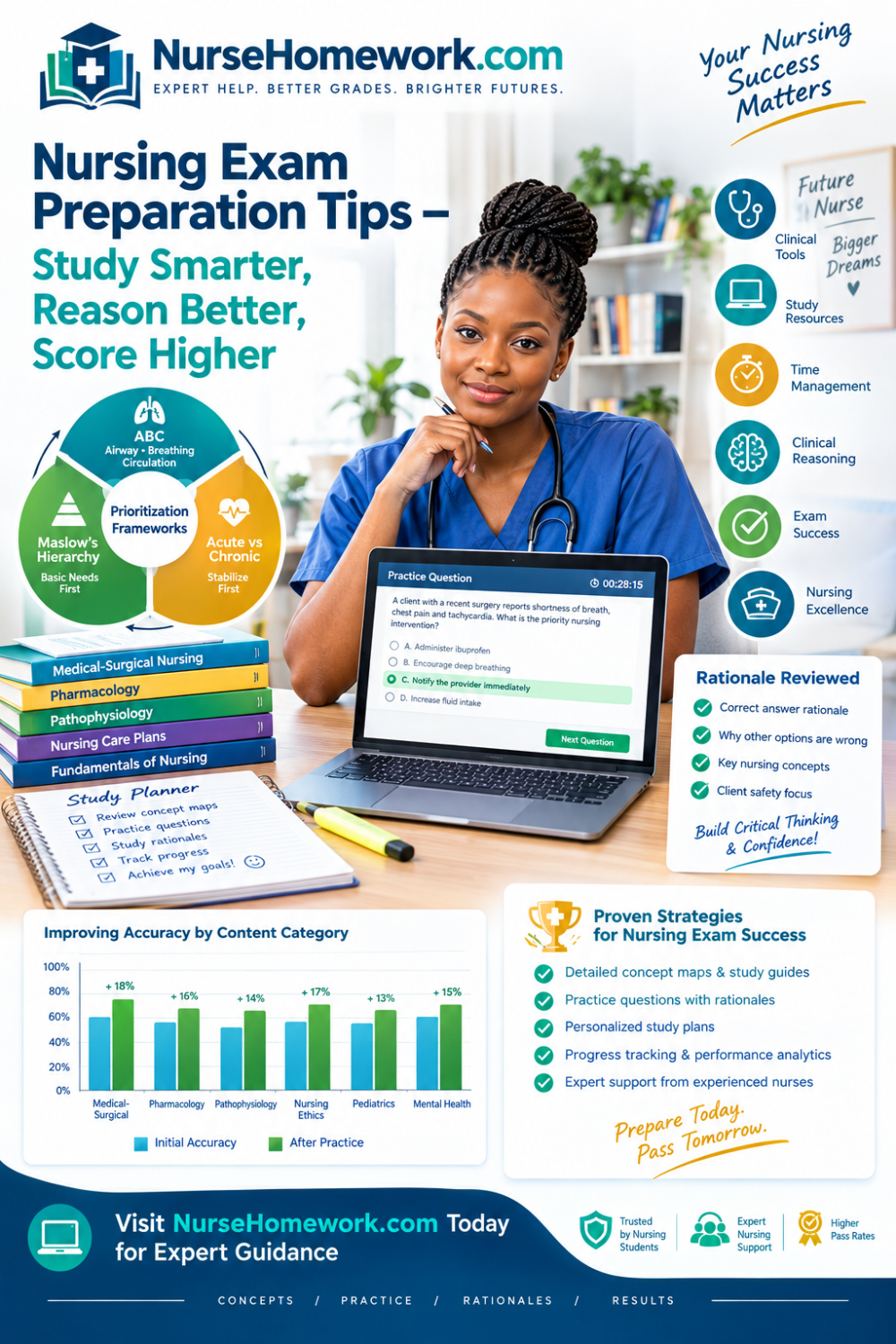
Nursing exam preparation tips are among the most valuable resources a nursing student can gather, because nursing examinations test a form of reasoning that ordinary study habits rarely develop. At NurseHomework.com, we understand that nursing exams differ fundamentally from the exams students encountered before nursing school. They reward clinical judgment, prioritization, and safe decision-making rather than factual recall alone. This comprehensive guide provides nursing exam preparation tips across study strategy, content organization, question analysis, anxiety management, and exam-day execution.
Why Nursing Exams Are Different
Before applying nursing exam preparation tips, it is essential to understand what makes nursing examinations distinctive. Most nursing exams present clinical scenarios and ask what the nurse should do first, what finding is most concerning, or which client should be assessed first. These are judgment questions, not recall questions.
The shift toward clinical judgment has accelerated with the Next-Generation NCLEX, which uses unfolding case studies and alternate item formats to assess reasoning rather than memorization. Nursing school exams have followed suit, incorporating case-based questions, prioritization items, and matrix formats.
This means that traditional study methods, such as rereading notes, highlighting textbooks, and memorizing lists, produce disappointing results in nursing programs. Effective nursing exam preparation tips focus on retrieval practice, application, and reasoning development.
Build a Foundation Before You Study
Understand the Test Blueprint
Every nursing exam maps to a content framework. Ask your instructor which body systems, client needs categories, or nursing concepts the exam will cover, and what proportion of questions comes from each area. Studying without knowing the blueprint wastes hours on unweighted content.
Review the Learning Objectives
Learning objectives describe exactly what you are expected to be able to do. They frequently become exam questions in slightly reworded form. Treating objectives as a study checklist is one of the highest-yield nursing exam preparation tips available.
Identify Your Weak Areas Honestly
Students gravitate toward content they already understand because it feels productive. Genuine preparation requires spending disproportionate time on weak areas. A diagnostic self-assessment at the start of each unit reveals where to concentrate effort.
Study Strategies That Actually Work
Retrieval Practice Over Rereading
Answer questions before reviewing content. Attempt to recall information without notes. Unsuccessful retrieval attempts strengthen memory more than successful rereading, because the effort of retrieval consolidates learning.
Spaced Repetition
Review material at expanding intervals, such as day one, day three, day seven, and day twenty-one. Massed review before an exam produces rapid forgetting, while spaced review produces durable retention. This is among the most consistently supported nursing exam preparation tips in learning science.
Elaborative Interrogation
Ask why a fact is true and how it connects to related concepts. Understanding that a beta-blocker reduces heart rate allows reasoning about why it is contraindicated in certain conditions, even if you have never memorized that specific contraindication.
Concept Mapping
Draw relationships between pathophysiology, manifestations, diagnostics, interventions, and evaluation. Concept maps reveal gaps in understanding that linear notes conceal.
Interleaving
Study related topics together rather than in isolated blocks. Alternating between cardiovascular and respiratory content forces you to discriminate between similar presentations, which is exactly what exam questions require.
Reciprocal Teaching
Explain concepts aloud to a study partner. Teaching exposes gaps in your own understanding and produces stronger retention for the explainer than the listener.
Organizing Content for Retention
Organize by Concept, Not by Chapter
Textbook chapters are organized for reading, not for retrieval. Reorganize content around recurring concepts such as perfusion, oxygenation, mobility, comfort, and safety. This structure allows reasoning about unfamiliar scenarios.
Build Comparison Tables
Create tables contrasting conditions that present similarly, such as Crohn’s disease versus ulcerative colitis, or hyperthyroidism versus hypothyroidism. Discrimination between similar conditions is heavily tested.
Master Medication Classifications
Rather than memorizing individual drugs, learn classifications and their mechanisms of action. This allows reasoning about side effects, contraindications, and nursing considerations for drugs you have never seen.
Anchor Laboratory Values
Memorize normal ranges for the most frequently tested values, particularly potassium, sodium, calcium, magnesium, glucose, hemoglobin, platelets, and creatinine. Nearly every clinical scenario involves interpreting at least one laboratory value.
Prioritize Safety Content
Isolation precautions, fall prevention, medication administration rights, and dangerous abbreviations appear repeatedly. These are high-yield and relatively easy to master.
Mastering Question Analysis
Read the Entire Question Before the Options
Scanning answers prematurely leads to premature commitment. Reading the full stem first prevents selecting an option that answers a different question.
Identify What the Question Is Asking
Determine whether the question asks for the first action, the best action, the priority client, an expected finding, or a complication to anticipate. Each type requires a different reasoning approach.
Note Key Qualifiers
Words such as initial, first, priority, most, least, immediate, and expected change the answer entirely. Highlighting qualifiers mentally is one of the most practical nursing exam preparation tips for reducing careless errors.
Eliminate Absolutes With Judgment
Options containing always, never, all, and only are frequently incorrect, though not universally so. Evaluate them rather than dismissing them automatically.
Apply the Nursing Process Sequence
Assessment generally precedes intervention unless the client is in immediate danger. Recognizing this sequence resolves a large proportion of priority questions.
Use the ABC Framework
Airway, breathing, and circulation outrank all other concerns in acute scenarios. When an option addresses airway compromise, it usually takes precedence.
Apply Maslow’s Hierarchy
Physiological needs precede safety, which precedes psychosocial needs. This framework resolves many prioritization questions involving non-emergent scenarios.
Compare Acute Versus Chronic
A newly symptomatic client outranks a client with an established, unchanged diagnosis.
Compare Unstable Versus Stable
Address the unstable client first regardless of admission time or room assignment.
Use the Umbrella Principle
When multiple options appear correct, select the one that encompasses the others. This technique is frequently applicable in management and delegation questions.
Avoid Reading Into the Question
Answer using only the information provided. Adding assumptions that are not stated introduces error, and this is one of the most common sources of missed questions.
Review Every Rationale
Review rationales for questions answered correctly as well as incorrectly. Most learning occurs in the rationale, not in the answer selection. This practice is among the most emphasized nursing exam preparation tips in nursing education.
Building an Effective Study Schedule
Plan Backward From the Exam Date
Map the content to be covered and allocate days proportionally to weighting. A visible schedule reduces the tendency to study whatever feels comfortable.
Study in Focused Blocks
Sixty to ninety minutes of focused study followed by a short break outperforms marathon sessions. Retrieval quality declines sharply with fatigue.
Schedule Active Sessions, Not Passive Ones
Every study block should include an active component: practice questions, self-testing, concept mapping, or teaching. Passive reading should occupy a small fraction of total study time.
Protect Sleep
Sleep consolidates memory. Sacrificing sleep to study additional hours reliably reduces examination performance, which makes sleep protection a genuine study strategy rather than a luxury.
Reserve the Final Day for Consolidation
The day before an exam should involve light review of high-yield material rather than new content acquisition. Cramming new material the night before produces anxiety without retention.
Leveraging Practice Questions Effectively
Practice Under Timed Conditions
Untimed practice develops knowledge but not examination performance. Timed practice develops pacing, stamina, and decision-making under pressure.
Track Accuracy by Content Category
Recording accuracy by category reveals genuine patterns that impressions miss. Data directs study time toward actual weaknesses.
Analyze Errors by Type
Categorize each missed question as a content error, a misread question, a priority reasoning error, or a knowledge application error. Each type requires a different remedy. Content errors require review, while misread questions require slower reading.
Maintain an Error Log
Record recurring mistakes in a single document and review it before each examination. Most students have a stable set of five to ten recurring errors that account for a disproportionate share of lost points.
Increase Case Study Practice
As exams move toward case-based formats, practice with unfolding scenarios that reveal information progressively. These require reasoning across multiple steps rather than single-question judgment.
Managing Test Anxiety
Prepare Thoroughly
Anxiety decreases with genuine preparedness. Adequate preparation remains the most reliable intervention available.
Simulate Examination Conditions
Practice in a quiet room, with a timer, without notes, and without interruptions. Reducing novelty lowers anxiety on examination day.
Use Controlled Breathing
Slow diaphragmatic breathing before the examination and during breaks moderates physiological arousal.
Reframe Physiological Arousal
Interpreting a racing heart as readiness rather than fear improves performance. This reframing technique is well supported in performance psychology.
Avoid Comparison With Peers
Individual preparation timelines differ substantially. Comparing progress produces anxiety without improving outcomes.
Address Persistent Anxiety Directly
If anxiety consistently impairs performance despite preparation, seek support from academic advisors, counseling services, or structured academic support. This is not a weakness but a practical remedy.
Examination Day Execution
Arrive Early
Confirming location, identification requirements, and timing in advance removes avoidable stress.
Read Every Question Fully
Time pressure encourages skimming, which produces careless errors. Reading the full stem before the options prevents most misread questions.
Manage Time Deliberately
Establish a target pace and monitor it. Excessive time on a single question reduces accuracy on later items.
Answer Every Question
There is no penalty for incorrect answers on most nursing examinations. Leaving items blank guarantees lost points.
Use Breaks Strategically
Scheduled breaks sustain attention. Skipping breaks frequently produces declining accuracy in later questions.
Avoid Post-Examination Analysis During Breaks
Attempting to calculate performance during breaks consumes working memory needed for subsequent questions.
Trust Your Preparation
Changing answers based on anxiety rather than reasoning reduces accuracy. Change an answer only when you identify a specific reason the original selection was wrong.
Subject-Specific Preparation Tips
Pharmacology
Focus on classifications, mechanisms, adverse effects, and nursing considerations rather than individual drug memorization. Practice dosage calculations until the method is automatic.
Medical-Surgical Nursing
Prioritize fluid and electrolytes, acid-base balance, perioperative care, and management of common chronic conditions. Practice interpreting laboratory values in context.
Maternal and Newborn Nursing
Focus on fetal monitoring interpretation, labor stages, postpartum complications, and newborn assessment. Practice recognizing normal versus abnormal findings.
Pediatric Nursing
Prioritize developmental milestones, weight-based dosing, and recognition of deterioration. Children compensate until they decompensate rapidly, which makes subtle cues clinically significant.
Mental Health Nursing
Focus on therapeutic communication, psychopharmacology, suicide risk assessment, and crisis intervention. Practice recognizing the difference between therapeutic and non-therapeutic responses.
Community Health Nursing
Prioritize epidemiology principles, health promotion, and population-focused interventions. Practice interpreting incidence and prevalence correctly.
Leadership and Management
Focus on prioritization, delegation, assignment making, and scope of practice. Remember that assessment, teaching, evaluation, and nursing judgment cannot be delegated.
Common Preparation Mistakes
Relying on rereading and highlighting. These produce familiarity without retrieval ability.
Studying familiar content repeatedly. This feels productive while leaving weak areas untouched.
Practicing untimed. This develops knowledge but not examination performance.
Skipping rationales. Most learning occurs in the rationale, not the answer.
Memorizing without understanding. Reasoning questions cannot be answered by memorized facts alone.
Cramming new content the night before. This increases anxiety without producing retention.
Sacrificing sleep. Sleep consolidates memory, and its loss reliably reduces performance.
Comparing progress with peers. Individual timelines differ, and comparison produces anxiety without benefit.
Ignoring recurring errors. Failing to log and review personal error patterns guarantees repeat point loss.
How NurseHomework.com Supports Exam Preparation
At NurseHomework.com, we provide comprehensive nursing exam preparation tips and structured academic support tailored to the demands of nursing coursework and licensure examinations. Our services include:
Personalized study plan development based on diagnostic assessment data
Content organization by concept, body system, and client needs category
Clinical judgment development using the Clinical Judgment Measurement Model
Structured practice with case studies, prioritization items, and alternate question formats
Prioritization and delegation strategy instruction
Rationale analysis for both correct and incorrect responses
Dosage calculation verification and safety convention review
Error log development to eliminate recurring mistakes
Test anxiety management strategies
Examination day execution planning
Whether you are preparing for a unit examination, a comprehensive final, or the NCLEX, NurseHomework.com provides nursing exam preparation tips calibrated to your specific performance profile.
Frequently Asked Questions About Nursing Exam Preparation Tips
What is the most effective way to study for nursing exams?
Retrieval practice, spaced repetition, and application through timed question practice consistently outperform rereading and highlighting.
Why do nursing exams feel harder than other exams?
They test clinical judgment and prioritization rather than factual recall, requiring reasoning about scenarios rather than recognition of memorized facts.
How far in advance should I start studying?
Begin structured preparation at least two weeks before a unit examination and six to twelve weeks before a licensure examination.
Should I review rationales for questions I answered correctly?
Yes. Most learning occurs in the rationale, and correct answers are sometimes selected for the wrong reason.
How do I answer prioritization questions correctly?
Apply Maslow’s hierarchy, the ABC framework, and the acute versus chronic and unstable versus stable comparisons. Assessment generally precedes intervention unless immediate danger exists.
How can I reduce careless errors on nursing exams?
Read the entire question before the options, note qualifiers such as first and priority, and avoid adding assumptions not stated in the scenario.
How do I manage test anxiety?
Prepare thoroughly, simulate examination conditions, use controlled breathing, reframe physiological arousal as readiness, and avoid comparing progress with peers.
What should I study the night before an exam?
Light review of high-yield material such as laboratory values, isolation precautions, medication classifications, and prioritization frameworks. Avoid new content.
Can NurseHomework.com help with nursing exam preparation?
Yes. NurseHomework.com offers personalized study planning, clinical judgment instruction, and question analysis support for students applying nursing exam preparation tips.
How do I know when I am ready for an exam?
Readiness indicators include consistent accuracy on timed practice questions, comfortable performance on case-based items, and stable scores across multiple practice attempts.
Applying nursing exam preparation tips effectively requires replacing passive study habits with active retrieval, organizing content by concept rather than chapter, mastering prioritization frameworks, analyzing every rationale, and managing anxiety deliberately. Nursing examinations reward reasoning, and reasoning can be developed through deliberate practice. At NurseHomework.com, we are committed to helping you succeed in every examination you face. Our personalized planning, clinical judgment instruction, and question analysis support make nursing exam preparation tips practical, targeted, and effective. Don’t leave your performance to chance or to study habits that no longer fit the way nursing is assessed. Visit NurseHomework.com today and discover how we can help you master nursing exam preparation tips and excel in your nursing studies.
- Nursing exam preparation tips
- Nursing exam preparation tips
- Nursing exam preparation tips
- Nursing exam preparation tips
- Nursing exam preparation tips
- Nursing exam preparation tips
- Nursing exam preparation tips
- Nursing exam preparation tips
- Nursing exam preparation tips
- Nursing exam preparation tips
- Nursing exam preparation tips
- Nursing exam preparation tips
- Nursing exam preparation tips
- Nursing exam preparation tips
Needs help with Nursing Assignment?
We are available 24x7 to deliver the best services and assignment ready within 3-4 hours? Order a custom-written, plagiarism-free paper
 Get Answer Over WhatsApp
 Order Paper Now
