Nursing Ethics Case Study Help: Your Complete Guide to Ethical Decision-Making in Clinical Practice
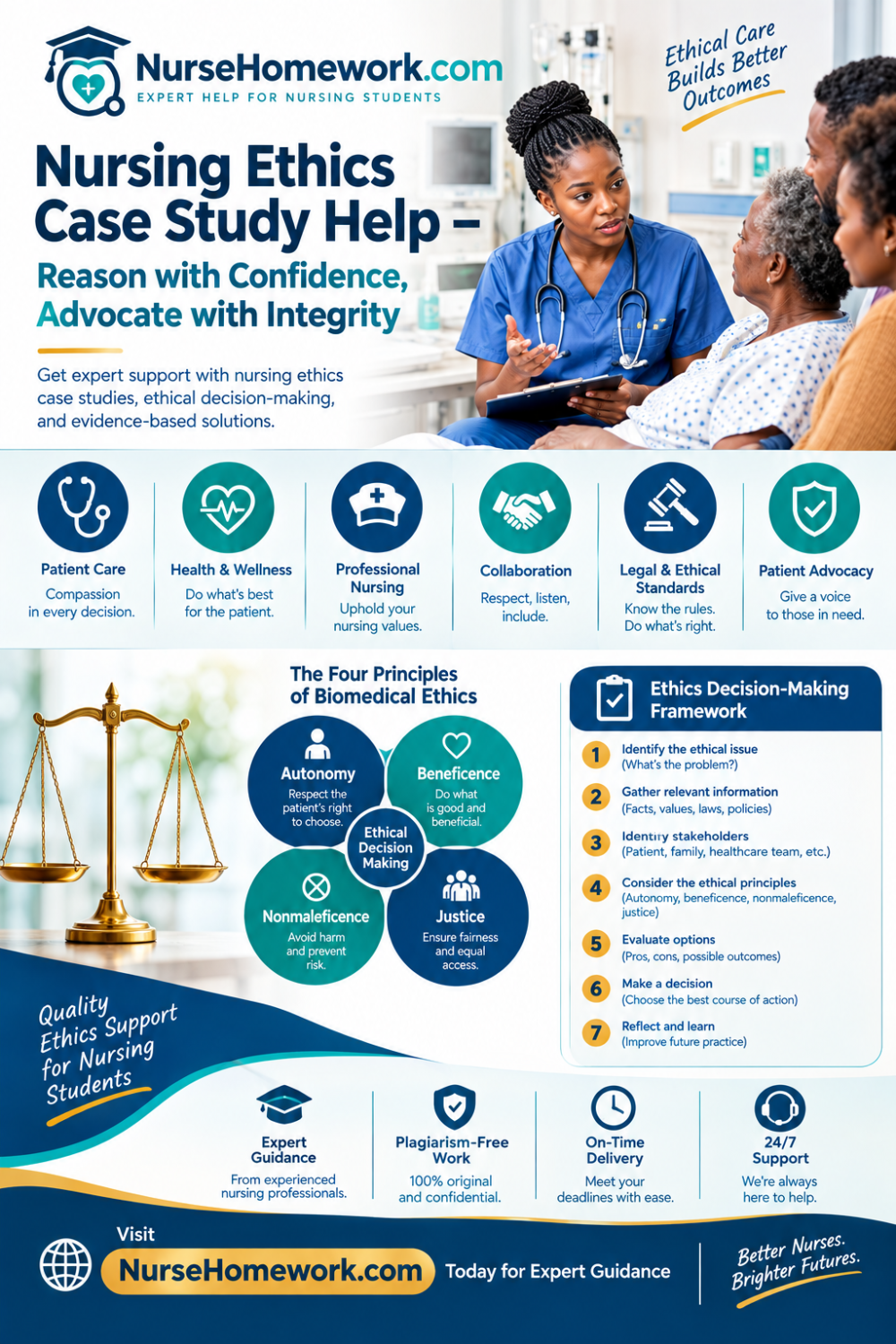
Nursing ethics case study help is an essential resource for every nursing student and practicing nurse navigating the complex moral terrain of modern healthcare. At NurseHomework.com, we understand that ethical reasoning is not an optional skill but a core professional competency required for safe, compassionate, and accountable nursing practice. This comprehensive guide will provide you with nursing ethics case study help across ethical theories, decision-making frameworks, common dilemmas, and NCLEX preparation.
Understanding Nursing Ethics Case Studies
Before diving into nursing ethics case study help, it is essential to understand what nursing ethics case studies are and why they matter. A nursing ethics case study presents a realistic clinical scenario involving moral conflict, competing values, or uncertainty about the right course of action, and requires the student to reason through the situation using established ethical frameworks. The purpose of nursing ethics case study help is to develop the moral reasoning, clinical judgment, and professional advocacy skills that nurses need when facing ethically challenging situations.
Ethics in nursing is guided by formal codes, including the American Nurses Association (ANA) Code of Ethics for Nurses with Interpretive Statements and the International Council of Nurses (ICN) Code of Ethics for Nurses. These documents establish the profession’s commitments to patients, families, communities, and society. When seeking nursing ethics case study help, students must learn to ground their reasoning in these professional standards rather than personal opinion alone.
Core Ethical Principles in Nursing
The Four Principles of Biomedical Ethics
The four-principles approach, developed by Beauchamp and Childress, is foundational to nursing ethics case study help. These principles include:
Autonomy: Respecting the patient’s right to self-determination, including the right to refuse treatment
Beneficence: Acting in the patient’s best interest and promoting good
Nonmaleficence: Avoiding harm, expressed in the maxim “first, do no harm”
Justice: Distributing benefits, risks, and resources fairly and equitably
When analyzing a case, students applying nursing ethics case study help should identify which principles are in tension and how each principle applies to the specific facts of the scenario.
Additional Ethical Principles
Beyond the four principles, nursing ethics incorporates:
Veracity: Truthfulness and honesty in all professional interactions
Fidelity: Keeping promises and maintaining trust
Confidentiality: Protecting patient privacy and protected health information
Accountability: Accepting responsibility for one’s actions and decisions
Advocacy: Speaking up for patients’ rights, needs, and preferences
Ethical Theories
Effective nursing ethics case study help draws on multiple ethical theories:
Deontology: Duty-based ethics emphasizing rules, obligations, and universal principles regardless of consequences
Utilitarianism: Consequentialist ethics weighing the greatest good for the greatest number
Virtue Ethics: Character-based ethics focusing on the moral qualities of the nurse, such as compassion, integrity, and courage
Ethics of Care: Relational ethics emphasizing context, relationships, and responsiveness to vulnerability
Casuistry: Case-based reasoning comparing the current situation with paradigm cases
The Nursing Process Applied to Ethical Reasoning
Step 1: Identify the Ethical Issue
The first step in nursing ethics case study help is determining whether the situation genuinely involves an ethical problem. Ask:
What makes this situation morally troubling?
Which values, duties, or rights are at stake?
Is this a clinical problem, a communication problem, or a true ethical conflict?
Students sometimes mislabel disagreements about clinical judgment as ethical dilemmas. A thorough analysis distinguishes between the two.
Step 2: Gather Relevant Facts
Thorough fact-gathering is essential for nursing ethics case study help. Collect:
Medical facts: diagnosis, prognosis, treatment options, and expected outcomes
Patient facts: age, capacity, values, culture, faith, and previously expressed wishes
Nursing facts: nursing scope of practice, standards, policies, and available resources
Legal facts: applicable statutes, advance directives, and reporting obligations
Step 3: Identify Stakeholders and Their Values
Identify everyone affected by the decision and the values each party brings. When using nursing ethics case study help, consider the patient, family, nurses, physicians, other disciplines, and the institution. Conflicts often arise because different stakeholders prioritize different values, such as autonomy versus beneficence, or individual rights versus resource stewardship.
Step 4: Apply Ethical Frameworks
Apply deontology, utilitarianism, virtue ethics, and the four principles to the scenario. Strong nursing ethics case study help requires that students analyze the case through more than one lens, because different frameworks can lead to different conclusions. Explain where frameworks converge and where they conflict.
Step 5: Consider Legal and Professional Standards
Ethical reasoning in nursing must align with:
The ANA Code of Ethics for Nurses
State nurse practice acts and scope of practice
Institutional policies and procedures
Federal regulations such as HIPAA and EMTALA
Mandatory reporting requirements for abuse, neglect, and communicable disease
Step 6: Generate and Evaluate Options
Identify all realistic courses of action, then evaluate each option against ethical principles, legal requirements, professional standards, and expected outcomes. A comprehensive nursing ethics case study help analysis considers the least restrictive and least harmful option that honors patient values.
Step 7: Take Action and Justify the Decision
Select an action, implement it, and articulate a clear ethical justification. This includes documenting the reasoning process, communicating with the team, and escalating to the ethics committee when appropriate.
Step 8: Evaluate the Outcome
Reflect on whether the decision achieved the intended moral goals and whether relationships and trust were preserved. Evaluation is often overlooked but is central to genuine nursing ethics case study help.
Common Ethical Dilemmas in Nursing Case Studies
Informed Consent and Capacity
Informed consent requires voluntariness, adequate disclosure, comprehension, and decision-making capacity. Cases frequently involve questions of whether a patient truly understands proposed treatments or whether family pressure invalidates consent.
Refusal of Treatment
Competent adults have the right to refuse any treatment, even life-sustaining therapy. Cases involving refusal require careful assessment of capacity, documentation of understanding of consequences, and respect for autonomy even when it conflicts with the nurse’s perception of benefit.
End-of-Life Decisions
End-of-life cases involve withdrawal or withholding of treatment, do-not-resuscitate orders, palliative sedation, and medical aid in dying where legally permitted. Ethical reasoning must distinguish between killing and allowing death, address the doctrine of double effect, and honor advance directives.
Confidentiality and Disclosure
Confidentiality is a foundational professional obligation, yet it has legal and ethical limits. Cases often involve adolescent confidentiality, duty to warn when a patient poses a threat to an identifiable third party, and disclosure obligations in cases of abuse or communicable disease.
Resource Allocation and Triage
Scarcity forces rationing decisions. Cases involve ventilator allocation, transplant candidate selection, staffing ratios, and catastrophic-event triage. Justice requires transparent, consistent criteria rather than bedside bias.
Mandatory Reporting and Advocacy
Nurses are legally mandated to report suspected abuse, neglect, and certain injuries. Cases explore the tension between protecting a patient from harm and respecting family privacy and cultural practices.
Cultural and Religious Conflict
Patients’ cultural and religious beliefs may conflict with standard treatment recommendations. Ethical practice requires cultural humility, negotiation, and accommodation where possible without compromising safety.
Moral Distress and Conscientious Objection
Moral distress occurs when nurses know the ethically appropriate action but feel prevented from taking it by institutional or hierarchical constraints. Cases explore conscientious objection, the limits of refusal to participate in care, and the nurse’s obligations when objecting.
Ethical Issues in Contemporary Nursing Practice
Artificial Intelligence and Patient Data
The growing use of artificial intelligence in nursing practice raises ethical questions about algorithmic bias, transparency, informed consent for data use, and accountability when AI-supported decisions cause harm. AI-enabled tools support clinical decision support, risk prediction, and documentation, making ethical oversight essential.
Telehealth and Digital Care
Telehealth introduces questions about equitable access, the digital divide, licensure across state lines, privacy in virtual encounters, and the quality of the nurse-patient relationship when care is mediated by technology.
Equity and Social Determinants of Health
Ethical practice requires attention to structural inequities that produce disparate health outcomes. Cases may involve implicit bias, access barriers, language, transportation, housing instability, and insurance status.
How to Structure a Nursing Ethics Case Study
Introduction
Introduce the clinical scenario, identify the ethical issue, and explain its significance. State the purpose of the analysis and preview the frameworks you will apply.
Case Presentation
Present the relevant medical, psychosocial, cultural, and legal facts. Use de-identified information to protect confidentiality.
Ethical Analysis
This is the core of your nursing ethics case study help. Identify stakeholders and their values, apply the four principles, apply ethical theories, examine relevant provisions of the ANA and ICN codes, and consider legal standards.
Alternative Courses of Action
Present at least three realistic options. Analyze the strengths, weaknesses, harms, and benefits of each.
Decision and Justification
State your chosen course of action and defend it with explicit ethical reasoning. Explain how your decision honors patient autonomy, minimizes harm, promotes benefit, and distributes burdens fairly.
Implementation and Evaluation
Describe how the decision would be implemented, who should be involved, what documentation is required, and how the outcome would be evaluated.
Reflection
Consider what you learned, how your moral reasoning developed, and what you might do differently. Reflective practice is a hallmark of ethical maturity.
Challenges in Nursing Ethics Education
Moving Beyond Personal Opinion
Students frequently rely on personal beliefs rather than professional frameworks. Effective nursing ethics case study help requires evidence-based moral reasoning grounded in the profession’s codes and standards.
Managing Emotional Weight
Ethical cases often involve suffering, death, and conflict. Students may experience moral distress themselves, particularly when they witness ethically troubling practice. Recognizing and addressing moral distress is part of professional development.
Navigating Hierarchy and Power
Nurses may hesitate to voice ethical concerns due to perceived power imbalances. Advocacy requires skill, preparation, and appropriate escalation through chain of command and ethics committees.
Ethical Sensitivity and Clinical Judgment
Ethical sensitivity—the ability to recognize that a situation has moral dimensions—is a prerequisite for ethical action. It must be deliberately cultivated alongside clinical judgment.
Effective Strategies for Nursing Ethics Case Study Success
Use a Structured Framework
Apply a recognized decision-making model consistently. Common frameworks include the four-principles approach, the DECIDE model, and the Ottawa Ethics Decision-Making Framework.
Cite Professional Standards
Reference the ANA Code of Ethics with specific provision numbers, the ICN Code, and relevant position statements. Grounding analysis in professional standards strengthens academic work.
Consider Multiple Perspectives
Analyze the case from the perspective of the patient, family, nurse, physician, organization, and society. Multi-perspective analysis is the hallmark of sophisticated nursing ethics case study help.
Address Legal Implications
Consider scope of practice, mandatory reporting, advance directives, informed consent doctrine, and confidentiality law. Ethical and legal analysis are complementary, not interchangeable.
Engage with Ethics Resources
Consult the institution’s ethics committee, ethics consultation service, clinical ethicists, and professional literature. Knowing how to access ethics resources is itself a professional competency.
Reflect and Write Clearly
Strong ethics papers combine precise reasoning with clear, well-organized writing. Use headings, define terms, and avoid unsupported assertions.
How NurseHomework.com Can Help with Nursing Ethics Case Studies
At NurseHomework.com, we provide comprehensive nursing ethics case study help for nursing students and professionals at all levels. Our services include:
Step-by-step guidance on nursing ethics case study help for any ethical scenario
Expert review of ethics papers with personalized feedback
Assistance applying the four principles and ethical theories
Help integrating the ANA and ICN Codes of Ethics
Analysis of informed consent, refusal of treatment, and end-of-life cases
Guidance on confidentiality, mandatory reporting, and duty to warn
Support for resource allocation and triage reasoning
Moral distress and conscientious objection analysis
NCLEX-style ethics and prioritization question practice
Documentation and advocacy communication support
Whether you are analyzing an end-of-life conflict, an informed-consent dilemma, or a resource allocation problem, NurseHomework.com is here to support your ethical reasoning development.
Frequently Asked Questions About Nursing Ethics Case Study Help
What is a nursing ethics case study?
A nursing ethics case study is a structured analysis of a clinical scenario involving moral conflict or uncertainty, requiring the nurse to apply ethical frameworks and professional standards to reach and justify a decision.
What are the four principles of biomedical ethics?
Autonomy, beneficence, nonmaleficence, and justice. These principles are widely used as an initial framework for ethical analysis in nursing.
What is the difference between ethics and law in nursing?
Ethics concerns what is morally right based on principles, values, and professional codes. Law concerns what is legally required or prohibited. An action may be legal but unethical, or ethical but legally constrained.
What ethical frameworks should I use in a nursing ethics case study?
Use multiple frameworks: the four principles, deontology, utilitarianism, virtue ethics, ethics of care, and casuistry. Applying more than one lens strengthens the analysis.
What is moral distress in nursing?
Moral distress occurs when a nurse knows the ethically appropriate action but feels prevented from taking it by institutional, hierarchical, or resource constraints. It is associated with burnout and turnover.
How do I analyze an informed consent case?
Assess voluntariness, disclosure, comprehension, and capacity. Determine whether the consent was valid and whether the nurse has an obligation to advocate for additional teaching or to escalate concerns.
Can NurseHomework.com help me with my nursing ethics case study?
Absolutely! NurseHomework.com offers expert guidance, personalized support, and comprehensive resources for nursing students needing nursing ethics case study help.
What should I include in the ethical analysis section?
Include identification of the ethical issue, stakeholder values, application of the four principles, application of ethical theories, relevant ANA and ICN code provisions, legal considerations, alternative courses of action, your decision, and justification.
How do I prepare for ethics questions on the NCLEX?
Practice NCLEX-style questions focused on prioritization, advocacy, confidentiality, informed consent, delegation, and client rights. Ethics questions frequently test whether you act in the patient’s best interest within scope of practice.
What resources can I use for nursing ethics case study help?
Use the ANA Code of Ethics, ICN Code of Ethics, nursing ethics textbooks, the institution’s ethics committee, clinical ethicists, and professional nursing ethics case study help support.
Mastering nursing ethics case study help is essential for nursing students and practicing nurses committed to safe, compassionate, and accountable practice. By applying the four principles, engaging multiple ethical theories, grounding reasoning in the ANA and ICN Codes of Ethics, and following a structured decision-making process, you can analyze even the most complex moral dilemmas with confidence and clarity. At NurseHomework.com, we are committed to helping you succeed. Our expert guidance, comprehensive resources, and personalized support make nursing ethics case study help easier and more effective. Don’t let the challenges of ethical reasoning hold you back. Visit NurseHomework.com today and discover how we can help you master nursing ethics case study help and excel in your nursing studies.
Needs help with Nursing Assignment?
We are available 24x7 to deliver the best services and assignment ready within 3-4 hours? Order a custom-written, plagiarism-free paper
 Get Answer Over WhatsApp
 Order Paper Now