Nursing Test-Taking Strategies: Your Complete Guide to Reasoning Through Every Exam
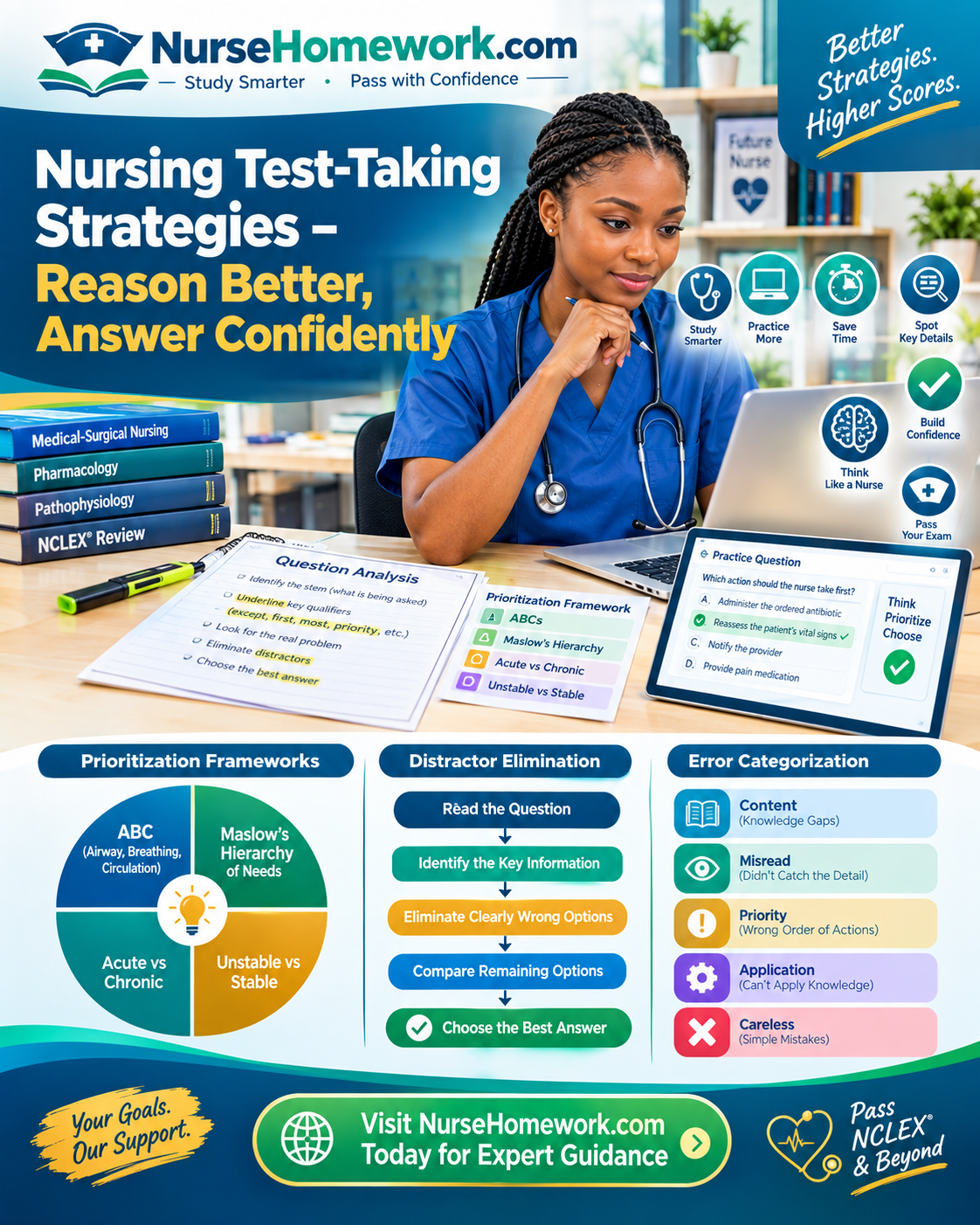
Nursing test-taking strategies are among the most valuable skills a nursing student can develop, because nursing examinations do not test what you remember. They test how you reason. At NurseHomework.com, we understand that capable students frequently underperform on nursing exams not because they lack knowledge but because they lack a systematic approach to questions. This comprehensive guide provides nursing test-taking strategies across question analysis, prioritization frameworks, distractor elimination, anxiety management, and examination-day execution.
Why Nursing Exams Require Different Strategies
Before applying any nursing test-taking strategies, it is essential to understand what makes nursing examinations structurally different from other exams. Most academic tests ask you to recognize or recall information. Nursing exams present clinical scenarios and ask what the nurse should do first, which finding is most concerning, or which client should be assessed first.
These are judgment questions. They require applying knowledge to a situation, ranking competing priorities, and recognizing safety implications. A student who has memorized every laboratory value may still miss the question if they cannot determine which abnormal value requires immediate action.
This is why nursing test-taking strategies cannot be reduced to tricks or mnemonics. They are reasoning frameworks that convert knowledge into correct decisions under time pressure. The shift toward clinical judgment on the Next-Generation NCLEX has made these frameworks more important than ever, because case-based items require reasoning across multiple steps rather than single-question recognition.
Start With the Question, Not the Answers
Read the Entire Stem Before Scanning Options
Time pressure encourages candidates to skim the stem and jump to the options. This produces premature commitment to an answer that may address a different question than the one asked. Reading the full stem first is the single most repeated recommendation in any collection of nursing test-taking strategies.
Identify What the Question Is Actually Asking
Nursing questions ask for one of a limited number of things. Determining which one changes the reasoning approach entirely.
First action: What should the nurse do initially?
Best action: Which intervention is most appropriate?
Priority client: Which client should be assessed first?
Expected finding: What should the nurse anticipate?
Complication: What is the client at risk for?
Interpretation: What do these findings indicate?
Misidentifying the question type is a leading cause of missed items, and it is entirely preventable.
Note Every Qualifier
Specific words determine the answer. Underlining them mentally before reading the options prevents careless errors. These qualifiers are frequently the deciding factor between two plausible options.
Initial
First
Priority
Most
Least
Immediate
Expected
Best
Appropriate
Confirm What Is Being Asked Before Selecting
Before choosing an answer, restate the question in your own words. This takes three seconds and prevents a meaningful proportion of missed items. It is one of the simplest and most effective nursing test-taking strategies available.
Master Prioritization Frameworks
Prioritization questions appear throughout nursing examinations and on the NCLEX. Consistent frameworks resolve them reliably.
The ABC Framework
Airway, breathing, and circulation outrank all other concerns in acute scenarios. When an option addresses airway compromise, it usually takes precedence over every other option.
Maslow’s Hierarchy
Physiological needs precede safety, which precedes psychosocial needs. This framework resolves many non-emergent prioritization items where the ABC framework does not apply.
Acute Versus Chronic
A newly symptomatic client outranks a client with an established, unchanged diagnosis. A client with chronic stable angina who is asymptomatic is lower priority than a client with new-onset chest pain.
Unstable Versus Stable
Address the unstable client first regardless of admission time or room assignment. A client admitted five minutes ago with stable vital signs is lower priority than a client admitted last week who is now deteriorating.
Safety and Infection Control Breaches
Immediate attention is required when precautions are breached or medication safety is compromised. A nurse about to administer the wrong medication outranks most other concerns.
The Least Invasive Principle
When multiple interventions are appropriate, the least invasive option is frequently correct unless the client is in immediate danger.
Assessment Before Intervention
Assessment generally precedes intervention unless the client is in immediate danger. This single principle resolves a large proportion of priority questions, and it belongs in every set of nursing test-taking strategies.
Delegation and Assignment Strategies
Delegation questions are a frequent source of point loss because they combine content knowledge with scope-of-practice rules.
What Cannot Be Delegated
Assessment, teaching, evaluation, and nursing judgment cannot be delegated to assistive personnel. Any option that assigns these tasks to unlicensed staff is incorrect.
Match Task to Licensure Level
Routine, stable, predictable tasks can be delegated. Complex, unpredictable, or high-risk tasks cannot.
Match Client to Staff
Unstable clients cannot be delegated to assistive personnel. The most experienced or most qualified staff should be assigned the most acute clients.
The Five Rights of Delegation
Delegation requires the right task, right circumstance, right person, right direction and communication, and right supervision and evaluation.
Assignment Versus Delegation
Assignment involves distributing work among staff with similar licensure. Delegation involves transferring a specific task to someone with different licensure. Distinguishing these prevents errors on management items.
Distractor Elimination Techniques
Eliminate Options That Are Unsafe
Any option that could harm the client is incorrect regardless of how plausible it appears. This eliminates approximately one option on most questions.
Eliminate Options That Require an Order
An option requiring a physician’s order is incorrect if the question asks what the nurse should do first. Nurses act within their own scope before seeking orders.
Eliminate Options That Delay Necessary Care
Options involving documentation, calling a supervisor, or waiting are frequently incorrect when the client requires immediate intervention.
Eliminate Absolutes With Judgment
Options containing always, never, all, and only are frequently incorrect, though not universally so. Evaluate them rather than dismissing them automatically.
Eliminate Options That Avoid the Client
Options such as leaving the room, delegating to another nurse, or postponing assessment are frequently incorrect because nursing requires direct assessment.
Use the Umbrella Principle
When multiple options appear correct, select the one that encompasses the others. The umbrella principle is frequently applicable in management, teaching, and delegation items. It is a consistently useful addition to any working set of nursing test-taking strategies.
Compare Remaining Options Directly
Once two options remain, compare them directly rather than re-evaluating each in isolation. Which one addresses the immediate concern more directly?
Strategies for Specific Question Formats
Traditional Multiple Choice
Read the stem, identify the question type, note qualifiers, eliminate unsafe options, and apply prioritization frameworks.
Select All That Apply
Evaluate each option independently as true or false. Do not look for a pattern or a specific number of correct answers, because no fixed count exists. Treat each statement as a separate true or false question.
Ordered Response
Sequence options according to standard practice. Assessment typically precedes intervention, least invasive precedes most invasive, and steps follow the nursing process order.
Matrix and Grid Items
Evaluate each row independently against the column options. These items frequently test cue recognition or evaluation of outcomes.
Bowtie Items
Identify the client’s central problem, then determine which actions address it and which parameters require monitoring. The relationship between action and parameter is frequently tested.
Highlight Text Items
Read the scenario first to identify the client’s primary concern, then highlight only the text directly relevant to that concern. Expected findings and unrelated information should not be highlighted.
Case Studies
Read each new piece of information carefully, because errors compound across the sequence. Track the client’s trajectory rather than evaluating each question in isolation.
Format familiarity produces measurable gains, and practicing each format belongs in any serious set of nursing test-taking strategies.
Reading Questions Carefully
Watch for Negative Wording
Questions asking which finding is least concerning, which action is inappropriate, or which statement indicates a need for further teaching invert the expected reasoning. Misreading negative wording is a frequent source of missed items.
Distinguish Priority From Initial
Priority asks which concern matters most. Initial asks what happens first chronologically. These are sometimes the same answer and sometimes different.
Distinguish Expected From Unexpected
An expected finding requires no action, while an unexpected finding requires intervention. Confusing these reverses the answer entirely.
Watch for Client Teaching Questions
Teaching questions ask which statement indicates understanding or which requires further teaching. Read carefully, because these invert the logic.
Note the Client Population
Pediatric, obstetric, older adult, and immunocompromised clients have different norms. Applying adult norms to a pediatric client produces incorrect answers.
Managing Time During the Examination
Establish a Pace
Approximately one minute per question is a reasonable target for most candidates. Monitor your pace periodically rather than continuously.
Do Not Linger
If a question consumes excessive time, select the best available answer and continue. Time lost on one item reduces accuracy on several later items.
Answer Every Question
Most nursing examinations do not penalize incorrect answers. Leaving items blank guarantees lost points.
Flag and Return Only If Permitted
Some examination formats allow flagged review, and others do not. Do not rely on the ability to return.
Use Breaks Strategically
Scheduled breaks sustain attention. Candidates who skip breaks frequently experience declining accuracy in the later portion of the examination.
Avoid Post-Question Analysis
Attempting to calculate performance during breaks consumes working memory needed for subsequent items.
Managing Test Anxiety
Prepare Thoroughly
Anxiety decreases with genuine preparedness. Adequate preparation remains the most reliable intervention.
Simulate Examination Conditions
Practice under timed, distraction-reduced conditions to reduce novelty on examination day.
Use Controlled Breathing
Slow diaphragmatic breathing before the examination and during breaks moderates physiological arousal.
Reframe Physiological Arousal
Interpreting a racing heart as readiness rather than fear improves performance. This reframing technique is well supported in performance psychology.
Avoid Comparison With Peers
Individual preparation timelines differ substantially. Comparison produces anxiety without improving outcomes.
Address Persistent Anxiety Directly
If anxiety consistently impairs performance despite preparation, seek support from academic advisors, counseling services, or structured academic support. Persistent anxiety affecting performance is a solvable problem, not a personal failing.
These psychological approaches are as important as content mastery in any complete set of nursing test-taking strategies.
Analyzing Your Errors Systematically
Categorize Every Missed Item
Classify each error as a content error, a misread error, a priority error, an application error, or a careless error. Each category requires a different remedy.
Content Errors
You did not know the underlying fact. Remedy is targeted content review followed by new questions on the same topic.
Misread Errors
You knew the content but overlooked a qualifier or misread the stem. Remedy is slower reading and mentally underlining qualifiers before scanning options.
Priority Errors
You knew the content but ranked interventions incorrectly. Remedy is systematic practice with prioritization frameworks.
Application Errors
You knew the facts but could not apply them to the scenario. Remedy is increased case study practice, because application deficits respond to reasoning practice rather than content review.
Careless Errors
You knew the answer but selected the wrong option. Remedy is verifying your selection before advancing.
Maintain an Error Log
Record the topic, your answer, the correct answer, the error category, and the governing principle. Review the log weekly and before each examination. Most students have a stable set of five to ten recurring errors accounting for a disproportionate share of lost points.
Extract Governing Principles
Record the transferable rule rather than the specific fact. “Assessment before intervention” transfers to hundreds of questions. “The answer was C” transfers to none. This practice is among the most emphasized elements of effective nursing test-taking strategies.
Applying the Clinical Judgment Measurement Model
The Next-Generation NCLEX organizes reasoning into six cognitive steps, and recognizing which step a question tests clarifies the expected answer.
Recognize Cues
Identify which findings are relevant or concerning. Questions here ask what matters, not what to do.
Analyze Cues
Interpret what a cluster of findings suggests. Questions here ask what the pattern indicates.
Prioritize Hypotheses
Determine which explanation is most likely or most dangerous. Questions here apply acute versus chronic and unstable versus stable comparisons.
Generate Solutions
Identify appropriate interventions. Questions here distinguish interventions addressing the underlying problem from those addressing only a symptom.
Take Action
Determine what to do first. Questions here apply assessment before intervention unless immediate danger exists.
Evaluate Outcomes
Assess whether the client is improving or deteriorating. Questions here clarify which findings indicate effectiveness.
Recognizing the cognitive step transforms ambiguous questions into structured reasoning tasks, which is why it belongs in every modern set of nursing test-taking strategies.
Practice Techniques That Build Strategy
Practice Under Timed Conditions
Untimed practice develops knowledge but not examination performance. Timed practice develops pacing, stamina, and decision-making under pressure.
Practice Across All Formats
Familiarity with matrix, bowtie, highlight text, cloze, ordered response, and unfolding case studies produces measurable gains because each format tests a different reasoning skill.
Read Every Rationale
Review rationales for questions answered correctly as well as incorrectly. Correct answers are sometimes selected for the wrong reason, and rationales for distractors reveal reasoning patterns.
Track Accuracy by Content Category and Question Type
Data reveals patterns that impressions miss. Knowing whether your weakness is pharmacology content or prioritization reasoning determines where to spend time.
Increase Case Study Practice Over Time
As examinations move toward case-based formats, the proportion of practice time devoted to unfolding scenarios should increase.
Teach Strategies to a Peer
Explaining frameworks aloud strengthens retention and exposes gaps in your own understanding.
Common Test-Taking Mistakes
Reading the options before the stem. This produces premature commitment to answers that address a different question.
Ignoring qualifiers. Words such as first, priority, initial, and most determine the correct answer.
Selecting unsafe options. Any option that could harm the client is incorrect regardless of plausibility.
Choosing options that require an order. Nurses act within their own scope before seeking orders.
Delegating tasks outside scope. Assessment, teaching, evaluation, and nursing judgment cannot be delegated.
Failing to categorize errors. Without categorization, you cannot distinguish content deficits from reasoning deficits.
Treating volume as progress. Completing more questions without analyzing rationales produces no measurable improvement.
Practicing untimed. This develops knowledge but not examination performance.
Ignoring negative wording. Inverted questions reverse the expected reasoning.
Skipping breaks. Sustained attention requires periodic recovery.
How NurseHomework.com Supports Strategy Development
At NurseHomework.com, we provide comprehensive nursing test-taking strategies support tailored to the demands of nursing coursework and licensure examinations. Our services include:
Question analysis training covering stem reading, question type identification, and qualifier recognition
Prioritization and delegation framework instruction
Distractor elimination technique development
Format-specific strategy practice across matrix, bowtie, highlight text, cloze, ordered response, and unfolding case studies
Clinical Judgment Measurement Model application training
Error categorization and error log development
Rationale analysis for both correct and incorrect responses
Timed practice scheduling and pacing development
Test anxiety management strategies
Examination-day execution planning
Whether you are preparing for a unit examination, a comprehensive final, or the NCLEX, NurseHomework.com provides nursing test-taking strategies support calibrated to your specific performance profile.
Frequently Asked Questions About Nursing Test-Taking Strategies
What are the most important nursing test-taking strategies?
Reading the entire question before the options, identifying the question type, noting qualifiers, eliminating unsafe options, and applying prioritization frameworks consistently.
How do I answer priority questions correctly?
Apply the ABC framework, Maslow’s hierarchy, and the acute versus chronic and unstable versus stable comparisons. Assessment generally precedes intervention unless immediate danger exists.
What is the umbrella principle?
When multiple options appear correct, select the one that encompasses the others. It is frequently applicable in management, teaching, and delegation questions.
What cannot be delegated in nursing?
Assessment, teaching, evaluation, and nursing judgment cannot be delegated to assistive personnel. Unstable clients cannot be delegated to assistive personnel either.
How do I handle select all that apply questions?
Evaluate each option independently as true or false without looking for a pattern or a specific number of correct answers.
Why do I miss questions I actually know the content for?
Usually because of misread errors, priority errors, or application errors rather than content gaps. Categorizing errors reveals which one applies.
How should I categorize my missed questions?
As content, misread, priority, application, or careless errors. Each category requires a different remedy.
Can NurseHomework.com help with nursing test-taking strategies?
Yes. NurseHomework.com offers question analysis training, prioritization instruction, and format-specific nursing test-taking strategies support.
How do I manage test anxiety during nursing exams?
Prepare thoroughly, simulate examination conditions, use controlled breathing, reframe physiological arousal as readiness, and avoid comparing progress with peers.
How long should I spend on each nursing exam question?
Approximately one minute per question is a reasonable target. Excessive time on a single item reduces accuracy on later questions.
Mastering nursing test-taking strategies means replacing guesswork with structured reasoning. By reading the full stem before the options, identifying the question type, noting every qualifier, eliminating unsafe and out-of-scope options, applying prioritization frameworks consistently, practicing every question format under timed conditions, categorizing errors accurately, and extracting governing principles from each rationale, you convert knowledge you already possess into correct answers under pressure.
At NurseHomework.com, we are committed to helping you reason like a licensed nurse. Our question analysis training, prioritization instruction, and format-specific practice make nursing test-taking strategies practical, transferable, and effective. Don’t let exam technique stand between your knowledge and your grade. Visit NurseHomework.com today and discover how we can help you master nursing test-taking strategies and excel in your nursing program.
- Nursing test-taking strategies
- Nursing test-taking strategies
- Nursing test-taking strategies
- Nursing test-taking strategies
- Nursing test-taking strategies
- Nursing test-taking strategies
- Nursing test-taking strategies
- Nursing test-taking strategies
- Nursing test-taking strategies
Needs help with Nursing Assignment?
We are available 24x7 to deliver the best services and assignment ready within 3-4 hours? Order a custom-written, plagiarism-free paper
 Get Answer Over WhatsApp
 Order Paper Now
