Orthopedic Nursing Care Plan Examples
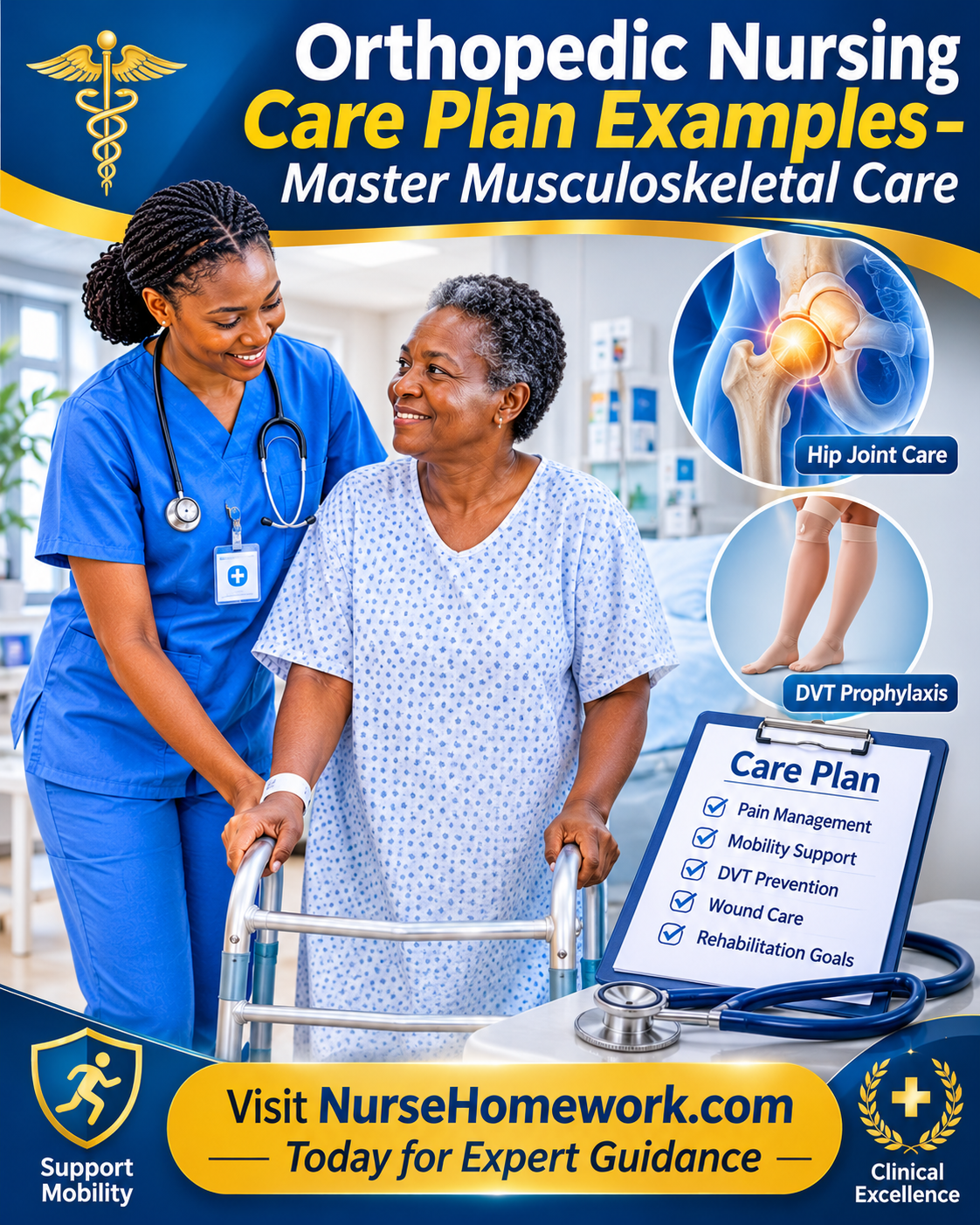
Orthopedic nursing care plan examples are essential tools for nursing students navigating the complexities of musculoskeletal trauma, surgical interventions, and rehabilitation. At NurseHomework.com, we understand that mastering orthopedic nursing care plan examples is critical for delivering safe, effective care to patients recovering from joint replacements, fractures, and spinal surgeries. This comprehensive guide provides orthopedic nursing care plan examples across the most common clinical scenarios, detailing NANDA-I diagnoses, SMART goals, evidence-based interventions, and evaluation criteria.
Why Orthopedic Care Plans Are Unique
Before diving into specific orthopedic nursing care plan examples, it is essential to understand why this specialty requires a distinct approach. Orthopedic nursing focuses heavily on the preservation and restoration of mobility, the management of acute and chronic pain, and the prevention of severe complications such as deep vein thrombosis (DVT) and fat embolism syndrome.
The second challenge is the strict adherence to weight-bearing protocols and movement restrictions. A patient recovering from a total hip replacement has very different mobility constraints than a patient recovering from a tibial fracture. Excellent orthopedic nursing care plan examples must reflect these specific surgical precautions, ensuring that nursing interventions do not inadvertently cause harm.
The third challenge is neurovascular assessment. The “5 Ps” (Pain, Pallor, Pulselessness, Paresthesia, Paralysis) are the cornerstone of orthopedic monitoring. When reviewing orthopedic nursing care plan examples, you will notice that neurovascular checks are consistently prioritized to catch compartment syndrome or impaired perfusion early.
Example 1: Total Hip Replacement (THR)
A total hip replacement is a common surgical procedure for severe osteoarthritis. The primary nursing focus is preventing dislocation, managing pain, and promoting early mobility while adhering to strict hip precautions.
Nursing Diagnosis
Impaired Physical Mobility related to surgical intervention, pain, and prescribed movement restrictions (hip precautions) as evidenced by limited ability to ambulate and difficulty performing activities of daily living.
SMART Goal
The patient will demonstrate safe transfer techniques and ambulate 50 feet with a walker by postoperative day two, while maintaining hip precautions.
Nursing Interventions
Enforce Hip Precautions: Educate the patient to avoid bending the hip past 90 degrees, crossing the legs, or turning the affected leg inward. Provide an abduction pillow if ordered.
Pain Management: Administer prescribed analgesics 30 to 45 minutes before physical therapy to facilitate participation.
Early Ambulation: Assist the patient out of bed to a chair on postoperative day zero or one, as ordered, and assist with ambulation using a walker.
Assistive Devices: Ensure the call light, water, and personal items are within reach to prevent unassisted reaching or twisting.
Evaluation
The patient ambulated 50 feet with a walker on postoperative day two without signs of dislocation or increased pain. (For more practical orthopedic nursing care plan examples, continue reading below).
Example 2: Total Knee Replacement (TKR)
Following a total knee replacement, the primary focus is on maximizing range of motion (ROM), managing significant postoperative swelling, and preventing DVT.
Nursing Diagnosis
Acute Pain related to surgical incision, soft tissue trauma, and joint manipulation as evidenced by patient reporting pain 8/10 on a 0-10 scale and guarding the affected knee.
SMART Goal
The patient will report pain at a level of 3/10 or less within one hour of receiving prescribed analgesia and will demonstrate an active knee flexion of at least 90 degrees by discharge.
Nursing Interventions
Continuous Passive Motion (CPM): If ordered, set up and manage the CPM machine, ensuring proper alignment and monitoring patient tolerance.
Cryotherapy: Apply ice packs or a cooling device to the knee as ordered to reduce swelling and provide localized pain relief.
Neurovascular Checks: Perform the 5 Ps assessment every 2 to 4 hours to ensure adequate circulation and nerve function.
DVT Prophylaxis: Ensure sequential compression devices (SCDs) are worn when in bed and administer prescribed anticoagulants.
Evaluation
The patient reported pain at 2/10 after analgesic administration and achieved 95 degrees of active knee flexion prior to discharge. This is one of the most frequently tested orthopedic nursing care plan examples on nursing exams.
Example 3: Post-Operative Hip Fracture (Open Reduction Internal Fixation)
Hip fractures in older adults carry high morbidity and mortality rates. The care plan must address fall risk, skin integrity, and postoperative complications.
Nursing Diagnosis
Risk for Falls related to altered mobility, postoperative pain, and the use of assistive devices.
SMART Goal
The patient will remain free from falls throughout the hospital stay by consistently calling for assistance before getting out of bed.
Nursing Interventions
Environmental Safety: Keep the bed in the lowest position, ensure the call light is functional, and maintain clear pathways to the bathroom.
Patient Education: Teach the patient not to attempt to get out of bed without assistance, especially if they have received sedating pain medications.
Hourly Rounding: Proactively address the patient’s needs (toileting, pain, positioning) every hour to reduce the impulse to get up unassisted.
Fall Risk Identification: Place a fall risk armband and signage on the door per facility protocol.
Evaluation
The patient remained free from falls during the hospitalization and successfully used the call light for all mobility needs. Reviewing these orthopedic nursing care plan examples highlights the critical role of proactive safety measures in elder care.
Example 4: Lumbar Spinal Fusion
Spinal surgery requires meticulous attention to log-rolling, nerve function, and pain management.
Nursing Diagnosis
Risk for Peripheral Neurovascular Dysfunction related to surgical intervention and potential nerve compression from edema.
SMART Goal
The patient will maintain baseline neurological function, including sensation and motor strength in the lower extremities, throughout the shift.
Nursing Interventions
Neurological Assessment: Assess lower extremity motor strength (dorsiflexion, plantar flexion) and sensation (light touch) every 2 to 4 hours.
Log-Rolling: Maintain strict spinal alignment by log-rolling the patient when turning in bed, using pillows between the knees for support.
Pain Management: Administer muscle relaxants and analgesics as prescribed, recognizing that muscle spasms are common post-spinal surgery.
Bowel Regimen: Monitor bowel sounds and administer stool softeners or laxatives as ordered, as anesthesia and opioids frequently cause constipation.
Evaluation
The patient demonstrated 5/5 bilateral lower extremity strength and intact sensation throughout the shift, with no signs of nerve compression. When seeking orthopedic nursing care plan examples for complex spine surgeries, ensuring accurate neurological checks is paramount.
Core NANDA-I Diagnoses in Orthopedics
To build your own orthopedic nursing care plan examples, it is important to understand the most common NANDA-I diagnoses used in this specialty.
Acute Pain: Related to tissue trauma, surgical incisions, or muscle spasms.
Impaired Physical Mobility: Related to pain, skeletal traction, or prescribed movement restrictions.
Risk for Peripheral Neurovascular Dysfunction: Related to fracture, orthopedic surgery, or compartment syndrome.
Risk for Falls: Related to altered gait, use of assistive devices, or postoperative weakness.
Risk for Ineffective Peripheral Tissue Perfusion: Related to immobility, venous stasis, or DVT.
Impaired Skin Integrity: Related to pressure from casts, traction, or immobility.
Preventing Severe Complications: The 5 Ps and Fat Embolism
Strong orthopedic nursing care plan examples always prioritize the prevention of life-threatening complications.
The 5 Ps of Neurovascular Assessment
When developing your care plans, always include neurovascular checks. The 5 Ps include:
Pain: Out of proportion to the injury (a hallmark of compartment syndrome).
Pallor: Pale or dusky skin color.
Pulselessness: Decreased or absent pulses.
Paresthesia: Numbness or tingling.
Paralysis: Inability to move the extremity.
Fat Embolism Syndrome (FES)
FES often occurs 24 to 72 hours after long bone fractures (like a femur fracture). It is caused by fat globules entering the bloodstream and lodging in the lungs or brain. The classic triad is hypoxemia, neurological abnormalities, and a petechial rash (usually on the chest, axillae, or neck). Excellent orthopedic nursing care plan examples will include monitoring for these specific cues.
Deep Vein Thrombosis (DVT)
Immobility is a major risk factor for DVT. Care plans should include SCDs, early ambulation, and pharmacological prophylaxis (like heparin or enoxaparin). Never massage a suspected clot, as it can break loose and cause a pulmonary embolism.
Structuring Your Orthopedic Care Plan Assignments
When writing your assignments, you can use the following structure to ensure high marks:
Patient Profile: Briefly describe the patient, their surgical procedure, and their baseline status.
Assessment Data: Include objective data (vital signs, incision appearance, neurovascular findings) and subjective data (pain level, feelings of anxiety).
Nursing Diagnoses: List 2-3 prioritized NANDA-I diagnoses. Focus on physiological needs (airway, breathing, circulation, pain) before psychosocial needs.
SMART Goals: Ensure every goal is Specific, Measurable, Achievable, Realistic, and Time-bound.
Interventions & Rationale: List your nursing actions and explain why you are doing them. (e.g., “Administer enoxaparin as ordered to prevent DVT formation”).
Evaluation: State whether the goal was met, partially met, or not met, and what adjustments need to be made.
How NurseHomework.com Supports Your Success
At NurseHomework.com, we know that constructing flawless care plans takes significant time and clinical reasoning. Our team of nursing educators is ready to help you master orthopedic nursing care plan examples and improve your academic performance.
Our services include:
One-on-one tutoring on how to formulate accurate NANDA-I diagnoses for orthopedic patients.
Reviewing your care plans to ensure your interventions are evidence-based and correctly prioritized.
Assistance with understanding the nuances of neurovascular assessments and surgical precautions.
Help with medication calculations for pain management and DVT prophylaxis.
Guidance on APA 7th edition formatting and citation to ensure your references are academically sound.
We also provide orthopedic nursing care plan examples support for NCLEX preparation. The NCLEX consistently tests your ability to prioritize care, interpret neurovascular findings, and recognize complications like fat embolism or compartment syndrome. Our resources help you build the clinical judgment necessary to pass your boards. Whether you are working on a specific assignment or need ongoing orthopedic nursing care plan examples tutoring, we are here to help you succeed.
Frequently Asked Questions About Orthopedic Nursing Care Plan Examples
What is an orthopedic nursing care plan?
It is a structured document that outlines the nursing diagnoses, goals, and interventions for a patient with a musculoskeletal condition, such as a fracture or joint replacement.
What are the most common nursing diagnoses in orthopedics?
Acute pain, impaired physical mobility, risk for falls, and risk for peripheral neurovascular dysfunction.
Why are neurovascular checks important in orthopedics?
Neurovascular checks using the 5 Ps are critical to detect early signs of compartment syndrome or impaired blood flow to an extremity, which are surgical emergencies.
Can NurseHomework.com help me with orthopedic nursing care plan examples?
Absolutely. NurseHomework.com provides expert tutoring, assignment review, and guidance on all aspects of orthopedic nursing care planning.
What is the classic triad of fat embolism syndrome?
The classic triad is hypoxemia (low oxygen), neurological abnormalities (confusion), and a petechial rash.
How do I manage pain for a patient after a total knee replacement?
Pain management should be multimodal, including scheduled analgesics (opioids and NSAIDs), cold therapy, elevation, and administering pain medication prior to physical therapy.
What are standard hip precautions after a total hip replacement?
Avoid bending the hip past 90 degrees, avoid crossing the legs, and avoid turning the affected leg inward (internal rotation).
What is compartment syndrome?
It is a painful condition resulting from pressure buildup within a closed muscle compartment, often due to bleeding or swelling after a fracture. It requires immediate surgical intervention (fasciotomy).
Can I use first person in an orthopedic care plan?
No, care plans are formal documents written in the third person (e.g., “The patient will…”, not “I will…”).
How do I cite my sources in APA 7?
Use standard APA 7th edition formatting for your textbooks and clinical guidelines, ensuring all in-text citations match your reference list.
Crafting exceptional care plans for orthopedic patients requires a deep appreciation for the delicate balance between promoting mobility and protecting fragile surgical sites. By utilizing the 5 Ps for neurovascular assessment, anticipating complications like fat embolisms, and strictly adhering to weight-bearing and movement protocols, you can develop nursing interventions that are both safe and highly effective. Every care plan you write is a chance to refine your clinical reasoning and prepare for the complex realities of orthopedic nursing.
At NurseHomework.com, we are dedicated to providing you with the best orthopedic nursing care plan examples and academic support to help you succeed. Our expert guidance ensures that you master the nuances of musculoskeletal care and deliver interventions that truly improve patient outcomes. Don’t let the complexities of orthopedic care planning hold you back; visit NurseHomework.com today and let our experts help you elevate your nursing practice.
Needs help with Nursing Assignment?
We are available 24x7 to deliver the best services and assignment ready within 3-4 hours? Order a custom-written, plagiarism-free paper
 Get Answer Over WhatsApp
 Order Paper Now
