Nursing Pharmacology Study Guide: Your Complete Roadmap to Medication Mastery
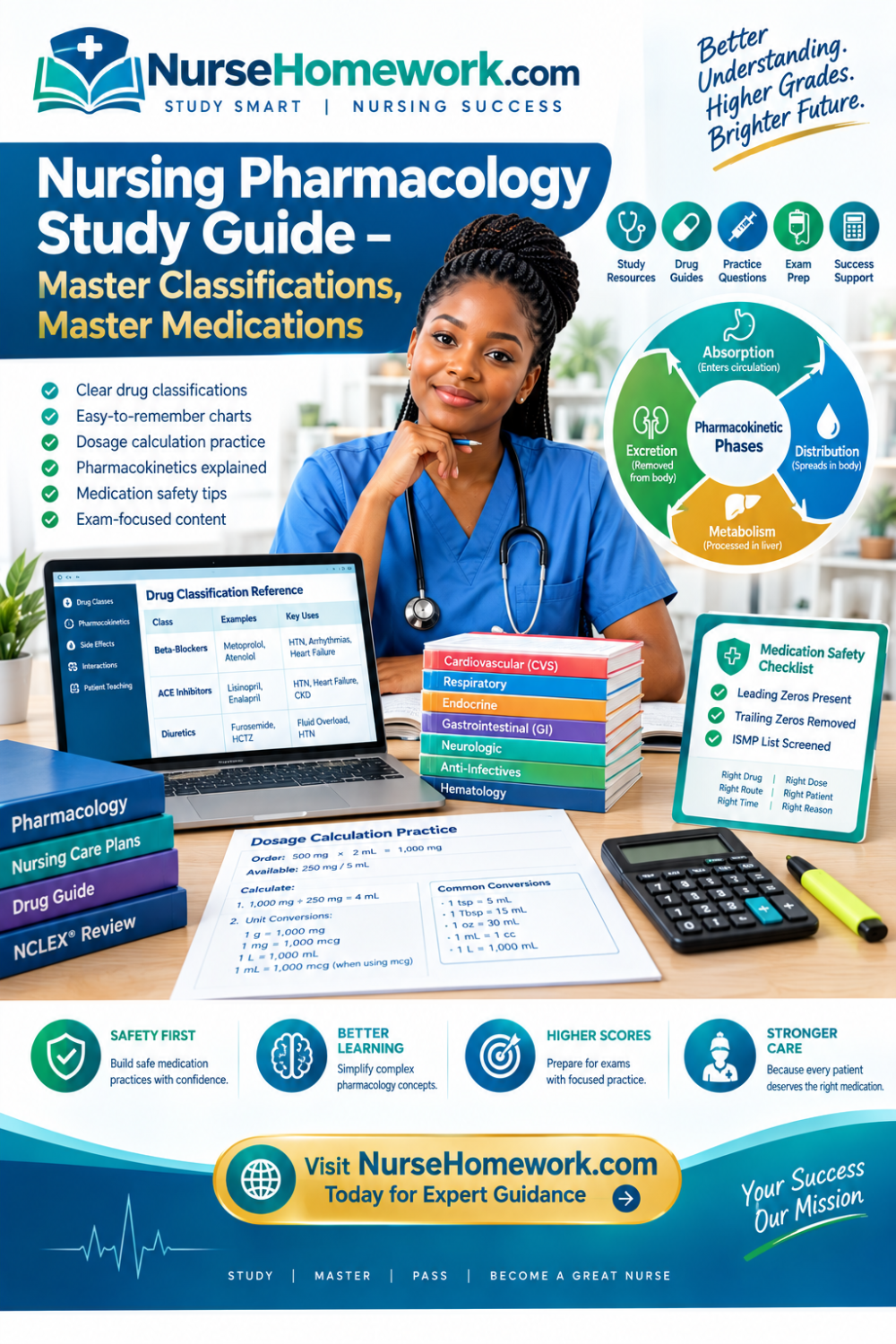
Nursing pharmacology study guide resources are among the most valuable tools a nursing student can possess, because pharmacology consistently ranks as one of the most challenging and highest-stakes subjects in nursing education. At NurseHomework.com, we understand that medication knowledge directly affects patient safety, and that a structured nursing pharmacology study guide converts overwhelming content into manageable, retrievable knowledge. This comprehensive guide provides nursing pharmacology study guide strategies across drug classifications, pharmacokinetics, dosage calculations, safety conventions, and examination preparation.
Why Pharmacology Overwhelms Nursing Students
Before applying any nursing pharmacology study guide, it is essential to understand why pharmacology produces so much anxiety. The volume is genuinely enormous. Thousands of drugs exist, and even the most commonly tested agents number in the hundreds. Traditional study methods, such as rereading drug tables and highlighting textbook pages, produce familiarity without retrieval ability.
The second problem is structure. Textbooks organize drugs alphabetically or by therapeutic category, but examination questions present clinical scenarios requiring reasoning about mechanism, adverse effects, and nursing considerations simultaneously. A good nursing pharmacology study guide reorganizes content around reasoning patterns rather than alphabetical order.
The third problem is application. Pharmacology questions rarely ask what a drug is. They ask which client should be assessed first, which finding requires immediate action, or which medication should be withheld. These are judgment questions, and judgment requires understanding rather than memorization. This is precisely why a well-constructed nursing pharmacology study guide emphasizes mechanism-level comprehension above rote recall.
Start With Core Pharmacokinetic Principles
Absorption, Distribution, Metabolism, Excretion
Every drug follows the same journey through the body, and understanding that journey explains most clinical considerations. Absorption determines onset. Distribution determines where the drug acts. Metabolism, primarily hepatic, determines duration and interaction potential. Excretion, primarily renal, determines elimination and accumulation risk.
A nursing pharmacology study guide that teaches these principles first allows reasoning about unfamiliar drugs rather than memorization of individual facts.
First-Pass Effect
Orally administered drugs pass through the liver before reaching systemic circulation, reducing bioavailability. This explains why some drugs require higher oral doses than intravenous equivalents, and why some cannot be given orally at all.
Half-Life and Steady State
Half-life determines dosing intervals. Steady state is reached after approximately four to five half-lives, which explains why some drugs require loading doses and why therapeutic effects may take days to appear.
Therapeutic Index
Drugs with narrow therapeutic indices, such as digoxin, lithium, warfarin, and phenytoin, require close monitoring because the gap between therapeutic and toxic levels is small. These drugs appear disproportionately on nursing examinations.
Protein Binding and Drug Interactions
Highly protein-bound drugs compete for binding sites, which can increase free drug concentration and toxicity when combined with other highly bound agents.
Master Drug Classifications Rather Than Individual Drugs
This is the single most important principle in any effective nursing pharmacology study guide. Learning classifications and their mechanisms allows reasoning about drugs you have never seen.
Cardiovascular Agents
Beta-blockers: Reduce heart rate and contractility. Monitor for bradycardia, hypotension, and bronchospasm. Do not abruptly discontinue.
ACE inhibitors: Reduce blood pressure by blocking angiotensin conversion. Monitor for dry cough, hyperkalemia, and angioedema.
Angiotensin receptor blockers: Similar effects with fewer cough side effects.
Calcium channel blockers: Reduce contractility and cause vasodilation. Monitor for hypotension and constipation.
Diuretics: Promote fluid excretion. Loop diuretics deplete potassium and are ototoxic. Potassium-sparing diuretics retain potassium.
Digoxin: Increases contractility and reduces rate. Monitor for toxicity, especially with hypokalemia.
Anticoagulants: Prevent clot formation. Monitor for bleeding and relevant laboratory values.
Antimicrobial Agents
Penicillins and cephalosporins: Cell wall inhibitors. Assess for allergy and cross-reactivity.
Aminoglycosides: Protein synthesis inhibitors with nephrotoxicity and ototoxicity requiring peak and trough monitoring.
Fluoroquinolones: Inhibit DNA gyrase. Avoid in children and pregnant clients, and monitor for tendon rupture.
Macrolides: Protein synthesis inhibitors frequently used for respiratory infections.
Vancomycin: Requires infusion over at least sixty minutes and trough monitoring to prevent infusion reaction.
Central Nervous System Agents
Benzodiazepines: Enhance GABA activity. Monitor for sedation and respiratory depression.
Antidepressants: Increase neurotransmitter availability. SSRIs require several weeks for full effect.
Antipsychotics: Block dopamine receptors. Monitor for extrapyramidal symptoms and metabolic effects.
Anticonvulsants: Stabilize neuronal membranes. Monitor serum levels and adherence.
Opioid analgesics: Bind opioid receptors. Monitor for respiratory depression and constipation, and have naloxone available.
Endocrine Agents
Insulins: Categorized by onset, peak, and duration. Know which types can be mixed and which cannot.
Oral hypoglycemics: Metformin requires renal monitoring and carries lactic acidosis risk. Sulfonylureas carry hypoglycemia risk.
Corticosteroids: Monitor for hyperglycemia, immunosuppression, and adrenal suppression with abrupt discontinuation.
Thyroid agents: Require careful titration and monitoring for signs of excess or deficiency.
A comprehensive nursing pharmacology study guide groups drugs this way, so that each classification becomes a reasoning template rather than a list.
Build a Structured Drug Card System
Essential Elements of a Drug Card
Each card in a functional nursing pharmacology study guide should include generic name, classification, mechanism of action, indications, major adverse effects, contraindications, nursing considerations, and client teaching points.
Keep Cards Concise
Cards that reproduce entire textbook sections are never reviewed. Cards should contain only the highest-yield information.
Organize by Classification
Grouping cards by classification rather than alphabetically allows side-by-side comparison and reinforces the reasoning patterns that examinations test.
Review Using Spaced Repetition
Review cards at expanding intervals such as day one, day three, day seven, and day twenty-one. This spaced approach produces durable retention far more reliably than massed review before an examination.
Use Active Recall
Cover the answer and attempt retrieval before checking. Unsuccessful retrieval attempts strengthen memory more than successful rereading.
Dosage Calculation Mastery
Calculation accuracy is a safety competency and appears on nearly every pharmacology assessment.
Choose One Method and Apply It Consistently
Dimensional analysis, ratio and proportion, and the formula method all produce correct answers. Mastery comes from consistency rather than from knowing multiple approaches.
Write Units at Every Step
Most calculation errors involve unit conversion rather than arithmetic. Writing units at each step exposes conversion errors before they reach the answer.
Apply Safe Formatting Conventions
Always use a leading zero, as in 0.5 mg. Never use a trailing zero, as in 5.0 mg. Avoid the letter U for units. These conventions reflect safe medication practice and are frequently assessed.
Practice Common Calculation Types
Oral solid and liquid dosage
Parenteral dosage
Intravenous flow rate in mL per hour
Drop factor in drops per minute
Weight-based dosing
Pediatric dosing
Titrated infusions
Verify Plausibility
Before submitting, confirm the answer is reasonable in magnitude. This single habit catches most arithmetic slips.
Safety Conventions Every Student Must Know
The Rights of Medication Administration
The traditional five rights have expanded in modern practice:
Right client
Right drug
Right dose
Right route
Right time
Right documentation
Right reason
Right response
Right to refuse
High-Alert Medications
Insulin, heparin, opioids, neuromuscular blockers, chemotherapy agents, and concentrated electrolytes require independent double checks and heightened vigilance.
ISMP Do-Not-Use Abbreviations
Avoid U for units, IU for international units, q.d. for daily, q.o.d. for every other day, MS for morphine sulfate, MSO4 and MgSO4, trailing zeros, and missing leading zeros. These conventions exist because these abbreviations have contributed to actual medication errors.
Laboratory Monitoring
Know which drugs require which monitoring. Aminoglycosides require peak and trough levels. Digoxin requires serum level and potassium monitoring. Warfarin requires INR. Heparin requires aPTT or anti-Xa. Vancomycin requires trough levels.
Pharmacological Considerations Across Populations
Pediatric Clients
Children require weight-based dosing, have immature hepatic and renal function, and are more vulnerable to fluid and electrolyte disturbances. A complete nursing pharmacology study guide addresses these differences explicitly.
Older Adults
Older adults experience decreased renal clearance, altered body composition, polypharmacy, and increased sensitivity to many drug classes. The Beers Criteria identify potentially inappropriate medications for this population.
Pregnancy and Lactation
Pregnancy categories have been replaced by the Pregnancy and Lactation Labeling Rule, but the principle remains that many drugs cross the placenta and enter breast milk, requiring careful risk-benefit assessment.
Clients With Hepatic or Renal Impairment
Impaired metabolism and excretion require dose adjustment and extended monitoring intervals. Recognizing this is essential for safe practice.
Applying the Nursing Process to Pharmacology
Assessment
Collect allergies, current medications, laboratory values, vital signs, and relevant history before administration.
Diagnosis
Identify NANDA-I diagnoses relevant to medication therapy, such as risk for injury related to adverse effects, or deficient knowledge related to medication regimen.
Planning
Establish SMART goals such as the client demonstrating correct administration technique before discharge.
Implementation
Administer safely using the rights of medication administration, provide client teaching, and document appropriately.
Evaluation
Assess therapeutic response and monitor for adverse effects. Revise the plan when outcomes are not met.
Examination Preparation Strategies
Practice Application Questions
Pharmacology examinations test application. Practice items that require reasoning about which client should be assessed first, which medication should be withheld, or which finding indicates toxicity.
Analyze Every Rationale
Review rationales for items answered correctly as well as incorrectly. Most learning occurs in the rationale rather than the answer selection. This is among the most emphasized recommendations in any nursing pharmacology study guide.
Maintain an Error Log
Record recurring mistakes and review the log before each examination. Most students have a stable set of recurring errors accounting for a disproportionate share of lost points.
Prioritize High-Yield Content
Focus disproportionate attention on high-alert medications, narrow therapeutic index drugs, and classifications with predictable adverse effects.
Practice Under Timed Conditions
Untimed practice develops knowledge but not examination performance. Timed practice develops pacing and decision-making under pressure.
Common Pharmacology Study Mistakes
Memorizing drugs individually. Classification-level understanding allows reasoning about unfamiliar drugs.
Relying on rereading. Passive review produces familiarity without retrieval ability.
Skipping rationales. Most learning occurs in the rationale, not the answer.
Neglecting dosage calculation practice. Calculation accuracy is a safety competency requiring repeated practice.
Ignoring safety conventions. Leading zeros, trailing zeros, and dangerous abbreviations are frequently assessed and directly affect patient safety.
Cramming before examinations. Massed review produces rapid forgetting and increases anxiety.
Studying high-yield content only after failing. Proactive emphasis on high-alert medications prevents predictable point loss.
How NurseHomework.com Supports Pharmacology Mastery
At NurseHomework.com, we provide comprehensive nursing pharmacology study guide support tailored to the demands of pharmacology coursework and licensure examinations. Our services include:
Drug card development organized by classification and mechanism
Pharmacokinetic and pharmacodynamic concept instruction
Dosage calculation method tutoring and safe formatting review
High-alert medication and narrow therapeutic index drug review
Laboratory monitoring requirements for specific drug classes
Client teaching point development
Rationale analysis for practice questions
Error log development to eliminate recurring mistakes
Population-specific considerations for pediatric, older adult, and pregnant clients
Examination preparation strategies for pharmacology assessments
Whether you are preparing for a pharmacology unit examination, a dosage calculation assessment, or the NCLEX, NurseHomework.com provides nursing pharmacology study guide support calibrated to your specific performance profile.
Frequently Asked Questions About Nursing Pharmacology Study Guides
What should a nursing pharmacology study guide include?
Drug classifications with mechanisms of action, indications, major adverse effects, contraindications, nursing considerations, client teaching points, dosage calculation methods, safety conventions, and laboratory monitoring requirements.
Is it better to memorize individual drugs or classifications?
Classifications. Understanding mechanisms allows reasoning about unfamiliar drugs, which is what examination questions require.
What are the most commonly tested drug classes?
Beta-blockers, ACE inhibitors, diuretics, digoxin, anticoagulants, antibiotics, opioids, benzodiazepines, antipsychotics, insulins, oral hypoglycemics, and corticosteroids.
How should dosages be formatted safely?
Always use a leading zero such as 0.5 mg, never use a trailing zero such as 5.0 mg, use standard unit abbreviations such as mg and mL, and never use the letter U for units.
What are the rights of medication administration?
The traditional five are right client, drug, dose, route, and time. Expanded rights include documentation, reason, response, and the right to refuse.
Which drugs are considered high alert?
Insulin, heparin, opioids, neuromuscular blockers, chemotherapy agents, and concentrated electrolytes require independent double checks.
How do I prepare for pharmacology examinations?
Practice application questions, analyze every rationale, maintain an error log, prioritize high-alert medications, and practice under timed conditions.
Can NurseHomework.com help with a nursing pharmacology study guide?
Yes. NurseHomework.com offers personalized nursing pharmacology study guide support including drug card development, calculation tutoring, and rationale analysis.
What laboratory monitoring is required for common drugs?
Aminoglycosides require peak and trough levels, digoxin requires serum level and potassium, warfarin requires INR, heparin requires aPTT or anti-Xa, and vancomycin requires trough levels.
How long should I study pharmacology each day?
Two to three focused hours daily using active recall and spaced repetition consistently outperforms marathon sessions, because retrieval quality declines sharply with fatigue.
A well-structured nursing pharmacology study guide transforms the most intimidating subject in nursing education into a manageable system. By starting with pharmacokinetic principles, mastering classifications rather than individual drugs, building concise drug cards, practicing dosage calculations until the method is automatic, internalizing safety conventions, applying the nursing process, and preparing through timed application questions with thorough rationale review, you develop the medication knowledge that patient safety depends on.
At NurseHomework.com, we are committed to helping you master pharmacology. Our classification-based instruction, calculation tutoring, and rationale analysis make nursing pharmacology study guide support practical, targeted, and effective. Don’t let pharmacology volume overwhelm your preparation. Visit NurseHomework.com today and discover how we can help you master nursing pharmacology study guide content and excel in your nursing program.
- Nursing pharmacology study guide
- Nursing pharmacology study guide
- Nursing pharmacology study guide
- Nursing pharmacology study guide
Needs help with Nursing Assignment?
We are available 24x7 to deliver the best services and assignment ready within 3-4 hours? Order a custom-written, plagiarism-free paper
 Get Answer Over WhatsApp
 Order Paper Now
