Critical Care Nursing Assignment Help
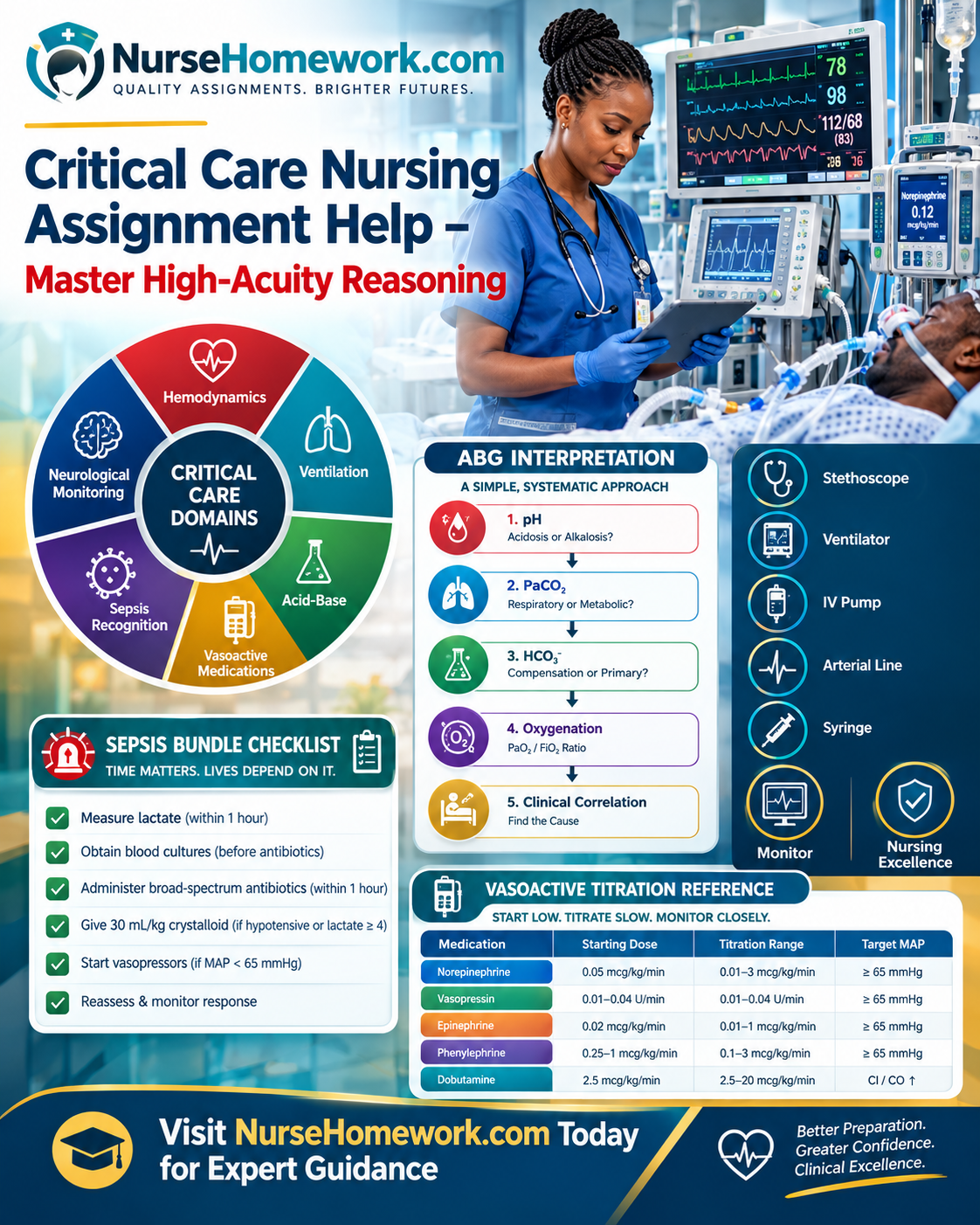
Critical care nursing assignment help is one of the most valuable resources an upper-level nursing student can access, because critical care content combines complex physiology, high-alert medications, and rapid clinical decision-making in ways that general medical-surgical coursework does not. At NurseHomework.com, we understand that critical care nursing assignment help must address both content mastery and clinical judgment simultaneously, since ICU examinations and assignments consistently test application rather than recall. This comprehensive critical care nursing assignment help guide covers hemodynamic monitoring, mechanical ventilation, vasoactive medications, sepsis recognition, and ICU-specific reasoning frameworks.
Why Critical Care Coursework Overwhelms Nursing Students
Before going further into critical care nursing assignment help, it is essential to understand why this content area produces such consistent difficulty. The volume is substantial, covering every body system at the level of acute failure rather than chronic management. Hemodynamics, ventilator mechanics, acid-base interpretation, vasoactive titration, sedation management, and organ support all appear within a single course.
The second challenge is precision. Critical care tolerates less margin for error than any other nursing specialty. A miscalculated vasoactive drip, a misinterpreted arterial blood gas, or a delayed recognition of deterioration produces immediate consequences. Assignments reflect this reality by testing exact values, specific titration parameters, and precise assessment findings.
The third challenge is integration. A patient in septic shock with acute respiratory distress syndrome on mechanical ventilation receiving multiple vasoactive infusions requires reasoning across cardiovascular, respiratory, renal, and pharmacological domains simultaneously. Understanding critical care nursing assignment help means learning to reason across systems rather than studying them in isolation.
Hemodynamic Monitoring Foundations
Hemodynamic monitoring is a core content area in any critical care nursing assignment help resource because it underlies nearly every ICU assessment.
Invasive Pressure Monitoring
Arterial lines provide continuous blood pressure measurement and access for blood sampling. Key considerations include zeroing and leveling the transducer at the phlebostatic axis, recognizing waveform damping, and interpreting the arterial waveform components.
Central venous pressure monitoring reflects right ventricular preload and volume status. Normal CVP ranges between 2 and 8 mmHg, though trends matter more than single values.
Pulmonary artery catheters, though less common than in previous decades, provide direct measurement of cardiac output, pulmonary artery pressures, and mixed venous oxygen saturation. Understanding these measurements remains part of critical care nursing assignment help content.
Cardiac Output and Index
Cardiac output is calculated as heart rate multiplied by stroke volume. Cardiac index adjusts cardiac output for body surface area and is normally 2.5 to 4.0 liters per minute per square meter.
Low cardiac index with elevated systemic vascular resistance suggests cardiogenic shock. Low cardiac index with low systemic vascular resistance suggests distributive shock such as sepsis.
Mixed Venous Oxygen Saturation
Mixed venous oxygen saturation reflects the balance between oxygen delivery and oxygen consumption. Normal values range from 60 to 75 percent. Values below 60 percent suggest inadequate oxygen delivery, increased consumption, or both.
Mechanical Ventilation Content
Mechanical ventilation appears extensively in critical care nursing assignment help coursework.
Ventilation Modes
Volume-controlled ventilation delivers a set tidal volume regardless of pressure. Pressure-controlled ventilation delivers a set pressure regardless of volume. Both modes may allow spontaneous breathing through assist-control, synchronized intermittent mandatory ventilation, or pressure support.
Understanding the difference matters because mode selection affects patient comfort, ventilator-associated lung injury risk, and weaning readiness.
Key Ventilator Settings
Tidal volume is typically set at 6 to 8 milliliters per kilogram of ideal body weight in lung-protective strategies. Respiratory rate is set based on minute ventilation requirements. Fraction of inspired oxygen is titrated to maintain target oxygenation. Positive end-expiratory pressure maintains alveolar recruitment and improves oxygenation.
Recognizing Deterioration on the Ventilator
High peak pressures suggest airway resistance problems such as bronchospasm, secretions, or tube obstruction. High plateau pressures suggest decreased compliance such as pneumothorax, pulmonary edema, or abdominal distension.
Understanding these patterns is essential for critical care nursing assignment help case studies that present ventilator alarms.
Ventilator-Associated Events
Ventilator-associated pneumonia prevention bundles include elevation of the head of the bed, daily sedation interruption, oral care with chlorhexidine where indicated, peptic ulcer prophylaxis, and deep vein thrombosis prophylaxis.
Arterial Blood Gas Interpretation
ABG interpretation appears in nearly every critical care nursing assignment help assignment, and mastery of a systematic approach resolves every question.
Systematic Interpretation Steps
First, determine whether the pH is acidotic below 7.35 or alkalotic above 7.45. Second, determine whether the partial pressure of carbon dioxide is acidotic above 45 or alkalotic below 35. Third, determine whether the bicarbonate is acidotic below 22 or alkalotic above 26. Fourth, identify which system matches the pH direction. Fifth, assess for compensation by examining whether the non-matching value has moved in the compensatory direction.
Common ICU Acid-Base Scenarios
Metabolic acidosis with respiratory compensation frequently occurs in sepsis and diabetic ketoacidosis. Respiratory acidosis with metabolic compensation occurs in chronic obstructive pulmonary disease. Mixed disorders require examining the expected compensatory response and identifying when compensation is inadequate.
Vasoactive Medications
Vasoactive medication management is a high-risk area that consistently appears in critical care nursing assignment help content.
Vasopressors
Norepinephrine is the first-line vasopressor in septic shock. It increases systemic vascular resistance through alpha-adrenergic stimulation. Monitoring includes mean arterial pressure targets, peripheral perfusion, and extravasation risk.
Vasopressin is frequently added as a second agent. Phenylephrine is used in specific situations such as tachyarrhythmias where increased heart rate is undesirable.
Inotropes
Dobutamine increases cardiac contractility and heart rate. Milrinone increases contractility and causes vasodilation. Both are used in cardiogenic shock and heart failure.
Vasodilators
Nitroglycerin reduces preload through venous dilation. Nitroprusside reduces both preload and afterload. Both require close blood pressure monitoring.
Titration and Monitoring
All vasoactive infusions require central line administration where possible, frequent blood pressure monitoring, and continuous assessment for extravasation. Calculation accuracy is essential, and safe formatting conventions include always using leading zeros, never using trailing zeros, and avoiding dangerous abbreviations.
Sepsis and Septic Shock
Sepsis recognition and management constitute a major content area in any critical care nursing assignment help resource.
Recognition Criteria
Sepsis involves life-threatening organ dysfunction caused by dysregulated response to infection. Screening tools such as qSOFA include altered mental status, respiratory rate above 22, and systolic blood pressure below 100.
Septic Shock
Septic shock involves sepsis with persistent hypotension requiring vasopressors to maintain mean arterial pressure above 65 and lactate above 2 despite adequate fluid resuscitation.
The Sepsis Bundle
The Surviving Sepsis Campaign recommends measuring lactate, obtaining blood cultures before antibiotics, administering broad-spectrum antibiotics, initiating rapid fluid resuscitation, and applying vasopressors for persistent hypotension. Each element has a defined time target.
Nursing Priorities
Critical care nursing priorities in sepsis include early recognition, rapid escalation, fluid resuscitation monitoring, vasopressor titration, source identification, and continuous reassessment. Case studies in critical care nursing assignment help frequently present deteriorating patients requiring these priorities to be sequenced correctly.
Acute Respiratory Distress Syndrome
ARDS appears frequently in critical care coursework.
Pathophysiology
ARDS involves acute inflammation leading to increased alveolar-capillary membrane permeability, protein-rich fluid accumulation in alveoli, and refractory hypoxemia.
Berlin Criteria
Diagnosis requires onset within one week of a known insult, bilateral opacities on imaging, respiratory failure not fully explained by cardiac failure, and oxygenation impairment classified as mild, moderate, or severe based on the ratio of partial pressure of oxygen to fraction of inspired oxygen.
Lung-Protective Ventilation
Low tidal volume ventilation at 6 milliliters per kilogram of ideal body weight, adequate positive end-expiratory pressure, and permissive hypercapnia reduce mortality. Understanding this rationale is central to critical care nursing assignment help ventilator content.
Prone Positioning
Prone positioning improves oxygenation in moderate to severe ARDS by recruiting dorsal lung regions and reducing ventilation-perfusion mismatch.
Neurological Critical Care
Increased Intracranial Pressure
Understanding the Monro-Kellie hypothesis, cerebral perfusion pressure calculation, and the consequences of herniation is essential. Nursing interventions include maintaining head of bed elevation, avoiding hip flexion, preventing hyperthermia, and maintaining adequate cerebral perfusion pressure.
Sedation and Delirium
The Richmond Agitation-Sedation Scale and the Confusion Assessment Method for the ICU are standard assessment tools. Daily sedation interruption and delirium prevention bundles are recommended practices.
Cardiac Critical Care
Acute Coronary Syndromes
Understanding ST-elevation myocardial infarction, non-ST-elevation myocardial infarction, and unstable angina allows reasoning about reperfusion priorities and post-intervention monitoring.
Heart Failure and Cardiogenic Shock
Cardiogenic shock involves inadequate cardiac output despite adequate intravascular volume. Management includes inotropic support, vasopressors, and mechanical circulatory support in refractory cases.
Dysrhythmias
Understanding atrial fibrillation, ventricular tachycardia, ventricular fibrillation, and heart blocks allows reasoning about hemodynamic consequences and intervention priorities.
Common Critical Care Assignment Types
Case Study Analysis
Case studies present deteriorating patients requiring identification of priority problems, sequencing of interventions, and anticipation of complications. Applying the Clinical Judgment Measurement Model allows systematic reasoning.
Hemodynamic Interpretation Assignments
These require interpreting hemodynamic data to determine shock type, volume status, and appropriate interventions.
Ventilator Management Assignments
These require interpreting ventilator settings and alarms, identifying complications, and recommending adjustments.
Medication Calculation Assignments
Critical care calculations include weight-based dosing, vasoactive infusion rates, and titration calculations. Practice until the method is automatic.
Care Plan Development
Critical care care plans address unstable patients with multiple simultaneous problems, requiring prioritization skills.
ABG Interpretation Assignments
These require systematic interpretation and clinical correlation with the patient scenario.
Effective Study Strategies
Build Physiological Foundations
Understanding why hemodynamic values change is more durable than memorizing normal ranges. Connect every value to the underlying physiology.
Master Calculation Methods
Choose one calculation method and apply it consistently until automatic. Verify units at every step, because most errors involve unit conversion rather than arithmetic.
Practice Interpreting Trends
Single values are less informative than trends. Practice identifying deterioration from serial measurements.
Analyze Every Rationale
Review rationales for correct and incorrect answers. Most learning occurs in the rationale, which is a consistent emphasis in critical care nursing assignment help guidance.
Maintain an Error Log
Record recurring mistakes by category and review before examinations. Most students have a stable set of recurring errors accounting for a disproportionate share of lost points.
Practice Under Timed Conditions
Untimed practice develops knowledge but not examination performance. Timed practice develops prioritization under pressure.
How NurseHomework.com Supports Critical Care Assignments
At NurseHomework.com, we provide comprehensive critical care nursing assignment help for nursing students at all levels. Our services include:
Hemodynamic monitoring interpretation including arterial lines, CVP, and cardiac output
Mechanical ventilation mode and setting analysis with alarm interpretation
Arterial blood gas interpretation using systematic approaches
Vasoactive medication calculation, titration, and monitoring review
Sepsis and septic shock recognition aligned with Surviving Sepsis Campaign guidance
ARDS pathophysiology and lung-protective ventilation content
Neurological critical care including intracranial pressure management
Cardiac critical care including acute coronary syndromes and dysrhythmias
Case study analysis using the Clinical Judgment Measurement Model
Dosage calculation verification and safe formatting convention review
APA 7th edition citation and reference verification
Rationale analysis and error log development
Whether you are preparing for a critical care examination, completing a case study, or developing a care plan for an unstable patient, NurseHomework.com is here to support your success.
Frequently Asked Questions About Critical Care Nursing Assignment Help
What is critical care nursing assignment help?
It is academic support for ICU-focused coursework covering hemodynamic monitoring, mechanical ventilation, vasoactive medications, sepsis recognition, and other high-acuity content areas.
What content areas appear most often in critical care assignments?
Hemodynamic monitoring, mechanical ventilation, arterial blood gas interpretation, vasoactive medications, sepsis and septic shock, ARDS, increased intracranial pressure, and cardiac dysrhythmias.
How do I interpret an arterial blood gas?
Determine whether the pH is acidotic or alkalotic, then determine which system matches that direction. Respiratory disorders involve the opposite direction of carbon dioxide, while metabolic disorders involve the same direction as bicarbonate.
What is the first-line vasopressor in septic shock?
Norepinephrine. It increases systemic vascular resistance and is titrated to maintain mean arterial pressure above 65.
What are the key elements of the sepsis bundle?
Measure lactate, obtain blood cultures before antibiotics, administer broad-spectrum antibiotics, initiate rapid fluid resuscitation, and apply vasopressors for persistent hypotension.
Can NurseHomework.com help with critical care nursing assignment help?
Yes. NurseHomework.com offers hemodynamic interpretation, ventilator analysis, ABG interpretation, and medication calculation support for critical care nursing assignment help.
What ventilator pressures indicate deterioration?
High peak pressures suggest airway resistance problems such as bronchospasm or secretions. High plateau pressures suggest decreased compliance such as pneumothorax or pulmonary edema.
What are safe medication formatting conventions?
Always use a leading zero such as 0.5 mg, never use a trailing zero such as 5.0 mg, use standard unit abbreviations, and never use the letter U for units.
How should I study for critical care examinations?
Build physiological foundations, master calculation methods, practice trend interpretation, analyze every rationale, maintain an error log, and practice under timed conditions.
What is the most common mistake in critical care assignments?
Memorizing normal values without understanding the underlying physiology, which prevents reasoning about abnormal findings and appropriate interventions.
Mastering critical care nursing assignment help is ultimately about developing the reasoning that unstable patients demand. By building hemodynamic foundations, understanding ventilator mechanics, interpreting arterial blood gases systematically, managing vasoactive medications safely, recognizing sepsis early, applying lung-protective ventilation principles, and practicing application questions with thorough rationale review, you develop the clinical judgment that intensive care requires.
At NurseHomework.com, we are committed to helping nursing students master high-acuity content. Our hemodynamic interpretation, ventilator analysis, and medication calculation support make critical care nursing assignment help structured, rigorous, and achievable. Don’t let the intensity of critical care content overwhelm your preparation. Visit NurseHomework.com today and discover how we can help you master critical care nursing assignment help and excel in your nursing program.
Needs help with Nursing Assignment?
We are available 24x7 to deliver the best services and assignment ready within 3-4 hours? Order a custom-written, plagiarism-free paper
 Get Answer Over WhatsApp
 Order Paper Now
