Nursing Theory Application Paper Help
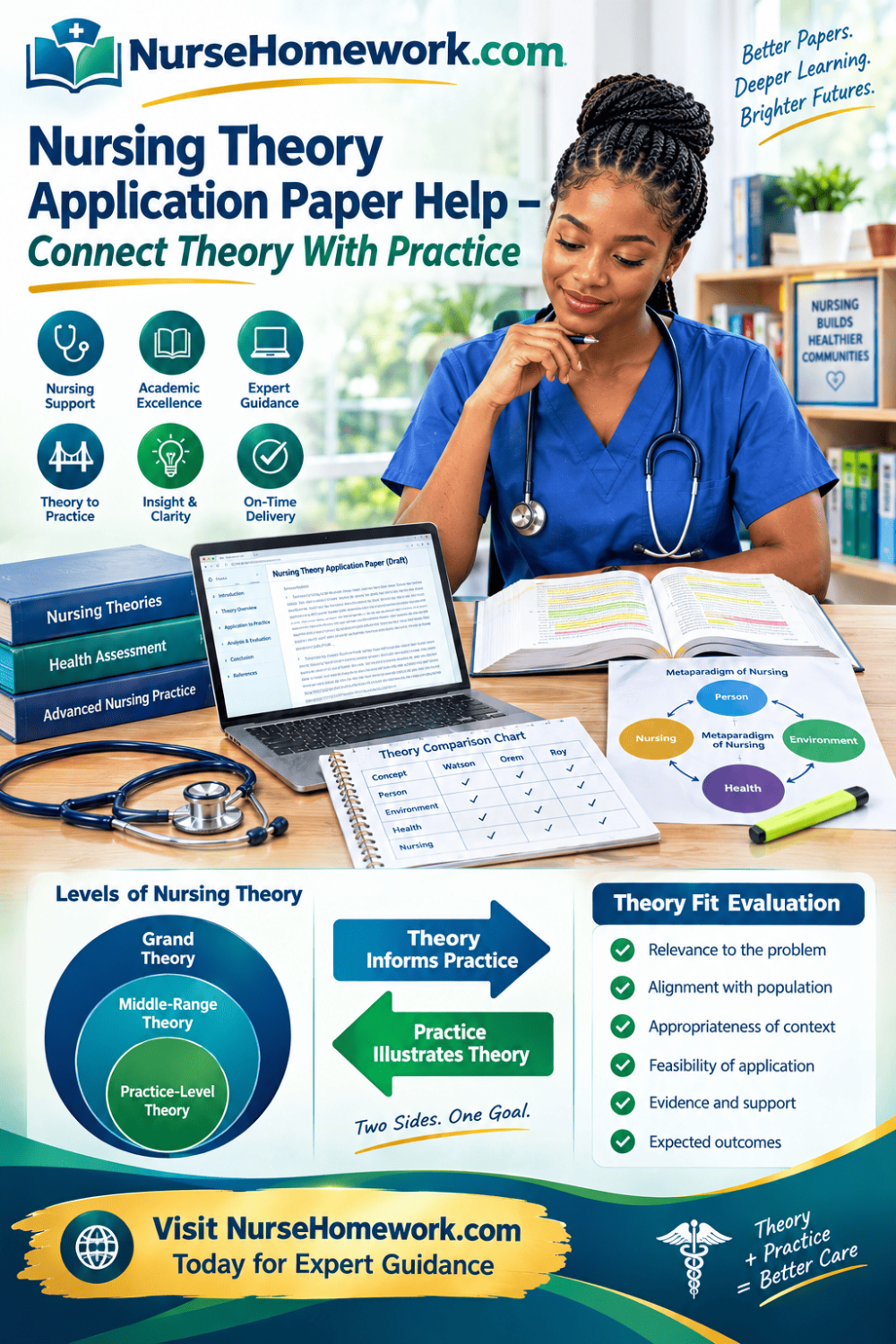
Nursing theory application paper help is one of the most valuable resources a nursing student can access, because theory application papers require you to demonstrate something that examinations cannot measure: the ability to see your own clinical practice through a conceptual lens. At NurseHomework.com, we understand that nursing theory application paper help differs fundamentally from general writing support, since these assignments demand genuine theoretical understanding rather than surface-level summarization. This comprehensive guide provides nursing theory application paper help across theory selection, framework analysis, clinical application, structural organization, and scholarly writing standards.
Why Theory Application Papers Confuse Nursing Students
Before going further into nursing theory application paper help, it is essential to understand why this assignment type produces such consistent difficulty. Nursing theory is frequently taught in a single course early in the program, then referenced only intermittently thereafter. By the time students are asked to apply a theory to a clinical situation, the conceptual foundation has faded.
The second problem is abstraction. Grand theories such as those developed by Watson, Orem, or Roy describe nursing at a philosophical level. Students struggle to move from statements about human caring or self-care deficits to specific interventions for a specific patient on a specific unit.
The third problem is application rather than description. A paper that summarizes a theory earns limited credit. A paper that uses the theory to interpret a clinical situation, justify interventions, and evaluate outcomes earns substantial credit. Understanding nursing theory application paper help means learning to make that transition deliberately rather than hoping it happens during drafting.
Understanding the Levels of Nursing Theory
Theory selection begins with understanding the levels of theoretical work, because mismatched levels produce incoherent papers.
Grand Nursing Theories
Grand theories are broad, abstract conceptual frameworks that define nursing’s domain. Examples include Watson’s Theory of Human Caring, Orem’s Self-Care Deficit Theory, Roy’s Adaptation Model, Neuman’s Systems Model, Parse’s Human Becoming Theory, and Leininger’s Culture Care Theory.
Grand theories suit papers examining the philosophical foundation of nursing practice, the nature of the nurse-patient relationship, or the overarching purpose of nursing care. They do not easily generate specific interventions without additional operationalization.
Middle-Range Theories
Middle-range theories are narrower and more directly testable. Examples include Pender’s Health Promotion Model, the Theory of Unpleasant Symptoms, the Theory of Comfort, and Kolcaba’s Comfort Theory.
Middle-range theories suit papers connecting theory to specific clinical phenomena such as symptom management, health behavior, or comfort. They are frequently the most appropriate choice for nursing theory application paper help because they bridge abstraction and intervention.
Practice-Level Theories
Practice-level theories address specific situations, populations, or interventions. Examples include the Synergy Model for patient care and specific clinical reasoning frameworks.
Practice-level theories suit papers focused on a defined clinical problem, unit-level practice change, or care delivery model.
Borrowed Theories
Nursing also draws on theories from psychology, sociology, and organizational science. Examples include Erikson’s developmental stages, Maslow’s hierarchy, Lewin’s change theory, Bandura’s self-efficacy theory, and the Health Belief Model.
Borrowed theories suit papers examining patient behavior, motivation, or organizational change, provided the paper explains why the borrowed theory is appropriate for nursing.
Choosing the Right Theory
Theory selection is the single most consequential decision in a theory application paper, and it is where nursing theory application paper help delivers the greatest value.
Match Theory to the Clinical Phenomenon
The theory must illuminate the specific phenomenon you are examining. A paper about medication adherence aligns naturally with the Health Belief Model or self-efficacy theory. A paper about end-of-life care aligns with Watson’s caring theory or Comfort Theory. A paper about patient self-management aligns with Orem’s theory.
Selecting a famous theorist without verifying alignment produces a paper that contradicts itself, which is the most common structural weakness in student work.
Confirm the Theory Is Operationalizable
Ask whether the theory generates specific, observable interventions. A theory that cannot produce concrete nursing actions cannot support an application paper.
Verify Literature Availability
Confirm that published literature applies your chosen theory to your clinical phenomenon. Theory application papers require citations showing prior application, and a theory with no applicable literature leaves you without support.
Check Program Requirements
Some programs specify required theorists, theoretical categories, or minimum source counts. Confirm requirements before committing, since violating them requires complete restructuring.
Consider Middle-Range Over Grand
Unless your assignment explicitly requires a grand theory, a middle-range theory frequently produces a stronger paper because it generates concrete interventions more readily.
Structuring a Theory Application Paper
Introduction
The introduction establishes the clinical phenomenon, identifies the theory you will apply, and states the purpose of the paper. It should be brief and should preview the structure without revealing the conclusion.
Strong introductions specify why this theory was selected for this phenomenon. Stating that Watson’s theory was chosen because it is well known provides no justification. Stating that Watson’s theory was chosen because the clinical situation involved a patient experiencing depersonalization during prolonged hospitalization provides genuine rationale.
Theory Overview
This section describes the theory accurately and concisely. Include the theorist’s background, the theory’s origins, its major concepts, and its core propositions.
Avoid excessive biographical detail, which consumes space without advancing the argument. Focus on the concepts you will actually apply.
For grand theories, this section should be longer because the concepts require more explanation. For middle-range theories, it can be briefer because the concepts are more concrete.
Metaparadigm Alignment
Every nursing theory addresses the four metaparadigm concepts: person, environment, health, and nursing. Explain how your chosen theory defines each concept, because this demonstrates that you understand the theory’s domain.
This section is frequently omitted by students and frequently required by rubrics, which makes it a reliable source of point loss. A thorough nursing theory application paper help review always verifies metaparadigm coverage.
Clinical Situation Description
Describe the clinical situation to which you will apply the theory. De-identify all patient details thoroughly, using initials or a pseudonym and omitting identifying features.
The description should include enough detail for the reader to understand the clinical context, the patient’s needs, and the nursing challenges involved. Excessive narrative detail crowds out analysis, while insufficient detail leaves the application ungrounded.
Theory Application
This is the core section and where marks are earned. Application requires using the theory’s concepts to interpret the clinical situation, not merely describing the situation alongside theory.
Effective application moves in both directions. The theory explains the situation, and the situation illustrates the theory. Papers that only explain without illustrating produce abstract analysis, while papers that only illustrate without explaining produce description without theoretical grounding.
Specific analytic moves include identifying which theoretical concepts are present in the situation, explaining how the theory interprets the patient’s behavior or needs, deriving interventions from theoretical propositions, and justifying those interventions using theory rather than habit.
Evaluation of Theory Fit
Strong papers evaluate how well the theory fit the situation. This includes identifying where the theory illuminated the situation effectively, where it fell short, and what limitations you encountered.
Acknowledging theoretical limitations demonstrates intellectual maturity. Papers that present the theory as universally applicable read as uncritical.
Implications for Practice
This section connects theoretical analysis to broader practice implications. Consider how the theory shapes assessment, intervention selection, patient education, or interdisciplinary collaboration.
Applying Specific Theories: Practical Guidance
Watson’s Theory of Human Caring
Watson’s theory centers on caring as the moral ideal of nursing, the transpersonal caring relationship, and ten carative factors that were later revised into caritas processes.
Application requires identifying specific caritas processes demonstrated in the situation. A paper examining a patient facing terminal diagnosis might address the caritas process of cultivating spiritual practices beyond self, or of being present and enabling faith-hope.
Strong application specifies concrete behaviors. Sitting with a patient without performing a task, asking about what matters most, or creating a healing environment all connect to specific caritas processes.
Orem’s Self-Care Deficit Theory
Orem’s theory frames nursing as helping patients meet self-care requisites they cannot meet independently. Concepts include self-care, self-care agency, therapeutic self-care demand, and nursing systems.
Application requires assessing which self-care requisites are unmet, evaluating the patient’s self-care agency, and determining which nursing system applies. Wholly compensatory, partly compensatory, and supportive-educative systems each correspond to different patient capabilities.
A paper examining a patient recovering from hip replacement might identify unmet self-care requisites in mobility and hygiene, assess limited self-care agency during the immediate postoperative period, and determine that a partly compensatory system applies.
Roy’s Adaptation Model
Roy’s model frames the person as an adaptive system responding to environmental stimuli through four adaptive modes: physiological, self-concept, role function, and interdependence.
Application requires identifying the focal stimulus, contextual stimuli, and residual stimuli, then assessing adaptation in each mode. Nursing interventions aim to manipulate stimuli to promote adaptive responses.
A paper examining a patient with a new ostomy might identify the ostomy as focal stimulus, body image as the self-concept mode challenge, and role changes as the role function mode challenge.
Neuman’s Systems Model
Neuman’s model describes the client system with lines of defense and resistance responding to environmental stressors.
Application requires identifying stressors, assessing the integrity of lines of defense, and determining whether primary, secondary, or tertiary prevention applies.
Leininger’s Culture Care Theory
Leininger’s theory addresses culturally congruent care through preservation, accommodation, and repatterning of care practices.
Application requires identifying the patient’s cultural values and practices, assessing whether those practices conflict with recommended care, and determining which mode of decision and action applies.
Pender’s Health Promotion Model
Pender’s model explains health-promoting behavior through individual characteristics, behavior-specific cognitions, and situational influences.
Application requires identifying perceived benefits, perceived barriers, self-efficacy, and interpersonal influences, then designing interventions that address the determinants most salient for the patient.
Kolcaba’s Comfort Theory
Kolcaba’s theory addresses comfort across three types—relief, ease, and transcendence—and four contexts—physical, psychospiritual, sociocultural, and environmental.
Application requires identifying which type and context of comfort is compromised and designing interventions targeting that specific dimension.
Bandura’s Self-Efficacy Theory
Bandura’s theory explains behavior through mastery experiences, vicarious experiences, verbal persuasion, and physiological states.
Application requires identifying which efficacy sources are available or absent and designing interventions that build self-efficacy through those sources.
Common Theory Application Paper Assignments
Theory-to-Practice Application Papers
These require selecting a theory and applying it to a clinical situation. They are the most common assignment type.
Theory Comparison Papers
These require comparing two theories and evaluating their relative usefulness for a clinical phenomenon. Strong comparisons avoid declaring one theory superior in all respects and instead specify contexts in which each excels.
Theory Critique Papers
These require evaluating a theory’s internal consistency, logical adequacy, usefulness, testability, parsimony, and empirical adequacy. Frameworks from Walker and Avant or Fawcett provide structure.
Concept Analysis Papers
These require analyzing a single concept such as caring, comfort, or resilience using a structured method. Wilson’s method and Walker and Avant’s method are most commonly used.
Theoretical Framework Sections
Many theses and capstones require a theoretical framework section that grounds the study in nursing theory. These sections follow a similar structure to standalone theory application papers.
Scholarly Writing Standards
Formal Academic Voice
Theory papers require formal, third-person scholarly voice except where reflection is explicitly required.
APA 7th Edition Compliance
APA 7th edition governs title pages, headings, in-text citations, reference lists, tables, and figures. Theory papers frequently require extended discussion of primary sources, which increases citation complexity.
Cite Primary Sources
Cite the theorist’s original work rather than relying exclusively on textbook summaries. Demonstrating engagement with primary sources signals scholarly maturity.
Avoid Excessive Quotation
Theory papers can drift toward extensive quotation because theoretical language is difficult to paraphrase. Excessive quotation eliminates your own voice and weakens the analysis.
Maintain Precision in Terminology
Theoretical terms have specific meanings. Misusing terms such as self-care agency or caritas process signals unfamiliarity with the theory.
Consistency
Terminology, tense, and heading structure should remain consistent throughout.
Common Mistakes in Theory Application Papers
Summarizing the theory without applying it. A paper that describes Watson’s theory at length without connecting it to a clinical situation has not completed the assignment.
Selecting a theory without verifying alignment. Framework mismatch produces contradictions.
Omitting the metaparadigm concepts. All four concepts must be addressed.
Applying theory superficially. Statements such as “the nurse demonstrated caring” without specifying which caritas process and how provide no analytic depth.
Neglecting to evaluate theory fit. Acknowledging limitations demonstrates maturity.
Overquoting theoretical text. Extended quotations eliminate personal voice.
Breaching patient confidentiality. Clinical examples must be de-identified and stated as such.
Ignoring the rubric. Rubrics frequently specify required sections, source counts, and formatting expectations.
Using secondary sources exclusively. Primary sources are expected at graduate level.
Failing to explain why this theory. Selection rationale must be explicit and specific.
Integrating Theory With Evidence-Based Practice
Theory and evidence-based practice are complementary rather than competing. Theory explains why an intervention should work, while evidence demonstrates that it does work.
A strong theory application paper connects theoretical propositions to empirical findings. For example, a paper applying self-efficacy theory to diabetes self-management would cite evidence showing that mastery experiences improve glycemic control, thereby demonstrating that the theory’s predictions align with empirical observation.
This integration distinguishes graduate-level work from undergraduate work and is a consistent feature of effective nursing theory application paper help guidance.
Connecting Theory to the Clinical Judgment Measurement Model
The Clinical Judgment Measurement Model provides a useful bridge between theory and clinical reasoning. Theory informs each step of the model.
Recognizing cues is shaped by theoretical concepts, because theories specify what matters. Analyzing cues draws on theoretical interpretation. Prioritizing hypotheses reflects theoretical propositions about what constitutes effective care. Generating solutions derives from theoretical intervention frameworks. Taking action applies theoretical direction. Evaluating outcomes assesses whether theoretical predictions held.
Making this connection explicit strengthens a theory application paper considerably, because it demonstrates that theory is operationally relevant rather than philosophically decorative.
Developing the Paper Over Time
Select the Theory Before Drafting
Commit to a theory before writing, because changing theories mid-draft requires complete restructuring.
Draft the Application Section First
Begin with the section you understand best. Writing the application before the theory overview frequently produces clearer analysis, because you are working from concrete experience rather than abstract concepts.
Add the Theory Overview
Summarize the theory accurately once the application is drafted. This sequence prevents the theory from overwhelming the clinical situation.
Add Metaparadigm Alignment
Address each of the four concepts explicitly.
Add Evaluation and Implications
Assess theory fit honestly and connect to practice.
Verify Primary Sources
Confirm that you have cited the theorist’s original work.
Read Aloud
Reading aloud reveals awkward constructions and unintended repetition that silent reading conceals.
Check the Rubric
Compare the completed paper against every rubric criterion before submission.
How NurseHomework.com Supports Theory Application Papers
At NurseHomework.com, we provide comprehensive nursing theory application paper help for nursing students at all levels. Our services include:
Theory selection guidance matched to your clinical phenomenon
Grand, middle-range, and practice-level theory analysis
Metaparadigm concept alignment across person, environment, health, and nursing
Clinical situation de-identification and description development
Application section development that moves between theory and practice in both directions
Theory fit evaluation and limitation analysis
Primary source identification and citation
Integration of theory with evidence-based practice literature
Connection to the Clinical Judgment Measurement Model
APA 7th edition citation and reference verification
Whether you are writing a theory-to-practice application, a theory comparison, a theory critique, or a concept analysis, NurseHomework.com is here to support your scholarly development.
Frequently Asked Questions About Nursing Theory Application Paper Help
What is a nursing theory application paper?
It is a scholarly paper in which you apply a nursing theory to a clinical situation, using the theory’s concepts to interpret the situation, justify interventions, and evaluate outcomes.
Which nursing theory should I choose?
Choose based on alignment with your clinical phenomenon. Middle-range theories such as Pender’s Health Promotion Model or Kolcaba’s Comfort Theory frequently generate stronger application papers than grand theories because they produce more concrete interventions.
What is the difference between a grand theory and a middle-range theory?
Grand theories are broad and abstract, defining nursing’s domain. Middle-range theories are narrower and more directly testable, bridging abstraction and intervention.
What are the four metaparadigm concepts?
Person, environment, health, and nursing. Every nursing theory addresses these concepts, and every theory paper should explain how your chosen theory defines them.
Can NurseHomework.com help with nursing theory application paper help?
Yes. NurseHomework.com offers theory selection guidance, metaparadigm alignment, application development, and APA verification for nursing theory application paper help.
Should I cite primary sources in a theory paper?
Yes. Cite the theorist’s original work rather than relying exclusively on textbook summaries, because primary source engagement signals scholarly maturity.
What is the most common mistake in theory application papers?
Summarizing the theory without applying it to a specific clinical situation. Description is not application.
How do I avoid breaching patient confidentiality?
Use initials or a pseudonym, omit identifying details such as dates, locations, and rare conditions, and state explicitly that confidentiality has been maintained.
How long should a theory application paper be?
Length varies by program, but most range from 1,500 to 3,000 words. Always confirm the required length and required sections.
How do I evaluate whether a theory fits my situation?
Assess whether the theory illuminated the situation, where it fell short, and what limitations you encountered. Acknowledging limitations demonstrates intellectual maturity.
Learning nursing theory application paper help is ultimately about seeing your own practice through a conceptual lens. By understanding the levels of nursing theory, selecting a theory that genuinely aligns with your clinical phenomenon, addressing all four metapardigm concepts, drafting the application before the theory overview, moving between theory and practice in both directions, evaluating theory fit honestly, citing primary sources, and writing with scholarly precision, you produce a paper that demonstrates genuine theoretical competence rather than surface familiarity.
At NurseHomework.com, we are committed to helping nursing students connect theory with practice. Our theory selection guidance, application development support, and APA verification make nursing theory application paper help structured, rigorous, and achievable. Don’t treat theory as a box to check. Visit NurseHomework.com today and discover how we can help you master nursing theory application paper help and see your practice more clearly.
- Nursing theory application paper help
- Nursing theory application paper help
- Nursing theory application paper help
- Nursing theory application paper help
- Nursing theory application paper help
- Nursing theory application paper help
- Nursing theory application paper help
- Nursing theory application paper help
- Nursing theory application paper help
- Nursing theory application paper help
- Nursing theory application paper help
- Nursing theory application paper help
- Nursing theory application paper help
- Nursing theory application paper help
- Nursing theory application paper help
Needs help with Nursing Assignment?
We are available 24x7 to deliver the best services and assignment ready within 3-4 hours? Order a custom-written, plagiarism-free paper
 Get Answer Over WhatsApp
 Order Paper Now
