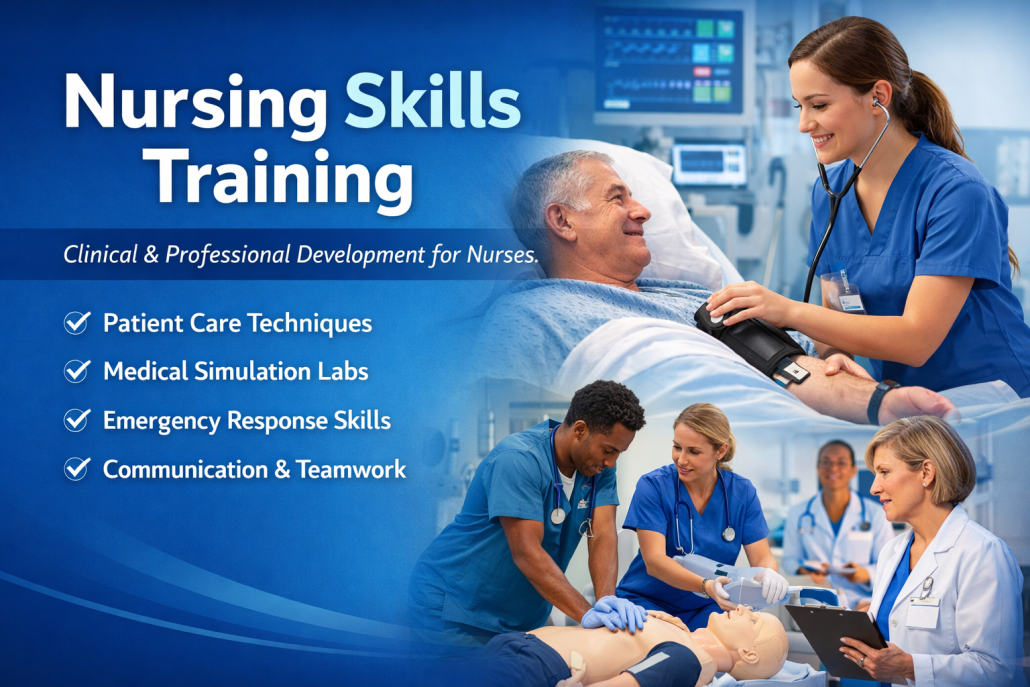
Nursing Skills Training | Clinical & Professional Development for Nurses
nursing skills training
🧑⚕️ Nursing Skills Training: Complete Guide for Students & Professionals
Nursing skills training equips aspiring nurses and healthcare professionals with the vital technical competencies and soft skills required to deliver high‑quality patient care. These hands‑on training programs combine clinical techniques, communication practice, safety protocols, and critical thinking activities to prepare learners for real‑world healthcare environments.
📌 What Is Nursing Skills Training?
Nursing skills training is an educational process that teaches both clinical procedures and professional competencies. It includes activities like vital signs monitoring, wound care, medication administration, patient safety, and communication techniques. Training often occurs through classroom instruction, simulation labs, and real‑world clinical placements.
🔑 Key Clinical Competencies Covered
Nursing skills programs typically include the following technical areas:
🩺 1. Basic Patient Care & Assessment
Taking accurate vital signs (blood pressure, pulse, respiration).
Performing physical assessments and health history reviews.
💉 2. Medication Administration & Therapy
Safe medication preparation and accurate dosage delivery.
🫀 3. Life Support & Emergency Skills
CPR and Basic Life Support (BLS) certification.
🩹 4. Wound Care & Infection Prevention
Proper dressing changes and infection control protocols.
🧑💻 5. Healthcare Technology
Electronic medical record (EMR) systems and patient monitoring.
👩⚕️ 6. Medical Simulation & Labs
Training in simulation centers allows learners to practice clinical scenarios safely before working with real patients.
🧠 Crucial Soft Skills Developed
Great nursing practice depends on more than clinical expertise — professional attitudes and interpersonal skills are equally important:
Effective communication with patients, families, and the care team.
Time management and prioritization on busy shifts.
Empathy and compassion — caring for emotional and physical needs.
Critical thinking and problem‑solving under pressure.
Adaptability to clinical environments and protocols.
These soft skills help nurses build trust, deliver patient‑centred care, and function effectively within multidisciplinary teams.
📈 Benefits of Nursing Skills Training
Investing in nursing skills training brings measurable advantages for both learners and healthcare facilities:
✔️ Improves clinical confidence and competence in real patient interactions.
✔️ Reduces medical errors and enhances patient safety outcomes.
✔️ Boosts career readiness and employability.
✔️ Promotes team collaboration and communication in clinical care.
📝 How to Choose an Effective Training Program
When evaluating a nursing skills training course, consider:
📍 Accredited curriculum covering core competencies
📍 Hands‑on clinical and simulation hours
📍 Skilled trainers and healthcare educators
📍 Job support and certification pathways
High‑quality programs ensure that graduates are clinical‑ready and confident to deliver safe, patient‑centred care.
📍 Conclusion
Nursing skills training bridges the gap between theory and practice. Structured training not only builds clinical proficiency — like vital signs assessment, emergency care, and medication administration — but also nurtures the soft skills nurses need to thrive in fast‑paced healthcare settings. With the right training, nurses are positioned for success and can make a meaningful difference in patient lives
📚 Advanced Nursing Skills Training Modules
Once foundational competencies are mastered, many programs offer advanced modules to prepare nurses for specialized roles:
🔬 1. Critical Care & ICU Training
Management of ventilators and monitoring critical patients
Advanced cardiac life support (ACLS) certification
Handling emergencies such as septic shock or cardiac arrest
👶 Pediatric & Neonatal Nursing Skills
Newborn resuscitation
Pediatric vital signs assessment
Medication dosing for infants and children
🤰 Maternal & Obstetric Care
Labor and delivery assistance
Monitoring maternal vital signs
Postpartum care and lactation support
🧪 Laboratory & Diagnostic Skills
Blood sampling and IV insertion
Interpreting lab results and imaging
Infection prevention in lab settings
💡 Tips for Maximizing Nursing Skills Training
To gain the most from your training program, follow these expert strategies:
Practice consistently – Repetition in simulations builds muscle memory.
Engage in case studies – Realistic scenarios improve decision-making.
Seek feedback – Ask instructors for corrections and tips.
Stay updated – Healthcare protocols change; ongoing learning is key.
Network with peers – Sharing experiences enhances understanding.
🌐 Online & Hybrid Nursing Skills Programs
Many modern programs offer flexible online or hybrid options, especially beneficial for working nurses:
Video demonstrations of procedures
Interactive quizzes to test clinical knowledge
Virtual simulations with patient scenarios
Access to discussion forums for peer learning
These approaches allow nurses to balance work and study, making training more accessible without sacrificing quality.
🏥 Career Benefits of Nursing Skills Training
Strong clinical skills and professional competence can significantly boost career opportunities:
Higher chances of promotion to senior nursing roles
Eligibility for specialized certifications (ICU, Pediatrics, Emergency)
Increased employability in hospitals, clinics, and telehealth settings
Enhanced confidence in handling complex clinical situations
📊 Measuring Training Outcomes
Effective programs often track success metrics to ensure quality:
Competency assessments before and after training
Clinical performance in simulation labs
Patient care quality indicators during clinical placements
Certification and licensing exam pass rates
Monitoring these outcomes helps institutions continuously improve their training programs.
✅ Summary
Nursing skills training is more than learning procedures — it’s developing clinical confidence, critical thinking, and patient-centered care skills. From foundational competencies to advanced specialties, comprehensive programs prepare nurses to excel in any healthcare environment. Investing in nursing skills training improves patient safety, career growth, and the overall quality of care.
Needs help with Nursing Assignment?
We are available 24x7 to deliver the best services and assignment ready within 3-4 hours? Order a custom-written, plagiarism-free paper
 Get Answer Over WhatsApp
 Order Paper Now

